高端机床

Search documents
2026年两会政府工作报告解读:新质生产力加码,高端装备制造长期向好
Guoxin Securities Co., Ltd· 2026-03-06 12:02
Investment Rating - The industry investment rating is "Positive," indicating an expectation that the industry index will outperform the market index by over 5% in the next six months [16]. Core Insights - The report emphasizes that the high-end equipment manufacturing industry is positioned for long-term growth, supported by strong government policies aimed at enhancing new productivity and technological advancements [4][10]. - The integration of "Artificial Intelligence +" is expected to drive the demand for intelligent equipment, leading to significant market opportunities in sectors such as industrial robots and smart factories [5]. - The report highlights the acceleration of equipment updates and technological renovations, which will release substantial demand for high-end equipment replacements, particularly in traditional industries [10]. - Future industry layouts are being strengthened, with a focus on emerging technologies like embodied intelligence, which is expected to open new growth avenues for high-end equipment manufacturing [11]. - The dual approach of expanding domestic demand while promoting international trade is anticipated to benefit competitive equipment enterprises, creating a robust market environment [12]. Summary by Sections Government Policy Support - The government has identified high-end equipment manufacturing as a core area for new productivity, with a commitment to increasing R&D funding by over 7% annually, aligning with the "14th Five-Year Plan" goals [4]. - A significant investment of 200 billion yuan in long-term special bonds is allocated for large-scale equipment updates, which is expected to stimulate investment in traditional industries [10]. Market Performance - As of March 6, 2026, the report indicates a strong performance in the high-end equipment manufacturing sector, with a 9.2% increase in added value and a 28% growth in industrial robot production by 2025 [4][10]. Investment Recommendations - The report suggests focusing on four main investment lines: 1. Core components sector, targeting companies with technological barriers in critical areas like reducers and servo systems [14]. 2. Intelligent equipment sector, emphasizing leaders in industrial robots and high-end machine tools [14]. 3. Future industry sectors, particularly in embodied intelligence and humanoid robots [14]. 4. Companies benefiting from international expansion, especially those with strong competitiveness in countries along the "Belt and Road" [14].
浙江每5家外贸企业就有1家“牵手”德国
Sou Hu Cai Jing· 2026-02-27 01:08
Trade Overview - Zhejiang's trade with Germany has strengthened in various sectors including machinery, chemicals, automotive, and high technology, with trade volume exceeding 162.4 billion yuan in 2025, marking an 8.3% year-on-year increase [1] - Germany is the largest trading partner of Zhejiang within the EU, with exports to Germany reaching 131 billion yuan, up 9.1%, and imports from Germany totaling 31.4 billion yuan, increasing by 5.2% [1] Company Performance - Zhejiang Longhu Forging Co., Ltd. has seen a significant increase in exports to Germany, with a nearly 100% growth in 2025 and a 36% increase in January alone [3] - The company specializes in automotive parts forging and mechanical processing, with over 1,000 product specifications primarily targeting the European market [3] Product Categories - Machinery and electrical products are the main exports from Zhejiang to Germany, with exports of 72.14 billion yuan in 2025, representing 55.1% of total exports to Germany, and an 8.1% increase [5] - Notable growth in specific categories includes electrical equipment (12.3%), automotive parts (15.4%), lighting (13.1%), and vehicle lithium batteries (12.7 times) [5] Labor-Intensive Products - Zhejiang's labor-intensive products are well-received in Germany, with exports reaching 37.62 billion yuan in 2025, a 9.8% increase, accounting for 32.3% of the national total in this category [5] - Growth in specific labor-intensive products includes textiles and clothing (7.2%), plastic products (16.5%), and toys (23.4%) [5] High-Tech Imports - Zhejiang imports high-tech products from Germany, which constitute nearly 30% of its total imports, with significant growth in instruments, biomedicine, and high-end machine tools [5] - In 2025, imports of machinery and electrical products from Germany reached 17.85 billion yuan, a 6.5% increase, while high-tech product imports totaled 9.11 billion yuan, growing by 10% [5] Pharmaceutical Sector - Hangzhou Merck Sharp & Dohme Pharmaceutical Co., Ltd. imports raw materials from Germany, with a focus on maintaining quality through advanced packaging techniques to avoid quality degradation during customs checks [7] - In 2025, imports of biopharmaceutical products from Germany by the company reached 277 million yuan, nearly tripling year-on-year [7] Trade Participation - The number of enterprises engaged in trade with Germany in Zhejiang reached 29,000 in 2025, indicating that one in five foreign trade companies in the province is involved in trade with Germany, a 7.5% increase [7] - The growth rate of imports and exports for German-funded enterprises in Zhejiang was 15.4%, surpassing the growth rate of other foreign-funded enterprises by 12.5 percentage points [7]


27国要对华加税30%?法国打响第一枪,美财长一句话定义中美关系
Sou Hu Cai Jing· 2026-02-15 03:42
Group 1 - France has proposed a 30% tariff on Chinese goods to address the significant trade deficit with China, suggesting that the EU should either impose these tariffs or allow the euro to depreciate by 20% to 30% against the yuan [1][3][21] - The report indicates that 55% of manufacturing output in the EU is facing direct competition from China, with Germany at 70% and France at 36%, highlighting the pressure on European industries from Chinese manufacturing [7][10] - The proposal reflects a shift in Europe’s stance from free trade to protectionism, as the continent struggles to compete with China's manufacturing capabilities, which are often 30%-40% cheaper [8][10] Group 2 - The report serves as a political maneuver by France to unify EU member states against China, but it may face resistance from countries like Germany and Hungary, which have strong economic ties with China [10][12] - The U.S. has shifted its strategy from aggressive trade wars to a more pragmatic approach, recognizing that tariffs have not effectively reduced the trade deficit with China, which reached $361 billion in 2025 [14][16] - The U.S. is now focusing on domestic manufacturing and reducing risks in key sectors while maintaining trade relations in other areas, indicating a strategic pivot rather than a complete decoupling from China [20][22]
27国要对我们加税30%?法国打响第一枪,美财长一句话定义中美关系
Sou Hu Cai Jing· 2026-02-14 04:41
Group 1 - France has proposed a significant government report suggesting that EU member states impose a 30% tariff on Chinese goods to address the trade deficit with China [2][10] - The report indicates that 55% of manufacturing output in the EU faces direct competition from China, with Germany at 70% and France at 36% [10][12] - The proposed tariffs are seen as a desperate measure to level the playing field, as Chinese products have a cost advantage of approximately 30% [12][14] Group 2 - The report reflects France's panic over its industrial decline, as it attempts to unify EU member states against China, despite differing interests among countries like Germany [15][18] - The U.S. Treasury Secretary's comments about being in a "comfortable position" regarding U.S.-China relations suggest a shift in strategy, moving from aggressive confrontation to a more pragmatic approach [20][22] - The U.S. has recognized that a hardline approach against China has not yielded the desired results, leading to a focus on "de-risking" rather than complete decoupling [24][26] Group 3 - France's proposal to manipulate the euro's value against the yuan is reminiscent of the 1985 Plaza Accord, which aimed to address trade imbalances through currency intervention [30][31] - The differences between China and Japan during the Plaza Accord era highlight China's current economic independence and robust domestic market, making such proposals less feasible [33][35] - The report indicates that France's protectionist measures may not effectively address the underlying issues of industrial competitiveness and could lead to further economic challenges [35][37]
上海经济2025成绩单:GDP实现5.67万亿,居民年收入首破9万
Sou Hu Cai Jing· 2026-02-04 07:05
Economic Growth Targets - Shanghai's economic growth target for 2026 is set at 5%, slightly lower than the 5.4% growth achieved in 2025, with GDP reaching 5.67 trillion yuan [2][4] - In 2025, Shanghai's key economic indicators, including consumption, exports, and investments, all showed growth exceeding the national average [2][4] Key Economic Indicators - Retail sales in Shanghai grew by 4.6% in 2025, surpassing the national average of 3.7% [7] - The total foreign trade volume in Shanghai reached 45.1 trillion yuan in 2025, with a growth rate of 5.6%, also above the national average of 3.8% [10] - Fixed asset investment in Shanghai increased by 4.6% in 2025, significantly better than the national average decline of 3.8% [5] Income and Employment - The per capita disposable income in Shanghai reached 91,987 yuan in 2025, marking a 4.1% increase, which is lower than the GDP growth rate [9] - The average urban unemployment rate in Shanghai was 4.2% in 2025, with a target to keep it below 5% in 2026 [9][8] Strategic Industries - The three leading industries in Shanghai—integrated circuits, biomedicine, and artificial intelligence—saw manufacturing output growth of 9.6% in 2025, with integrated circuits growing by 15.1% [4][6] - Strategic emerging industries accounted for 45% of Shanghai's industrial output, with a 6.5% increase in output in 2025 [4] Consumption and Services - The government plans to enhance consumption by promoting initiatives such as the transformation of key shopping districts and the introduction of consumption vouchers [3][8] - In 2025, Shanghai's service sector saw significant growth, with a focus on cultural, tourism, and health services to boost consumption [8] Export Performance - Shanghai's exports reached a record high of 20.15 trillion yuan in 2025, with a growth rate of 10.8% [10] - The export of high-end manufacturing products, including electric vehicles and industrial robots, showed significant growth, with electric vehicle exports exceeding 100 billion yuan [11] Future Development Plans - Shanghai aims to establish a national service trade innovation development demonstration zone by 2026, focusing on high-end design and knowledge-intensive service trade [12][10] - The city plans to develop the low-altitude economy and other emerging industries as new growth points [5][6]
城记 | 长三角交出“十四五”亮丽答卷:5年超7万亿元增长显“引擎”担当
Xin Hua Cai Jing· 2026-01-30 07:16
Core Viewpoint - The Yangtze River Delta region (Shanghai, Jiangsu, Zhejiang, Anhui) has demonstrated strong economic resilience and growth potential, achieving significant GDP increases and maintaining its strategic position as a key driver of China's economic development [1][2]. Economic Performance - In 2025, the Yangtze River Delta achieved a GDP of 34.66 trillion yuan, an increase of 7.06 trillion yuan from 2021, with its share of national GDP rising from 24.1% to 24.7% [2]. - Jiangsu's GDP reached 14.24 trillion yuan in 2025, growing by 5.3%, marking it as the second province to surpass 14 trillion yuan after Guangdong [2]. - Zhejiang's GDP was 9.45 trillion yuan, with a growth rate of 5.5%, positioning it as the fourth largest economy in China [3]. - Shanghai's GDP was 5.67 trillion yuan, growing by 5.4%, maintaining its status as the leading city in the country [3]. - Anhui's GDP reached 5.30 trillion yuan, with a growth rate of 5.5%, showcasing its rapid economic development [3]. Foreign Trade and Consumption - The Yangtze River Delta has excelled in foreign trade, with Jiangsu, Zhejiang, and Shanghai ranking second, third, and fourth in national import and export totals, respectively [4]. - In 2025, Jiangsu's foreign trade reached 5.95 trillion yuan, while Zhejiang and Shanghai reported 5.55 trillion yuan and 4.51 trillion yuan, respectively [4]. - The region's foreign trade resilience is highlighted by a significant increase in exports of high-tech products, including electric vehicles and industrial robots [4][6]. - Shanghai's retail sales of consumer goods surpassed 1.6 trillion yuan in 2025, growing by 4.6%, reflecting a strong consumer market [7]. - Jiangsu's retail sales reached 4.6 trillion yuan, with a growth of 3.3%, making it the largest in the country [7]. Structural Optimization and New Drivers - The Yangtze River Delta is transitioning towards innovation-driven growth, with Shanghai's leading industries showing significant production value increases [8]. - In 2025, Shanghai's manufacturing output grew by 9.6%, with the integrated circuit and artificial intelligence sectors seeing substantial growth [8][10]. - Jiangsu's high-tech industry accounted for 52.1% of its industrial output, with significant increases in the production of optical devices and lithium batteries [10]. - Anhui's high-tech manufacturing output grew by 30.4%, indicating a strong industrial growth trajectory [11]. - The digital economy is also accelerating, with Jiangsu's core digital manufacturing output increasing by 10.2% [10].
【读年报·看亮点·谋发展】外贸稳量提质多元转型
Jing Ji Ri Bao· 2026-01-29 13:14
Core Insights - In 2025, China's foreign trade demonstrated resilience and vitality, achieving a record total import and export value exceeding 45 trillion yuan, marking a 3.8% growth and maintaining growth for nine consecutive years since joining the WTO [1] Group 1: High-Tech Product Exports - High-tech products played a crucial role in China's export growth, with exports reaching 5.25 trillion yuan, a 13.2% increase, contributing 2.4 percentage points to overall export growth [2] - Exports of "new three samples" and wind turbine generators surged by 27.1% and 48.7%, respectively, while self-branded products saw a 12.9% increase, raising their share of total exports by 1.4 percentage points [2] - Specialized equipment, high-end machine tools, and industrial robots experienced significant export growth of 20.6%, 21.5%, and 48.7%, respectively, with China becoming a net exporter of industrial robots [2] Group 2: Market Dynamics - Over 780,000 market entities recorded import and export activities, with private enterprises continuing to be the main drivers of foreign trade, achieving 26.04 trillion yuan in imports and exports, a 7.1% increase, and accounting for 57.3% of total trade [3] Group 3: Trade Structure Optimization - China's foreign trade foundation is solidifying, with new trade dynamics accelerating due to a combination of institutional, market, and industrial advantages [4] - Since 2025, the government has implemented various policies to stabilize foreign trade, including 29 pilot measures that have been well-received by localities and businesses, with 25 measures being promoted nationwide [4] - In 2025, China imported 18.48 trillion yuan worth of goods, maintaining about 10% of global imports, driven by an upgraded business environment and the dual push of digital and green initiatives [5] Group 4: Trade Innovation Development - Promoting trade innovation is essential for the continuous optimization of trade structure, with the 20th Central Committee emphasizing the importance of technological innovation and the integration of innovation and industrial chains [6][7] - There is significant potential for growth in service trade, which currently represents a low proportion of total trade, necessitating the integration of goods and service trade to create new growth areas [7] - The establishment of the Hainan Free Trade Port in December 2025 marks the beginning of a new phase of opening up, expected to enhance trade structure optimization and innovation development [7]
外贸稳量提质多元转型
Jing Ji Ri Bao· 2026-01-28 21:58
Core Insights - In 2025, China's foreign trade demonstrated resilience and vitality despite global economic slowdown, achieving a record total import and export value exceeding 45 trillion yuan, marking a 3.8% growth and the longest continuous growth since joining the WTO [1] Group 1: High-Tech Product Exports - High-tech product exports reached 5.25 trillion yuan, growing by 13.2%, contributing 2.4 percentage points to overall export growth [2] - Exports of "new three samples" and wind turbine generators increased by 27.1% and 48.7%, respectively [2] - The export of industrial robots surged by 48.7%, making China a net exporter of industrial robots [2] Group 2: Market Dynamics - Over 780,000 market entities engaged in import and export activities, with private enterprises playing a crucial role, accounting for 26.04 trillion yuan in trade, a 7.1% increase, and representing 57.3% of total trade [3] Group 3: Trade Structure Optimization - China's foreign trade foundation is solidifying, with new trade dynamics accelerating due to institutional, market, and industrial advantages [4] - In 2025, imports totaled 18.48 trillion yuan, maintaining a 10% share of global imports, driven by an upgraded business environment and the dual push of digital and green initiatives [5] Group 4: Trade Innovation Development - Promoting trade innovation is essential for the continuous optimization of trade structure, with a focus on integrating technology innovation into the industrial chain [6][7] - The establishment of Hainan Free Trade Port marks a new phase of expanded openness, enhancing trade structure optimization and innovation development [7]
达沃斯上的中国声音:坚定支持自由贸易,维护多边主义
Hua Xia Shi Bao· 2026-01-23 03:38
Core Viewpoint - China demonstrates significant certainty in a volatile global environment, providing strong momentum for global economic growth [2] Group 1: Economic Performance - In 2025, China's foreign trade reached 45.47 trillion yuan, marking a 3.8% increase and achieving a historical high for the first time surpassing 45 trillion yuan [5] - China's exports grew by 5% in 2025, with a notable resilience despite previous concerns, maintaining a high share in global exports [5] - The export growth was supported by a strong performance in high-tech products, which reached 5.25 trillion yuan, growing by 13.2% [8] Group 2: International Relations and Trade - The ongoing U.S.-China competition remains a critical variable affecting both China's and the global economy, with exports expected to maintain around 5.5% growth in 2026 [5][6] - China's engagement with non-U.S. countries is deepening, with discussions held at the Davos Forum to address economic issues with the U.S. and the UK [7] - The diversification of export markets, particularly to emerging markets and countries along the Belt and Road Initiative, has reduced reliance on any single market [8] Group 3: Future Outlook - Predictions for 2026 indicate continued strong growth in China's imports and exports, driven by a temporary easing of U.S.-China tensions and rising global investment demands in AI infrastructure [10] - The integration of AI into manufacturing is expected to enhance China's competitive edge, with optimism for sustained export growth extending into 2027 and 2028 [9][10]

上海去年增速超预期:工业投资为何激增20%?高出口能否延续?
2 1 Shi Ji Jing Ji Bao Dao· 2026-01-21 14:44
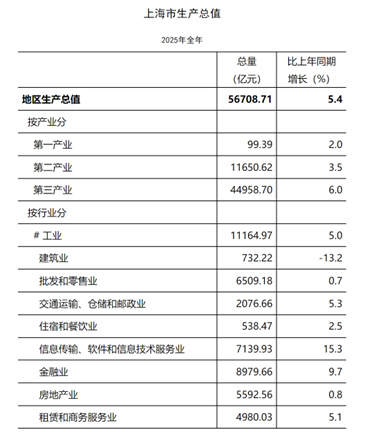
Economic Overview - In 2025, Shanghai's GDP reached 5.67 trillion yuan, growing by 5.4% year-on-year, surpassing the initial target of 5% and the national average growth rate of 5.0% [1][2] - The primary industry added value was 99.39 billion yuan (2.0% growth), the secondary industry was 11,650.62 billion yuan (3.5% growth), and the tertiary industry was 44,958.70 billion yuan (6.0% growth) [1][3] Income and Employment - The per capita disposable income in Shanghai was 91,987 yuan, a 4.1% increase from the previous year, which is lower than the GDP growth rate [1] - The average urban unemployment rate was 4.2%, better than the national average of 5.2% [1] Key Economic Drivers - Shanghai's economic growth is primarily supported by advanced manufacturing, new foreign trade products, and modern service industries [1][2] - The three leading manufacturing sectors (integrated circuits, biomedicine, and artificial intelligence) saw a 9.6% increase in output, while the new energy sector grew by 12.9% [6] Investment Trends - Fixed asset investment in Shanghai grew by 4.6%, which is below the GDP growth rate [7] - Industrial investment surged by 20.0%, the highest in over a decade, while real estate investment declined by 3.1% [10] - Urban infrastructure investment increased by 11.2%, indicating a structural optimization in investment [10] Consumption Patterns - The total retail sales of consumer goods reached 1.66 trillion yuan, growing by 4.6% year-on-year, reversing a decline from the previous year [11] - The increase in inbound tourism, with 9.36 million visitors, contributed significantly to the consumption market [12] Trade Performance - Shanghai's total import and export volume reached 4.51 trillion yuan, a 5.6% increase, with exports growing by 10.8% [13] - The export of "new three samples" products increased by 17.4%, with electric vehicle exports rising by 13.8% [6][13] Future Outlook - For 2026, Shanghai aims for a GDP growth target of around 5%, considering external uncertainties and internal structural adjustments [16] - Key factors influencing future economic performance include exports, investments, and consumption [17] - The "14th Five-Year Plan" emphasizes synchronized growth of resident income and economic growth, along with improving labor remuneration and productivity [20]