硬科技

Search documents
广电运通:公司投资方式主要以控股为主
Zheng Quan Ri Bao Zhi Sheng· 2025-08-22 11:47
Core Viewpoint - The company, Guangdian Yuntong, focuses on controlling stakes in growth-stage enterprises with strong revenue and net profit, emphasizing the importance of growth potential and sustainable profitability [1] Group 1: Investment Strategy - The company's primary investment approach is to hold controlling stakes, favoring enterprises that are in their growth phase [1] - The company targets high-quality candidates that have reached a certain revenue scale and exhibit good net profit [1] Group 2: Focus Areas - Guangdian Yuntong is concentrating on two main themes: "artificial intelligence" and "data elements X" [1] - The company aims to explore and promote mergers and acquisitions of high-quality targets in fields such as hard technology, new production capacity, domestic substitution, and new business models [1]

广州推动国有资本赋能“硬科技”新赛道
Zhong Guo Jing Ji Wang· 2025-08-22 08:40
Group 1 - Guangzhou is actively promoting the construction of a financial strong city, guiding financial resources to serve technological and industrial innovation, and injecting continuous financial support into the "hard technology" sector [1] - As of the end of last year, the total assets of state-owned enterprises in Guangzhou exceeded 7.3 trillion yuan, with 391 high-tech enterprises and 280 specialized and innovative enterprises [1] - Key investments in "hard technology" projects include Weidu Microelectronics, Yinnuo Medical, and Weiguang Medical, with established projects like Funeng Battery and Inpai Battery [1] Group 2 - Guangzhou is focusing on cultivating patient capital to support the high-quality development of the "hard technology" industry, aiming to set a benchmark for the national development of patient capital [2] - The city is exploring special policies and long-term assessment mechanisms for state-owned patient capital, enhancing its integration with high-tech industries [2] - A long-term incentive mechanism for state-owned patient capital is being established to ensure its value preservation and appreciation [2] Group 3 - Various districts in Guangzhou are leveraging their unique characteristics to accelerate the development of innovative capital linked to advantageous industries, with Huangpu District attracting venture capital and private equity [3] - Huangpu District has formed a system of "state-owned investment + industrial fund guidance + social capital participation," with over 800 venture capital institutions and a funding scale exceeding 240 billion yuan [3] - The total scale of green loans in Guangzhou surpassed 1.32 trillion yuan, with a year-on-year growth rate of 24%, accounting for 16.2% of the city's total loans [3]
帮主郑重收评:沪指放量冲高,半导体掀涨停潮!这波热度藏着三个信号
Sou Hu Cai Jing· 2025-08-22 07:57
Group 1 - The market showed strong performance with the Shanghai Composite Index rising by 1.45%, while the ChiNext Index surged by 3.36%, indicating a robust recovery in market sentiment [1][4] - Trading volume exceeded 2.5 trillion, an increase of over 800 billion from the previous day, suggesting a significant influx of capital into the market [3][4] - Over 2800 stocks experienced gains, with the semiconductor sector leading the charge, showcasing a strong trend towards hard technology and domestic substitution [4][6] Group 2 - Key signals indicate a clearer focus on hard technology, with substantial policy support and high industry prosperity, making this direction highly certain for medium to long-term investments [6][7] - The increase in trading volume reflects improved market sentiment and confidence, although caution is advised as rapid volume spikes may lead to short-term fluctuations [6][7] - There is a noticeable rotation and differentiation among sectors, indicating a more rational and discerning approach from investors, who are increasingly focused on fundamental company performance [6][7]


硬科技主线逐渐清晰!科创板ETF(588090)标的指数创两年新高,20CM高弹性品种聚焦科创龙头配置机遇
Xin Lang Ji Jin· 2025-08-22 06:35
Group 1 - The technology sector has collectively risen, becoming a focal point for market investment, with the ChiNext 50 Index reaching a new high since May 2023 as of August 21 [1] - The ChiNext ETF (588090) has seen significant capital inflow since August 12, with an average daily trading volume of 219 million, indicating increased trading activity [1] - The ChiNext ETF's scale has grown to 5.378 billion, marking nearly two consecutive weeks of positive growth from August 11 to August 21 [1] Group 2 - The ChiNext ETF (588090) covers high-growth sectors such as new-generation information technology, biotechnology, and new materials, with a significant weight of 60.64% in semiconductors [2] - The top five weighted stocks in the ChiNext ETF are leading semiconductor companies, which are expected to continuously inject development momentum into the ChiNext 50 Index [2] - The Huatai-PB ChiNext 50 ETF Connect Y (022950) is among the first index funds included in the personal pension product directory, with its fund share reaching 6.1 million, an increase of 5.6 million from the end of 2024 [2] Group 3 - Huatai-PB Fund, one of the first ETF managers in China, has over 18 years of ETF operation experience and has created the largest ETF product in the A-share market, the CSI 300 ETF (510300) [3] - The company manages a comprehensive range of ChiNext ETFs, including those tracking the ChiNext 100, 200, and comprehensive indices, providing diverse investment opportunities in the ChiNext market [3]
沪指突破3800点,科创50指数涨超7%,科创50ETF(588000)大涨7.2%
Mei Ri Jing Ji Xin Wen· 2025-08-22 06:20
Group 1 - The Shanghai Composite Index surpassed 3800 points on August 22, 2025, with the Sci-Tech Innovation 50 Index rising over 7% [1] - The largest Sci-Tech Innovation 50 ETF (588000) surged by 7.2%, with a trading volume exceeding 10 billion yuan, ranking first among its peers [1] - Nvidia's decision to halt H20 chip production has led to a significant increase in the market value of Cambrian, which rose by 17%, surpassing 500 billion yuan, and its stock price reached a historical high of 1200 yuan, marking an 84% increase year-to-date [1] Group 2 - The suspension of H20 chip production creates greater market opportunities for domestic AI chip manufacturers in China, benefiting the development of local AI chips [1] - Huawei and other domestic companies' Ascend ecosystem is expected to accelerate its maturity and expansion, promoting independent innovation and development in China's AI chip industry [1] - The Sci-Tech Innovation 50 ETF (588000) tracks the Sci-Tech Innovation 50 Index, which has a concentrated industry distribution with 63.74% in the electronics sector and 11.78% in the pharmaceutical and biotechnology sector, totaling 75.52% [1] Group 3 - The index covers multiple sub-sectors, including semiconductors, medical devices, software development, and photovoltaic equipment, indicating a high content of hard technology [1] - The current position of the Sci-Tech Innovation 50 Index is near its base point, and based on the historical performance of the ChiNext, future growth potential is promising [1] - Investors optimistic about the long-term development prospects of China's hard technology are encouraged to continue monitoring relevant ETFs, particularly the Sci-Tech Innovation 50 ETF (588000) [1]
续创十年新高!沪指突破3800点,深市最大证券ETF(159841)涨超3%,连续3日净流入,规模创近3月新高
Sou Hu Cai Jing· 2025-08-22 06:19
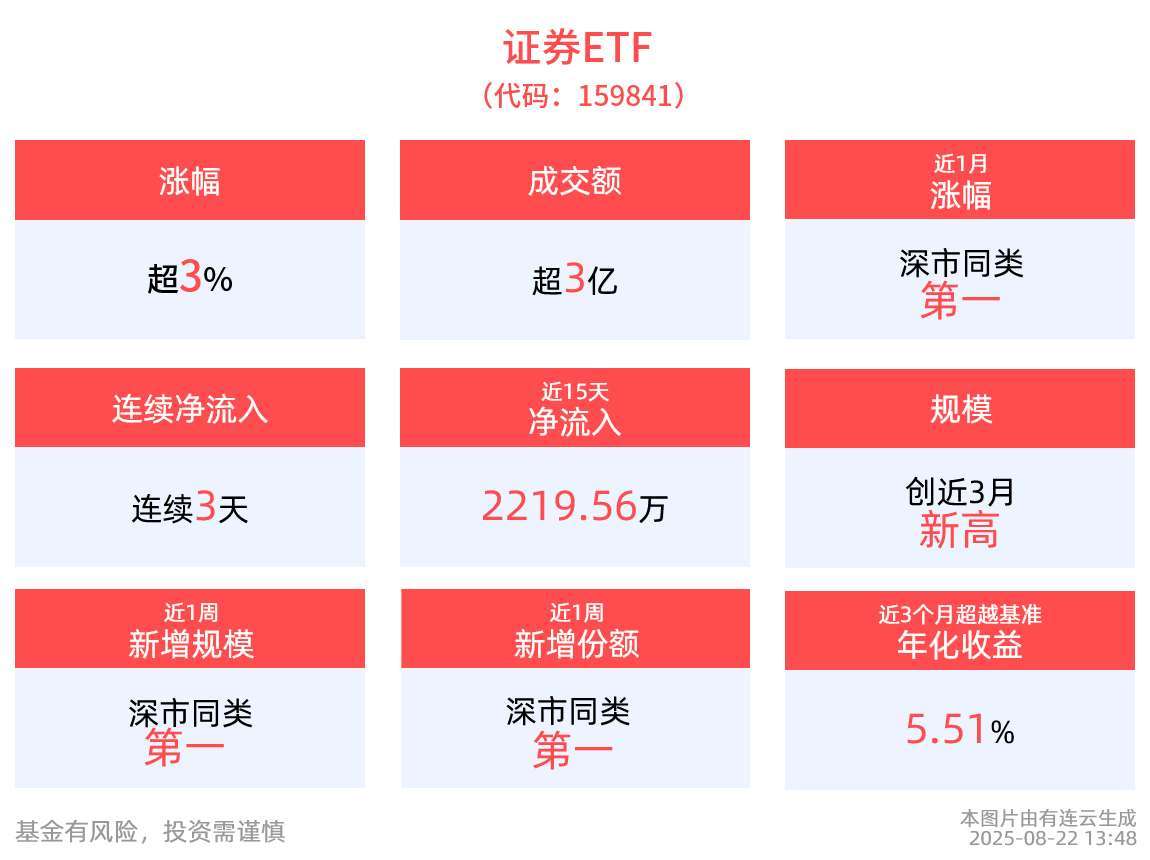
Group 1 - The core viewpoint of the articles highlights a strong performance in the securities sector, driven by the overall market momentum and the influence of technology sectors like AI and semiconductors [3][4]. - The Securities ETF (159841) has seen a significant increase of 3.50%, with a trading volume of 418 million yuan, indicating robust market activity [3]. - Key stocks within the securities sector, such as Everbright Securities (601788) and Xinda Securities (601059), have experienced notable gains of 10.01% and 9.98% respectively, reflecting strong investor interest [3]. Group 2 - The current market environment is characterized by healthy liquidity, which supports investor confidence and reduces the need for excessive panic [3]. - The brokerage sector is identified as a "bull market flag bearer," benefiting directly from increased market activity and trading volume, with a strong certainty of earnings growth [4]. - The price-to-book (PB) ratio of the brokerage sector is currently around the 50th percentile of the last decade, suggesting a favorable valuation compared to other high-volatility sectors, making it a key area for investment focus [4].





刚刚,沪指站上3800点!“硬科技”全面爆发!
天天基金网· 2025-08-22 06:01
Core Viewpoint - The market is experiencing a significant surge, with the Shanghai Composite Index surpassing 3800 points, marking a new high since August 2015, driven by strong performances in AI chips, rare earths, and other sectors [2] Semiconductor Industry - The "hard technology" sector is witnessing a comprehensive breakout, with stocks like Cambricon, Haiguang Information, and others seeing substantial gains. The STAR Market's Sci-Tech 50 Index rose by 5.25% [4][6] - Key semiconductor stocks include: - Shengmei Shanghai: 139.00, up 17.29% - Haiguang Information: 181.70, up 17.19% - Cambricon: 1164.45, up 12.40% [7] AI Hardware and Ecosystem - The recent surge in the semiconductor sector is attributed to the strong performance of AI hardware, particularly in North America, and the rising risk appetite in the A-share market [8] - Cambricon's stock price reached a historical high, influencing market perceptions of domestic computing power chains [8] - The release of DeepSeek-V3.1 is expected to accelerate the domestic computing power ecosystem [9] Rare Earth Sector - The rare earth permanent magnet sector has also seen significant gains, with major stocks like San Chuan Wisdom and Fangbang Co. experiencing notable increases [10][11] - Recent price increases in key rare earth products have prompted recommendations to focus on companies with strong resource attributes and growth potential in production [12]



A股突破3800点!硬科技板块大涨,芯片产业指数劲升8%,中证人工智能指数涨超6%
Ge Long Hui· 2025-08-22 05:49
Group 1 - The Shanghai Composite Index broke through the 3800-point mark, with an increase of 0.8%, while the Sci-Tech 50 surged by 5.25%, reaching a nearly three-and-a-half-year high [1] - The semiconductor industry chain experienced a significant rally, with Cambrian Technologies rising by 18% to a new high, and strong rebounds in AI hardware [1] - The Tianhong CSI Chip Industry ETF Connect saw a surge of 8%, with a cumulative increase of 35.36% since April 9 [1] Group 2 - The Tianhong CSI Artificial Intelligence Theme Index, tracking the CSI Artificial Intelligence Index, recorded a gain of 6.19% [1] - The Tianhong Sci-Tech Index Enhanced Fund, which tracks the Sci-Tech Composite Index, rose by 4.76%, with a cumulative increase of 45.17% since April 8 [1] - The Tianhong ChiNext ETF Connect, tracking the ChiNext Index, achieved a cumulative increase of 47.3% since April 8 [1] Group 3 - Financial analysts at Caixin Securities maintain a positive outlook for the market, expecting a strong performance in the context of a mild recovery in the domestic economy, continuous policy support, and stable overseas trade [2] - Investors are encouraged to utilize low-fee, straightforward index funds to capitalize on market opportunities, available on platforms like Ant Wealth, Tian Tian Fund, and JD Finance [2]
再创新高!“硬科技”全面爆发,上证指数破3800点
Xin Jing Bao· 2025-08-22 05:41
Group 1 - The stock market reached a new high on August 22, with the Shanghai Composite Index breaking 3800 points during the afternoon session [1] - Key sectors leading the market include GPU, servers, stock trading software, and optical communication, while sectors such as pet economy and air transportation experienced significant declines [1] - Despite the index reaching a new high, individual stock performance showed significant divergence, with a general trend of "more declines than gains" across the market [1] Group 2 - The "hard technology" sector saw a comprehensive surge, with the Sci-Tech Innovation 50 Index rising over 5% [1] - Notably, Cambrian's stock surged over 16% during the session, pushing its total market capitalization above 500 billion yuan [1]
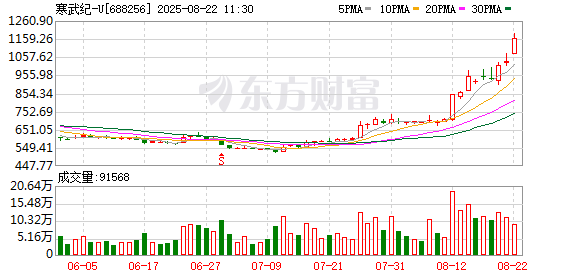
688256 大涨!“硬科技”全面爆发
Zhong Guo Zheng Quan Bao· 2025-08-22 04:58
Core Viewpoint - The discussion around whether Cambricon's stock price can surpass Kweichow Moutai has intensified, with Cambricon experiencing a significant price increase of 12.4% to reach a closing price of 1164.45 yuan, resulting in a market capitalization of 4871 billion yuan [2][4]. Group 1: Market Performance - The "hard technology" sector saw a broad surge, with notable gains in stocks such as Haiguang Information, Zhongke Shuguang, and SMIC, contributing to a rise in the Shanghai Composite Index, which increased by 0.67% to 3796.36 points [2][3]. - The ChiNext Index rose by 2.56%, reflecting strong investor sentiment and a market turnover exceeding 1.53 trillion yuan [2]. Group 2: Factors Driving Growth - The recent rally in the AI hardware sector, particularly in North America, has led to a significant rebound in A-share indices, creating a favorable environment for domestic computing chains to catch up [4][5]. - Cambricon's recent stock performance has created a demonstration effect, reshaping market perceptions of domestic computing chains, especially after its stock price reached a historical high [5]. - The release of DeepSeek-V3.1, which supports the next generation of domestic chips, is expected to catalyze the domestic computing ecosystem [5]. - The announcement of a share transfer agreement involving Zhonghao Xinying, a company focused on high-performance AI chips, has further fueled interest in the AI chip sector [5]. Group 3: Rare Earth Sector - The rare earth permanent magnet sector experienced a notable increase, with leading stocks like Northern Rare Earth rising over 7% [6][7]. - Recent price increases in major rare earth products have prompted analysts to recommend focusing on leading companies with strong resource attributes and growth potential in production [8].