
绿色金融

Search documents
持续优化普惠金融服务体系
Ren Min Ri Bao· 2025-11-11 22:40
Core Viewpoint - The development of inclusive finance in China has significantly improved financial service accessibility for key groups, driven by technological advancements and a focus on people's needs [2][4][6]. Group 1: Achievements in Inclusive Finance - Since the 18th National Congress, China's financial system has embraced a people-centered development approach, leading to substantial progress in inclusive finance [2]. - Financial services have rapidly expanded, with mobile payments becoming widespread and online services deeply integrated [2][4]. - Key groups such as rural populations, small and micro enterprises, and low-income urban residents have seen enhanced access to financial services [2][4]. Group 2: Technological Integration - The deep integration of digital technology has been a highlight in the banking sector, improving online penetration of inclusive finance and significantly shortening loan approval times [4][5]. - Financial institutions are innovating products that are customized, bulk, and intelligent, enhancing service delivery [4][5]. Group 3: Innovations in Financial Products - The insurance sector has accelerated the development of inclusive products, such as inclusive medical and pension insurance, improving risk coverage for specific groups [4][5]. - Various financial companies are innovating business models to serve flexible employment groups effectively [4][5]. Group 4: Strategic Support and Service Quality - Agricultural Bank of China emphasizes a strategy focused on rural finance, addressing the challenges of financing for small and micro enterprises [6][7]. - The bank has established a dual-driven system to enhance service quality and operational efficiency [6]. Group 5: Support for Small and Micro Enterprises - China Construction Bank has prioritized support for small technology enterprises, developing unique service methods and operational systems [8][9]. - The bank has created a scoring model to evaluate technology innovation capabilities, aiding in identifying promising enterprises [8][9]. Group 6: Digital Transformation and Risk Management - Postal Savings Bank of China is integrating technology into its financial services, enhancing risk management and operational efficiency [9][10]. - The bank is developing a comprehensive digital financial service system to support new productive forces [9][10]. Group 7: Focus on Local Industries - The People's Bank of China in Maoming is constructing a financial service system tailored to local agricultural industries, implementing targeted financial products [13]. - The bank has established specialized institutions to provide precise financial services for local agricultural needs [13]. Group 8: Comprehensive Financial Ecosystem - Industrial and Commercial Bank of China is building a comprehensive financial ecosystem to support the development of small and medium-sized enterprises and technology companies [14][15]. - The bank is leveraging data to enhance service delivery and has achieved significant loan growth for small enterprises [14][15].

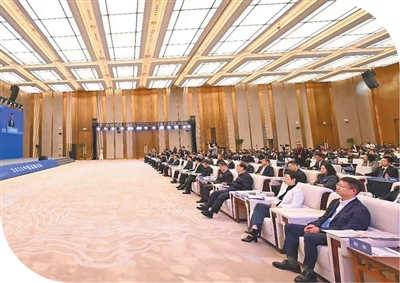
紧抓机遇助力金融强国建设
Jing Ji Ri Bao· 2025-11-11 22:20
Core Viewpoint - The company emphasizes its commitment to serving the real economy, enhancing financial services, and promoting sustainable development through various initiatives and strategies [1][2][3][4][5]. Group 1: Commitment to Political Leadership - The company adheres to the centralized leadership of the Party in financial work, ensuring that its operations align with national policies and directives [1]. - It aims to strengthen the political attributes of state-owned financial enterprises and integrate party-building work with core business operations [1]. Group 2: Service to the Real Economy - The company has supported 124 enterprises in A-share listings and 366 in the New Third Board, facilitating over 200 billion yuan in direct financing for technology-related companies [2]. - It has invested in over 200 equity projects, totaling more than 15 billion yuan, and established specialized funds to support high-quality listed companies [2]. Group 3: Focus on People's Financial Needs - The company prioritizes a people-centered approach in its financial services, enhancing customer service and expanding access to low-risk financial products [3]. - It has a leading position in the market for pension financial products, with its pension fund's Y share holding exceeding 1.5 billion yuan [3]. Group 4: Green Finance Initiatives - The company has developed a comprehensive green finance service system, achieving over 500 billion yuan in green finance projects [3]. - It actively promotes innovation in green finance and collaborates with high-end partners to support the green transformation of the economy [3]. Group 5: Digital Transformation - The company is committed to digital financial development, enhancing its digital service capabilities and creating a customer-centric service platform [4]. - It aims to improve operational efficiency and risk management through digitalization, ensuring comprehensive coverage of its digital initiatives [4]. Group 6: Risk Management - The company has established a robust compliance and internal control system to mitigate financial risks, ensuring sustainable and high-quality development [4]. - It employs technology to enhance the efficiency of its internal control mechanisms, reinforcing its risk management framework [4]. Group 7: Future Development Goals - The company aims to leverage opportunities in the evolving capital market, aligning its strategies with national financial development goals [5]. - It seeks to contribute to the advancement of China's financial sector through high-quality growth and adherence to the principles outlined by national leadership [5].

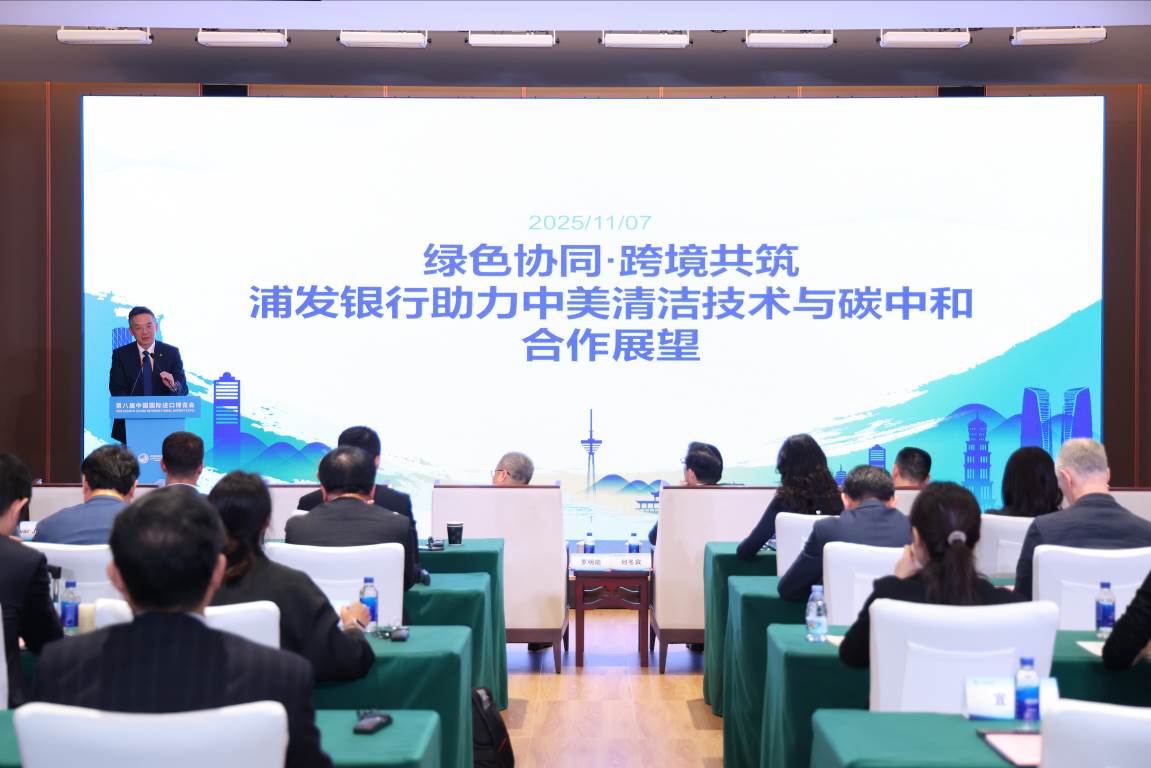
承接进博溢出效应 浦发银行举办上海北美清洁技术与碳中和路演对接活动
Zhong Guo Jin Rong Xin Xi Wang· 2025-11-11 14:19
Core Insights - The event organized by Shanghai Pudong Development Bank (SPDB) at the National Exhibition and Convention Center focused on clean energy, carbon neutrality technologies, and green low-carbon development opportunities, attracting around 80 industry leaders and representatives from China and the U.S. [1][3] - SPDB highlighted its green financial service philosophy through the keywords "green, cross-border, internationalization," reporting a green loan balance exceeding 700 billion yuan with a compound annual growth rate of 26% as of September 2025 [1][3]. Group 1 - SPDB possesses a comprehensive cross-border platform advantage in the green sector, leveraging its international business experience and professional service team [3]. - The bank has supported multiple Chinese enterprises in overseas green projects through green credit, with a total cross-border green loan balance of approximately 2.6 billion USD and overseas green bond investments totaling 380 million USD [3]. - SPDB, in collaboration with various institutions, launched China's first high-grade bond index fund addressing climate change, filling a gap in the domestic market and providing a benchmark for global investors [3]. Group 2 - The event featured presentations from CEOs and executives of 13 leading U.S. clean technology companies, showcasing innovative solutions in clean energy, carbon capture, green buildings, clean transportation, wind and solar energy equipment, and smart transportation systems [3]. - Participating companies expressed their eagerness to engage in deeper collaborations with enterprises and industrial parks in Shanghai following the summit [3]. Group 3 - The event was guided by the Shanghai Municipal Commission of Commerce, the People's Government of Pudong New Area, and the People's Government of Jinshan District, and co-hosted by several local investment promotion centers and the U.S.-China Clean Technology Center [4].

服务区域战略 践行金融担当 交通银行四川省分行荣获金鼎奖“年度支持地方经济奖”
Mei Ri Jing Ji Xin Wen· 2025-11-11 13:45
Core Viewpoint - The article highlights the achievements of the Bank of Communications Sichuan Branch in supporting local economic development, emphasizing its strategic commitment and innovative financial services that contribute to high-quality regional growth [1][3]. Group 1: Financial Support and Achievements - The Sichuan Branch has provided over 20 billion yuan in new loans to support the real economy since 2025, ranking among the top in the system [1]. - The branch signed a strategic cooperation agreement with the Sichuan provincial government, committing to provide 800 billion yuan in special credit support during the 14th Five-Year Plan period [4]. - As of September, the branch has engaged with 14,000 enterprises, with a total credit amount exceeding 50 billion yuan, including nearly 400 first-time loan recipients [5]. Group 2: Sector-Specific Financial Initiatives - The branch has established specialized teams for technology finance, inclusive finance, and green finance, resulting in a 14.9% increase in technology finance loans and serving over 4,500 technology enterprises [6]. - Green finance loans have increased by 19.3%, with significant projects funded, including major green initiatives in the solar industry [7]. - Inclusive finance loans have also seen a 17.9% increase, serving over 14,000 clients [7]. Group 3: Digital and Innovative Financial Solutions - The branch has integrated digital operations into its management, launching various online agricultural loans that have driven strong growth in online business [8]. - It has developed tailored financial solutions for the cultural and tourism sectors, supporting key projects and enhancing consumer spending [11]. Group 4: Strategic Vision and Future Plans - The branch aims to align its development with regional economic strategies, focusing on a credit resource allocation system that supports the real economy, small and micro enterprises, and rural revitalization [10]. - Future plans include innovative financial service models and a commitment to contribute significantly to the modernization of Sichuan [12].


香港特区政府成功发行第三批数码绿色债券 总额约100亿港元
Zhi Tong Cai Jing· 2025-11-11 13:01
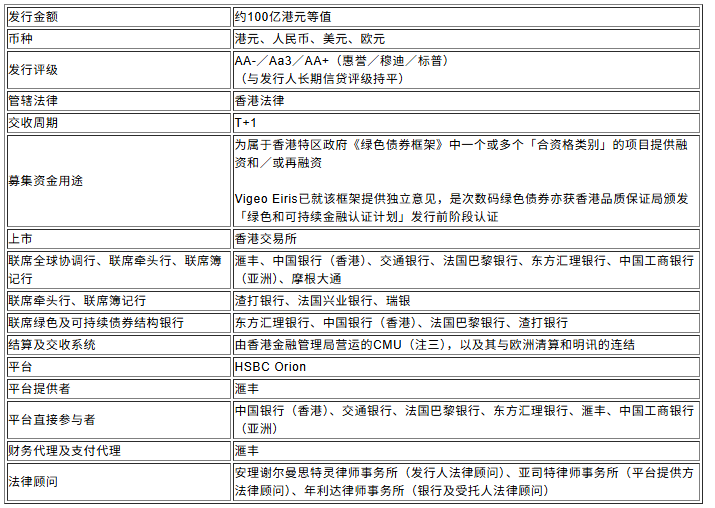
Core Insights - The Hong Kong SAR government successfully priced approximately HKD 10 billion worth of digital green bonds under its sustainable bond program, covering multiple currencies including HKD, RMB, USD, and EUR [1][2] Summary by Categories Issuance Details - The issuance includes HKD 2.5 billion two-year bonds at 2.5%, RMB 2.5 billion five-year bonds at 1.9%, USD 300 million three-year bonds at 3.633%, and EUR 300 million four-year bonds at 2.512% [2] - The total issuance amount reached HKD 10 billion, with total subscriptions exceeding HKD 130 billion, marking it as the largest digital bond issuance globally to date [2][3] Innovation and Technology - The bonds incorporate digital currency in the settlement process, allowing for tokenized central bank currency options, which helps reduce settlement time, costs, and counterparty credit risk [2] - The issuance utilizes Digital Token Identifiers (DTIs) in compliance with the ISO 24165 standard, linking the bonds to global standards [2][3] Market Impact and Future Outlook - The issuance reflects strong market support for tokenized products and aims to enhance the interoperability between traditional capital markets and digital industries [3][4] - The Hong Kong government plans to regularize the issuance of tokenized bonds to establish a comprehensive benchmark and promote broader applications of digital finance [3][4] Regulatory and Legal Framework - The bonds are governed by Hong Kong law, with a settlement cycle of T+1, and are certified under the "Green and Sustainable Finance Certification Scheme" by the Hong Kong Quality Assurance Agency [6] - The issuance received ratings of AA-/Aa3/AA+ from Fitch, Moody's, and S&P, respectively, aligning with the issuer's long-term credit rating [6]
生态治理与脱贫攻坚创造性结合,中国将“绿富同兴”方案带到世界
Zhong Guo Qing Nian Bao· 2025-11-11 12:25
Core Insights - The concept of "Lucid waters and lush mountains are invaluable assets" creatively combines ecological governance with poverty alleviation, contributing to global sustainable development with Chinese wisdom and solutions [1] - China has achieved the UN's 2030 sustainable development agenda poverty reduction goal ten years ahead of schedule, exploring various transformation paths for ecological poverty alleviation [1][2] Group 1: Ecological Compensation Mechanisms - China has established various ecological protection compensation mechanisms, including vertical fiscal compensation, horizontal inter-regional compensation, and market mechanism compensation [2] - Over 20 provinces in China have signed horizontal ecological protection compensation agreements for cross-province river basins, with a unified compensation mechanism for the Yangtze and Yellow Rivers expected by 2027 [2] Group 2: Financial Investments in Ecological Protection - From 2013 to 2023, the central government's transfer payment for key ecological function areas increased from 42.3 billion to 109.1 billion, with a total investment of 790 billion [2] - Water pollution prevention funding is projected to rise from 12.2 billion in 2015 to 26.7 billion by 2024 [2] Group 3: Green Economic Models - The "Green Development" model emphasizes the creation of wealth through the development of green industries, leveraging technological innovation and brand building [3] - The Daxing'anling region has halted commercial logging of natural forests, focusing on developing the under-forest economy and tourism, with projected carbon storage of 1.72 billion tons by 2024 [3] Group 4: Green Finance and Market Development - The "Borrowing Green to Create Wealth" model promotes the development of green markets and finance, facilitating the market circulation of ecological resources [3] - By the end of 2024, the balance of green loans in China is expected to reach 36.6 trillion, with green bonds issued exceeding 4.1 trillion [3] Group 5: Global Environmental Leadership - Under the guidance of the ecological civilization concept, China has transitioned from a participant to a leader in global environmental governance [4] - China has constructed the world's largest and fastest-growing renewable energy system, contributing nearly 64% of the global new installed capacity in 2024 [4]
世纪互联(VNET.US)成功发行数据中心行业全国首单绿色持有型不动产ABS
智通财经网· 2025-11-11 10:58
Core Viewpoint - Century Internet (VNET.US) successfully issued the "Taibao Asset-Century Internet Data Center Holding-type Real Estate Green Asset-backed Special Plan," marking a significant breakthrough in green finance and asset securitization for the data center industry, setting a new benchmark for high-quality and sustainable development [1][2] Group 1 - The project is the first successful issuance of a green holding-type real estate ABS in the national data center industry, indicating innovation in green finance [1][2] - The issuance scale of the project is 860 million yuan, with underlying assets transferred to the asset-backed special plan through equity transfer [1] - The underlying assets consist of urban IDC projects held by Century Internet, located in core cities with high demand for data centers, ensuring stable and predictable cash flow [2][3] Group 2 - The project received a G-1 rating from a professional third-party evaluation agency, the highest level in the green asset support securities assessment system [2] - The project integrates national dual carbon strategies through technologies like photovoltaic power generation and AI energy management, establishing a positive correlation between environmental benefits and investment returns [2] - Century Internet aims to revitalize existing IDC assets through innovative financial tools, enhancing operational and capital efficiency while promoting green and intelligent upgrades in data centers [3]

45万亿建行新曲线:绿色、普惠、科技三轮驱动
市值风云· 2025-11-11 10:15
Core Viewpoint - The article emphasizes that China Construction Bank (CCB) is focusing on high-quality development amidst a challenging industry environment, characterized by pressure on interest margins and a shift towards value-driven growth in the banking sector [3][17]. Financial Performance - For the first three quarters of 2025, CCB reported operating income of 573.7 billion yuan, a year-on-year increase of 0.82%, and net profit attributable to shareholders of 257.4 billion yuan, up 0.62% year-on-year [4][6]. - In Q3 2025, CCB achieved a net profit of 95.3 billion yuan, reflecting a significant year-on-year growth of 4.19%, indicating a positive trend in profitability [5][6]. Revenue Structure - Non-interest income reached 146.1 billion yuan, growing by 13.95% year-on-year, becoming a key driver of revenue growth [6]. - The net interest margin for the first three quarters was 1.36%, a decrease of 4 basis points from the previous half-year, primarily due to declining asset yields [6]. Asset Quality and Capital Strength - As of September 30, 2025, CCB's total assets amounted to 45.37 trillion yuan, an increase of 11.83% from the end of the previous year, with total loans and advances reaching 27.68 trillion yuan, up 7.1% [7][10]. - The non-performing loan (NPL) ratio stood at 1.32%, a slight decrease of 2 basis points, indicating stable asset quality [8][10]. - CCB's capital adequacy ratios remain strong, with a core Tier 1 capital ratio of 14.36% and a total capital ratio of 19.24%, positioning the bank favorably within the industry [10][18]. Strategic Initiatives - CCB is actively pursuing digital transformation and strategic breakthroughs in areas such as green finance and inclusive finance, with green loan balances increasing by 18.38% year-to-date [12][13]. - The bank has also made significant strides in supporting small and micro enterprises, with loans in this segment exceeding 3.8 trillion yuan [13][18]. Future Outlook - CCB plans to continue enhancing its "retail + inclusive + green" collaborative development strategy, leveraging digital transformation to optimize its asset-liability structure and improve risk pricing capabilities [19].

下一阶段货币政策主要思路,央行最新披露
Di Yi Cai Jing· 2025-11-11 09:43
Core Viewpoint - The People's Bank of China (PBOC) has implemented a moderately accommodative monetary policy in 2023, aiming to create a favorable monetary environment for economic recovery and financial market stability [1][2]. Monetary Policy Implementation - The PBOC has maintained reasonable growth in money and credit by utilizing various monetary policy tools such as open market operations and medium-term lending facilities to ensure ample liquidity [1][2]. - The central bank aims to reduce the overall financing costs in society by enhancing the market-oriented interest rate adjustment framework, leading to a decline in both deposit and loan rates [1][2]. - The PBOC is focusing on optimizing the credit structure by utilizing 500 billion yuan for consumption and pension-related loans, as well as increasing support for technology innovation and transformation [1][3]. Exchange Rate Stability - The PBOC emphasizes maintaining basic stability in the exchange rate, allowing the market to play a decisive role in its formation while ensuring it serves as a stabilizer for the macro economy and international balance of payments [1][4]. Financial Risk Management - The central bank is committed to systematically addressing financial risks by enhancing monitoring, assessment, and early warning systems for key financial sectors [2][6]. - The PBOC plans to maintain reasonable growth in financial aggregates and ensure that social financing conditions remain relatively loose, adapting to changes in the economic and financial landscape [2][6]. Financial Market Development - The PBOC is focused on accelerating the development of the bond market, particularly for technology enterprises, and enhancing the legal framework for corporate bonds [5]. - The central bank aims to promote the internationalization of the renminbi and expand its use in cross-border trade and investment [5].
“绿色外资”首落民企!兴业银行南京分行落地江苏省首批绿色外债试点业务
Sou Hu Cai Jing· 2025-11-11 09:42
Core Points - The green foreign debt pilot policy was officially implemented in Jiangsu province on November 1, allowing eligible non-financial enterprises to borrow foreign and domestic currency for green low-carbon transformation projects [1][2] - The pilot policy aims to support green low-carbon development, serve the real economy, and expand financing channels for enterprises [1] - The policy allows such projects to occupy less of the enterprise's overall cross-border financing risk-weighted balance, thereby increasing the upper limit of cross-border financing [1] Summary by Sections Implementation and Initial Success - On the same day the policy was implemented, Industrial Bank's Nanjing branch successfully executed Jiangsu's first green foreign debt pilot business through its Taizhou branch [1][2] - The bank formed a cross-functional team to identify eligible enterprises, focusing on key indicators such as foreign debt limits, compliance of use, and exchange rate risks [2] Targeted Enterprises - The team identified RT Company, a private enterprise established in July 2015, which specializes in chemical products and has been certified as a high-tech and "little giant" enterprise in Jiangsu [2] - RT Company's borrowing project met the requirements for green low-carbon transformation, leading to expedited support from the bank [2] Future Plans - Industrial Bank's Nanjing branch plans to continue promoting the green foreign debt pilot and enhance foreign exchange management services to support the real economy's green transformation and high-quality development [3]
