双碳目标

Search documents
证券公司服务绿色金融高质量发展的现状和展望
GUOTAI HAITONG SECURITIES· 2026-02-25 07:55
Core Insights - The report emphasizes the role of securities companies in promoting high-quality development of green finance, highlighting their transition from traditional service providers to key players in building green industry ecosystems and driving innovation [5][20]. - It identifies the challenges faced by securities companies, including imbalanced business layouts, insufficient product innovation, and weak risk management systems, and proposes strategies to enhance their contributions to green finance [12][19]. Group 1: Current Practices in Green Finance by Securities Companies - Securities companies have steadily expanded their green financing business, enhancing their role as intermediaries in financing green enterprises through increased green bond underwriting and equity financing [6][8]. - The green investment business is gaining momentum, with securities companies guiding capital towards green sectors and integrating ESG principles into their investment decision-making processes [8][9]. - Innovations in green financial services are emerging, with securities companies exploring carbon finance, green advisory services, and green derivatives to enhance service offerings [10][11]. Group 2: Challenges in Green Finance Development - There is a notable imbalance in the business layout of securities companies, with resources concentrated in leading firms and coastal regions, leaving smaller firms and inland areas underserved [13][14]. - The capacity for product innovation is lacking, with a predominance of traditional products and insufficient offerings tailored to the diverse needs of green enterprises [15][16]. - The risk management framework for green finance is underdeveloped, with inadequate mechanisms for identifying and managing environmental, credit, and policy risks [17][18]. Group 3: Recommendations and Outlook - Securities companies should strengthen their strategic layouts to promote balanced development in green finance, leveraging their advantages to support smaller firms and enhance service capabilities in underdeveloped regions [21][22]. - There is a need to increase innovation efforts to diversify green financial products and services, focusing on the development of new financing instruments and tailored asset management solutions [23][24]. - Improving the risk management system is crucial, requiring the establishment of comprehensive risk assessment frameworks and enhanced collaboration among financial institutions to share risk data and best practices [25].
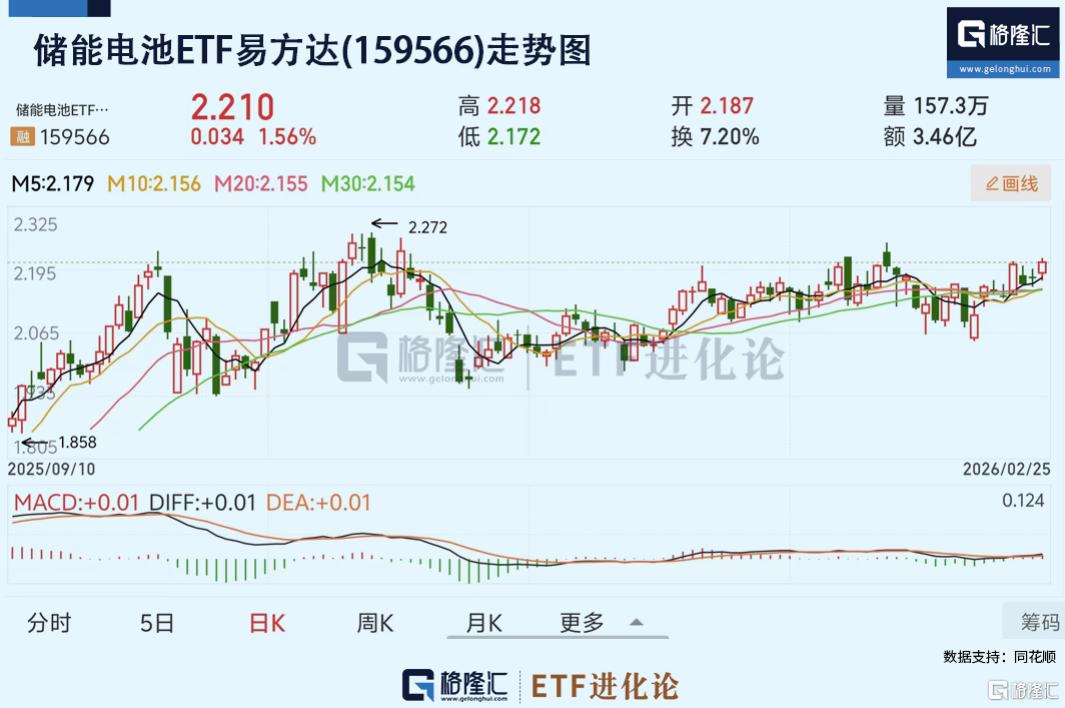
碳酸锂期货大涨+1月新型储能新增装机同比翻倍,储能电池ETF易方达(159566)标的指数上涨1.63%
Ge Long Hui· 2026-02-25 07:37
Group 1 - The core viewpoint of the news is that lithium carbonate futures have significantly increased, with the main contract rising by 6% to 170,700 yuan/ton, marking the seventh consecutive day of gains and reaching the highest level since January 29. This surge is driven by expectations of tightening supply due to the suspension of lithium exports from Zimbabwe, heightening concerns over global lithium resource availability [2] Group 2 - As a key raw material for energy storage batteries, the rising price of lithium carbonate is positively impacting the entire energy storage battery industry chain, leading to improved sentiment in the sector. The E Fund Energy Storage ETF (159566) focuses on core assets in the energy storage industry and directly benefits from this positive outlook [3] - The global lithium market is expected to show clear signs of recovery by 2026 after a period of deep adjustment and capacity clearing from 2023 to 2025. Additionally, the new energy storage installation data released by the Zhongguancun Energy Storage Industry Technology Alliance indicates a significant year-on-year growth of 62% and 106% in newly added capacity [3] Group 3 - The energy storage industry is currently experiencing dual benefits from policy and industry dynamics. Recent milestone policies have established new energy storage as an independent market entity, enhancing investment confidence and providing a stable revenue model for storage projects [4] - The demand for energy storage is highly robust, with first and second-tier battery manufacturers operating at full capacity, and some order delivery times extending to April 2026. The compound annual growth rate for energy storage demand from data centers is projected to reach 23% [4] Group 4 - Emerging demand from data centers, commercial energy storage, and residential energy storage is continuously expanding, with predictions indicating that by 2030, China's new energy storage cumulative installed capacity could exceed 370 million kilowatts, with an average discharge duration of 3.47 hours [5] - The solid-state battery industry is accelerating towards commercialization, with key testing phases expected in 2026 and mass production anticipated in 2027, which will enhance battery performance and reduce costs, further stimulating industry demand [5] Group 5 - The E Fund Energy Storage ETF (159566) has three core characteristics: high purity in energy storage-related stocks with a weight of 62.41%, significant exposure to artificial intelligence data centers (AIDC) at nearly 25%, and a 30.44% weight in solid-state battery-related companies, positioning it well to capitalize on the industry's growth [5] - As of February 24, 2026, the E Fund Energy Storage ETF has surpassed 4.7 billion yuan in scale, making it the largest ETF tracking this sector, with strong liquidity and recent net inflows of 65.44 million yuan [5]

3月杭州生物制造大会【生物基化学品与材料专场】,邀您免费注册参会!
synbio新材料· 2026-02-25 07:14
Core Viewpoint - The article emphasizes the importance of bio-based chemicals and materials as a key pillar of the bio-manufacturing industry, highlighting their potential to replace traditional petroleum-based products in various sectors such as packaging, textiles, and automotive, driven by their renewable raw materials and low-carbon environmental benefits [2]. Group 1: Industry Context - The global push for green transformation and "dual carbon" goals positions bio-based chemicals and materials as critical to the industry's transition [2]. - China prioritizes the development of bio-based new materials, categorizing them as strategic materials, with multiple supportive industrial policies being implemented [2]. Group 2: Challenges - The industry faces significant challenges, including competitive cost structures, stability of raw material supply chains, optimization of product performance, and market acceptance of end products [2]. Group 3: Event Details - The "5th China Synthetic Biology and Bio-Manufacturing Conference" will be held in Hangzhou from March 31 to April 1, 2026, focusing on bio-based chemicals and materials [4]. - The conference aims to gather insights from various sectors to address industry development challenges and promote high-quality growth in the bio-based chemicals and materials sector [2][4]. Group 4: Conference Topics - Proposed topics for the conference include green bio-manufacturing of bio-based bulk chemicals, molecular and material innovations based on synthetic biology, and industrial practices for high-value utilization of non-food biomass [9]. Group 5: Participation and Collaboration - The conference will offer exhibition opportunities for companies involved in synthetic biology and modern biotechnology applications, including sponsorship options for various promotional activities [11]. - Registration for the conference is currently free, with limited spots available on a first-come, first-served basis [16].

定调!十五五“期间初步建成新型能源体系
Guo Ji Jin Rong Bao· 2026-02-25 07:05
在能源系统发展中,如何平衡好"能源安全、能源公平(可负担性)与环境可持续性"三者之间的矛盾, 是所有国家都面临的难题。中国要想建设"能源强国",就必须加快建设新型能源体系。 2月23日,国家能源局发布消息,明确2026年作为"十五五"规划开局之年,将发布实施新型能源体系及 系列分领域能源规划,深入践行能源安全新战略,加快建设新型能源体系,推进能源强国建设。 关键转折点来了 为什么在此时提出要建立新型能源体系?业内人士分析称,主要是"十四五"期间,我国非化石能源消费 占比显著提升(占到总能源消耗的两成),而煤炭消费占比稳步下降,意味着我国建立了全球最大的可 再生能源体系。这一趋势带来了一个历史性的变革时刻,那就是中国可再生能源(风电光伏等)总装机 容量第一次超过了传统的煤电和其他化石能源,这是一个非常关键的转折点,为我国初步建成清洁低 碳、安全高效的新型能源体系奠定了基础。此次新型能源体系建设的目标是要从根本上颠覆过去100多 年里的传统能源网络。 为什么急于建立这样一个"新"体系?业内认为,因为当前我国能源发展面临多重挑战。 根据国家发展改革委、国家能源局等权威部门发布的政策文件,到2030年,我国将基本建成 ...
创新技术路径与实施机制,推进“能源—水—物料”协同 以系统工程思维驱动园区绿色转型
Zhong Guo Hua Gong Bao· 2026-02-25 05:09
Core Viewpoint - The chemical industry parks play a crucial role in achieving China's "dual carbon" goals, necessitating high-quality engineering construction for green development [1] Group 1: Challenges in Current Practices - Many parks exhibit an "engineering island" phenomenon, where energy efficiency, wastewater treatment, and resource recovery projects are planned and implemented independently, leading to missed optimization opportunities [2] - This fragmented approach neglects the inherent coupling of materials and energy in chemical processes, resulting in cascading waste of energy and materials within the park ecosystem [2] Group 2: Key Pathways for Optimization - Energy cascading utilization and deep coupling of water resource regeneration are essential for carbon reduction and water conservation, exemplified by integrating low-grade waste heat recovery with seawater desalination [3] - Closed-loop design for material metabolism and resource recovery treats waste as "misplaced resources," focusing on green design and establishing park-level waste energy and resource recovery centers [3] Group 3: Digital Empowerment for Optimization - The development of a smart energy-environment management system is underway, utilizing IoT for real-time data collection and digital twin technology for simulation modeling, enabling proactive and dynamic optimization of resources [4] Group 4: Mechanisms for Sustainable Transformation - A unified planning mechanism is recommended to incorporate "energy-water-material" collaborative networks into the park's overall planning and long-term green development [6] - A shared data and service platform should be established to facilitate resource management and reduce transaction costs among enterprises [6] - A market-based incentive and constraint mechanism is proposed, focusing on differentiated resource pricing and exploring internal carbon and water rights trading [6] - A collaborative招商 mechanism should prioritize attracting enterprises that can utilize by-products and provide clean energy or key recycling technologies [6] Group 5: Conclusion on Transformation - The transformation of chemical parks under the "dual carbon" goals represents a systemic and epochal challenge, with a belief that systematic engineering thinking, innovative technology, and collaborative management mechanisms will lead to a more efficient, safe, and sustainable development path [7]

春节假期不停工 南方电网超级工程建设“不打烊”
Zhong Guo Fa Zhan Wang· 2026-02-25 04:00
Core Viewpoint - The article emphasizes the importance of investment in driving economic growth and highlights the ongoing construction of major energy projects by the Southern Power Grid, which aims to stabilize economic growth and enhance development momentum [1][2][3] Group 1: Investment and Economic Growth - Investment is identified as a crucial engine for economic and social development, with the Central Economic Work Conference advocating for measures to "promote investment stabilization" [1] - The State Council's meeting on February 6 further stressed the importance of effective investment in stabilizing economic growth and enhancing development potential [1] Group 2: Major Energy Projects - The Southern Power Grid is actively pursuing several major energy projects, including the Huizhou Zhongdong Pumped Storage Project and the Guilin Guanyang Pumped Storage Project, with a planned investment exceeding 3 billion yuan in the first quarter [1] - The construction of the world's first four-terminal ultra-high voltage flexible direct current project, the Tibet-Guangdong Direct Current Project, is also underway, with a planned investment of over 900 million yuan in the first quarter [2] Group 3: Construction Progress and Workforce - Over 1,400 builders are engaged in construction activities during the Spring Festival, demonstrating a commitment to maintaining project momentum [1] - The Guilin Guanyang Pumped Storage Project has recently achieved a significant milestone with the completion of a 2,376-meter self-flow drainage tunnel, indicating progress in the underground construction phase [2] - The project team is prioritizing safety and quality while aiming to complete key tasks to ensure the main project construction starts smoothly in November [2]
锦西石化:将全会精神转化为行动实践
Zhong Guo Hua Gong Bao· 2026-02-25 02:06
Group 1 - The core message of the articles emphasizes the commitment of Jinxin Petrochemical to transform the spirit of the 20th Central Committee into practical actions for building a green and intelligent new energy system and becoming a model for sustainable development [1][2] - Jinxin Petrochemical has established an "online + offline" learning matrix to facilitate the understanding of the "14th Five-Year Plan" and the important speeches of General Secretary Xi Jinping, ensuring comprehensive training for party members and cadres [1] - The company actively promotes the core significance of the Central Committee's spirit through a "visual + all-media" communication matrix, producing thematic promotional videos to make the content more accessible to all employees [1] Group 2 - Jinxin Petrochemical is closely integrating the spirit of the Central Committee with the construction of a new energy system and high-quality development, focusing on the requirement for "promoting clean and low-carbon energy transformation" [2] - The company has completed five key energy-saving projects, including enhancing heating furnace efficiency and low-temperature heat recovery, and plans to develop green methanol and waste plastic recycling projects during the "14th Five-Year Plan" [2] - The company is committed to building a customized 5G network across the plant and aims to establish a comprehensive environmental protection facility system, including wastewater treatment and VOCs governance, in line with the "dual carbon" goals [2]
研判2026!全球及中国光伏背板行业政策、产业链、发展现状、重点企业及未来展望:光伏背板市场需求萎缩,玻璃背板成为行业主流[图]
Chan Ye Xin Xi Wang· 2026-02-25 01:26
Core Viewpoint - The Chinese photovoltaic backsheet industry exhibits a fluctuating market scale, with growth driven by policy support and installation expansion from 2015 to 2017, followed by a downturn due to regulatory adjustments and price declines in 2018-2019. The market rebounded from 2020 onwards, reaching 8.5 billion yuan in 2022, but is expected to decline in 2023-2024 due to increased penetration of bifacial modules and intensified price competition [1][14]. Industry Overview - Photovoltaic backsheets are essential encapsulation materials located at the back of photovoltaic modules, providing protection against environmental factors and ensuring insulation [2][5]. - The structure of photovoltaic backsheets typically consists of five layers, with the outer layer made of PVDF for environmental resistance, a middle layer of PET for insulation, and inner layers of PVDF and EVA for adhesion [2][4]. Market Dynamics - The market for photovoltaic backsheets is influenced by the rapid penetration of bifacial modules, increased competition in traditional backsheet pricing, and adjustments in the global photovoltaic supply chain [1][14]. - The market scale reached 8.5 billion yuan in 2022, but is projected to decline in 2023-2024 due to various factors [1][14]. Industry Policies - The photovoltaic industry is supported by national policies aimed at promoting renewable energy, which has led to significant growth in both scale and technology within the sector [5][13]. - Policies such as the "14th Five-Year Plan for Renewable Energy Development" aim for renewable energy consumption to reach 18% of total energy consumption by 2025 [13]. Industry Chain - The photovoltaic backsheet industry has a complex supply chain, with upstream materials including PVDF, PVF, PET, and glass. Domestic materials have increasingly met performance and quality standards, reducing reliance on foreign suppliers [5][7]. - The midstream involves the manufacturing of backsheets, while the downstream is focused on application within the photovoltaic industry [5][6]. Market Share of Materials - The primary materials used in photovoltaic backsheets include PVDF (53%), PVF (15%), glass (14%), PET (10%), and others, with PVDF being the dominant material due to its superior properties [7][8]. Competitive Landscape - The market is characterized by a high concentration of leading domestic companies such as Zhonglai Co., Foster, and Saiwu Technology, with significant production bases primarily located in Jiangsu and Zhejiang provinces [15][16]. - In 2024, the estimated shipment volumes for major companies are projected to be 135 million square meters for Zhonglai, 100 million for Foster, and 89 million for Saiwu [15]. Development Trends - The industry is expected to see advancements in flexible photovoltaic backsheet technology, ultra-thin and lightweight materials, and the integration of smart functionalities into backsheets [17][18][19]. - These innovations aim to enhance adaptability, reduce costs, and improve the overall efficiency and reliability of photovoltaic systems [17][18][19].





昔年秃山,今春披绿装
Xin Lang Cai Jing· 2026-02-24 23:26
Core Insights - The article highlights the successful implementation of a forestry carbon sink project in Bato Village, Kaifa County, where over 30,000 saplings have been cultivated, transforming previously barren hills into lush greenery through community involvement and ecological compensation funds [1] Group 1: Carbon Sink Projects - The Kaifa County Forestry Development Company collaborates with local villages to develop carbon sink projects, funded by carbon compensation payments, which are used for planting and managing trees, with part of the profits benefiting the village [1] - The "Prosecutor + Carbon Sink" ecological restoration mechanism has been introduced in Kaifa County to address traditional ecological restoration challenges, ensuring that compensation funds are specifically allocated for ecological restoration rather than merely settling damages [1] Group 2: Broader Implementation and Impact - The Quzhou City Prosecutor's Office aims to extend the application of carbon sinks beyond forest damage cases to encompass all areas of ecological and resource protection, integrating ecological protection with carbon neutrality goals [2] - Since March 2025, Quzhou's prosecutors have guided parties in carbon sink subscriptions totaling over 3,600 tons, achieving a balance of ecological, legal, and social benefits [3] - The practice of using forestry carbon sink subscriptions as a substitute for traditional restoration has been incorporated into local legislation, providing a replicable model for promoting green transformation in economic and social development [3]
山东:向绿向新构建新型能源体系
Xin Lang Cai Jing· 2026-02-24 23:26
Core Viewpoint - Shandong province is focusing on building a new energy system aligned with "dual carbon" goals, emphasizing integrated development of non-fossil energy sources such as wind and solar power [3][4]. Group 1: Energy Development - Shandong is advancing the development of non-fossil energy by integrating land and sea resources, promoting wind and solar energy projects [3]. - The province is developing clean energy bases in areas like the saline-alkali land in northern Shandong and coal mining subsidence areas in southwestern Shandong [3]. Group 2: Energy Equipment Industry - Shandong is actively cultivating the energy equipment industry, enhancing the wind power industry chain [3]. - The province is fostering a synergistic development between the new energy structure transformation and the energy equipment industry [3].