
外汇储备

Search documents
肯外汇储备增至120亿美元
Shang Wu Bu Wang Zhan· 2025-12-17 16:44
Core Viewpoint - The Central Bank of Kenya reported that as of December 8, foreign exchange reserves reached $12 billion, equivalent to 5.3 months of import cover, indicating a stable financial position and ability to manage short-term shocks [1] Group 1 - The increase in foreign exchange reserves is attributed to diversified inflows, including exports, remittances, and foreign currency-denominated debt earnings [1] - The Monetary Policy Committee (MPC) emphasized the importance of closely monitoring external conditions to ensure sufficient foreign exchange reserves to meet import needs [1] - The reserves are seen as a buffer to protect the economy from short-term pressures [1]
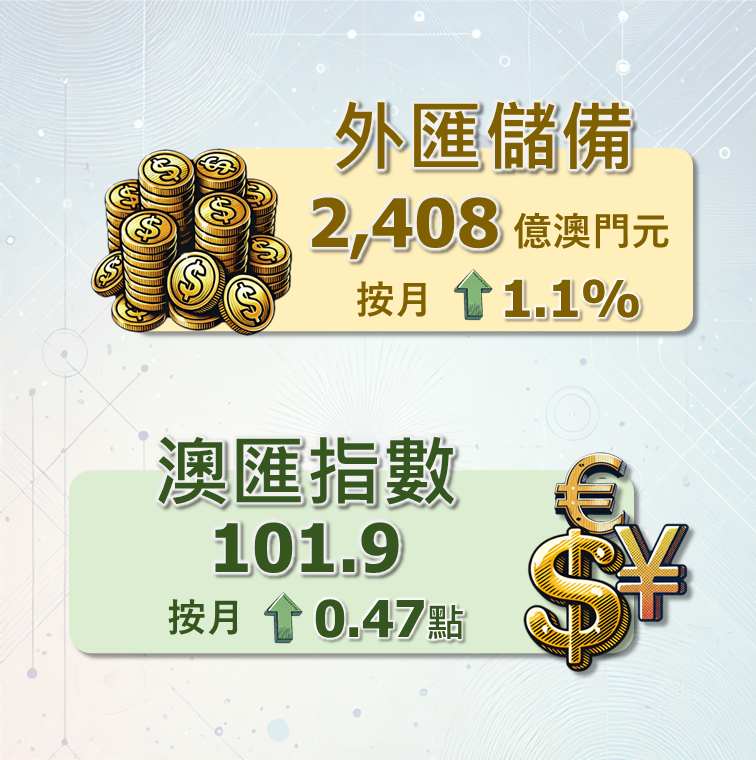
澳门金管局:11月底外汇储备资产总额初步统计为2408亿澳门元 环比上升1.1%
智通财经网· 2025-12-15 12:43
Core Viewpoint - The Monetary Authority of Macao announced that as of the end of November 2025, the total foreign exchange reserves of the Macao Special Administrative Region reached 240.8 billion Macanese Patacas (approximately 30.05 billion USD), reflecting a 1.1% increase from the revised total of 238.0 billion Macanese Patacas (approximately 29.74 billion USD) at the end of October 2025 [1] Summary by Category Foreign Exchange Reserves - As of November 2025, the total foreign exchange reserves amounted to 240.8 billion Macanese Patacas (30.05 billion USD) [1] - This represents a 1.1% increase from the revised total of 238.0 billion Macanese Patacas (29.74 billion USD) reported at the end of October 2025 [1] Monetary Supply - The total foreign exchange reserves at the end of November 2025 are approximately 11 times the amount of Macao's circulating currency as of the end of October 2025 [1] - The reserves constitute 89.6% of the Macanese Pataca portion of the broad money supply (M2) [1]

美国掉入全球第三,中国贸易顺差超万亿,3万亿外汇储备是底气
Sou Hu Cai Jing· 2025-12-11 13:40
Group 1 - The core argument of the article highlights that despite initial predictions of a decline in China's exports due to trade pressures, China has achieved a historic trade surplus exceeding 1 trillion USD, with the U.S. falling to third place in trade relations with China [1][32] - In the first eleven months of 2025, China's total goods trade value reached 41.21 trillion yuan, a year-on-year increase of 3.6%, with exports at 24.46 trillion yuan (up 6.2%) and imports at 16.75 trillion yuan (up 0.2%), resulting in a trade surplus of 7.71 trillion yuan, equivalent to 1.07 trillion USD [3][5] - China is the first country to achieve a trade surplus exceeding 1 trillion USD, a figure that surpasses the combined trade surpluses of the second to eighth ranked countries globally [5] Group 2 - ASEAN remains China's largest trading partner, with a total trade value of 6.82 trillion yuan (16.6% of total trade), followed by the EU at 5.37 trillion yuan (13%), while the U.S. has dropped to third place with a trade value of 3.69 trillion yuan (8.9%), a year-on-year decline of 16.9% [5] - Trade with countries involved in the Belt and Road Initiative reached 21.33 trillion yuan, growing by 6%, highlighting its significance as a key driver of foreign trade growth [8] Group 3 - The export structure has shifted significantly, with mechanical and electrical products accounting for 60.9% of total exports at 14.89 trillion yuan, a year-on-year increase of 8.8%, while labor-intensive products have decreased to 15.1% of exports, down 3.5% [10][12] - A representative case is a Zhejiang automotive parts company that shifted its focus from the U.S. market to ASEAN, resulting in over 50% growth in exports to ASEAN countries [14][17] Group 4 - Companies are leveraging retained foreign exchange funds for overseas investments, such as a Guangdong home appliance company that used 1.5 million USD of its foreign exchange earnings for purchasing high-end components and establishing an assembly base in Mexico [21][23] - The "hidden reserves" policy has stabilized domestic prices, with the CPI remaining low at 0.1% in June 2025, contrasting with inflation in other countries [25][27] Group 5 - Recent changes in U.S.-China trade relations indicate a shift from "comprehensive containment" to "economic competition and military deterrence," with over 30% of U.S. small and medium enterprises resuming business discussions with China, although the U.S. share in trade with China has not yet recovered [28][30]
蒙古国外汇储备达60亿美元
Shang Wu Bu Wang Zhan· 2025-12-11 10:01
Core Insights - Mongolia's foreign exchange reserves reached a historic high of $6.014 billion as of December 2, driven by improvements in sovereign credit and favorable external financing conditions [1] - Rapid growth in mineral exports has significantly boosted foreign exchange inflows, enhancing the country's international balance of payments [1] - The government and central bank have effectively managed debt obligations through refinancing international bonds and repaying maturing external debts, which has further supported the increase in reserve levels [1]
斯11月外汇储备下降3%至60亿美元
Shang Wu Bu Wang Zhan· 2025-12-09 18:19
Group 1 - The official foreign exchange reserves decreased by 3% from October, falling from $6.21 billion to $6.03 billion as of November 2025, marking the lowest level for the year [1] - The peak of the reserves for the year was $6.51 billion in March 2025, while the reserves for November 2024 were $6.45 billion [1] - Gold reserves increased from $800 million to $850 million, while the Special Drawing Rights (SDR) from the International Monetary Fund (IMF) dropped from $31 million to $2 million [1] Group 2 - The central bank estimates the foreign exchange payment needs for the next 12 months to be $2.05 billion [1]
经济学家宋清辉:未来中国有能力继续保持外储规模的基本稳定
Sou Hu Cai Jing· 2025-12-09 05:09
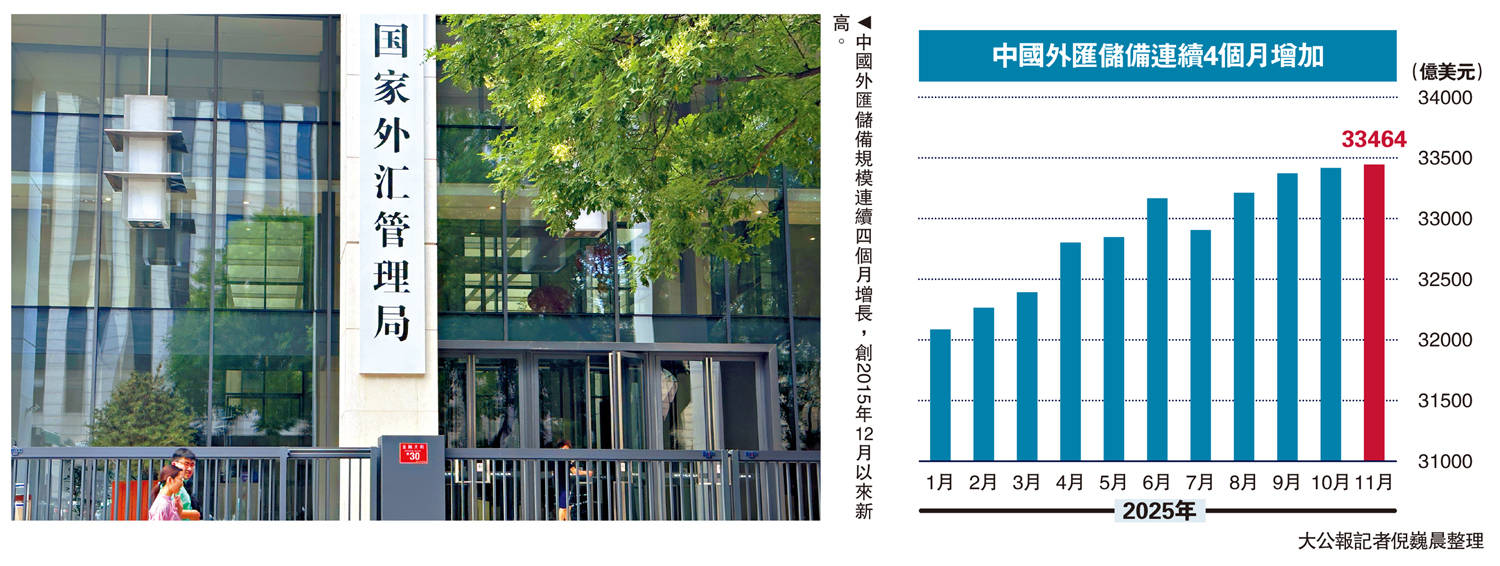
Core Viewpoint - The continuous growth of China's foreign exchange reserves indicates a stable status in international balance of payments, cross-border capital flows, exchange rates, and asset price changes, providing a strategic buffer for the country against external shocks and ensuring the stability of the RMB exchange rate [1][6]. Group 1: Foreign Exchange Reserves - As of the end of November, China's foreign exchange reserves reached 33,464 billion USD, marking a month-on-month increase of 30 million USD or 0.09%, and achieving the highest level since December 2015 [3]. - The sustained stability of foreign reserves suggests that China maintains a robust position in international payments and capital flows, with expectations for continued stability at high levels [3][7]. - The increase in foreign reserves is attributed to factors such as macroeconomic data from major economies and expectations regarding monetary policy, leading to a decline in the US dollar index [3][8]. Group 2: Exchange Rate Dynamics - The global currency market has seen a trend of a weakening US dollar, with the dollar index dropping 0.29% to 99.4 in November, while major non-USD currencies have shown mixed performance [6][8]. - The offshore RMB appreciated significantly, surpassing 7.09 against the USD, reflecting a cumulative increase of over 3,500 basis points since its low in April [6]. - Analysts predict that the RMB exchange rate will remain stable or slightly stronger in December, with expectations of fluctuations within the range of 7.05 to 7.1 [8]. Group 3: Future Outlook - The National Foreign Exchange Administration emphasizes that China's economy remains stable and progressing, supporting the future stability of foreign exchange reserves [7]. - China's commitment to a market-oriented exchange rate mechanism and ongoing financial market opening will attract foreign investment, contributing to stable foreign capital inflows [7]. - The strong manufacturing sector and complete supply chain in China are expected to ensure a continued trade surplus, further supporting foreign exchange inflows [7].
11月末我国外储规模为33464亿美元 央行已连续13个月增持黄金
Sou Hu Cai Jing· 2025-12-08 13:31
Core Insights - China's foreign exchange reserves increased to $33,464 billion by the end of November 2025, marking a rise of $3 billion or 0.09% from the end of October [1] - The People's Bank of China reported a gold reserve of 7.412 million ounces at the end of November, with an increase of 30,000 ounces [1] - Analysts attribute the rise in reserves to expectations of a Federal Reserve rate cut and a slight depreciation of the US dollar, which positively impacted the valuation of non-dollar assets in China's reserves [1][2] Foreign Exchange Reserves - The increase in foreign exchange reserves is influenced by macroeconomic data and monetary policy expectations from major economies, leading to a slight decline in the US dollar index [2] - The reserves have remained above $3.3 trillion for four consecutive months, the highest level since December 2015, with a significant increase of $144 billion compared to the end of the previous year [2] - Factors contributing to this stability include a significant depreciation of the dollar, a decline in US Treasury yields, and rising global stock indices [2] Gold Reserves - China's gold reserves increased by 30,000 ounces in November, continuing a trend of 13 consecutive months of gold accumulation [4] - The price of gold rose from $4,000 per ounce at the end of October to above $4,200 in November, driven by expectations of a Federal Reserve rate cut and a depreciating dollar [4] - The current gold reserve proportion in China's international reserves is 8.0%, significantly below the global average of around 15%, indicating a need for continued accumulation of gold [5] Economic Context - The US economic data released in November showed weakness, contributing to an increased probability of a Federal Reserve rate cut to over 80% [3] - The reduction of tariffs on Chinese exports to the US by 10% is expected to stabilize China's export scale to the US [3] - China's capital market is being progressively opened to foreign investors, enhancing the attractiveness for overseas investments [3]
突然,崩了!刚刚,印度央行紧急“救市”!
Zheng Quan Shi Bao Wang· 2025-12-08 11:52
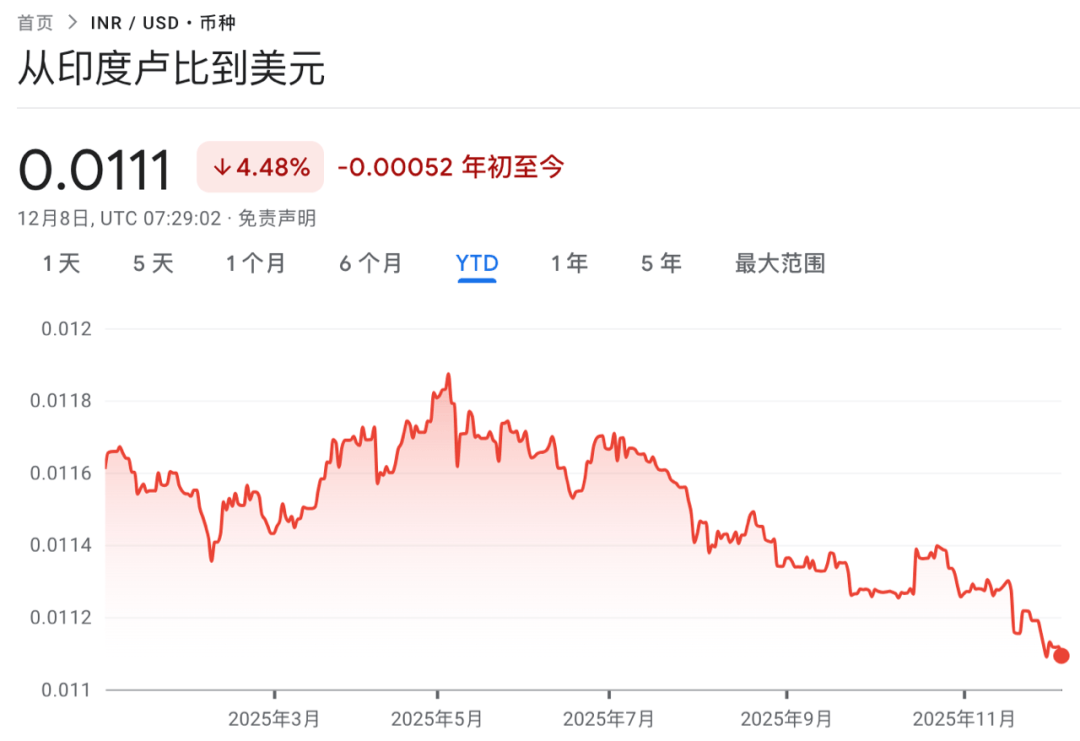
12月8日,据彭博社报道,印度央行行长桑贾伊·马尔霍特拉(Sanjay Malhotra)正试图在打击投机与避免过度干预之间寻找平衡。 报道称,印度央行的干预决策每天早晨在孟买南部总部做出。交易员在隔音房间接收指令,有时每分钟向市场抛售1亿美元,试图缓解印度卢比贬值 压力。 今年以来,印度卢比汇率遭遇重挫,截至发稿,印度卢比兑美元汇率累计贬值幅度接近4.5%。在31种主要货币中,印度卢比的年内跌幅仅次于土耳 其里拉、阿根廷比索。 印度央行紧急出手。 12月8日,印度卢比再度遭遇抛售,美元兑印度卢比汇率已经升破90心理大关。据最新消息,印度央行正入市干预以缓解印度卢比贬值压力,专职交 易员有时以每分钟抛售1亿美元的力度维稳汇市。 但有分析指出,印度央行进一步干预的空间可能有限,其"救市"行动已经对印度金融系统产生显著影响,自今年6月高点以来,外汇储备中的外币资 产减少约380亿美元(约合人民币2700亿元)。 印度"救市" 值得注意的是,今年以来,美元指数累计跌幅超7%。意味着,印度卢比的贬值幅度更为惨烈。 交易员表示,如果不是印度央行持续入市干预,印度卢比跌幅本会更大。 据彭博社报道,接受采访的银行家、交易员 ...
突然,崩了!刚刚,紧急“救市”!
券商中国· 2025-12-08 11:13
Core Viewpoint - The Reserve Bank of India (RBI) is intervening in the foreign exchange market to stabilize the Indian Rupee, which has recently depreciated significantly against the US Dollar, surpassing the psychological threshold of 90 [1][3]. Group 1: RBI's Intervention Strategy - The RBI is attempting to balance between curbing speculation and avoiding excessive intervention, with the central bank's governor, Sanjay Malhotra, leading these efforts [2]. - The intervention decisions are made daily at the RBI's headquarters in Mumbai, where traders receive instructions to sell up to $1 billion per minute to alleviate the depreciation pressure [3][6]. - Since June, the RBI's actions have led to a reduction of approximately $38 billion in foreign currency assets within the foreign exchange reserves [10]. Group 2: Market Impact and Currency Performance - The Indian Rupee has depreciated nearly 4.5% year-to-date, making it one of the worst-performing currencies among 31 major currencies, second only to the Turkish Lira and Argentine Peso [3]. - The US Dollar index has dropped over 7% this year, indicating that the Rupee's depreciation is more severe than it appears [6]. - If not for the RBI's interventions, the depreciation of the Rupee would have been more pronounced, according to traders [6]. Group 3: Challenges and Limitations - The RBI's intervention has significantly impacted the financial system, leading to liquidity issues as the central bank has sold an average of $1.2 billion in foreign exchange reserves weekly over the past four weeks [11]. - The RBI's net short position in forward contracts was approximately $64 billion as of October, indicating a commitment to sell dollars in the future, which constrains its intervention capacity [12]. - Factors contributing to the Rupee's depreciation include an expanding trade deficit, punitive tariffs imposed by the US, and capital outflows, with foreign investors selling $17 billion worth of Indian stocks this year [12][17]. Group 4: Future Outlook - The outcome of ongoing trade negotiations between India and the US is a critical variable for the future trajectory of the Indian Rupee [13]. - If a favorable trade agreement is reached, the RBI may find relief in its efforts to stabilize the currency [14]. - The US trade negotiation team is scheduled to visit India to continue discussions, which could influence the Rupee's performance [15].

国元香港晨报-20251208
Guoyuan International· 2025-12-08 05:40
Core Insights - The report highlights the ongoing investigation into potential price manipulation in the food industry initiated by Trump, which may impact market dynamics and investor sentiment [4] - The report notes a significant increase in China's foreign exchange reserves and a continuous 13-month trend of gold accumulation by the central bank, indicating a strengthening of financial stability [4] - The report mentions a year-end push in the real estate market with various regions increasing home purchase subsidies, which could stimulate housing demand [4] Economic Data - The report provides key economic indicators, including the Baltic Dry Index at 2727.00, down 3.09%, and the CME Bitcoin futures at 89425.00, down 3.68% [5] - Oil prices are noted with ICE Brent crude at 63.86, up 0.95%, while gold is at 4197.41, down 0.25% [5] - The report lists major stock indices, with the Hang Seng Index closing at 26085.08, up 0.58%, and the Shanghai Composite Index at 3902.81, up 0.70% [8][5] Market Performance - The report indicates that the Nasdaq Composite Index closed at 23578.13, up 0.31%, and the Dow Jones Industrial Average at 47954.99, up 0.22% [8] - The S&P 500 index is reported at 6870.40, up 0.19%, while the Nikkei 225 is at 50491.87, down 1.05% [8] - The report also highlights the performance of the Shenzhen Composite Index at 2468.88, up 1.24%, and the ChiNext Index at 3109.30, up 1.36% [8]