慢牛

Search documents
周五尾盘下跌后 A股明天怎么走?你还相信“慢牛”吗?
Mei Ri Jing Ji Xin Wen· 2025-11-16 03:45
Market Overview - The A-share market experienced both positive and negative movements during the trading week from November 10 to 14, with the Shanghai Composite Index reaching new highs in the first four days before a significant drop on Friday erased gains across many indices [2][4]. Index Performance - The Shanghai Composite Index saw a weekly decline of 0.18%, with a year-to-date increase of 19.06% [5]. - The ChiNext Index dropped by 3.01% for the week, but it has a year-to-date increase of 45.29% [5]. - The total trading volume in the market fell below the psychological threshold of 2 trillion yuan, indicating a potential limitation on market rebound height if it continues to shrink [10]. Market Sentiment and Trends - The market is currently characterized by a "slow bull" trend, although upward momentum is diminishing, requiring consolidation before further advances [8]. - Investors are becoming more cautious, leading to a consensus on market volatility, which may result in further fluctuations or downward corrections [8]. - The recent trading patterns suggest a tendency for "Friday declines" to be followed by "Monday recoveries," indicating a potential for short-term market corrections [8]. Economic and Earnings Outlook - Short-term economic recovery is expected to remain weak, with corporate earnings likely to continue their upward trajectory, supported by narrowing declines in PPI and improved earnings growth in Q3 compared to Q2 [9]. - The liquidity environment is anticipated to remain loose, despite a slowdown in capital inflows into the stock market [9]. Upcoming Events and Policy Implications - Significant events that could influence market sentiment include the upcoming China International Photovoltaic and Energy Storage Conference and the Nvidia Q3 earnings report, which is expected to be a key indicator for AI-related stocks [12][13]. - There are expectations for potential adjustments in LPR rates by the end of the year, driven by policies aimed at boosting domestic demand and stabilizing the real estate market [15].


时至年末,回顾今年的投资,聊聊复盘与应对
Sou Hu Cai Jing· 2025-11-13 01:26
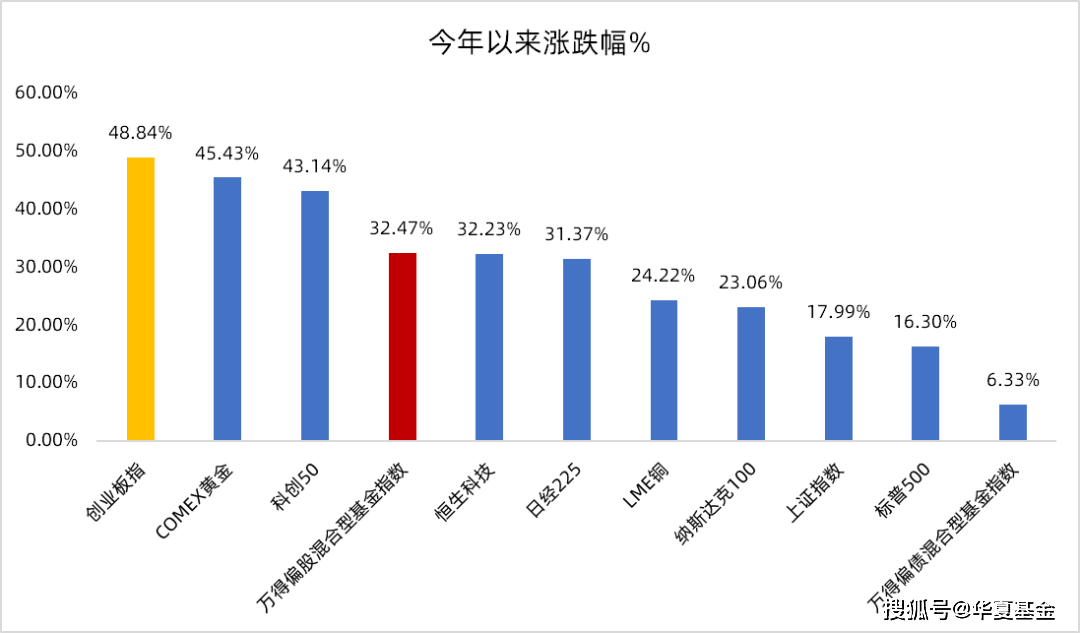
Core Insights - The year 2025 has been marked by significant market movements, with the Shanghai Composite Index reaching a nearly ten-year high, validating earlier bullish predictions [1] - Key themes for 2025 include the impact of Trump's new policies, domestic policy responses, and the challenges of asset allocation in a low-interest-rate environment [1] - The A-share market has seen a surge in investor participation, with nearly 250 million investors, indicating a robust market environment [2] Market Performance - A-shares and Hong Kong stocks have performed well, driven by sectors like AI and innovative pharmaceuticals, with the ChiNext Index outperforming gold [3] - Among 31 primary industries, 30 have reported positive returns, with a stark contrast between the leading materials sector and the declining food and beverage sector, showing an 80% difference [4] - Various fund types have achieved positive returns, with equity and mixed funds averaging 29.97% and 26.17% returns respectively [7] Fund Performance - Commodity funds have seen unprecedented gains, with returns nearing 40%, while QDII funds have also performed well with a 26.46% increase [8] - FOF funds have benefited from diversified asset allocation, achieving an average return of 15.84%, marking one of the best years historically [8] - Bond funds have lagged, with an average return of only 2.13%, although convertible bond funds have performed better, exceeding 20% returns [8] Investment Trends - The concept of "slow bull" has gained traction, with expectations for a sustainable market rally over the next two to three years, supported by technological innovation and policy backing [16] - Investors are increasingly favoring low-volatility products, with a focus on absolute returns and diversified strategies [14] - The market is characterized by alternating sentiments of fear and greed, with a need for disciplined investment approaches amidst volatility [12][19]
券商密集召开2026年策略会!慢牛成关键词 细分行业现分化
Bei Jing Shang Bao· 2025-11-11 14:22
Group 1 - The core viewpoint of the news is that the A-share market is expected to maintain a slow bull trend in 2026, driven by various long-term factors such as capital inflow, technological innovation, institutional reform, and consumption upgrade [2][3][4] - Multiple securities firms have held annual strategy meetings, with a consensus that the A-share market will continue to exhibit a bull market pattern, albeit with some divergence in sector preferences [1][4] - The "New Four Bulls" concept is highlighted, which includes capital inflow, technological innovation, institutional reform, and consumption upgrade as key drivers for the market's long-term growth [2][3] Group 2 - The "capital inflow bull" is supported by macroeconomic conditions that favor the return of funds to A-shares and Hong Kong stocks, with long-term funds gradually increasing their market participation [2] - The "technology innovation bull" reflects China's ongoing advancements in technology and clear strategies for industrial upgrades, indicating a long-term growth trajectory [2] - The "institutional reform bull" is characterized by effective policies from regulatory bodies that enhance investor confidence and shift the market focus from financing to investment [3] - The "consumption upgrade bull" is driven by rising GDP per capita, leading to increased consumer spending and higher quality consumption [3] Group 3 - Analysts suggest that the A-share market's performance should be viewed in the context of global market demand rather than solely domestic factors, indicating a broader perspective on market dynamics [4] - The outlook for 2026 includes a focus on sectors such as technology, energy, consumption, and real estate, with an emphasis on high-quality leading companies in traditional industries [6] - The market is expected to experience some short-term fluctuations, but the overall trend remains positive due to the underlying "New Four Bulls" forces [3][4]



市场震荡蓄势,不断试探4000点:——策略周专题(2025年11月第1期)
EBSCN· 2025-11-09 13:14
Group 1 - The A-share market experienced a general upward trend this week, with the Shanghai Composite Index showing the best performance at a gain of 1.1%, while the Small and Medium-sized Enterprises Board Index had the worst performance with a decline of 0.6% [1][10][12] - The valuation of the Wind All A Index is currently at the 89.2 percentile since 2010, indicating a relatively high valuation level [1][10][16] - The sectors of power equipment, coal, and oil and petrochemicals performed relatively well, with respective gains of 5.0%, 4.5%, and 4.5% [1][12][54] Group 2 - The market style this week leaned towards value, with large-cap value stocks showing a gain of 2.3%, while large-cap growth stocks only gained 0.3% [12][51] - The market is currently in a bull phase, but short-term fluctuations are expected due to influences from overseas markets, including the volatility of the US stock market [3][23][24] - The overall market valuation is at a relatively high level, with the PE-TTM valuation of the Wind All A Index at 22.2 times, which may lead to increased market divergence [23][24][36] Group 3 - Recent economic data shows that China's goods trade maintained a steady growth trend, with a year-on-year increase of 3.6% in the first ten months of 2025 [2][20] - The import and export values for October were 3.7 trillion yuan, with exports decreasing by 0.8% and imports increasing by 1.4% [2][20] - The three major memory manufacturers have suspended DDR5 pricing, which may impact the supply chain [2][21] Group 4 - The report suggests focusing on defensive and consumer sectors in the short term, while continuing to pay attention to TMT and advanced manufacturing sectors in the medium term [34][36] - The TMT sector is expected to become a main line in the mid-term due to liquidity-driven market conditions, while advanced manufacturing may gain attention if the market shifts to a fundamental-driven phase [36][38]

下周A股领涨板块可能大变样?别错过这些重要事件
Mei Ri Jing Ji Xin Wen· 2025-11-09 05:23
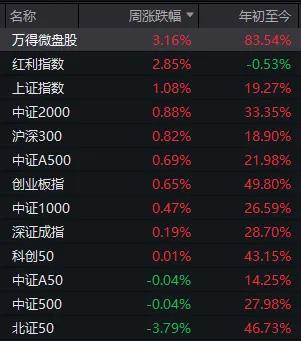
Core Viewpoint - The A-share market experienced a rebound during the week of November 3 to 7, maintaining a high-level fluctuation pattern, with micro-cap and dividend stocks performing notably well while other indices showed mixed results [1][3]. Market Performance - The performance of major indices for the week and year-to-date is as follows: - Wind Micro-Cap Index: Weekly increase of 3.16%, Year-to-date increase of 83.54% - Dividend Index: Weekly increase of 2.85%, Year-to-date decrease of 0.53% - Shanghai Composite Index: Weekly increase of 1.08%, Year-to-date increase of 19.27% - CSI 2000: Weekly increase of 0.88%, Year-to-date increase of 33.35% - CSI 300: Weekly increase of 0.82%, Year-to-date increase of 18.90% - ChiNext Index: Weekly increase of 0.65%, Year-to-date increase of 49.80% - CSI 1000: Weekly increase of 0.47%, Year-to-date increase of 26.59% - Shenzhen Component Index: Weekly increase of 0.19%, Year-to-date increase of 28.70% - Sci-Tech 50: Weekly increase of 0.01%, Year-to-date increase of 43.15% - CSI 50: Weekly decrease of 0.04%, Year-to-date increase of 14.25% - CSI 500: Weekly decrease of 0.04%, Year-to-date increase of 27.98% - North Exchange 50: Weekly decrease of 3.79%, Year-to-date increase of 46.73% [2]. Stock Movement - The number of stocks that rose during the week increased slightly compared to the end of October, but overall, the market remained mixed with both gains and losses [5]. - On November 7, the number of stocks that rose was 2,977, while 2,423 stocks fell, compared to 2,861 rising and 2,523 falling on October 31 [6]. Sector Rotation - The market saw sector rotation due to the narrow fluctuation of indices without significant volume breakthroughs, with recent hot sectors experiencing ups and downs, while long-term low-performing sectors showed signs of recovery [7]. - The leading sectors for the week included power generation, chemicals, and certain regional stocks, while the sectors that declined were primarily those that had performed well in the previous week, such as pharmaceuticals and AI applications [7]. Investment Recommendations - Short-term investment advice suggests a balanced allocation towards sectors with upward policy and industry trends, such as new energy (wind power, energy storage, solid-state batteries), machinery (robots), non-ferrous metals, media (gaming), computing (AI applications), and pharmaceuticals [10]. - Sectors that may benefit from the "14th Five-Year Plan" and potential marginal improvements in fundamentals include consumption (food, retail), military (commercial aerospace), electronics (AI hardware), and communications (computing power) [10]. External Demand Concerns - There is a growing discussion regarding the weakening of external demand, which may lead to increased focus on domestic demand themes in the upcoming week [12]. - In October, China's total import and export value was 3.7 trillion yuan, a slight increase of 0.1%, with exports at 2.17 trillion yuan, down 0.8%, marking the first negative growth in monthly export growth since the second half of this year [12][13]. Upcoming Events - Important upcoming events include the China Robot Industry Development Conference on November 10, the International Summit on Battery New Energy Industry in Suzhou on November 11, and the World Power Battery Conference on November 12, among others [17].
技术强支撑?“W底”形态显现,百亿金融科技ETF(159851)跌逾2%,资金单日狂买1.69亿份
Xin Lang Ji Jin· 2025-11-07 11:38
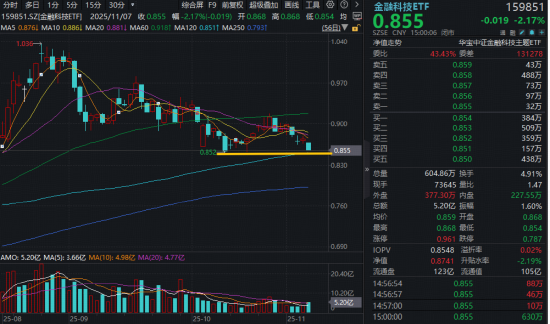
Core Viewpoint - The A-share market experienced fluctuations with all three major indices retreating after initial gains, while the financial technology sector faced significant declines, particularly in financial software and internet brokerage stocks [1][3]. Market Performance - On November 7, A-shares showed a volatile adjustment, with total trading volume reaching 2 trillion yuan. The financial technology theme index fell over 2%, nearing its six-month line, with many constituent stocks in the red [1]. - The financial software sector saw substantial losses, with Shenzhou Information leading the decline at over 8%, while other stocks like Yingshisheng and Runhe Software dropped more than 4% [1]. - Internet brokerages also performed poorly, with stocks like Guiding Compass and Dazhihui falling over 2% [1]. ETF Insights - The Baijia Financial Technology ETF (159851) opened lower and closed down 2.17% at 0.855 yuan, with a total trading volume of 520 million yuan. Despite this, there was a net subscription of 169 million units, indicating continued capital inflow [1][4]. - Technical analysis suggests potential buying points, with significant capital inflow observed. The ETF's price has tested the 0.852 yuan level twice, possibly forming a "W" bottom, with strong support expected at the six-month line [1]. Sector Analysis - Factors suppressing the financial technology sector include overall stagnation in the securities sector, a divergence between strong performance and market conditions, and negative news affecting key stocks like Guiding Compass [3]. - The current market trend is shifting towards traditional cyclical and dividend sectors, impacting the performance of technology growth stocks [3]. Future Outlook - Open Source Securities suggests that the A-share market is in a "slow bull" phase, with continued revaluation of sectors. They recommend focusing on internet brokerages and financial IT as promising areas [3]. - Non-bank financials are expected to benefit from the slow bull market, with potential for profit and valuation increases during the capital market upcycle [3]. Investment Recommendations - It is advised to pay attention to the financial technology ETF (159851) and its linked funds, which cover a wide range of themes including internet brokerages, financial IT, cross-border payments, and AI applications [4]. - The financial IT sector is highlighted for its cost rigidity and significant profit elasticity during bull markets, with certain companies expected to enjoy valuation premiums due to market share growth [5].
金融科技普跌,半年线能否有效支撑?百亿金融科技ETF吸金,机构:“慢牛”持续验证,板块亟待重估
Xin Lang Ji Jin· 2025-11-07 03:07
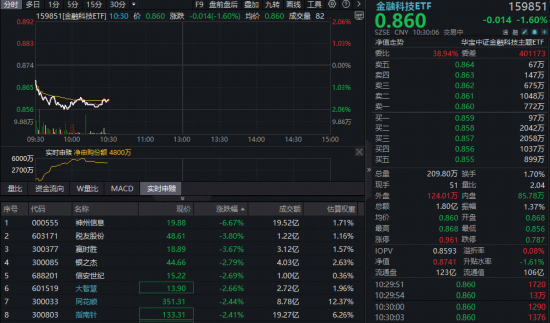
Core Viewpoint - The financial technology sector is experiencing a significant decline, with major stocks and ETFs showing negative performance, particularly in internet brokerage and financial IT companies [1][3]. Group 1: Market Performance - The China Securities Financial Technology Theme Index fell over 2%, approaching its six-month line, with many constituent stocks in the red [1]. - The popular financial technology ETF (159851) opened lower and saw a price drop of over 2%, despite a net subscription of over 40 million units during the day [1][4]. - Notable declines were observed in stocks such as Shenzhou Information, which dropped over 6%, and other stocks like Yingshisheng, Dazhihui, Yinzhijie, Tonghuashun, and Zhinan were down over 2% [1]. Group 2: Sector Analysis - The internet brokerage sector is currently under pressure, with a noticeable divergence between strong performance and market trends [1][5]. - The brokerage sector is expected to see growth in institutional and cross-border business, leading to an anticipated increase in industry concentration [5]. - Financial IT companies are expected to benefit from significant profit elasticity due to reduced cost ratios during a bull market, with some companies likely to enjoy valuation premiums [5]. Group 3: Investment Recommendations - Open Source Securities suggests continuing to focus on internet brokerages and financial IT sectors, as non-bank financials are expected to benefit from the ongoing "slow bull" market [3]. - The financial technology ETF (159851) and its linked funds are recommended for investment, as they cover a wide range of popular themes including internet brokerages and AI applications [4].
盘得越久,越要警惕日线级别回撤的凶险
猛兽派选股· 2025-11-04 16:02
Group 1 - The overall market sentiment has been poor since September, with limited profit opportunities except for a few individual stocks [1] - Retail investors often struggle with recognizing the diminishing profit effects and confuse short-term fluctuations with long-term trends [1] - The performance of different market segments varies significantly, with some experiencing substantial gains while others face corrections [2][3] Group 2 - The transition between leading sectors is often painful, as seen in the shift from the robotics sector to the blockchain computing sector, which experienced significant volatility [3] - Certain stocks have seen over 30 times increases from their cyclical lows, indicating potential bubbles, as such valuations are rare even in bull markets [3] - The concept of a "slow bull market" is misunderstood; it involves periods of stagnation and corrections rather than continuous upward movement [4]

通胀、外贸与房地产视角:在A股转入“慢牛”、房价未显著回升的情景下,长期收益率可能维持震荡
Bank of China Securities· 2025-11-04 09:12
1. Report Industry Investment Rating - Not mentioned in the provided content 2. Core Views of the Report - In the scenario where the A - share market turns into a "slow - bull" and housing prices do not rebound significantly, long - term bond yields are likely to remain in a volatile pattern, and the low - interest - rate state will basically stay the same [5][84][85]. - In the long run, China is probably in the "bear - steepening" phase of the yield curve as it emerges from the low - interest - rate state, but the speed of "bear - steepening" is uncertain. Long - term yields are expected to rise ahead of short - term yields, and short - term yields will tend to be stable before long - term yields continue to rise [5][84]. - The relationship between China's long - term yields and the real estate cycle has strengthened in recent years. The new 500 billion yuan policy - based financial instruments and the newly issued 500 billion yuan local government debt may ensure that the social financing growth rate at the end of this year is roughly similar to that at the end of the third quarter, without a significant increase [5][84]. - The central bank's decision to resume Treasury bond trading reflects its intention to maintain yield stability, and the bond market's volatile pattern may become more obvious. The base - money injection effect of Treasury bond trading may replace reserve requirement ratio cuts [5][84]. 3. Summaries According to Related Catalogs 3.1 Low - Interest - Rate Period: Japan's Experience - The root cause of low interest rates is generally relatively low financing demand, and low interest rates and low asset values (except for fixed - income assets) are often two sides of the same coin. Japan entered a low - interest - rate era after the asset bubble burst in the 1990s [13]. - From 1990 - 1998, Japan's interest rates declined rapidly. The Bank of Japan cut interest rates 9 times from 1991 - 1995, and the 10 - year Japanese government bond yield dropped from about 8% in 1990 to below 1% in September 1998 [13]. - After 1998, Japanese bond yields entered a new low - level range. Japan's economy remained in a low - inflation state until the post - pandemic period when inflation increased, leading to a turning point in its long - term loose monetary policy [13]. - When the main inflation indicators (such as CPI growth) fluctuate around 0, short - term interest rates like the 1 - year Treasury bond yield may hit the bottom. Japan's CPI mainly fluctuated around 0 from the late 1990s to 2021, and the bond market did not react significantly to tax - induced inflation [16]. - During the low - interest - rate period, Japanese residents' risk appetite was low, and their cash and deposit scales grew rapidly. Japanese financial institutions' risk appetite weakened from the late 1990s to the first decade of the 21st century, with bonds replacing loans to some extent. The Japanese stock market rebounded first, but long - term yields did not rise until both housing and stock prices increased recently [19][21]. - Japan's real estate bubble burst in the 1990s, and housing prices remained low. The household leverage ratio stagnated and then declined in 2000, but increased again after 2020, followed by a real - estate market rebound [23][25]. - The relationship between asset prices and long - term interest rates may be based on the "balance - sheet effect." The bursting of the stock and housing bubbles in Japan led to a decline in long - term interest rates, while their subsequent rebounds may have repaired the household balance sheets [25]. 3.2 China's Bond Market and Inflation - China's recent inflation shows CPI remaining flat and PPI declining, similar to Japan's inflation trend since the early 1990s. Core CPI has stabilized, but food prices have offset core inflation, keeping CPI slightly down year - on - year [28][29]. - Food price growth has been restricted due to slow - growing catering consumption, which may be persistent. Short - term attention should be paid to the impact of climate and pests on the supply of edible agricultural products [30][31]. - PPI has been flat month - on - month and stable year - on - year. Since October 2022, it has declined year - on - year for 36 months, which may be affected by real - estate and export prices. Future PPI trends may affect CPI [35][37]. 3.3 China's Bond Market and Foreign Trade Environment - Since the trade friction this year, China's export volume has not been significantly affected. Exports to the US have declined, but those to the EU have increased, and those to Japan have been stable. Exports to ASEAN have offset the decline in exports to the US, EU, and Japan [41]. - The US's import tariff increase since April has negatively affected its foreign trade. The trade deficit as a percentage of GDP decreased from over 6% in Q1 to 3.5% in Q2, which is related to tariffs and the cooling of the US employment market [43]. - The main risk in the US employment market may come from the real - estate market. Production - type employment in the US private non - farm sector has not recovered to the pre - "subprime mortgage crisis" level, and service - type employment is a lagging variable, while production - type employment may be a leading variable [47]. - The US has recently experienced local credit risk exposure, and mortgage delinquency rates have increased. The impact of US credit risk exposure on trade policies and import demand needs to be analyzed in different scenarios [52][59]. - Although China's overall export volume is growing, the export price index declined year - on - year from July to September. Maintaining an appropriate level of exports to the US is significant for domestic inflation [58]. 3.4 China's Bond Market and Real Estate Market - The relationship between China's long - term yields and the real - estate cycle has strengthened in recent years, with household loan growth as the main transmission mechanism. Since 2021, the slowdown in household loan growth has affected long - term yields [61]. - China's household loan - to - GDP ratio has stabilized recently, similar to Japan's situation during the real - estate price trough. The sales area of commercial residential buildings is still bottom - fishing, and it will take time for the real - estate market to fully rebound [63][64]. 3.5 China's Bond Market and Incremental Policy Tools - Infrastructure investment affects long - term yields from the perspective of capital demand. In recent quarters, the sum of infrastructure and real - estate investment has declined [66]. - The newly established 500 billion yuan policy - based financial instruments and the newly issued 500 billion yuan local government debt are expected to ensure that the social financing growth rate at the end of this year is roughly similar to that at the end of the third quarter, without a significant increase [68][73]. 3.6 China's Bond Market and Monetary Policy: Implications of Resuming Treasury Bond Trading - The central bank's decision to resume Treasury bond trading reflects its intention to maintain yield stability. The price - discovery function of Treasury bond trading is more important than its liquidity - adjustment function [75]. - The resumption of Treasury bond trading may provide a channel for base - money injection, which may replace reserve requirement ratio cuts. Different scenarios of base - money injection will lead to different M2 growth rates [78][79]. 3.7 Conclusion and Outlook - Based on Japan's experience, China's short - term bond yields are mainly determined by monetary policy, while long - term yields are related to real - estate cycles. China's inflation is affected by core CPI, food prices, real - estate, and export prices [26][83]. - For long - term yields, three scenarios are possible: A - share turns "slow - bull" but housing prices do not rebound, long - term yields will fluctuate; A - share rises rapidly and housing prices rebound, long - term yields will rise; A - share has a turning point, long - term yields will fall again. The first scenario is the benchmark scenario [84][85].

现在是慢牛吗?一名一级从业者对二级市场的思考
叫小宋 别叫总· 2025-11-04 03:46
Market Characteristics - The secondary market is characterized by a high proportion of retail investors [1] - Investors tend to favor chasing hot stocks rather than relying on rational analysis, leading to price movements that defy conventional investment logic [2] - There is a tendency for investors to inflate stock prices based on future expectations, sometimes projecting valuations three, five, or even ten years ahead [3] Institutional Investment Strategy - There is a lack of primary institutions that adjust their investment strategies based on the characteristics of the secondary market [4] - The experience of investing in multiple companies shows that only a few make it to the secondary market, making it impractical to consider secondary market characteristics for primary market strategies [5] Slow Bull Market Discussion - The concept of a slow bull market raises questions about its duration and implications for primary institutions, particularly regarding the timing of exits for invested companies [6] - There is skepticism about whether primary institutions analyze past bull markets to inform their investment strategies in the primary market [6] Role of Institutional Shareholders - Institutional shareholders are expected to play a significant role in optimizing corporate governance and enhancing the capital market [7] - However, the reality is that institutional investors often celebrate a single successful exit among many investments, indicating limited engagement in governance [8] - There is a perception that institutional investors lack the capacity to significantly influence corporate governance or market improvement [9] Investment Focus and Market Dynamics - The focus of primary market investments may be shifting towards hard technology and AI, with a desire to keep investment funds within the domestic market rather than seeking overseas opportunities [14][17] - The discussion hints at a broader context of market dynamics, suggesting that the positioning of primary market institutions may be influenced by higher-level strategic considerations [17] Reflection on the Investment Industry - The narrative reflects a critical view of the investment industry, suggesting that some professionals may overestimate their status and influence within the broader social hierarchy [21] - The insights presented are based on seven years of experience in the primary market, indicating a level of introspection and acknowledgment of potential limitations in understanding [22]