
科技赋能

Search documents
一杯黄山茶的芬芳
Xin Lang Cai Jing· 2026-01-17 04:22
Group 1 - The core viewpoint of the article highlights the integration of technology and traditional tea production in Huangshan, leading to a significant transformation in the tea industry [1][3][4] - The introduction of the Tai Ping Hou Kui geographical indication protection certification trademark has enhanced consumer trust and transparency in the tea market, allowing customers to trace the product's origin easily [1] - Huangshan's tea industry has embraced digitalization, with the establishment of a blockchain platform and a city-level tea industry management platform, which have collectively issued over 2 million special identifiers [1][2] Group 2 - The innovation in tea production is exemplified by the collaboration between Tunxi Tea Kele Biotechnology Co., Ltd. and Zhejiang University, resulting in the development of probiotic tea tablets that quickly became the top-selling product in its category [2] - Huangshan has emerged as a core supply base for new-style tea drinks, collaborating with over 90% of domestic producers and launching more than 100 new tea products and derivatives [2] - The tea industry in Huangshan is not only a product but also a cultural and tourism driver, with various tea-themed tourism routes and experiences attracting over 50,000 visitors since the opening of the "Qi Yi·Qun Fang Zui" tea tourism complex [3] Group 3 - The comprehensive output value of Huangshan's tea industry is projected to exceed 32.1 billion yuan in 2025, reflecting a year-on-year growth of 13% [3] - All districts in Huangshan have been recognized as key tea-producing counties in the country, indicating a robust development of the tea sector across the region [3]
广西玉州区:以科技赋能设施农业 推动产业迈向高质量发展
Xin Lang Cai Jing· 2026-01-16 13:55
Group 1 - The modern chicken breeding demonstration base in Yuzhou District, Guangxi, showcases a significant shift towards standardized, large-scale, and intelligent agricultural practices, producing over 5 million high-quality Sanhuang chicken chicks annually on an area of more than 160 acres [1] - Yuzhou District is actively exploring a three-dimensional planting and breeding model, promoting a modern production pattern that integrates fruits and vegetables, mushrooms, livestock, and poultry, thereby enhancing the efficiency and intensification of traditional agriculture [1] - The local beef noodle industry park supports the construction of automated rice noodle production lines, achieving a daily output of 50 tons and an annual processing capacity of nearly 20,000 tons, while also improving grain drying, storage, and processing systems [1] Group 2 - The mushroom industry is leveraging technological innovation, introducing smart spraying systems and automated temperature control equipment, which shortens sterilization time by 30% and saves 40% on fuel, with an annual processing capacity of 6,000 tons [2] - The digital transformation in the breeding industry is being driven by the "Internet + modern agriculture" initiative, with smart monitoring devices and digital management platforms enhancing the entire production chain, resulting in an increase in per capita breeding capacity to 8,000 birds and a labor productivity improvement of over 10% [2] - The automation rate in breeding has reached 95%, contributing to a steady increase in egg production rates [2]
临近春节,天润用科技“鲜”行一步!
Xin Lang Cai Jing· 2026-01-16 13:37
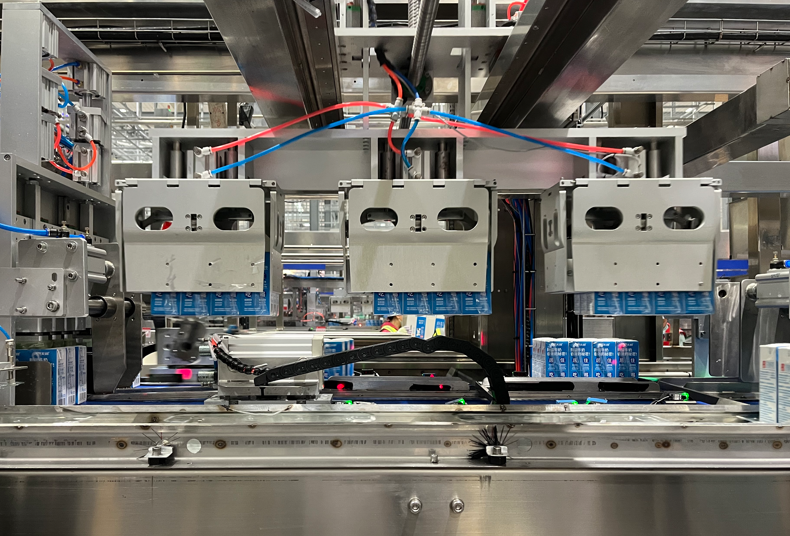
Core Viewpoint - The demand for dairy products is increasing as the Spring Festival consumption peak approaches, and Xinjiang Tianrun Dairy Industry Co., Ltd. is ramping up production to meet this demand [1][11]. Group 1: Production Capacity and Technology - Tianrun Dairy has fully activated its production facilities, utilizing smart filling lines and fully automated palletizing robots to enhance efficiency [3][13]. - The company has transitioned from manual control to intelligent control, significantly improving production efficiency and enabling it to better handle cyclical consumption fluctuations [5][15]. - The daily production capacity has reached 350 tons, with the introduction of intelligent palletizing robots reducing labor intensity for workers [7][17]. Group 2: Quality Control - Tianrun Dairy prioritizes product quality and safety, implementing a comprehensive quality control system that spans from raw milk testing to production monitoring and finished product inspection [9][19]. - The company conducts over 40 strict tests on its products, covering various dimensions such as microbiological, nutritional components, sensory indicators, and packaging integrity [11][21]. - Increased inspection frequency and dedicated quality control personnel during the shipping process ensure that product quality is maintained despite high production demands [9][19].


多部门联动护航市民出行
Zheng Zhou Ri Bao· 2026-01-16 00:47
Group 1 - The Zhengzhou Transportation Bureau held a meeting to ensure taxi service during the 2026 Spring Festival, focusing on key areas like train stations [1] - The meeting emphasized the "improve service, reduce complaints, ensure safety" initiative to enhance service quality and lower complaint rates during the Spring Festival [1] - The transportation industry is facing challenges such as increased passenger flow, regulatory violations, and heightened public sentiment risks during the Spring Festival [2] Group 2 - The industry must take political responsibility for safety, traffic flow, and service quality during the Spring Festival [2] - A cross-departmental coordination mechanism will be established to optimize resource allocation and strengthen supervision in key areas and times [2] - The industry will focus on technology empowerment, credit supervision, and driver education to improve service and manage public sentiment effectively [2]
数十亿大动作频频!快递江湖“换轨”,巨头抢滩新战场
证券时报· 2026-01-15 11:50
岁末年初的物流江湖,正经历一场深刻的资本与产业重构。 顺丰控股与极兔速递83亿港元相互持股开启全球协同新篇章,京东物流推进德邦股份私有化退市 深化"京邦达跨合体 " 整合,叠加顺丰、圆通、京东等龙头企业在低空物流领域的密集布局,中 国快递业正从规模竞争加速迈向以资本协同、科技赋能为核心的价值竞争新阶段。 资本运作密集落地 行业整合迈入深水区 与顺丰的"向外结盟 " 不同,京东物流选择以"向内整合 " 的方式重塑产业格局。1月13日晚间,德 邦股份公告拟主动撤回A股上市申请,成为2026年首家提出主动退市的上市公司。此次退市背 后,是京东物流斥资37.97亿元推进的私有化计划。 从产业逻辑看,德邦退市是京东物流整合进程的关键一步,双方在资本整合基础上,正式迈向业 务与网络深度融合的新阶段。早在2022年京东物流收购德邦股份时,京东物流就提到,未来要打 造综合型寄递物流供应链集团。 德邦股份在公告中提到,此次主动退市的核心原因之一是京东物流此前收购德邦时解决同业竞争 的承诺的履行。京东物流下属境内子公司京东卓风于2022年9月6日出具承诺,自前次要约收购完 成之日起五年内,京东卓风拟通过具有可操作性的方式解决京东 ...




张小泉发预增,预计2025年度归母净利润同比增长91.67%-171.53%
Zhi Tong Cai Jing· 2026-01-15 11:43
Core Viewpoint - Zhang Xiaoqian (301055.SZ) forecasts a net profit attributable to shareholders of 48 million to 68 million yuan for the year 2025, representing a year-on-year growth of 91.67% to 171.53% [1] Group 1: Business Strategy - The company continues to deepen its operational strategy by enhancing product quality and improving production processes [1] - The company leverages technology to optimize overall supply chain efficiency [1] Group 2: Market Approach - The company aims to meet diverse consumer demands by refining market channels and closely engaging with interest e-commerce [1] - The dual approach of strengthening shelf e-commerce and delving into interest e-commerce has contributed to significant performance growth [1] Group 3: Research and Development - The company is committed to consolidating its research and technical capabilities, facilitating the transformation of research outcomes into product applications [1] - Steady progress in production and operations has led to growth in both revenue and net profit [1]
张小泉:2025年全年净利润同比预增91.67%—171.53%
2 1 Shi Ji Jing Ji Bao Dao· 2026-01-15 10:23
Core Viewpoint - Zhang Xiaoqin has released its annual performance forecast, expecting a significant increase in net profit for 2025, indicating strong operational strategies and market engagement [1] Financial Performance - The company anticipates a net profit attributable to shareholders of 48 million to 68 million yuan for 2025, representing a year-on-year increase of 91.67% to 171.53% [1] - The expected net profit after deducting non-recurring gains and losses is projected to be between 46 million and 66 million yuan, with a year-on-year growth of 98.16% to 184.32% [1] Strategic Initiatives - The company is focusing on enhancing product quality and improving production processes while leveraging technology to optimize overall supply chain efficiency [1] - To meet diverse consumer demands, the company is refining its market channels and embracing interest e-commerce, pursuing both "solidifying shelf e-commerce" and "deepening interest e-commerce" strategies to drive performance growth [1] Research and Development - The company is committed to consolidating its research and technological capabilities, ensuring that research outcomes are effectively transformed into product applications, contributing to steady operational success [1]
张小泉:预计2025年净利润同比增长91.67%~171.53%
Xin Lang Cai Jing· 2026-01-15 10:18
Core Viewpoint - The company anticipates a net profit of between 48 million to 68 million yuan for the year 2025, representing a year-on-year growth of 91.67% to 171.53% [1] Group 1: Business Strategy - The company is focused on deepening its operational strategy by enhancing product quality and improving production processes [1] - The company aims to leverage technology to optimize overall supply chain efficiency [1] Group 2: Market Approach - The company is targeting diverse consumer needs by refining market channels and embracing interest-based e-commerce [1] - The company is pursuing two main paths: strengthening traditional e-commerce and delving into interest-based e-commerce to drive performance growth [1] Group 3: Research and Development - The company is committed to accumulating research and technical capabilities, facilitating the conversion of research outcomes into product applications [1] - The company has made steady progress in its operations, achieving growth in both revenue and net profit [1]
《阿凡达3》火热公映!如果纳威人也开车,他们会选哪款江铃大道?| 头条
第一商用车网· 2026-01-15 03:16
Core Viewpoint - The article highlights the connection between the characters from "Avatar 3: Fire and Ash" and the various models of Jiangling Dadao vehicles, emphasizing how each vehicle aligns with the traits and responsibilities of the characters, showcasing their unique capabilities in extreme environments [1][17]. Group 1: Character and Vehicle Alignment - Jake Sully, as the leader of the Na'vi tribe, embodies responsibility and strength, paralleling the Dadao All-Rounder, which is designed for versatility and reliability in various scenarios [3][4]. - Neytiri, the skilled hunter, represents agility and fearlessness, which is mirrored in the Dadao Adventurer, built for hardcore off-road capabilities [6][7]. - Kiri, the spiritual representative of the Na'vi, symbolizes harmony with nature, aligning with the Dadao EV's zero-emission electric drive, promoting environmental consciousness [10]. Group 2: Vehicle Specifications and Features - The Dadao All-Rounder features a Ford 2.3T diesel engine with 177 horsepower and 450 Nm of torque, designed for heavy-duty tasks and rugged terrains, ensuring reliability akin to Jake's role in the tribe [4]. - The Dadao Adventurer is equipped with advanced off-road capabilities, including a BorgWarner four-wheel drive system and high ground clearance, allowing it to navigate extreme environments effortlessly, similar to Neytiri's agility [7]. - The Dadao EV offers a quiet cabin and low energy consumption, designed to minimize environmental impact while providing a serene driving experience, reflecting Kiri's connection to nature [10]. Group 3: Market Positioning and Brand Message - Jiangling Dadao positions its vehicles as not just transportation but as extensions of personal identity, catering to diverse lifestyles and personalities, from leaders to adventurers [17]. - The article emphasizes that true strength lies in being true to oneself and moving forward fearlessly, aligning with the brand's message of reliability and empowerment in the journey of life [17].


端牢“中国饭碗” 多省份“十五五”农业规划路线图出炉
2 1 Shi Ji Jing Ji Bao Dao· 2026-01-14 23:04
Core Viewpoint - The "14th Five-Year Plan" emphasizes strengthening food security and enhancing the supply capacity of important agricultural products, with a focus on technological innovation and land management as key strategies for agricultural development across various provinces [1][2]. Group 1: Food Security and Agricultural Production - Food security is identified as a national priority, with the "14th Five-Year Plan" proposing a new round of actions to increase grain production capacity by 100 billion jin [2]. - Provinces like Heilongjiang aim to achieve a grain output of 1640.1 billion jin by 2025, with a target of 2000 billion jin by 2030 [2]. - Each province has specific goals, such as Jilin focusing on maintaining national food security and Shandong on building a higher-level grain storage system [2]. Group 2: Technological Innovation - Technological innovation is highlighted as a core driver for enhancing agricultural production capacity and quality, addressing critical issues in seed technology and promoting smart machinery and agricultural big data applications [3][4]. - Various provinces are implementing seed industry revitalization actions, with initiatives to establish breeding centers and promote advanced agricultural technologies [4][5]. Group 3: Land Management and Agricultural Infrastructure - High-standard farmland construction is a key focus for ensuring food security during the "14th Five-Year Plan," with multiple provinces outlining specific measures for land protection and quality improvement [6]. - The development of a diversified food supply system is emphasized, with provinces proposing targeted actions to enhance livestock, aquaculture, and specialty agricultural sectors [6]. Group 4: Agricultural Industry Upgrading - The "14th Five-Year Plan" encourages the upgrading of agricultural industries and the development of specialty products, with provinces like Jilin and Henan prioritizing modern agricultural practices and the integration of various agricultural sectors [8][9]. - There is a strong emphasis on extending industrial chains, improving agricultural product processing, and enhancing logistics and storage infrastructure to facilitate market access [9]. Group 5: Regional Differentiation and Consumer Demand - Agricultural development strategies should be tailored to local resource endowments, with a focus on consumer demand to strengthen local specialty industries [7][9]. - The plan advocates for the development of organic food and convenience food industries to meet changing consumer preferences, particularly among younger demographics [7].