
商业航天

Search documents
商业火箭企业IPO新进展
Zhong Guo Zheng Quan Bao· 2026-01-25 01:03
Core Viewpoint - The commercial rocket company Zhongke Aerospace has completed its IPO counseling work, indicating readiness for public listing and highlighting the importance of capital in the commercial space industry [1]. Group 1: Company Developments - Zhongke Aerospace's counseling status has changed from "counseling acceptance" to "counseling work completed" as of January 24 [1]. - The company signed a counseling agreement with Guotai Junan Securities in August 2025, completing two phases of counseling by December 2025 [1]. - Zhongke Aerospace, established in December 2018, focuses on the development of medium to large rockets and has successfully launched its "Lijian" series rockets, with the "Lijian No. 1" rocket completing 11 flights and delivering 84 satellites into orbit by the end of 2025 [1]. Group 2: Industry Trends - The commercial space industry is seeing increased IPO activity, with companies like Xinghe Power, Xingji Glory, and Tianbing Technology updating their IPO counseling progress [2]. - The Shanghai Stock Exchange has provided clear pathways for commercial rocket companies to meet the fifth set of listing standards, emphasizing the importance of successful orbital launches using reusable technology [2]. - 2026 is expected to be a pivotal year for multiple commercial rocket companies, with several new main models set for their first flights or critical tests [3][6]. Group 3: Technological Advancements - Blue Arrow Aerospace's "Zhuque No. 3" reusable rocket successfully completed its first flight by the end of 2025, achieving successful orbital insertion of its second stage [4]. - Xinghe Power's reusable rocket "Zhishen No. 1" plans to conduct recovery tests in 2026, while its "Zhishen No. 2" rocket's main engine has recently completed full system hot testing [4]. - Other companies like Dongfang Space and Tianbing Technology are also advancing their projects, with significant milestones expected in 2026 [5][6].
陆家嘴财经早餐2026年1月25日星期日
Wind万得· 2026-01-24 22:24
Group 1 - The Beijing government has proposed measures to promote the development and utilization of commercial satellite remote sensing data, encouraging capable enterprises to engage in mergers and acquisitions to create globally competitive leading companies [3] - The US stock market experienced a significant outflow of nearly $17 billion amid tariff threats from President Trump regarding Greenland, with India reducing its holdings of US Treasury bonds to $174 billion, a 26% decrease from its peak in 2023 [3] - Nvidia's founder Jensen Huang visited China for the first time in 2026, meeting employees and reviewing major events from 2025, indicating ongoing engagement with the Chinese market [3] Group 2 - In early 2026, the Beijing Stock Exchange saw a surge in new stock listings, with three companies going public and significant interest in specialized enterprises, leading to a record high in frozen funds for new stock subscriptions [6] - The commercial aerospace leader, China Aerospace Science and Industry Corporation, has completed its IPO counseling process, indicating a growing interest in the commercial space sector [6] - Eight banks in the A-share market reported positive net profit growth for 2025, with stable asset expansion and improved non-performing loan ratios, highlighting a resilient banking sector [6] Group 3 - The 2026 Beijing International Commercial Aerospace Exhibition will showcase cutting-edge technologies and solutions in the aerospace sector, reflecting China's advancements in this field [8] - The National Development and Reform Commission has issued guidelines to support the sustainable development of intercity railways, prioritizing key urban areas and restricting unauthorized projects [8] - The China Renewable Energy Society predicts that the new wind power installation capacity in 2026 will reach approximately 120 GW, indicating robust growth in the renewable energy sector [9]






每周股票复盘:经纬恒润(688326)L3级自动驾驶准入推动高阶智驾产品量产
Sou Hu Cai Jing· 2026-01-24 19:01
Core Viewpoint - The company, Jingwei Hirain (688326), has seen a significant increase in stock price and market capitalization, driven by advancements in L3-level autonomous driving and developments in commercial aerospace and low-altitude economy sectors [1][4]. Group 1: L3-Level Autonomous Driving - The approval of L3-level autonomous driving models is expected to drive the production of high-level intelligent driving products, enhancing the value of domain controllers and perception products [4]. - The company has been continuously laying out its products around the requirements for high-level intelligent driving, including domain controllers, perception, sensors, and safety compliance [1][4]. - The contribution to the company's performance from high-level intelligent driving will depend on the progress of customer model approvals, pilot promotion scope, and mass production ramp-up [1]. Group 2: Commercial Aerospace - The subsidiary, Runke General, has made progress in commercial aerospace by providing rocket control system components and establishing cooperative development opportunities for satellite payloads [2][4]. - Runke General leverages its expertise in electronics, radar, communication, control, and electromechanical systems to offer a complete technical system and comprehensive solutions for the entire lifecycle of commercial aerospace [2]. Group 3: Low-Altitude Economy - The company has already established a business layout in the low-altitude economy, expanding its service capabilities from aircraft and automobiles to this emerging sector [2]. - The main advantages in the low-altitude economy include a team with backgrounds in automotive and high-end equipment, facilitating smooth communication and cooperation with long-term clients [2]. - The low-altitude economy business capabilities cover avionics, control, power, and energy systems, supporting the entire R&D process and including electronic product offerings [2].

商业航天接棒AI?白银破百美元!周末突放两大王炸,下周A股剧本提前泄露
Sou Hu Cai Jing· 2026-01-24 17:56
Group 1: Commercial Aerospace Sector - The establishment of the National Space Administration's Commercial Aerospace Department and the release of the "Action Plan for Promoting High-Quality and Safe Development of Commercial Aerospace" signal a strong governmental push for the sector, with specific tasks outlined for 2025 to 2027 [3][4] - Domestic private rocket companies, such as Blue Arrow Aerospace and Galactic Glory, are planning significant technological advancements, including the verification of vertical recovery technology for their rockets by 2026, which could drastically reduce launch costs [4] - The capital market is responding rapidly, with the Shanghai Stock Exchange introducing new regulations to support companies in the commercial rocket sector, and Blue Arrow Aerospace has submitted an IPO application to raise 7.5 billion yuan [4][5] Group 2: Satellite Internet and Industry Chain - The "National Satellite Internet" project in China is expected to require the launch of over 12,000 satellites, creating a vast industrial chain from rocket manufacturing to satellite development and ground equipment construction [5] - The recent surge in stock prices for companies involved in this sector indicates a comprehensive investment strategy targeting the entire industry chain, including both state-owned and private enterprises [5][12] Group 3: Precious Metals Market - The price of silver has historically surpassed $100 per ounce, driven by various factors including resource nationalism and increased demand from central banks, which are accumulating gold reserves [7][9] - The rise in industrial demand for silver, particularly due to the needs of AI data centers and green energy technologies, is expected to sustain long-term demand for the metal [10] - The overall performance of the non-ferrous metals sector has been strong, with a nearly 95% increase in 2025, indicating a potential "super cycle" driven by a combination of monetary attributes, supply constraints, and new technological demands [10][12] Group 4: Market Dynamics and Investment Trends - The A-share market is experiencing a divergence, with large-cap indices like the Shanghai 50 declining while nearly 4,000 stocks are rising, indicating a healthy "slow bull" market driven by growth sectors [12][15] - Investment focus has shifted towards sectors with real policy support and visible order growth, particularly in commercial aerospace and non-ferrous metals, as investors seek to capitalize on these trends [12][14] - The ongoing high trading volume reflects intense competition for capital allocation within these main investment themes, with funds actively rotating into these sectors [15]

商业航天新材料合集|10+篇硬核解析:降本革命与千亿赛道机遇(附多份报告)
材料汇· 2026-01-24 15:44
Core Insights - The article provides a comprehensive overview of the opportunities and investment logic in the commercial aerospace new materials sector, highlighting the critical materials used in aerospace applications and their domestic production progress [3][4]. Material Categories - **Metal Materials**: - Aluminum-lithium alloys (e.g., 2195, 2099) reduce weight by 10-15% compared to traditional aluminum alloys and enhance strength by 20% [3]. - Titanium alloys (e.g., Ti-6Al-4V) are used in engine components and have a density of 4.5g/cm³, withstanding temperatures up to 600°C [3]. - Stainless steel and high-temperature alloys are fully domestically produced, with stainless steel being low-cost and capable of withstanding temperatures up to 1400°C [3]. - **Composite Materials**: - Carbon fiber reinforced polymers (CFRP) are lightweight (1/5 the weight of steel) and have a strength 5-7 times that of steel, with T300-T800 grades fully produced domestically [3]. - Basalt fiber composites offer a cost advantage (1/3 the cost of carbon fiber) while achieving comparable strength [3]. - **Ceramic and Thermal Protection Materials**: - Ceramic matrix composites (CMC) are highlighted for their high-temperature resistance, with applications in rocket nozzles and thermal protection systems [4]. - Various thermal insulation materials are fully domestically produced, enhancing the performance of reusable rockets [4]. Investment Opportunities - The article emphasizes the growing market for ceramic matrix composites (CMC) in aerospace, with significant potential for domestic companies to capture market share as the technology matures [11]. - Investment in companies producing high-temperature alloys and stainless steel is encouraged due to the increasing demand for these materials in the aerospace sector [16]. Cost Analysis and Trends - The cost breakdown of satellite core systems indicates that structural materials like aluminum honeycomb panels are critical, with prices ranging from 1.5-4 million yuan per square meter depending on specifications [8]. - The article notes a trend towards reducing costs in satellite manufacturing through advancements in materials and production techniques, which is essential for the scalability of low Earth orbit satellite deployments [21]. Conclusion - The commercial aerospace sector is poised for growth, driven by advancements in material science and domestic production capabilities, presenting numerous investment opportunities for stakeholders in the industry [3][11][21].

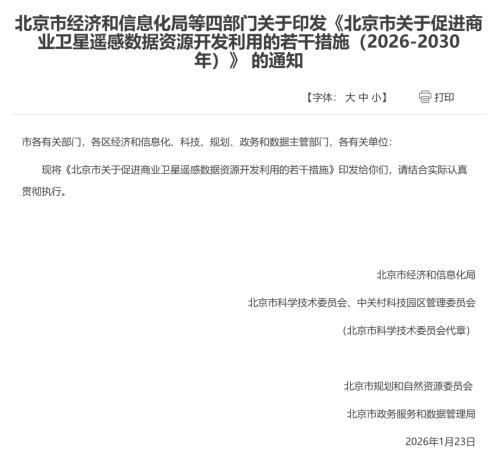
商业航天大消息!北京鼓励对卫星数据上下游企业进行并购重组
Jing Ji Ri Bao· 2026-01-24 14:54
Core Viewpoint - The Beijing Municipal Bureau of Economy and Information Technology has issued measures to promote the development and utilization of commercial satellite remote sensing data resources from 2026 to 2030, aiming to create an innovative service hub for satellite applications and generate new products, services, and business models in the remote sensing data sector [1][6]. Group 1: Strengthening Basic Capability Construction - The measures emphasize the importance of strengthening diverse operational entities and encouraging mergers and acquisitions among satellite data-related companies to create globally competitive leaders in the industry [3][7]. - There is a focus on enhancing space infrastructure and supporting the planning and construction of commercially viable satellite constellations with clear application prospects [7]. Group 2: Enhancing Common Support Capabilities - The initiative supports the construction of multi-source satellite big data platforms to standardize and integrate various types of remote sensing data, improving overall utilization efficiency [4][8]. - Encouragement is given for the development of urban spatial digital bases that integrate various information technologies to create comprehensive urban information models [8]. Group 3: Promoting Technological Innovation - The measures aim to enhance the technological innovation capabilities of remote sensing data resources, encouraging research in key technologies such as agile data acquisition and intelligent interpretation [4][11]. - Funding support will be provided for units undertaking technological research through competitive selection processes [11]. Group 4: Optimizing Development and Utilization Environment - The measures advocate for the assetization of satellite data and the establishment of mechanisms for data sharing and collaboration among government, research institutions, and enterprises [4][12]. - There is a focus on ensuring data security and establishing a robust management system for satellite data [13]. Group 5: Expanding Application Scenarios - The initiative aims to leverage artificial intelligence to enhance the application of remote sensing data in various industries, including urban governance and disaster prevention [4][14]. - Support will be provided for enterprises to create innovative application cases in key sectors, with rewards for solutions that effectively address industry needs [14]. Group 6: Support Measures - The measures emphasize coordination with national policies and encourage financial support for quality projects in the remote sensing data sector [5][15]. - There is a commitment to talent development through industry-education integration and collaboration among various stakeholders to enhance the overall development of the remote sensing data industry [15].
商业火箭企业,IPO新进展
Zhong Guo Zheng Quan Bao· 2026-01-24 13:56
Core Insights - The China Aerospace Science and Technology Corporation (CASC) has completed the IPO counseling process for its commercial rocket enterprise, Zhongke Yuhang, indicating readiness for public listing [1] - Zhongke Yuhang, established in December 2018, focuses on the development of medium to large-scale rockets and has successfully launched its "Lijian" series rockets, achieving significant milestones in satellite deployment [1] - The commercial space industry is experiencing increased competition for IPOs, with several leading companies, including Blue Arrow Aerospace and Star River Dynamics, advancing their listing processes [2] Company Summary - Zhongke Yuhang's IPO counseling was completed with the assistance of Guotai Junan Securities, ensuring compliance with corporate governance and internal control standards [1] - The company emphasizes the importance of capital in the commercial space sector, highlighting the need for a balanced approach between equity and debt financing [1] - As of December 2025, the "Lijian No. 1" rocket has successfully launched 84 satellites, demonstrating its capability for mass production and operational consistency [1] Industry Summary - The commercial space sector is set for a surge in key launches and tests in 2026, with multiple companies preparing for significant milestones [3] - Blue Arrow Aerospace's "Zhuque No. 3" rocket has successfully completed its maiden flight, while Star River Dynamics is set to conduct recovery tests for its reusable rocket [4] - The industry anticipates that increased launch frequency and reusable rocket tests will alleviate the current bottleneck of "many stars but few rockets," improving launch capacity over the next 3-5 years [6]
商业航天利好!北京发布!
券商中国· 2026-01-24 11:09
Core Viewpoint - The article outlines measures to promote the development and utilization of commercial satellite remote sensing data resources in Beijing from 2026 to 2030, aiming to create a highland for satellite application services and foster new products, services, and business models in the remote sensing data sector [2]. Group 1: Strengthening Basic Capabilities - The initiative emphasizes enhancing the foundational capabilities of remote sensing data resources, focusing on market support, technical backing, and resource assurance to improve circulation efficiency and application effectiveness [3]. - It encourages internet and geographic information companies to develop value-added services based on commercial satellite data and to foster integrated business entities that combine satellite data with various industries [3]. - The plan supports the construction of differentiated commercial satellite constellations with clear commercial value and application prospects, integrating new information technologies like cloud computing and AI [4]. Group 2: Common Support Capabilities - The article advocates for the establishment of multi-source satellite big data platforms to integrate various data types and enhance overall utilization efficiency by breaking down data silos [5]. - It encourages the construction of urban spatiotemporal digital foundations, promoting the integration of information technologies to create urban information models and support the development of digital twin city systems [5]. Group 3: Technological Innovation Capabilities - The measures aim to enhance the technological innovation capabilities of remote sensing data resources, encouraging the development of key technologies such as agile data acquisition and intelligent interpretation [7]. - It promotes the establishment of innovation platforms and laboratories focused on remote sensing data, facilitating the integration of research and industry [7]. Group 4: Optimizing Development Environment - The article discusses accelerating the assetization of satellite data, encouraging enterprises to manage data assets effectively and promoting data registration and circulation through platforms like the Beijing International Big Data Exchange [9]. - It emphasizes the importance of data security management and the establishment of a comprehensive data security system to protect satellite data throughout its lifecycle [10]. Group 5: Expanding Application Scenarios - The initiative aims to leverage AI to enhance the application of remote sensing data across various industries, promoting the development of industry-specific models and improving service efficiency in areas like natural resources and disaster management [11]. - It supports the creation of innovative application cases in key industries, encouraging the scaling of remote sensing data applications in sectors such as agriculture, urban governance, and financial services [11]. Group 6: Support Measures - The article highlights the need for coordinated efforts with national policies and major projects to ensure the successful implementation of satellite remote sensing data initiatives [12]. - It calls for financial support and investment in high-quality remote sensing data projects, as well as talent development in satellite data governance [12].
头部拟IPO火箭企业同台
财联社· 2026-01-24 10:38
Core Viewpoint - The 2026 Beijing International Commercial Aerospace Exhibition showcases the latest developments in China's commercial aerospace industry, highlighting a significant increase in investor participation and the focus on liquid reusable rockets as a mainstream path for high-frequency, high-capacity, and low-cost launches [2][4][7]. Group 1: Exhibition Highlights - The exhibition features a wide range of displays, including rockets, satellite manufacturing, space tourism, and supporting services, demonstrating the full industrial chain of China's commercial aerospace [4][6]. - Major companies such as Blue Arrow Aerospace, Star River Dynamics, and China Aerospace Science and Technology Corporation presented their latest technologies, with a particular emphasis on liquid reusable rockets [4][7][9]. Group 2: Technological Innovations - Blue Arrow Aerospace showcased the world's first continuously successful liquid oxygen-methane rocket, the Zhuque-2, and the Zhuque-3, which has completed China's first orbital-level launch verification for a reusable rocket [7][9]. - Star River Dynamics introduced the "Zhishen" series of medium-sized reusable liquid rockets, with the Zhishen-2 having a takeoff mass of approximately 757 tons and a low Earth orbit (LEO) capacity of 20 tons [9][11]. Group 3: Space Tourism Developments - The "Lihong-2" reusable spacecraft from China Aerospace Science and Technology Corporation, designed for space tourism, can carry at least 3 tons of scientific payload or 7 passengers, with a planned reuse of at least 30 times [12][13]. - Beijing Chuanxie Technology Co., Ltd. announced the "Chuanxie-1" commercial manned spacecraft, expected to achieve its first manned flight in 2028, with ticket pre-sales starting at 3 million yuan [12][13]. Group 4: Satellite Manufacturing and Applications - Galaxy Aerospace presented the "Lingxi-03" satellite, China's first satellite using flexible solar wings, which successfully launched in July 2023 and is designed for high-density deployment [14][16]. - The exhibition highlighted advancements in satellite internet technology, with Galaxy Aerospace achieving mobile direct connection capabilities comparable to SpaceX's Starlink [14][16]. Group 5: Industry Ecosystem - The Beijing Economic and Technological Development Area has become a hub for commercial aerospace, hosting over 210 companies and 75% of China's commercial rocket manufacturers, creating a dense industrial ecosystem [19].

商业航天迎利好!北京鼓励对卫星数据上下游企业进行并购重组
Zhong Guo Zheng Quan Bao - Zhong Zheng Wang· 2026-01-24 10:06
Core Viewpoint - Beijing's Economic and Information Technology Bureau has issued measures to promote the development and utilization of commercial satellite remote sensing data resources from 2026 to 2030, aiming to create an innovative service hub for satellite applications and generate new products, services, and business models in the field of remote sensing data [1][3][14]. Group 1: Strengthening Basic Capabilities - The measures emphasize the importance of strengthening diverse operational entities and encouraging mergers and acquisitions among satellite data-related companies to create globally competitive leaders in the industry [4][14]. - There is a focus on enhancing space infrastructure and supporting the planning and construction of commercial satellite constellations with clear commercial value and application prospects [4][18]. Group 2: Enhancing Common Support Capabilities - Support for the construction of multi-source satellite big data platforms is highlighted, aiming to integrate various data types and develop processing algorithms that combine remote sensing big data with artificial intelligence [2][5][19]. - The establishment of a digital foundation for urban spatiotemporal data is encouraged, promoting the integration of various information technologies to create comprehensive urban information models [6][19]. Group 3: Promoting Technological Innovation - The measures advocate for the development of key technologies related to satellite remote sensing data, including agile acquisition, efficient processing, and intelligent interpretation [8][22]. - There is a push for the establishment of innovation platforms and laboratories to foster collaboration between academia and industry, enhancing the development and application of cutting-edge technologies [8][22]. Group 4: Optimizing the Utilization Environment - The measures propose accelerating the assetization of satellite data and promoting its circulation and transaction to foster a healthy market for remote sensing data [9][23]. - Strengthening data security management systems is emphasized to ensure the safe acquisition, storage, transmission, and use of satellite data [10][24]. Group 5: Expanding Application Scenarios - The integration of artificial intelligence in the application of remote sensing data is encouraged, with support for developing large models tailored to specific industries [12][25]. - The measures aim to promote the large-scale application of remote sensing data in key sectors such as agriculture, urban governance, and disaster prevention [12][26]. Group 6: Support Measures - Coordination with national policies and major projects is emphasized to facilitate the implementation of significant satellite remote sensing data projects [13][27]. - Financial support mechanisms are proposed to encourage investment in high-quality remote sensing data projects across various districts [13][27].