生成式AI

Search documents
25岁失业潮来袭?
Hu Xiu· 2025-09-24 07:15
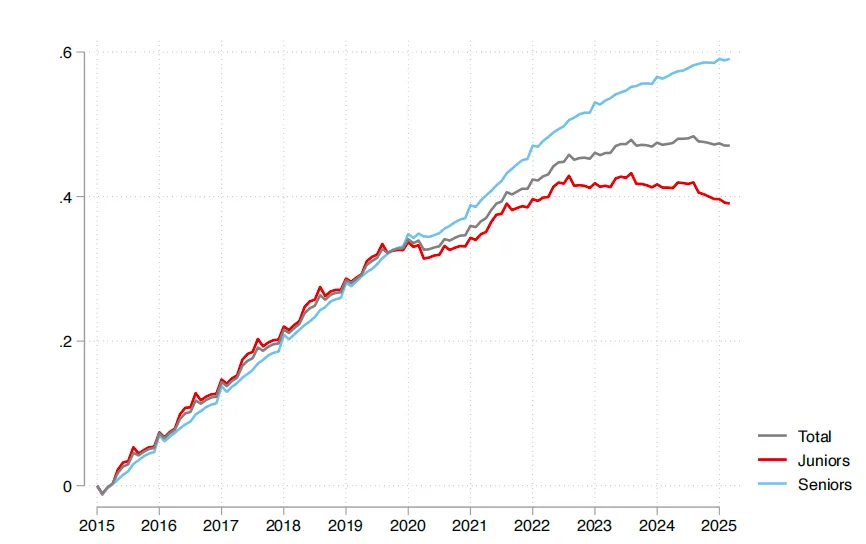
Core Insights - The article discusses the shift in the age of career crises from 35 to 25, influenced by the rise of generative AI technologies [1][2]. Group 1: Impact of Generative AI on Employment - A recent economic research report indicates that generative AI is reshaping the labor market in a "seniority-biased" manner, significantly affecting junior employees more than senior ones [3][4]. - Data from Q1 2023 shows a notable decline in hiring for junior positions in companies that adopted AI compared to those that did not, while senior positions continued to rise [4][7]. - The wholesale and retail trade sectors experienced the most severe impact regarding the reduction of junior roles [7]. Group 2: Job Roles at Risk - Specific job roles that are likely to be adversely affected by AI include customer service, e-commerce content operations, and junior sales support [8][12]. - The implementation of AI in customer service has led to significant efficiency gains, allowing a reduction in workforce from 200 to 50 employees, indicating a trend towards layoffs rather than just hiring slowdowns [9][11]. Group 3: Educational Background and Employment Impact - The research reveals a "U-shaped" impact of AI on employment, where graduates from non-prestigious universities are the most affected, while graduates from top-tier institutions face relatively less impact [15][18]. - Graduates from elite universities typically engage in complex, non-structured work that is less likely to be replaced by AI, thus forming a complementary relationship with the technology [17]. Group 4: The Matthew Effect - The article highlights a growing disparity in capabilities due to AI, where advanced users can leverage AI as a powerful tool, while intermediate users may face challenges in maintaining their competitive edge [21][27]. - The ease of access to AI tools allows novice users to present themselves as intermediate players, leading to a compression of the survival space for true intermediate players [39][40]. Group 5: Future Implications for Job Seekers - The article suggests that the traditional path for junior players to advance through skill accumulation is being disrupted by AI, which can perform many repetitive tasks, making it harder for them to develop genuine skills [40][43]. - Companies may become more stringent in their expectations for new hires, as the reduced trial-and-error opportunities for junior players could lead to a more challenging job market [44][46]. Group 6: Conclusion - The article concludes that AI is fundamentally transforming work and life, leading to a contraction of junior roles and an increase in the value of higher-order thinking skills [47][48]. - The emergence of a new capability pyramid is anticipated, with a small number of experts at the top, followed by a few skilled individuals, many intermediate players, and a large base of unskilled workers [49].

阿里巴巴宣布加大云算力投入,“阿里”含量超16%的港股通科技ETF(159262)半日涨近3%
Xin Lang Cai Jing· 2025-09-24 05:39
Group 1 - Alibaba's stock surged over 7% on September 24, reaching its highest level since October 2021, driven by CEO Wu Yongming's announcement regarding significant investments in AI and cloud computing [1] - Alibaba Cloud's energy consumption is projected to increase tenfold by 2032, indicating a substantial rise in computational power investment [1] - The launch of Qwen3-Max, Alibaba's largest and most capable AI model, has positioned it ahead of competitors like GPT-5-Chat in various benchmarks [1] Group 2 - The Hong Kong internet sector is expected to rebound after a period of negative sentiment, with reasonable valuations and high growth potential in AI technology [2] - The Hong Kong Stock Connect Technology ETF (159262) rose by 2.84%, with significant gains in key stocks such as ASMPT and Hua Hong Semiconductor [2] - Major AI companies like Alibaba, Tencent, and Xiaomi account for nearly 45% of the ETF's weight, highlighting the concentration of technology leaders in the market [2] Group 3 - The Hong Kong Stock Connect Technology ETF saw a significant increase in scale, growing by 518 million yuan over the past week, marking the highest growth among comparable funds [3] - The ETF's latest share count reached 3.885 billion, a record high since its inception, indicating strong investor interest [3] - Continuous net inflows into the ETF over the past 11 days totaled 693 million yuan, with a peak single-day inflow of 325 million yuan [3] Group 4 - The Hong Kong Stock Connect Technology ETF provides exposure to leading technology companies, capitalizing on the opportunities presented by the AI revolution [4]

服务机器人如何“弯道超车”
Jin Rong Shi Bao· 2025-09-24 03:37
Core Insights - The article highlights the advancements in service robots, particularly the XMAN-R1 developed by Qianlang Intelligent, showcasing its capabilities in various environments and tasks [1][2][3] Group 1: Company Innovations - Qianlang Intelligent's XMAN-R1 can replicate standardized restaurant service processes and navigate complex environments with dynamic balance technology, likened to "indoor L4-level autonomous driving" [1] - The company employs a "general + specialized" approach in its robots, enabling them to perform tasks across different scenarios, such as food preparation and hospital logistics [2] - Qianlang's strategy of providing 120% performance at 80% of the price has led to over 50% of its revenue coming from international markets, with robots currently operating in over 600 cities across 60 countries [3] Group 2: Industry Trends - The rise of generative AI is significantly enhancing the intelligence of robots, with "embodied intelligence" becoming a key focus in the tech industry [4] - The commercialization of humanoid robots is seen as a crucial development, although the industry still faces challenges in achieving advanced decision-making capabilities [4] - Collaboration among robot manufacturers is deemed essential for addressing various aspects of the robotics ecosystem, as no single company can cover all technological needs [6]

神州控股旗下科捷发布供应链智能体“小金”
Zheng Quan Ri Bao Wang· 2025-09-24 03:11
Core Insights - The launch of the self-developed supply chain intelligent agent "Xiao Jin" by Digital China Holdings' subsidiary, KJ Supply Chain, aims to enhance efficiency in data querying, intelligent decision-making, and customer service [1][2] - The global generative AI market is projected to reach $10 trillion, indicating a strong demand for intelligent transformation across industries, particularly in supply chains [2] Group 1 - "Xiao Jin" is part of Digital China's ongoing "Data x AI" strategy, leveraging the Yanyun Infinity platform to empower core supply chain business scenarios [1] - The intelligent agent has shown significant improvements in order completion rates, warehouse management efficiency, and a reduction in customer complaints during its deployment at KJ's flagship warehouse in Kunshan [2] - The core issue with general large models is their disconnect from actual business needs, which "Xiao Jin" aims to address by integrating industry-specific knowledge and real-time business data [1][2] Group 2 - The development of "Xiao Jin" is based on over 20 years of operational experience and technical reserves, enabling it to understand logistics data and industry pain points effectively [2] - The future competition in the AI space will focus on the ability to industrialize applications that solve real business problems, rather than just the capabilities of large models [2] - KJ Supply Chain plans to collaborate with logistics companies, e-commerce platforms, and manufacturers to expand the ecosystem of supply chain intelligent agents, leading to a new era of "full-link intelligent collaboration" in the supply chain industry [3]

企业培训| 未可知 x 国家能源集团: 人工智能+能源的创新趋势与应用
未可知人工智能研究院· 2025-09-24 03:02
近日,未可知人工智能研究院院长杜雨博士应邀为 国家能源集团 开展主题为 "AI赋能能源行业智能化转型:创新趋势与实践应用" 的企业内训。此次培 训聚焦人工智能在能源行业的最新发展趋势、核心技术突破及落地应用场景,吸引了集团各业务板块的管理与技术骨干参与。 培训中,杜雨博士结合 国家电网、南方电网、华为云、施耐德电气 等国内外典型案例,深入剖析了AI在智能巡检、功率预测、客服系统、能源管理等场 景中的成熟应用。他特别提到,由未可知人工智能研究院持续关注的国产大模型代表——DeepSeek,正以其高效低成本的训练优势,加速AI在能源等垂 直行业的落地进程。 杜雨博士从宏观、中观、微观三个维度系统讲解了AI如何重塑能源产业格局。他指出,当前全球AI产业正处于快速发展期,生成式AI作为新一轮技术革 命的核心引擎,正深刻改变传统行业的生产方式与服务模式。 尤其在能源领域,AI不仅在资源勘查、发电调度、电网运维等环节实现降本增效,更在推 动"双碳"目标落地、构建新型电力系统中发挥关键作用。 " AI不是未来的技术,而是当下的生产力。 "杜雨博士强调,能源企业应积极拥抱AI技术,从顶层设计到业务场景逐步推进智能化转型,构建 ...

生成式AI驱动“边缘演进” 超八成 CIO寻求边缘云服务
Zhong Guo Jing Ying Bao· 2025-09-23 18:44
Group 1 - The core viewpoint of the articles emphasizes that traditional centralized cloud services are inadequate for the low-latency, high-concurrency, and cost-effective computing demands of generative AI, leading to a shift towards edge computing as a solution [1][2][3] - A recent study by Akamai and IDC indicates that 31% of surveyed organizations in the Asia-Pacific region have deployed generative AI in production, while 64% are in testing or pilot phases [2][3] - The existing cloud architecture reveals significant deficiencies, particularly in handling massive intelligent computing demands, resulting in latency issues and bottlenecks [3][4] Group 2 - Companies face challenges in managing multi-cloud environments due to inconsistent tools, fragmented data management, and the need for seamless data transfer across platforms, especially in cross-border scenarios [4][5] - The report highlights that many enterprises are constrained by legacy infrastructure that cannot adapt quickly to the explosive demands of generative AI applications [4][5] - The edge computing market is experiencing significant growth, with organizations recognizing the need to integrate edge services into their infrastructure strategies to remain competitive and compliant [5][6] Group 3 - Edge computing is defined as an open platform that integrates network, computing, storage, and application capabilities close to data sources, addressing key needs in digital transformation [6][7] - The architecture of edge services allows for distributed computing, reducing latency and enhancing service stability by processing data closer to users [7][8] - Predictions indicate that by 2028, the annual compound growth rate (CAGR) for public cloud services at the edge will reach 17%, with total spending expected to hit $29 billion [7][8]

加速量子材料发现:AI助力合成具奇异磁性行为的化合物
Ke Ji Ri Bao· 2025-09-23 08:52
Core Insights - A joint research team led by MIT has developed a new AI technology to accelerate the discovery of quantum materials, generating over 10 million candidates with Archimedean lattice characteristics [1][2] - The SCIGEN computational framework ensures that generative AI models adhere to user-defined geometric rules, addressing the limitations faced by existing models in identifying materials with exotic quantum properties [1][2] Group 1: Technology Development - The SCIGEN framework was integrated into a popular material generation model, targeting materials with Archimedean lattice structures, which are significant for inducing various quantum phenomena [1] - The method allows for the simulation of rare earth element electronic behaviors without relying on scarce resources, highlighting its potential applications [1] Group 2: Research Outcomes - The model generated over 10 million candidates, with approximately 1 million passing initial stability screening, and 26,000 selected for high-precision simulations at Oak Ridge National Laboratory [2] - 41% of the analyzed structures exhibited magnetic characteristics, indicating their value for further experimental exploration [2] - The research team successfully synthesized two previously undiscovered compounds, TiPdBi and TiPbSb, with their actual performance aligning closely with AI predictions, validating the method's feasibility and accuracy [2] Group 3: Implications for Research - This approach provides experimental scientists with hundreds of new candidates, significantly accelerating research progress and opening doors to numerous cutting-edge materials [2]
中集集团首发《科技创新白皮书》 确立高端化、数智化、绿色化转型升级战略
Zheng Quan Shi Bao Wang· 2025-09-23 07:36
Core Insights - CIMC Group has launched its "Technology Innovation White Paper," establishing "high-end, digital, and green" as the core strategies for transformation and upgrade, with over 30 new business initiatives contributing to revenue exceeding 100 billion yuan [1] - The year 2025 is identified as a critical year for the implementation of CIMC's new five-year strategic plan and the acceleration of new productive forces [1] - CIMC aims to enhance its global influence in high-end equipment sectors through technological innovation and product upgrades, alongside increased R&D investment and international cooperation [1] High-End Transformation - CIMC's subsidiary, CIMC Raffles, constructed the "Blue Whale No. 1" semi-submersible drilling platform, aiding China's first successful trial extraction of combustible ice [2] - The company has developed the latest generation of deep-sea integrated large wind power installation vessel "Boqiang 3060" and has undertaken the EPC general contracting project for the first FPSO upper core module, breaking foreign market monopolies [2] - CIMC Qinglong has independently developed the first RAP active temperature-controlled air cargo box in China, ensuring precise temperature control for pharmaceutical transport [2] Digital Transformation - Since 2018, CIMC has initiated a comprehensive digital transformation, integrating industrial internet, AI, and 5G technologies [2] - The company has established a national-level intelligent manufacturing demonstration factory and multiple intelligent factories, achieving a leap from Industry 3.0 to 4.0 [2][3] - CIMC has implemented AI solutions across various business scenarios, significantly reducing response times for maintenance issues [3] Green Development - CIMC Anruike is constructing South China's first bio-green methanol demonstration plant, expected to produce 50,000 tons per year, with a future total capacity of 250,000 tons [4] - The collaboration with Ansteel on a coke oven gas hydrogen production project aims to produce 15,000 tons of hydrogen and 100,000 tons of LNG annually, reducing carbon emissions by 470,000 tons [4] - CIMC is actively involved in clean energy sectors, including hydrogen, offshore wind power, and energy storage, contributing to national low-carbon initiatives [4] Innovation Ecosystem - CIMC has established a unique "small team operations, large platform support" innovation system, with an annual R&D investment growth rate of 18.2% since 2018 [5] - The company collaborates with top universities and research institutions to create joint R&D platforms, achieving breakthroughs in several core technologies [5] - CIMC has set up 20 overseas R&D centers, building a global innovation network [5]

神州控股旗下科捷推出供应链智能体“小金”
Bei Jing Shang Bao· 2025-09-23 07:13
Group 1 - The intelligent agent "Xiao Jin" launched by Shenzhou Holdings' KJ aims to enhance supply chain efficiency through natural language interaction, automated report generation, and 24/7 online service [3] - The intelligent agent has completed a pilot in the flagship warehouse in Kunshan, resulting in improved order punctuality and reduced customer complaints [3] - The global generative AI market is projected to reach $10 trillion by 2025, driven by the urgent demand for intelligent transformation across various industries, particularly in the supply chain sector [1] Group 2 - The "3+N" architecture of the intelligent agent includes three general agents that cover 80% of query scenarios, improving daily data retrieval efficiency by 90% [1] - The N-specific agents target roles such as product design and operational analysis, compressing processes like demand breakdown, data collection, and document writing by over 50% [1] - Despite the market potential, the transition from "technical prototype to industrial application" remains a common challenge across industries [1]
18个月养成百亿独角兽
投中网· 2025-09-23 07:05
Core Viewpoint - Sierra, an AI customer service company, has rapidly achieved a valuation of $10 billion within 18 months, with $635 million in cash and an annual recurring revenue nearing $100 million, highlighting its exceptional growth in the AI sector [4][12]. Group 1: Company Overview - Sierra was co-founded by Bret Taylor, former co-CEO of Salesforce, and Clay Bavor, a former Google executive, focusing on using generative AI to enhance customer experience for enterprises [5][10]. - The company has successfully attracted significant investment, including a $350 million round led by Greenoaks Capital, solidifying its position in the "unicorn" club [5][13]. Group 2: Market Dynamics - The demand for AI customer service solutions is driven by the high costs and turnover associated with human customer service roles, particularly in the U.S. market [5][6]. - Voice AI is becoming a critical component of AI applications, with predictions indicating it will be a primary interaction method for consumers engaging with AI [6][28]. Group 3: Business Model and Strategy - Sierra targets medium to large enterprises, which have higher revenue potential and more complex customer interactions, making them more likely to adopt AI solutions [15][16]. - The company employs an outcome-based pricing model, where clients pay for successful resolutions rather than usage, aligning Sierra's incentives with customer satisfaction [26]. Group 4: Technology and Implementation - Sierra does not develop its own large language model but integrates various existing models, allowing flexibility for enterprises to choose based on their needs [20]. - The company has established a robust framework for AI development, including a lifecycle management process that ensures stability and maintainability of AI agents [24][26]. Group 5: Client Success Stories - Notable clients include Casper and Brex, with Casper reporting a 20% increase in customer satisfaction after implementing Sierra's AI solution, which handled 74% of customer inquiries during peak periods [17][18]. Group 6: Industry Outlook - The AI customer service industry is projected to continue expanding rapidly, with increasing reliance on self-service channels by consumers and a growing need for efficient, intelligent customer relationship management [28][30].