卫星互联网

Search documents
积极看涨!今日市场情绪指数来了
第一财经· 2025-08-28 10:32
Core Viewpoint - The market is experiencing a structural recovery driven by technology stocks, with significant divergence in sector performance, particularly between hard technology and defensive sectors [4][5]. Market Performance - The Shanghai Composite Index closed at 3843.60, showing a strong rebound in the afternoon, primarily led by technology stocks [10]. - A total of 2867 stocks rose, indicating a broad market recovery, while defensive sectors like agriculture, pharmaceuticals, and energy faced declines [4]. Trading Volume - The trading volume in both markets has decreased but remains at a high level, reflecting ongoing investor interest in growth sectors despite some profit-taking in high-positioned technology stocks [5]. Fund Flow - Institutional investors are reallocating funds towards technology leaders, particularly in semiconductors and communication equipment, while withdrawing from defensive sectors [7]. - Retail investors are following suit, with funds flowing into micro-cap stocks and defensive sectors [7]. Investor Sentiment - The sentiment among retail investors shows a mixed approach, with 31.32% increasing their positions, 21.27% reducing, and 47.41% maintaining their current positions [12]. - The overall market sentiment indicates a preference for growth-oriented investments, particularly in AI and semiconductor sectors [5][7].


ETF复盘0828-上证综指V型大反转,半导体ETF(159813)收涨超8%
Xin Lang Cai Jing· 2025-08-28 09:38
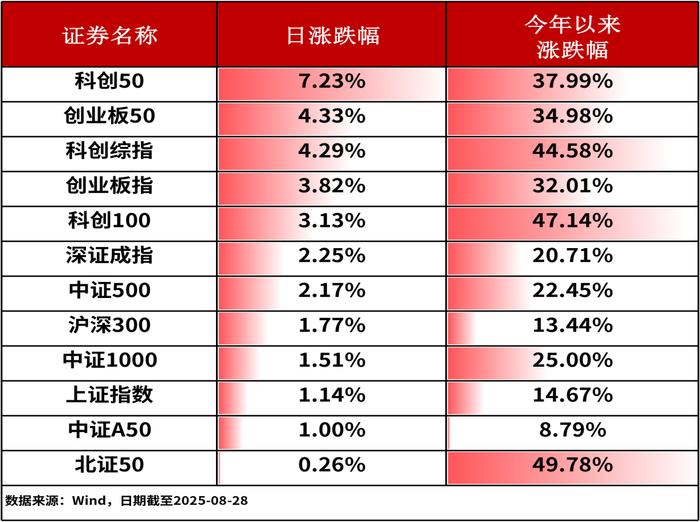
Market Overview - On August 28, A-shares saw all three major indices rise, with the Shanghai Composite Index up by 1.14%, the Shenzhen Component Index up by 2.25%, and the ChiNext Index up by 3.82% [1] - The total market turnover in the Shanghai and Shenzhen stock exchanges was 29,708 billion RMB, showing a significant decrease compared to the previous trading day [2] Index Performance - The STAR 50 Index increased by 7.23% and has risen 37.99% year-to-date [2] - The ChiNext 50 Index rose by 4.33% with a year-to-date increase of 34.98% [2] - The STAR Comprehensive Index increased by 4.29% and has a year-to-date rise of 44.58% [2] - The Shenzhen Component Index rose by 2.25% with a year-to-date increase of 20.71% [2] - The CSI 500 Index increased by 2.17% and has risen 22.45% year-to-date [2] - The Shanghai Composite Index rose by 1.14% with a year-to-date increase of 14.67% [2] Hong Kong Market - On August 28, Hong Kong's main indices showed mixed results, with the Hang Seng China Enterprises Index rising by 1.35% [4] - The Hang Seng Index decreased by 0.81% year-to-date, while the Hang Seng Technology Index fell by 0.94% [5] Sector Performance - In the A-share market, the telecommunications sector led with a rise of 7.14%, followed by electronics at 5.53%, and defense and military at 2.29% [5] - Conversely, the coal sector fell by 0.81%, agriculture, forestry, animal husbandry, and fishery by 0.73%, and textiles and apparel by 0.47% [5] Semiconductor Sector - The semiconductor ETF (159813) rose by 8.11%, driven by multiple positive developments in chip stocks [5] - DeepSeek launched a new AI model optimized for domestic chips, priced lower than OpenAI, and Cambrian's mid-year report showed a revenue increase of over 43 times, marking its first half-year profit since its 2020 IPO [5][6] - Domestic GPGPU manufacturers are gradually closing the gap with Nvidia and AMD, with companies like Cambrian making significant advancements [6][8] Telecommunications Sector - Recent news indicates that China will officially issue satellite internet business licenses to major telecom operators, marking the commercial launch of the satellite internet industry [8] - Analysts suggest that telecom operators will benefit significantly from the growth of intelligent computing services driven by AI [8]
8月28日主题复盘 | 指数“v型反转”,国产芯片、算力热度空前,卫星互联网也有资金关注
Xuan Gu Bao· 2025-08-28 09:00
Market Overview - The market experienced a V-shaped rebound in the afternoon, with the Shanghai Composite Index rising over 1%, the ChiNext Index increasing over 3%, and the STAR Market Index soaring over 7% [1] - Chip stocks collectively surged, with SMIC rising over 17% to reach a new high, and Cambrian Technology increasing over 15%, surpassing Kweichow Moutai to become the new king of A-shares [1][3] - The trading volume reached 3 trillion yuan, with over 2800 stocks in the Shanghai and Shenzhen markets showing gains [1] Key Highlights Domestic Chips - The domestic chip sector saw significant gains, with stocks like Wantong Development, Tianpu Co., Broadcom Integration, and others hitting the daily limit [3] - Cambrian Technology's market capitalization exceeded 600 billion yuan, while SMIC's stock price rose over 17%, marking a historical high [3] - The catalyst for this surge was the announcement by GF Fund on August 27 to lift the purchase limit for its technology ETF, aimed at better meeting investor demand [3] Optical Communication - The optical communication sector continued to rise, with Longfly Fiber and other leading companies reaching new highs [6] - Nvidia reported a significant increase in its networking business, with annual revenue around $29 billion, reflecting a 50% quarter-over-quarter growth and a 100% year-over-year increase [6] - Nvidia's CFO projected that AI infrastructure spending could reach $3 to $4 trillion by 2030, indicating strong growth potential in the sector [6] Satellite Internet - The satellite internet sector also saw continued growth, with companies like Sanwei Communication and Xingwang Yuda hitting the daily limit [9] - The Ministry of Industry and Information Technology issued guidelines to support telecom operators in exploring satellite communication applications, promoting direct connections between mobile devices and satellites [9][11] - The satellite internet market in China is expected to grow from 29.3 billion yuan in 2021 to 44.7 billion yuan by 2025, with a compound annual growth rate of 11.2% [11] Performance of Key Stocks - Notable stock performances included: - Wantong Development: 15 days of gains, closing at 13.52 yuan, up 10.01% [5] - Tianpu Co.: 5 days of gains, closing at 42.90 yuan, up 10.00% [5] - SMIC: Closing at 119.22 yuan, up 17.45%, with a market cap of 2370.52 billion yuan [5] - Longfly Fiber: Closing at 82.95 yuan, up 10.00% [7] - Sanwei Communication: Closing at 9.52 yuan, up 10.06% [10]



A股收评:三大指数尾盘拉升,创业板指涨近4%,科创50涨超7%,CPO概念走高,寒武纪涨15%逼近1600元登顶A股新股王!超2800股上涨,成交3万亿缩量1969亿
Ge Long Hui· 2025-08-28 08:27
Market Overview - A-shares experienced slight fluctuations in the morning session, followed by a rally in the afternoon, with the Shanghai Composite Index closing up 1.14% at 3843 points, the Shenzhen Component Index up 2.25%, and the ChiNext Index up 3.82% [1][2] - The total trading volume for the day reached 3 trillion yuan, a decrease of 196.9 billion yuan compared to the previous trading day, with over 2800 stocks rising across the market [1] Index Performance - Shanghai Composite Index: 3843.60, +43.25 (+1.14%) [2] - Shenzhen Component Index: 12571.37, +276.30 (+2.25%) [2] - ChiNext Index: 2827.17, +92.05 (+7.23%) [2] - STAR Market 50 Index: 1364.60, +95.74 (+1.58%) [2] - CSI 300 Index: 4463.78, +77.66 (+1.77%) [2] - CSI 500 Index: 7011.16, +148.60 (+2.17%) [2] Sector Performance - The CPO concept stocks surged, with Tianfu Communication and Woge Optoelectronics hitting the daily limit [3] - The copper cable high-speed connection sector rose, with Yidong Electronics reaching a 20% limit up [3] - F5G and 6G concepts saw significant gains, with Tefa Information hitting the daily limit [3] - The satellite internet sector was active, with Wantong Development and Xingwang Yuda also hitting the daily limit [3] - Semiconductor and chip sectors performed well, with SMIC rising over 17% and Cambrian Technology up over 15% [3] - The transgenic sector declined, with Top Cloud Agriculture falling over 7% [3] - The Alzheimer's sector weakened, led by Kangyuan Pharmaceutical [3] - The automotive services, grain concepts, and real estate services sectors experienced notable declines [3]
2025年中国商业航天行业发展研究报告-甲子光年
Sou Hu Cai Jing· 2025-08-28 08:18
Industry Background - The commercial space industry focuses on market-driven resource allocation and profit generation, distinguishing itself from traditional government-led space activities [7][19] - The global space industry has evolved through three phases: government-led (1950s-1980s), commercialization initiation (1980s-1990s), and the "new space" breakthrough phase (2000s-present), with SpaceX leading the way through reusable rocket technology [1][12] - China began its commercial space development later, accelerating after policy changes in 2014, with significant advancements in satellite internet recognized as a "new infrastructure" by 2020 [1][19] Current Industry Status - The industry exhibits three main characteristics: 1. Collaborative breakthroughs across the supply chain, with a closed loop formed from upstream materials to downstream applications, leading to a global space economy of $415 billion in 2024, with commercial space accounting for 71% [2][36] 2. Focus on core technology advancements, including reusable rockets and low-orbit satellite constellations, with significant projects like the Chinese Starlink GW constellation planning 12,900 satellites [2][3] 3. Active capital investment, with domestic financing exceeding 2.9 billion yuan in 2024, focusing on rocket development and satellite components [2][28] Representative Companies - Blue Star Space focuses on laser communication, achieving a 100% success rate in on-orbit chain construction and establishing China's first mass production base for laser terminals [2] - Geospace Aerospace specializes in intelligent satellite manufacturing, producing 300 satellites annually from its digital factory [2] - Blue Arrow Aerospace has made breakthroughs in liquid oxygen-methane rocket technology, successfully completing vertical takeoff and landing tests [2] Future Trends and Challenges - The future points towards integrated space, air, land, and sea systems (6G vision) and space-based computing to address ground computing bottlenecks, but challenges include space debris management, low approval efficiency, long capital return cycles, and international competition [3][19] - Recommendations include developing space robots, establishing debris removal funds, and promoting international space treaty revisions to help China transition from "catching up" to "keeping pace" in commercial space [3][22] Policy and Market Dynamics - National policies have progressively recognized the strategic value of commercial space, evolving from "encouraging participation" to "building new growth engines" [22][23] - Major cities in China are actively developing commercial space industries, forming regional clusters through policy support and resource integration [24][26] - The market is driven by diverse capital investments, with private capital playing a crucial role in the commercial space sector's growth [27][29]

中国卫通上半年实现营业收入12.21亿元
Zheng Quan Ri Bao Wang· 2025-08-28 07:48
Core Insights - China Satcom Group Co., Ltd. reported a revenue of 1.22 billion yuan and a net profit attributable to shareholders of 181 million yuan for the first half of 2025 [1] - As of June 30, 2025, the total assets of China Satcom amounted to 22.81 billion yuan, with net assets of 15.75 billion yuan and a debt-to-asset ratio of 12.13% [1] Group 1 - The company focused on consolidating satellite resource operation services while participating in broadcasting satellite projects and enhancing 4K/8K ultra-high-definition program services [1] - China Satcom provided stable and reliable satellite transmission services to telecom operators, governments, and enterprises in Southeast Asia, South Asia, the Middle East, and Africa [1] - The company emphasized scenario-driven innovation and deepened its research and analysis of market trends, user needs, and technological developments [1][2] Group 2 - China Satcom advanced its comprehensive information services by enhancing its core competitiveness in "network, platform, and terminal" [2] - The company accelerated the application of high-throughput satellites such as Zhongxing 26, Zhongxing 19, and Zhongxing 6E, and improved the capabilities of the "Haixing Tong" platform [2] - China Satcom collaborated with international network operators to promote the deployment of airborne satellite internet covering major global shipping routes [2]

A股收盘|科创50涨7.23% 寒武纪登顶A股新股王
Di Yi Cai Jing· 2025-08-28 07:27
Group 1 - Major stock indices collectively rose today, with the Shanghai Composite Index increasing by 1.14%, the Shenzhen Component Index by 2.25%, and the ChiNext Index by 3.82% [1] - The STAR Market 50 Index surged by 7.23%, indicating strong performance in the technology sector [1] - Major technology stocks experienced significant gains, with SMIC and Cambrian both rising over 15% [1] Group 2 - AI hardware sectors, including CPO, fiberglass, circuit boards, and liquid cooling, showed strong performance across the board [1] - Semiconductor and satellite internet concepts performed notably well, reflecting investor interest in these areas [1] - Traditional defensive sectors such as agriculture, coal, and electricity saw widespread declines [1]
卫星互联网牌照发放在即,谁将引领中国“太空互联网”新篇章?
Sou Hu Cai Jing· 2025-08-28 06:06
Core Insights - The issuance of satellite internet licenses marks a significant step towards the commercialization and standardization of satellite communication services in China [1][2][3] - The licenses will allow companies to legally provide satellite internet services, securing access to scarce spectrum and orbital resources, similar to mobile communication operator licenses [1][2] Industry Overview - The satellite internet license falls under the A13 category of the Basic Telecommunications Business Operating License, covering both satellite mobile and fixed communication services [1] - The high entry barriers for obtaining the license include a minimum state-owned share of 51% and a registered capital requirement between 100 million to 1 billion RMB [1] Competitive Landscape - Major candidates for the first batch of license holders include China Telecom, China Mobile, China Unicom, China Star Network, and Shanghai Yuanxin [2] - China Telecom operates the Tian Tong satellite system, while China Mobile is exploring 5G integration with its low-orbit satellite [2] Strategic Implications - The license issuance is seen as a strategic move to enhance China's position in the global space resource competition, especially against established players like SpaceX [2][3] - The initiative aims to transition satellite internet from a defense and research focus to a more general public service [3] Technological Development - The GW constellation, led by China Star Network, has successfully launched multiple satellites, increasing launch frequency significantly [3][5] - However, there remains a technological gap compared to SpaceX's Starlink, particularly in satellite capacity and core technologies [3][5] Future Outlook - The GW constellation plans to deploy 12,992 satellites by 2029, with a 10% deployment target to secure spectrum resources [5] - The development of a rich application ecosystem based on satellite internet services is crucial for creating value in the market [5]
普天科技(002544):2025 年半年报点评:卫星互联网“国家队”布局空天计算,长期成长机遇可期
Minsheng Securities· 2025-08-28 05:58
Investment Rating - The investment rating for the company is "Recommended" [6] Core Views - The company is positioned as a leader in the satellite internet sector and is part of the "national team" focused on advancing satellite communication technology. It aims to develop a comprehensive technology system integrating air and space, with significant growth potential in emerging industries such as AI computing and low-altitude economy [4][6] - The company reported a revenue of 2.024 billion yuan for the first half of 2025, a year-on-year decrease of 16.96%, and a net profit attributable to shareholders of -21 million yuan, compared to a profit of 39 million yuan in the same period last year [1][2] Summary by Sections Financial Performance - The company experienced a significant decline in revenue across its main business segments: public network communication down 9.04%, private network communication down 27.16%, and smart manufacturing down 11.32%. The overall gross margin decreased to 14.14%, down 3.45 percentage points year-on-year, with the smart manufacturing segment's gross margin dropping by 6.48 percentage points due to rising precious metal prices [2] - Despite the profit pressure, the net cash flow from operating activities improved significantly compared to the previous year, indicating better cash flow management [2] Business Strategy - The company is actively pursuing strategic emerging industries, particularly in the field of space computing. It has successfully launched China's first fully interconnected space computing satellite constellation, marking a significant milestone in its growth strategy [3] - A strategic cooperation agreement was signed with Helium Star Light Technology Co., Ltd. and Beijing Yixin Technology Co., Ltd. to establish a joint R&D center focused on building a space computing constellation and developing high-speed data transmission technologies [3] Financial Forecast - The projected net profit attributable to shareholders for 2025-2027 is estimated at 108 million, 145 million, and 201 million yuan, respectively, with corresponding PE ratios of 161X, 120X, and 87X [4][5] - The expected revenue growth rates for the years 2025 to 2027 are 10.5%, 10.7%, and 10.9%, respectively, indicating a recovery trend after the current downturn [5][10]

新经济增长点!卫星互联网深度融入生产生活 成发展新质生产力重要引擎
Yang Shi Wang· 2025-08-28 05:23
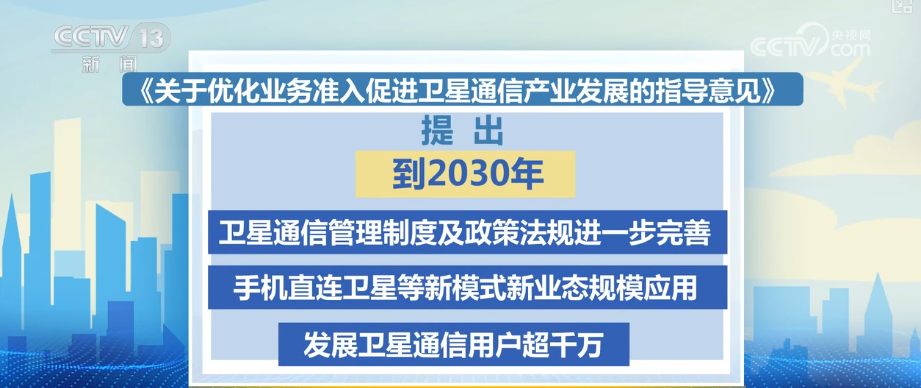
Core Insights - The Ministry of Industry and Information Technology (MIIT) has released guidelines to promote the development of the satellite communication industry, focusing on low Earth orbit (LEO) satellite internet and the orderly opening of satellite communication services [1][3]. Group 1: Policy and Development Goals - By 2030, the satellite communication management system and regulations are expected to be further improved, with over 10 million satellite communication users and the application of new models such as direct satellite connections for mobile phones [3]. - The guidelines aim to accelerate the development of LEO satellite internet to achieve global broadband network coverage and to conduct commercial trials for satellite IoT [3][4]. Group 2: Industry Trends and Economic Impact - The rapid development of satellite internet is seen as a significant trend in the information and communication technology industry, with the potential to create new economic growth points [6]. - The MIIT supports state-owned satellite communication companies and encourages private enterprises to explore new satellite communication services, indicating a phased and structured approach to opening the satellite communication market [4][5]. Group 3: Infrastructure and Projects - The MIIT has facilitated domestic frequency coordination for satellites and issued licenses for space radio stations, providing support for the implementation of satellite internet projects [8]. - A new space and data industry park is under construction in Jiaozuo, Henan Province, aiming to establish a comprehensive space information service system and to develop a 6 billion-level space information industry base over the next decade [9]. - In Jinan, Shandong Province, a specialized assembly and testing base for small commercial satellites is being established, with a production capacity of 100 satellites weighing 500 kg each per year [10].