创新药出海

Search documents
财经聚焦|药品价格登记系统上线,将带来哪些影响?
Xin Hua She· 2025-12-04 11:07
Core Viewpoint - The launch of the China Drug Price Registration System aims to provide a transparent and authoritative pricing framework for pharmaceutical companies, facilitating their international market entry and addressing pricing challenges in global markets [1][2][3]. Group 1: Impact on Pharmaceutical Companies - The new system serves as a platform for companies to establish a global and diversified pricing strategy, addressing the lack of reliable pricing information for Chinese drugs in international markets [2][3]. - The system allows drug companies to obtain multilingual price certificates, which can be used as authoritative proof of pricing when entering foreign markets [3][4]. - By providing a clear pricing structure, the system helps break down barriers for Chinese innovative drugs seeking to enter global markets, allowing companies to better reflect the true value of their products [4][8]. Group 2: Relationship with Existing Pricing Systems - The China Drug Price Registration System operates independently from provincial medical procurement platforms, ensuring that the registration prices do not affect the daily medication costs for insured and uninsured patients [5][6]. - The registration prices reflect real transaction prices from various channels outside of the medical insurance system, such as private hospitals and retail pharmacies, thus providing a comprehensive view of drug pricing [6][7]. Group 3: Future Prospects and Support for Innovation - The system is expected to support the development of innovative drugs by providing a pricing mechanism that aligns with global standards, thereby enhancing competitiveness in international markets [8][9]. - The launch of the system is part of broader initiatives to support high-quality development of innovative drugs, including regional procurement platforms and measures to enhance research and development [9].
财经聚焦丨药品价格登记系统上线,将带来哪些影响?
Xin Hua Wang· 2025-12-04 10:59
Core Viewpoint - The launch of the China Drug Price Registration System aims to provide a transparent pricing framework for pharmaceutical companies, facilitating their entry into international markets and addressing pricing challenges faced by innovative drugs [1][3][7]. Group 1: Impact on Pharmaceutical Companies - The new system serves as a platform for companies to establish a global pricing framework, addressing the lack of authoritative pricing information for Chinese drugs in international markets [3][4]. - Companies can now provide verified pricing information to foreign markets, which is crucial for negotiations and market entry, thus breaking down barriers for Chinese innovative drugs [7][12]. - The system allows drug manufacturers to register prices that reflect real market conditions, independent of the lower prices set by national health insurance [8][10]. Group 2: Relationship with Existing Pricing Structures - The registration prices in the new system are distinct from provincial procurement prices and do not affect the daily medication costs for insured and uninsured patients [8][10]. - The system operates independently from provincial medical procurement platforms, ensuring that the basic health insurance benefits remain intact while allowing for market-driven pricing [8][12]. - The registration process involves drug manufacturers voluntarily submitting price information, which is then verified to ensure accuracy and authenticity [9][10]. Group 3: Future Prospects and Support for Innovation - The system is expected to support the development of innovative drugs by providing a pricing mechanism that aligns with global standards, thus enhancing competitiveness [12][15]. - It is part of a broader strategy to empower innovative drug companies, enabling them to leverage pricing as a tool for market expansion and to attract foreign investment [12][15]. - The establishment of this system is seen as a significant step in fostering a conducive environment for pharmaceutical innovation and market entry, benefiting both domestic and international stakeholders [12][15].


创新药板块早盘走强,恒生创新药ETF(159316)标的指数涨超1%,行业并购整合机遇受关注
Mei Ri Jing Ji Xin Wen· 2025-12-04 03:53
Group 1 - The Hong Kong innovative drug sector showed strength in early trading, with companies like Kangfang Biopharma and Zai Lab rising over 3% [1] - The Hang Seng Innovative Drug ETF (159316) saw its index increase by over 1%, reflecting positive market sentiment [1] - Chinese innovative drug development is becoming a significant global player, with increasing overseas licensing transactions driving growth in the sector [1] Group 2 - The pharmaceutical industry is entering a critical phase characterized by "innovation realization + global layout," supported by population and domestic demand, as well as comprehensive manufacturing capabilities [1] - Companies are actively exploring diverse overseas expansion paths, indicating a strategic shift towards international markets [1] - By 2026, opportunities in innovative commercialization, global breakthroughs, policy optimization, and industry mergers and acquisitions are expected to emerge [1] Group 3 - The Hang Seng Hong Kong Stock Connect Innovative Drug Index is one of the first "pure" 100% innovative drug indices, accurately reflecting the overall performance of China's innovative drug companies [1] - The Hang Seng Innovative Drug ETF (159316) is currently the only product tracking this index, providing investors with a convenient way to seize industry development opportunities [1]
12月4日热门路演速递 | 银行重启、北交所崛起、科技医药共振,四会连发洞见2026
Wind万得· 2025-12-04 00:14
Group 1 - The core performance of banks is expected to recover and grow in 2026, marking the first year of the 14th Five-Year Plan, with a focus on a "new momentum combination" for bank stocks [2] - The investment strategy for bank stocks will be discussed, including the outlook on fundamentals and the value of bank stock investments [2] - The investment perspective on the banking sector and stock selection strategies will be highlighted [2] Group 2 - The investment strategy for 2026 will focus on three main investment lines, targeting new opportunities in the Beijing Stock Exchange, particularly in technology growth, high-end manufacturing, and new materials [5] - The valuation levels of the Beijing Stock Exchange are expected to recover, with a decrease in discount rates, aligning with national strategic emerging industry development directions [5] - The Beijing Stock Exchange is home to a number of high-quality enterprises that are technically solid and leading in niche fields, providing investors with opportunities to capture long-term value [5] Group 3 - The potential for AI and intelligent control to ignite a new wave in the computer industry will be explored, along with the prospects for the "rare metals" cycle and the energy sector's transition to a zero-carbon era [7] - East Guangdong Securities will focus on the technological, resource, and energy transformations as the main investment lines for 2026 [7] Group 4 - The potential for innovative drugs to expand internationally and the expected turnaround in biotechnology will be examined, alongside the performance improvements in the medical device sector [9] - Structural opportunities in consumer healthcare and biological products will be discussed, aiming to reshape the investment logic in the pharmaceutical sector for 2026 [9]



鼓励创新药出海,中国药品价格登记系统上线:我国药企授权出海交易超920亿美元
Mei Ri Jing Ji Xin Wen· 2025-12-03 13:24
Core Insights - The launch of the Chinese Drug Price Registration System on December 2 is seen as a significant positive development for the innovative drug sector, facilitating the international expansion of domestic innovative drugs [1][4]. Group 1: Drug Price Registration System - The Chinese Drug Price Registration System was launched on December 2, with nine pharmaceutical companies participating in the initial registration, including both multinational and traditional Chinese medicine firms [2]. - The system currently includes limited information, with only 10 drug entries available, indicating a nascent stage of development [2]. - The system allows for independent pricing by companies outside of the National Medical Insurance (NMI) framework, which is a notable shift in policy [1][5]. Group 2: Innovative Drugs Highlighted - Four drugs showcased on the system are recognized as either the first of their kind in China or globally, including innovative treatments like Toripalimab and Icaritin [3]. - For instance, Toripalimab is the first Chinese PD-1 monoclonal antibody approved in both Europe and the U.S., while Icaritin is the first CAR-T therapy targeting BCMA approved in China [3]. Group 3: Market Implications - The establishment of the registration system is expected to enhance the global pricing framework for Chinese innovative drugs and attract high-quality foreign drugs to the Chinese market [4][5]. - Data indicates that in the first three quarters of 2025, Chinese pharmaceutical companies completed 103 license-out transactions totaling $92.03 billion, highlighting the growing importance of the Chinese market in the global pharmaceutical industry [4]. - The NMI's non-interference in pricing for the non-NMI market is seen as a positive step towards respecting market dynamics and enhancing the pricing power of domestic companies in international markets [5].



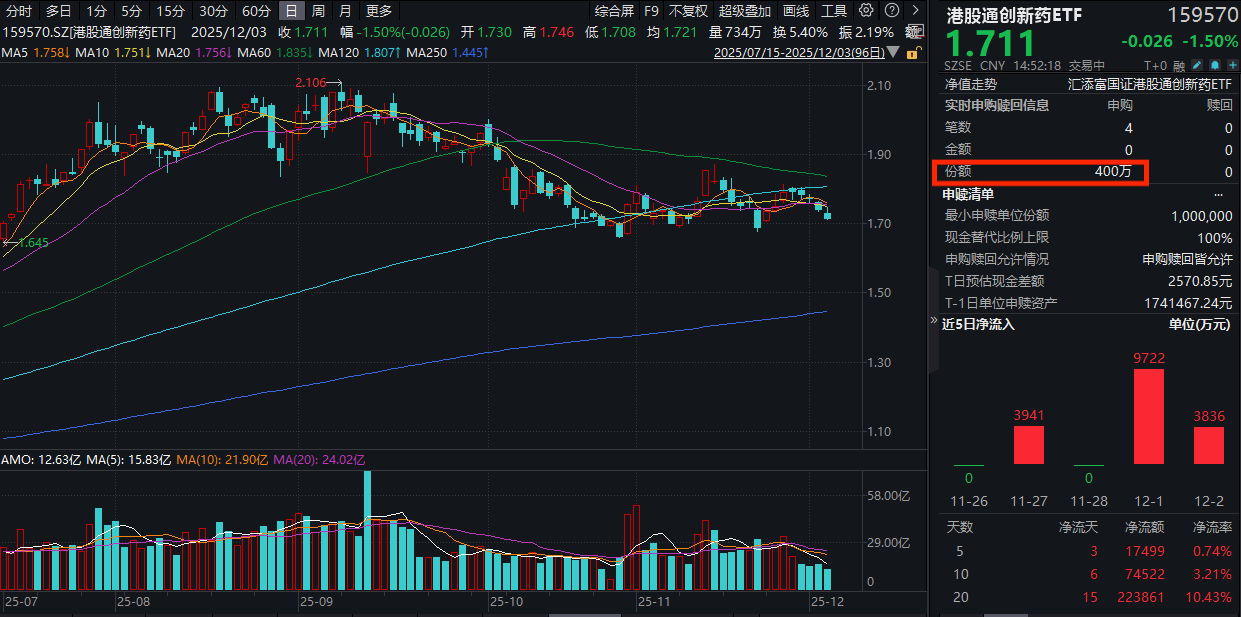
ASH数据催化临近!港股通创新药ETF(159570)回调1.5%录得弱势四连跌,资金再度逢跌加仓!创新药出海有望持续高增长!
Xin Lang Cai Jing· 2025-12-03 07:13
Group 1 - The Hong Kong Innovation Drug ETF (159570) experienced a 1.5% decline, marking its fourth consecutive day of decrease, with a trading volume exceeding 1.3 billion yuan [1] - The ETF has attracted a net inflow of over 6 million yuan during the day and has accumulated over 740 million yuan in the last 10 days, with a total size exceeding 23.6 billion yuan as of December 2 [1] - Major weighted stocks in the ETF, such as 3SBio, Innovent Biologics, and China Biologic Products, saw declines of over 2%, while others like CSPC Pharmaceutical and BeiGene dropped over 1% [2][3] Group 2 - The upcoming ASH conference is expected to reveal key data in the hematology field, which may catalyze the valuation recovery of related pipelines, particularly for companies with differentiated advantages in oncology, autoimmune, and rare disease products [5] - The Chinese innovative drug industry has shown significant growth, with the number of clinical trials increasing from 1,473 in 2020 to 2,539 in 2024, reflecting a compound annual growth rate of over 15% [6][9] - Chinese pharmaceutical companies are becoming increasingly prominent in global research, contributing 27% in oncology and 19% in autoimmune fields, with significant positions in ADC targets such as HER2 and TROP2 [9]
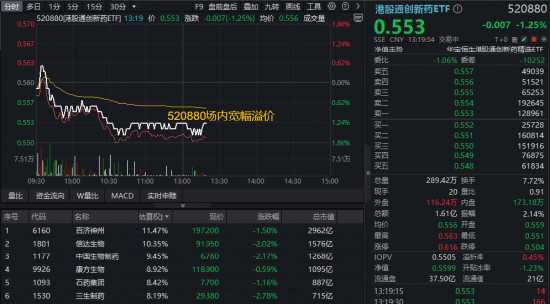
港股创新药继续调整,龙头股普跌,520880连跌4日,场内宽幅溢价!最新消息:中国药品价格登记系统上线
Xin Lang Ji Jin· 2025-12-03 05:32
投创新药,首选同类最大港股通创新药ETF(520880)及其场外联接基金(025221),标的指数恒生港 股通创新药精选指数具备三大独特优势: 1、纯粹,全面。不含CXO,纯正创新药!全面覆盖创新药研发类公司。 2、龙头占比大。前十大创新药龙头权重超72%,表征创新药硬核力量。 3、风险更可控。对流动性较差的成份股强制降权,有力管控尾部风险。 | | | 港股通创新药ETF (520880) 标的指数 | | | --- | --- | --- | --- | | | | 前十成份股权重高达72.57%,龙头优势显著 | | | 代码 | 简称 | 权重(%) | 总市值(亿港元) | | 6160.HK | 百济神州 | 11.51 | 3,070 | | 1801.HK | 信达生物 | 10.19 | 1,613 | | 1177.HK | 中国生物制药 | 9.47 | 1,323 | | 9926.HK | 康方生物 | 66'8 | 1,132 | | 1093.HK | 石药编团 | 8.39 | 911 | | 1530.HK | 三生制药 | 8.32 | 760 | | 3692.HK | ...
港股医药:回调之后,机会浮现?
Quan Jing Wang· 2025-12-02 14:02
Core Insights - The article discusses the recent developments in the Hong Kong pharmaceutical sector, particularly focusing on the innovative drug industry, which is experiencing a shift from traditional financing to becoming a showcase for new economy enterprises [3][4][5] - The article emphasizes the importance of external factors such as U.S. Federal Reserve monetary policy, international trade environment, and competition dynamics in influencing the performance of the Hong Kong pharmaceutical sector [6][7][8] Industry Overview - The Hong Kong stock market is transitioning to showcase high-quality companies in sectors like technology, innovative drugs, and new consumption, attracting global capital [3] - Recent adjustments in the Hong Kong pharmaceutical sector are attributed to short-term market sentiment fluctuations and profit-taking, rather than fundamental changes in the industry [4][5] Market Dynamics - The Hang Seng Healthcare Index and the Hong Kong Stock Connect Innovative Drug Select Index are highlighted for their differing coverage and focus, with the former being broader and the latter concentrating on high R&D investment and liquidity companies [2][20] - The innovative drug sector is seeing a significant increase in attention from investors, driven by strong performance in CXO and life sciences services, with profits in these areas growing over 50% year-on-year [19] Policy Environment - Domestic policies are shifting towards supporting genuine innovation, with measures like the establishment of a new drug pricing mechanism and the integration of commercial insurance with the medical insurance directory [7][8] - The article notes that the regulatory environment is improving, which is expected to stabilize profit expectations for pharmaceutical companies [7][8] Investment Strategies - The article advocates for ETF investments in the innovative drug sector due to their diversification, low entry barriers, cost advantages, and high liquidity [21][22] - Suggested investment strategies include dollar-cost averaging and phased investments to manage volatility in the high-risk pharmaceutical sector [24][25] Future Outlook - The long-term growth of the innovative drug sector is supported by a combination of favorable policies, improving industry fundamentals, and the ongoing internationalization of Chinese pharmaceutical companies [15][16] - The article concludes that the current market adjustments provide an opportunity for investors to reassess the long-term value of companies in the innovative drug sector [15][16]

中国药品价格登记系统上线!创新药出海传来利好
Guo Ji Jin Rong Bao· 2025-12-02 13:41
Core Viewpoint - The launch of the drug price registration system in China is a significant step towards establishing a global pricing framework for innovative drugs, enhancing the international competitiveness of Chinese pharmaceutical companies [1][3][6]. Group 1: Drug Price Registration System - The drug price registration system, initiated by the National Healthcare Security Administration, allows domestic and foreign pharmaceutical companies to independently declare drug prices, creating a comprehensive pricing archive [1][3]. - The system operates independently from provincial procurement platforms and follows principles of "one location acceptance, nationwide sharing, and global openness," which aids in building a globalized drug pricing system [1][3]. - The registration of prices does not alter the medication costs for insured and uninsured individuals [1]. Group 2: Support for Chinese Pharmaceutical Companies - The new system addresses the shortcomings in the pricing mechanism for innovative drugs, facilitating their entry into international markets and allowing for pricing that aligns with local payment systems [3][4]. - Companies like Yifan Pharmaceutical highlight that the system will provide substantial support for overseas expansion, allowing for a more accurate reflection of the true value of innovative drugs [4]. - The system enables companies to register prices according to international practices, providing verifiable pricing information to regulatory bodies and partners [4]. Group 3: Attracting Foreign Innovative Drugs - The establishment of the drug price registration system is expected to attract more high-quality foreign innovative drugs into the Chinese market, as multinational companies will be encouraged to participate in national healthcare negotiations [6][7]. - The system allows multinational companies to register prices independently in China, creating a clear distinction between market supply prices and negotiated healthcare prices, which enhances the certainty of market entry for innovative drugs [7].

2025年度十大医药技术研报,解码产业创新与全球化新机遇
Xin Lang Cai Jing· 2025-12-02 11:59
Core Insights - In 2025, China's pharmaceutical and healthcare industry enters a critical phase driven by "innovation deepening + global breakthrough," with emerging therapies like small nucleic acids, PROTAC, and CGT accelerating from clinical validation to commercialization [2][34] - The reports from the top ten Chinese securities firms provide authoritative insights into technological iterations, industry trends, and globalization strategies, serving as a guide for industry practitioners and investors [2][34] Group 1: Small Nucleic Acids - 2025 is a pivotal year for small nucleic acid drugs, driven by technological breakthroughs and expanding indications from rare diseases to chronic diseases like hyperlipidemia and hypertension [4][36] - The small nucleic acid sector is expected to see a surge in catalysts, including the commercialization of major products like Novartis' Inclisiran and the approval of Alnylam's Vutrisiran and Fitusiran [5][37] - The market for small nucleic acids is projected to reach approximately $30 billion, with significant growth anticipated in CNS diseases [10][42] Group 2: Brain-Computer Interface - The brain-computer interface industry is accelerating innovation with three main technical paths: invasive, semi-invasive, and non-invasive, each with distinct advantages and challenges [7][39] - The global brain-computer interface market is expected to reach approximately $2.6 billion by 2024, with a CAGR of about 13% from 2023 to 2027 [7][39] Group 3: PROTAC - PROTACs are gaining traction as targeted protein degradation drugs, with advantages such as high oral bioavailability and broad target range, making them popular in oncology and autoimmune disease research [19][51] - The first BTK PROTAC has entered Phase III trials, showcasing promising efficacy and safety data [19][51] Group 4: Chinese Innovative Drugs - Chinese innovative drugs are entering a "DeepSeek" moment, with domestic companies increasingly recognized overseas, and the number of license-out projects surpassing license-in projects for the first time in 2023 [16][48] - The market for innovative drugs in China is expected to exceed 2 trillion RMB by 2030, with a CAGR of 24.1% [29][63] Group 5: Peripheral Intervention Industry - The peripheral intervention industry is experiencing rapid growth, with a significant patient base and low treatment penetration compared to international standards [25][57] - The market for peripheral artery interventions is projected to grow at a CAGR of 15.6% from 2021 to 2030, while peripheral venous interventions may see a CAGR of 29.3% [25][57] Group 6: Weight Loss and Diabetes Treatment - The market for GLP-1RA drugs, such as semaglutide and tirzepatide, is expected to exceed $150 billion by 2031, with significant business development opportunities emerging for domestic companies [26][58] - Multi-target drug development is anticipated to overcome the limitations of single-target therapies, enhancing efficacy in weight loss and metabolic health [26][58]