
对外开放

Search documents
明确“路线图” 中央经济工作会议部署八项任务
Zhong Guo Xin Wen Wang· 2025-12-12 06:05
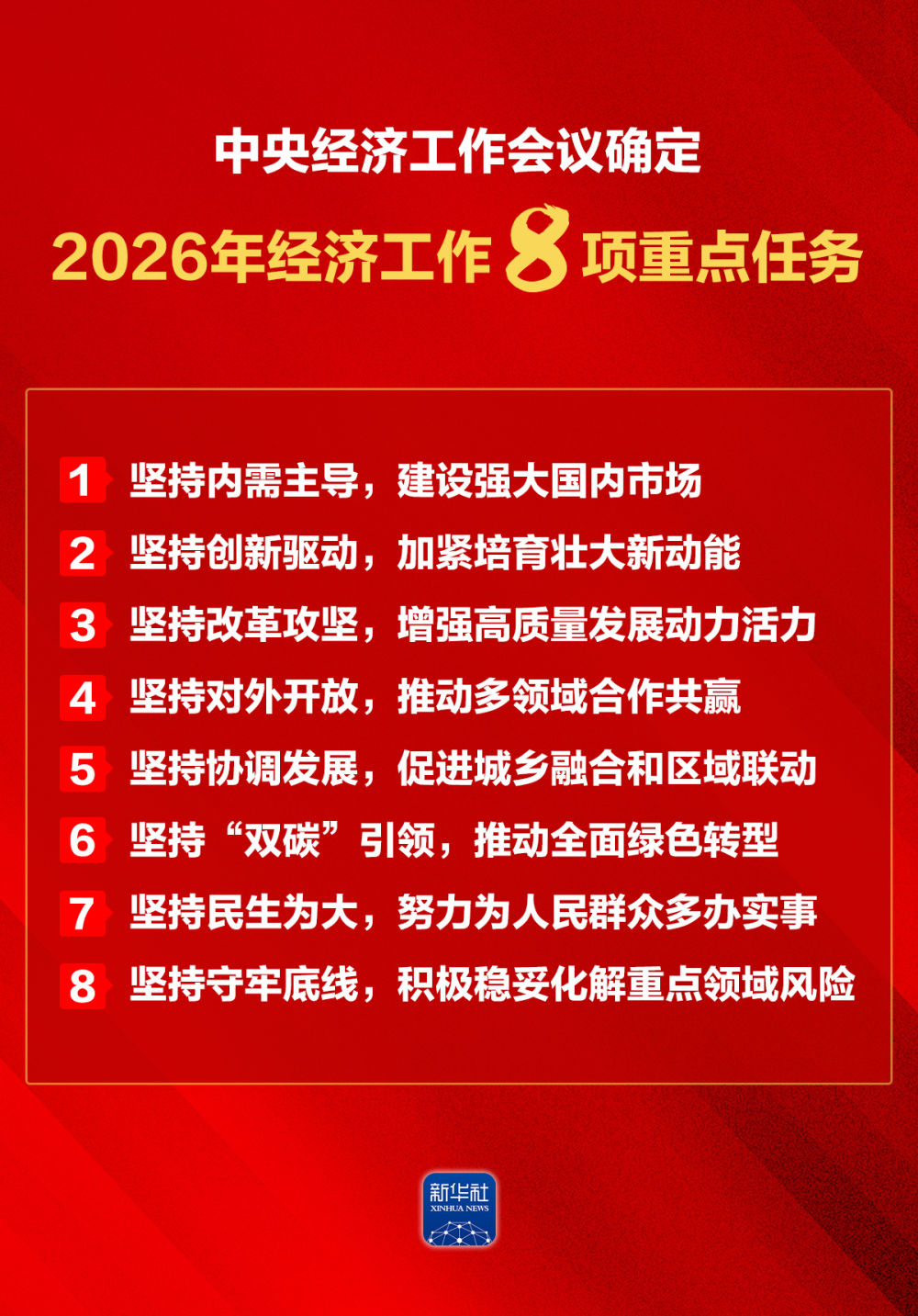
Core Insights - The Central Economic Work Conference outlined eight key tasks for China's economic work in 2026, emphasizing the importance of domestic demand and innovation-driven growth [1][2][3] Group 1: Economic Strategy - The first task is to "insist on domestic demand as the main driver and build a strong domestic market," highlighting its significance in the overall economic development [1] - The second task focuses on "insisting on innovation-driven growth and accelerating the cultivation of new momentum," indicating that technological innovation will play a crucial role in expanding domestic demand [1] - The third task emphasizes "deepening reforms to enhance the vitality of high-quality development," which includes improving the national unified market and optimizing the business environment to address institutional bottlenecks [1] Group 2: External Relations and Cooperation - The fourth task is to "insist on opening up and promoting win-win cooperation in multiple fields," which aims to enhance the synergy between domestic and international markets and resources [2] - The fifth task stresses "coordinated development to promote urban-rural integration and regional linkage," essential for achieving a broader and more robust new development pattern [2] Group 3: Sustainability and Social Welfare - The sixth task is to "insist on leading with 'dual carbon' goals to promote comprehensive green transformation," aligning with the previously announced goals of carbon peak and carbon neutrality [2] - The seventh task focuses on "prioritizing people's livelihoods and striving to do practical things for the public," reiterating the importance of stabilizing employment, businesses, markets, and expectations [2] Group 4: Risk Management - The eighth task is to "ensure bottom-line stability and actively and prudently resolve risks in key areas," particularly in stabilizing the real estate market and managing local government debt risks [2] - The overall economic policy approach is shifting from "promoting stability through growth" to "quality and efficiency," emphasizing the need for coordinated policy efforts [3]
稳中向新:2026中国经济的“加速密码”
Sou Hu Cai Jing· 2025-12-12 05:34
Core Viewpoint - The article emphasizes that the Chinese economy is not merely relying on luck for 2026, but rather on patience, structure, and practical efforts, suggesting a steady rhythm will lead to faster progress [5] Group 1: Economic Strategy - The year-end review and planning for the upcoming year highlight the importance of addressing pressures while maintaining a clear long-term positive outlook, which serves as a stabilizing factor [4] - The policy approach is characterized as a combination of precise measures, with continued active fiscal policies and flexible monetary policies aimed at boosting consumption, investment, and innovation simultaneously [4] - The focus on domestic demand is prioritized, with a clear logic that stabilizing income and consumption will naturally stabilize expectations [4] Group 2: Structural Changes - The article identifies new productive forces, artificial intelligence, and green transformation as key areas for economic acceleration, emphasizing the need to optimize new growth while revitalizing existing resources [4] - The stance against "involutionary competition" indicates a shift towards higher quality economic development rather than mere expansion [4] Group 3: Reform and Opening Up - Ongoing reforms in the unified market, private economy, and capital markets are highlighted, along with a shift in foreign trade focus from goods to services and digital trade, enhancing the attractiveness of the Chinese market [4] - The article suggests that true strength comes from freedom within order, reflecting a commitment to reform and opening up [4] Group 4: Social Welfare - The emphasis remains on improving livelihoods through concrete actions in employment, education, healthcare, and housing, reinforcing that stabilizing expectations equates to stabilizing confidence [4]


中央经济工作会议:2026年加快新型能源体系建设,扩大绿电应用
Xin Lang Cai Jing· 2025-12-12 01:37
Core Viewpoint - The Central Economic Work Conference held on December 10-11, 2025, emphasized the need for a stable and progressive economic policy, focusing on quality improvement and efficiency enhancement in the economic work for 2026 [5][21]. Economic Policy Direction - The conference highlighted the importance of maintaining stability while seeking progress, enhancing the effectiveness of macroeconomic governance, and integrating existing and new policies [3][18]. - It was decided to implement a more proactive fiscal policy, ensuring necessary fiscal deficits and optimizing fiscal expenditure structures [8][24]. Key Tasks for 2026 - The conference outlined several key tasks for 2026, including: - Promoting a strong domestic market and enhancing consumer spending through targeted actions [9][25]. - Fostering innovation and developing new growth drivers, particularly in technology and education [10][26]. - Strengthening reforms to boost high-quality development and addressing issues in state-owned enterprises and private sector regulations [10][26]. - Expanding international cooperation and trade, particularly in digital and green sectors [10][26]. - Coordinating urban and rural development, ensuring food security, and maintaining poverty alleviation efforts [11][27]. - Leading with a "dual carbon" approach to promote green transformation and environmental protection [11][27]. Emphasis on People's Livelihood - The conference stressed the importance of improving people's livelihoods, including stabilizing employment for key groups and enhancing education and healthcare services [12][28]. - It also highlighted the need to address risks in key sectors, particularly in the real estate market, and to manage local government debt effectively [12][28]. Overall Economic Confidence - The conference called for unity and confidence in the economic outlook, emphasizing the need to adapt to new challenges while leveraging existing strengths [22][29]. - It underscored the importance of aligning actions with the central government's strategic vision and ensuring effective implementation of economic policies [30][31].
从中央经济工作会议看“十五五”开局之年中国经济着力点
Xin Hua Wang· 2025-12-11 16:50
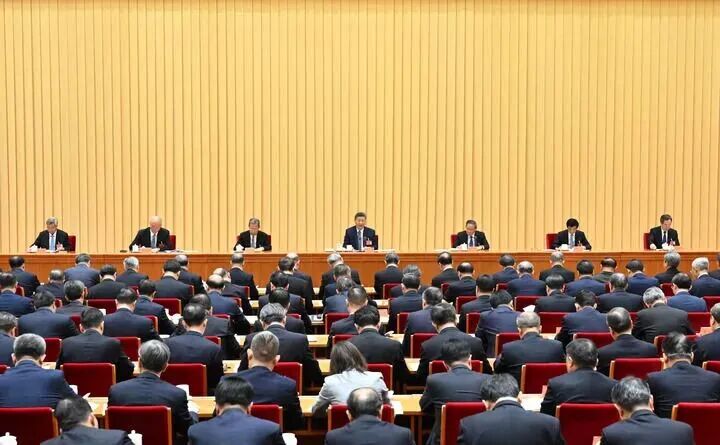
中央经济工作会议12月10日至11日在北京举行。习近平总书记出席会议并发表重要讲话,总结2025年经济工作,分析当前 经济形势,部署2026年经济工作,为实现"十五五"良好开局定向领航。 不断深化新形势下做好经济工作的规律性认识 2025年是"十四五"规划收官之年,在中国式现代化进程中具有重要意义。 会议总结今年经济运行情况,指出"经济社会发展主要目标将顺利完成""'十四五'即将圆满收官,第二个百年奋斗目标新征 程实现良好开局"。 会议认为,通过实践,我们对做好新形势下经济工作又有了新的认识和体会:必须充分挖掘经济潜能,必须坚持政策支持 和改革创新并举,必须做到既"放得活"又"管得好",必须坚持投资于物和投资于人紧密结合,必须以苦练内功来应对外部挑 战。 新时代以来的中央经济工作会议,一贯重视理论总结,用以指导经济发展实践。随着形势变化,中央经济工作会议持续深 化对经济工作的规律性认识,2021年提出"四个必须",2022年提出"六个坚持",2023年提出"五个必须",2024年提出"根本保 证""五个必须统筹"。 原标题:新华全媒头条·聚焦中央经济工作会议|推动经济实现质的有效提升和量的合理增长——从中央经 ...
(经济观察)明确“路线图” 中央经济工作会议部署八项任务
Zhong Guo Xin Wen Wang· 2025-12-11 15:28
Core Insights - The Central Economic Work Conference outlined eight key tasks for China's economic work in 2026, emphasizing the importance of domestic demand and innovation as primary drivers for economic growth [1][2][3] Group 1: Domestic Demand and Market Development - The first task is to "insist on domestic demand as the main driver and build a strong domestic market," highlighting its significance in the overall economic development strategy [1] - The conference plans to implement actions to boost consumption and optimize policies related to new projects, indicating that expanding domestic demand remains a primary focus for economic work [1] Group 2: Innovation and New Growth Drivers - The second task emphasizes "insisting on innovation-driven development and accelerating the cultivation of new growth drivers," which is seen as crucial for constructing a new development pattern and expanding domestic demand [1][2] - Technological innovation is expected to create new products and consumption demands while reducing costs, thereby increasing supply [1] Group 3: Reform and High-Quality Development - The third task focuses on "insisting on reform to enhance the vitality of high-quality development," which includes deepening reforms and optimizing the business environment to remove institutional barriers [2] - This approach aims to stimulate internal dynamics and facilitate economic circulation [2] Group 4: Open Economy and International Cooperation - The fourth task is to "insist on opening up and promoting win-win cooperation in multiple fields," recognizing the complex changes in the development environment and the need for high-level openness to enhance domestic and international market interactions [2] Group 5: Coordinated Development - The fifth task emphasizes "insisting on coordinated development to promote urban-rural integration and regional linkage," which is essential for achieving a broader and more robust new development pattern [2] Group 6: Green Transformation - The sixth task focuses on "insisting on carbon neutrality as a guiding principle to promote comprehensive green transformation," aligning with the goals of reducing carbon emissions and promoting sustainable growth [2] Group 7: Social Welfare and Stability - The seventh task is to "insist on prioritizing people's livelihoods and strive to do practical things for the public," reiterating the importance of stabilizing employment, businesses, markets, and expectations [2][3] Group 8: Risk Management - The eighth task is to "insist on maintaining a bottom line and actively and prudently resolving risks in key areas," particularly in stabilizing the real estate market and managing local government debt risks [3] - The conference emphasizes a shift in economic policy focus from growth to quality and efficiency, advocating for a coordinated approach to policy implementation [3]
解读中央经济工作会议:多个“首提”表述 释放七大明确信号
Xin Jing Bao· 2025-12-11 15:12
Group 1 - The core viewpoint of the Central Economic Work Conference emphasizes a positive policy orientation, focusing on "stability while seeking progress" and "quality improvement and efficiency enhancement" [1][2] - The conference highlights the importance of stabilizing employment, enterprises, markets, and expectations, introducing new expressions such as "flexible and efficient" monetary policy tools [1][2] - The meeting indicates that macroeconomic policies will be more proactive and effective to achieve "qualitative improvement and reasonable growth" [2][3] Group 2 - The conference stresses "quality improvement and efficiency enhancement," repeatedly mentioning high-quality development across various sectors [3][4] - It aims to integrate traditional and innovative policy tools to promote high-quality economic growth while maintaining reasonable growth rates [3][5] - The focus on high-quality development reflects a higher demand for development quality and efficiency, especially as 2026 marks the beginning of the 14th Five-Year Plan [3][4] Group 3 - The meeting prioritizes "domestic demand" as the main driver for economic growth, indicating a shift towards relying more on domestic consumption [4][5] - This approach is in response to the anticipated decline in export growth due to external factors, such as high tariffs from the U.S. [4][5] - The conference plans to expand the supply of quality consumer goods and services, fostering new consumption growth points [4][5] Group 4 - The conference reiterates the commitment to a proactive fiscal policy and moderately loose monetary policy, emphasizing policy coordination [5][6] - It highlights the need for comprehensive use of fiscal, monetary, industrial, and employment policies to enhance economic support [6][7] - The focus is on maintaining necessary fiscal deficits while addressing local fiscal difficulties and ensuring stable monetary policy [6][7] Group 5 - The meeting emphasizes the importance of innovation-driven growth and the cultivation of new economic drivers [7][8] - It includes plans for developing a comprehensive education and technology talent development strategy and establishing international technology innovation centers [7][8] - The shift from "project-driven" to "systematic construction" in technology policy aims to improve the sustainability of technology investments [7][8] Group 6 - The conference signals support for the real estate market, focusing on stabilizing the market and addressing risks in key areas [8][9] - It encourages policies to stabilize the real estate market and improve financing channels for affordable housing [8][9] - The emphasis on resolving local government financing platform debt risks indicates a shift in focus towards managing operational debt [8][9] Group 7 - The meeting underscores the importance of maintaining openness to foreign trade and investment, balancing domestic and international priorities [9][10] - It aims to enhance the quality of foreign trade and expand bilateral investment cooperation [9][10] - The strategy includes high-quality development of the Belt and Road Initiative, reflecting a proactive approach to international economic engagement [9][10]
中央经济工作会议释放十大政策信号
21世纪经济报道· 2025-12-11 13:59
此次中央经济工作会议释放了哪些新信号,21世纪经济报道记者进行了梳理和解读。 作者丨王峰 编辑丨周上祺 中央经济工作会议12月10日至11日在北京举行。会议对2025年做出了"我国经济顶压前行、向 新向优发展"的重要判断。 这一局面来之不易,特别是2024年9月26日中央政治局会议果断部署一揽子增量政策,使社会 信心有效提振,经济明显回升,2025年宏观政策贯彻落实了多项超常规逆周期调节举措。 对于2026年经济工作,中央经济工作会议提出"加大逆周期和跨周期调节力度",其中对多项宏 观政策的部署,措辞则从2025年的"加大""加强""增加""扩大"等,转为更加注重"保持""优 化"。同时,会议提出了多项新举措、新任务。 信号一:继续实施更加积极的财政政策 会议指出,保持必要的财政赤字、债务总规模和支出总量,加强财政科学管理,优化财政支出 结构,规范税收优惠、财政补贴政策。重视解决地方财政困难,兜牢基层"三保"底线。严肃财 经纪律,坚持党政机关过紧日子。 会议还指出,适当增加中央预算内投资规模,优化实施"两重"项目,优化地方政府专项债券用 途管理。 回顾2025年,赤字率从2024年的3%提升至2025年的4% ...
明年经济工作怎么干 记住“八个坚持”
Xin Hua She· 2025-12-11 13:30
Core Viewpoint - The Central Economic Work Conference has outlined eight key tasks for economic work in 2026, focusing on domestic demand, innovation, reform, openness, coordinated development, green transformation, improving people's livelihoods, and risk management [1]. Group 1: Domestic Demand and Market Development - Emphasis on maintaining domestic demand as the primary driver and building a strong domestic market [1]. Group 2: Innovation and New Momentum - Focus on innovation-driven growth and accelerating the cultivation of new growth drivers [1]. Group 3: Reform and High-Quality Development - Commitment to tackling reforms to enhance the vitality and momentum for high-quality development [1]. Group 4: Openness and Cooperation - Advocacy for maintaining openness and promoting win-win cooperation across multiple fields [1]. Group 5: Coordinated Development - Support for coordinated development to promote urban-rural integration and regional synergy [1]. Group 6: Green Transformation - Commitment to leading with "dual carbon" goals and promoting comprehensive green transformation [1]. Group 7: Livelihood Improvement - Focus on prioritizing people's livelihoods and striving to address practical issues for the populace [1]. Group 8: Risk Management - Emphasis on safeguarding the bottom line and actively and prudently resolving risks in key areas [1].
【图解】速览!2026年经济工作八大重点任务
Zhong Guo Jing Ji Wang· 2025-12-11 12:29
Core Viewpoint - The Central Economic Work Conference held on December 10-11 in Beijing outlined eight key tasks for economic work in 2026, focusing on domestic demand, innovation, reform, openness, coordinated development, green transformation, public welfare, and risk management. Group 1: Domestic Demand - Emphasis on leading domestic demand and building a strong domestic market through actions to boost consumption and implement urban and rural income increase plans [1] - Expansion of quality goods and services supply, optimization of "two new" policy implementation, and removal of unreasonable restrictions in the consumption sector to unleash service consumption potential [1][2] - Encouragement of investment stabilization, with an increase in central budget investment scale and optimization of local government special bond usage [1] Group 2: Innovation - Focus on innovation-driven growth by developing a comprehensive plan for education, technology, and talent development [2] - Establishment of international technology innovation centers in key regions such as Beijing, Shanghai, and the Guangdong-Hong Kong-Macau Greater Bay Area [2] - Strengthening the role of enterprises in innovation and improving intellectual property protection in emerging fields [2] Group 3: Reform - Commitment to reform efforts to enhance high-quality development, including the establishment of a unified national market and further deepening state-owned enterprise reforms [3] - Initiatives to clear overdue payments to businesses and promote win-win scenarios for platform enterprises and their operators [3] - Expansion of market-oriented reforms and improvement of the local tax system [3] Group 4: Openness - Promotion of multi-field cooperation and gradual advancement of institutional openness, including the expansion of service sector autonomy and optimization of free trade zone layouts [4] - Encouragement of service exports and development of digital and green trade [4] - Strengthening of foreign investment promotion mechanisms and enhancing overseas service systems [4] Group 5: Coordinated Development - Coordination of urban-rural integration and regional collaboration, focusing on high-quality development in county economies [5] - Maintenance of arable land and food production stability, ensuring reasonable prices for key agricultural products [5] - Support for major economic provinces and enhancement of cooperation among key urban clusters [5] Group 6: Green Transformation - Advancement of energy-saving and carbon reduction initiatives in key industries and the establishment of a new energy system [6] - Strengthening of the national carbon emissions trading market and implementation of comprehensive waste management actions [6] - Promotion of environmental protection initiatives and improvement of disaster response infrastructure [6] Group 7: Public Welfare - Implementation of actions to stabilize employment for key groups such as college graduates and migrant workers, and support for flexible employment [7] - Adjustment of educational resource allocation to increase high school and quality university enrollment [7] - Optimization of drug procurement and deepening of medical insurance payment reforms [7] Group 8: Risk Management - Focus on stabilizing the real estate market with city-specific policies to control inventory and encourage the acquisition of existing housing for social welfare [8]

“八个坚持”!明年经济工作重点任务来了
Zhong Guo Xin Wen Wang· 2025-12-11 12:14
Core Viewpoint - The Central Economic Work Conference held on December 10-11 in Beijing outlined eight key tasks for economic work in the coming year, emphasizing the importance of domestic demand, innovation, reform, and sustainable development. Group 1: Domestic Demand and Market Development - Emphasis on domestic demand as the main driver for economic growth, with plans to implement actions to boost consumption and increase residents' income [1] - Initiatives to expand the supply of quality goods and services, and to optimize the implementation of new policies [1] - Measures to stabilize investment, including increasing central budget investments and optimizing the use of local government special bonds [1] Group 2: Innovation and New Growth Drivers - Focus on innovation-driven development, with plans to enhance education, technology, and talent development [2] - Establishment of international technology innovation centers in key regions such as Beijing, Shanghai, and the Guangdong-Hong Kong-Macau Greater Bay Area [2] - Strengthening the role of enterprises in innovation and improving intellectual property protection in emerging fields [2] Group 3: Reform and High-Quality Development - Commitment to reform efforts to enhance the vitality of high-quality development, including the establishment of a unified national market [2] - Plans to deepen state-owned enterprise reforms and improve regulations supporting the private economy [2] - Initiatives to clear overdue payments to businesses and promote win-win development for platform enterprises and their operators [2] Group 4: Opening Up and International Cooperation - Promotion of multi-field cooperation and gradual expansion of service sector openness [2] - Encouragement of service exports and development of digital and green trade [2] - Efforts to enhance the foreign investment promotion system and support the Belt and Road Initiative [2] Group 5: Coordinated Development and Urban-Rural Integration - Focus on urbanization and rural revitalization, with an emphasis on county-level economic development [3] - Commitment to maintaining food production and stabilizing prices of essential agricultural products [3] - Strengthening coordination among major urban clusters and enhancing cross-administrative cooperation [3] Group 6: Green Transformation and Carbon Neutrality - Initiatives to promote energy efficiency and carbon reduction in key industries [3] - Development of a new energy system and expansion of green electricity applications [3] - Implementation of comprehensive waste management actions and environmental protection measures [3] Group 7: Social Welfare and Employment - Actions to stabilize employment for key groups such as college graduates and migrant workers [4] - Plans to optimize educational resource allocation and increase the supply of quality educational opportunities [4] - Initiatives to enhance healthcare services and support for vulnerable groups [4] Group 8: Risk Management and Financial Stability - Focus on stabilizing the real estate market with tailored measures for different cities [4] - Efforts to reform the housing provident fund system and promote the construction of affordable housing [4] - Strategies to manage local government debt risks and optimize debt restructuring methods [4]