
货币政策正常化

Search documents
日本执政联盟破裂新首相或“难产”,日央行或推迟加息
2 1 Shi Ji Jing Ji Bao Dao· 2025-10-14 14:07
Market Overview - The Japanese stock market experienced significant declines, with the Nikkei 225 index falling by 2.58% and the Topix index down by 1.99% as of October 14 [2][3] - The decline is attributed to political instability following the announcement of the Komeito party's exit from the ruling coalition with the Liberal Democratic Party, raising concerns about the potential inability of the new LDP president, Sanae Takaichi, to assume the role of Prime Minister [2][3] Currency and Bond Market - The Japanese yen showed volatility, initially declining but later rising by 0.14% against the US dollar, reflecting increased demand for safe-haven assets amid global market uncertainties [4] - The yield on Japan's 20-year and 30-year government bonds increased by 0.15% and 0.81%, respectively, indicating a cooling interest in Japanese bonds despite the yen's safe-haven status [4] Economic Implications - Analysts suggest that the political turmoil in Japan is causing heightened investor caution, particularly affecting technology and banking stocks, which are sensitive to economic outlook and policy changes [3] - The potential for a new fiscal stimulus from a new government could lead to increased government debt issuance, raising concerns about fiscal sustainability and pushing bond yields higher [5][6] Interest Rate Outlook - The likelihood of a rate hike by the Bank of Japan has decreased significantly, with current market expectations placing the probability of a rate increase this month at only 10%, down from 63% earlier in October [6][7] - The uncertainty surrounding the new government's monetary policy direction, whether dovish or hawkish, adds to the complexity of the interest rate outlook in Japan [7]


日元大跌 日本央行加息进程生变
Shang Hai Zheng Quan Bao· 2025-10-09 18:39
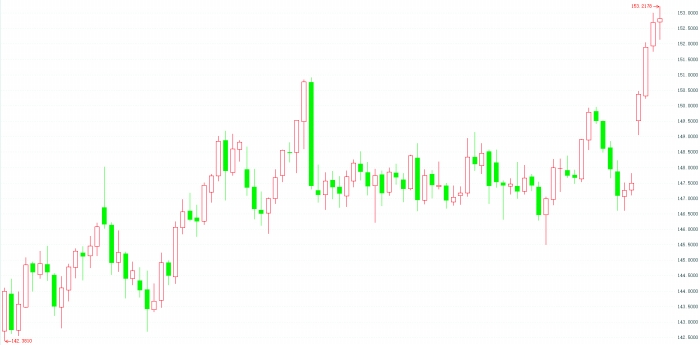
Core Viewpoint - The recent political changes in Japan, particularly the election of former Economic Security Minister Sanae Takaichi as the president of the ruling Liberal Democratic Party, have led to a significant depreciation of the Japanese yen against the US dollar, driven by market concerns over Japan's fiscal outlook and uncertainty regarding future interest rate hikes by the Bank of Japan [2][3][4]. Currency Movement - On October 6, the yen depreciated sharply by 1.94%, breaking the key level of 150 against the dollar, and continued to weaken, falling below 151, 152, and 153 in the following days [3]. - On October 8, the yen reached a low of 153.003 against the dollar, marking a decline of over 3.7% since October 2, and this was the first time it hit this level since mid-February [3]. - The yen also depreciated against other major currencies, hitting a historic low against the euro at 177.86, the lowest since the euro's inception in 1999 [3]. Economic Policy Implications - Takaichi's economic policies are expected to maintain a loose monetary stance and advocate for active fiscal policies, which are seen as contributing to downward pressure on the yen [4][5]. - Her approach is viewed as a continuation of "Abenomics," focusing on fiscal expansion and tax reduction to address rising prices [4][5]. Long-term Outlook - The long-term trajectory of the yen will depend on the implementation and impact of Takaichi's policies, with current market reactions primarily reflecting short-term sentiment [6][9]. - Despite the current depreciation, the yen is considered significantly undervalued, suggesting limited further downside even if Takaichi becomes Prime Minister [6][9]. Monetary Policy Considerations - The independence of the Bank of Japan may be influenced by Takaichi's leadership, with potential delays in interest rate hikes due to her dovish stance [8][9]. - The necessity for monetary policy adjustments will ultimately hinge on macroeconomic conditions, with the Bank of Japan's actions likely to remain responsive to economic performance rather than political rhetoric [7][9].
日元汇率大幅贬值!高市早苗力推放水政策,恐引发美国不满
Sou Hu Cai Jing· 2025-10-07 00:18
Group 1 - The election of Sanae Takaichi as the new leader of the Liberal Democratic Party in Japan marks a significant gender breakthrough in Japanese politics and reflects the structural challenges facing Japan's political economy in the post-Abe era [1] - Takaichi's economic policy is seen as an upgraded version of "Abenomics 2.0," advocating for a combination of active fiscal policy and sustained monetary easing, including plans to eliminate temporary fuel taxes and increase subsidies for healthcare and small businesses [1][2] - The market reacted positively to Takaichi's policies, with the Nikkei index surging by 4.83% on October 6, breaking the 48,000-point barrier and reaching a historical high, indicating optimism about liquidity expansion [2] Group 2 - In contrast to the stock market's positive response, the yen experienced a significant depreciation against the dollar, with a nearly 2% drop in a single day, reflecting deep concerns about the yen's future [4] - The depreciation of the yen complicates U.S.-Japan relations, as it undermines the effectiveness of the 15% tariffs imposed by the U.S. and raises questions about the stability of trade agreements established by previous administrations [4] - Japan's long-standing zero or negative interest rate policy is being challenged as the Bank of Japan has begun normalizing monetary policy, with interest rates rising from -0.1% to 0.25% in 2024, which will increase the burden of debt servicing on the government [6][7]

日股新高!
Shang Hai Zheng Quan Bao· 2025-10-06 08:38
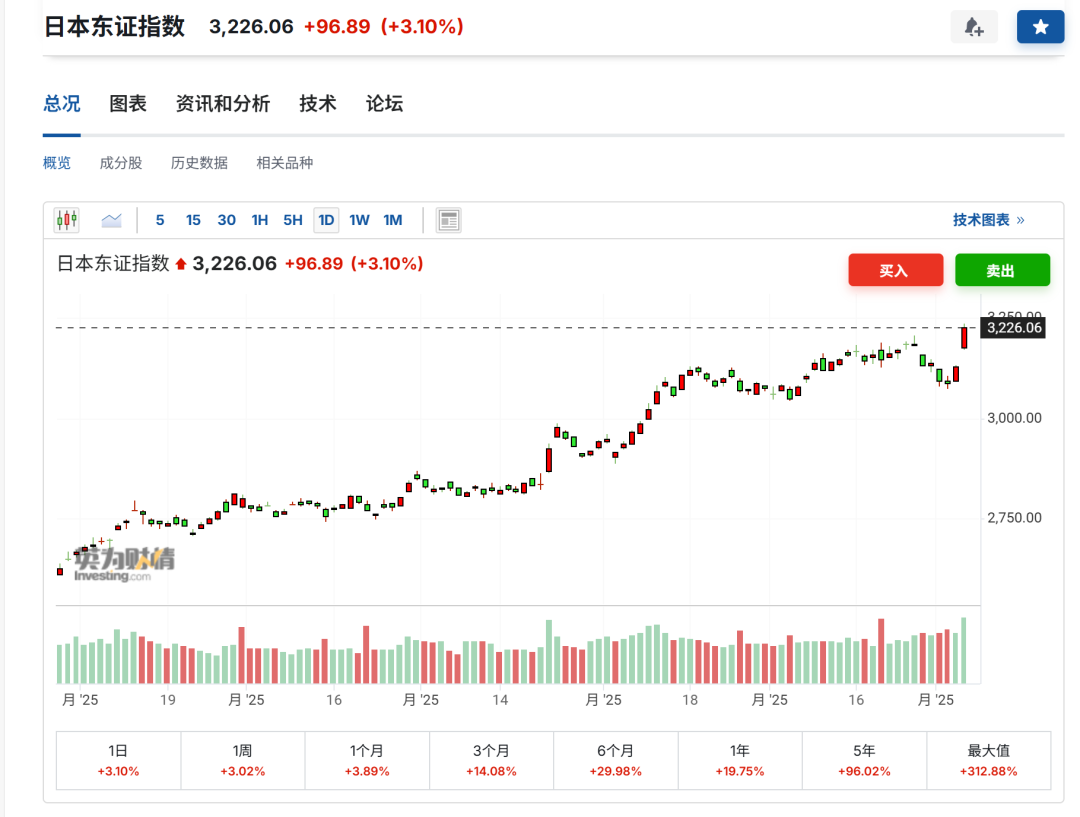
Market Performance - On October 6, Japanese stocks surged, with the Nikkei 225 and the Tokyo Stock Exchange indices reaching historical closing highs. The Nikkei 225 index rose by 4.75% to close at 47,944.76 points, while the Tokyo Stock Exchange index increased by 3.1% to 3,226.06 points [1]. Economic Policy Implications - Former Economic Security Minister Sanae Takaichi won the ruling Liberal Democratic Party's presidential election and is poised to become Japan's first female Prime Minister. Japan's economy faces challenges such as fiscal and monetary policy dilemmas, sluggish growth, and insufficient international competitiveness [2]. - Takaichi's stance on fiscal expansion contrasts sharply with that of former Prime Minister Shigeru Ishiba, who criticized "Abenomics" for overemphasizing monetary easing, leading to asset price inflation and widening wealth gaps. Takaichi, viewed as a proponent of Abenomics, advocates for expansionary fiscal policies aimed at doubling Japan's economic size within ten years through tax cuts, economic stimulus, and government investment [3]. Fiscal Concerns - Market participants express concerns over Japan's debt exceeding 250% of GDP, one of the highest globally. Continued fiscal expansion or increased issuance of government bonds could pose financial risks [4]. - Chief Economist Tomohisa Ishikawa from the Japan Research Institute emphasizes the need for Takaichi's expansionary fiscal policy to balance economic growth with fiscal health, highlighting the risks associated with fiscal expansion [5]. Monetary Policy Outlook - Takaichi's avoidance of clear monetary policy stances during the election contrasts with other candidates advocating gradual interest rate hikes. She previously opposed interest rate increases and emphasized the need for collaboration between the government and the Bank of Japan to achieve demand-driven growth supported by rising wages and corporate profits [7]. - Market analysts suggest that Takaichi's preference for loose monetary policy may impact the Bank of Japan's decisions regarding interest rate hikes, potentially leading to a delay in such actions until the new government's policies are clearer [8][9]. Trade Relations with the U.S. - Takaichi stated that she would not immediately alter the existing U.S.-Japan trade agreement but would address any issues that do not align with Japan's interests through diplomatic channels. The agreement includes a 15% tariff on nearly all Japanese exports to the U.S. and a commitment from Japan to invest $550 billion in the U.S. [14]. - Analysts believe that despite the agreement's enactment, uncertainties remain regarding its implementation and the realization of U.S. investments, which will be a significant economic challenge for Takaichi if she assumes office [16].
热点问答丨高市早苗执政将给日本经济带来什么影响
Xin Lang Cai Jing· 2025-10-05 06:47
Core Viewpoint - The election of former Economic Security Minister Sanae Takaichi as the president of Japan's ruling Liberal Democratic Party positions her as a potential first female Prime Minister, amidst Japan's economic challenges including fiscal and monetary policy dilemmas, sluggish growth, and international competitiveness issues [1]. Fiscal Policy - Takaichi advocates for expansionary fiscal policies, aiming to double Japan's economic size within ten years through tax cuts, economic stimulus, and government investment, contrasting sharply with the outgoing Prime Minister Shigeru Ishiba's focus on stability and wealth distribution [1][2]. - Concerns arise regarding Japan's debt exceeding 250% of GDP, raising fears that continued fiscal expansion could lead to financial risks [1]. Monetary Policy - Takaichi has not clearly defined her stance on monetary policy during the election, previously opposing interest rate hikes, and emphasizes the need for collaboration between the government and the Bank of Japan to achieve demand-driven growth supported by rising wages and corporate profits [3][4]. - Market analysts suggest that her victory introduces uncertainty into monetary policy, potentially delaying interest rate hikes as the Bank of Japan may adopt a wait-and-see approach until new government policies are clarified [4]. Trade Relations - Takaichi stated she would not immediately alter the existing Japan-U.S. trade agreement but would address any issues that do not align with Japan's interests through diplomatic channels [5]. - The trade agreement, which includes a 15% tariff on nearly all Japanese exports to the U.S. and a commitment from Japan to invest $550 billion in the U.S., has been criticized for not adequately reflecting Japan's positions, indicating that negotiations may continue under her leadership [6]. - Analysts believe Takaichi's conservative political stance and experience in U.S.-Japan relations may facilitate her handling of bilateral trade issues, although uncertainties remain regarding the execution of the trade agreement and related investments [6].
经济热点问答丨高市早苗将给日本经济带来什么影响
Xin Hua Wang· 2025-10-05 06:36
Group 1: Economic Impact of New Leadership - The election of former Economic Security Minister Sanae Takaichi as the potential first female Prime Minister of Japan comes amid multiple economic challenges, including fiscal and monetary policy dilemmas, sluggish economic growth, and insufficient international competitiveness [1] - Takaichi's stance on fiscal expansion contrasts sharply with the outgoing Prime Minister Shigeru Ishiba, who advocates for a more stable economic policy focused on wealth distribution rather than growth [1][2] - Takaichi aims to double Japan's economic scale within ten years through tax cuts, economic stimulus, and government investment, emphasizing the importance of economic growth [1] Group 2: Fiscal Policy Concerns - Japan's debt exceeds 250% of its GDP, raising concerns among market participants about the risks associated with continued fiscal expansion and potential issuance of government bonds [2] - Chief Economist Tomohisa Ishikawa highlights the need for Takaichi's expansionary fiscal policy to balance economic growth with fiscal health, warning of the risks involved [2] Group 3: Monetary Policy Implications - Takaichi has not clearly articulated her monetary policy stance, differing from other candidates who support gradual interest rate hikes, and previously opposed rate increases [3][4] - Market analysts suggest that Takaichi's preference for loose monetary policy may delay the Bank of Japan's interest rate hikes, as the new government's policies become clearer [4] - The Bank of Japan has shown a hawkish stance, with discussions about raising policy rates, but the transition in leadership may introduce uncertainty regarding the pace of rate increases [4] Group 4: Japan-U.S. Trade Relations - Takaichi has stated that she will not immediately modify the existing Japan-U.S. trade agreement but is open to renegotiation if the terms do not align with Japan's interests [5][6] - The trade agreement includes a 15% tariff on nearly all Japanese exports to the U.S. and a commitment from Japan to invest $550 billion in the U.S., which has raised concerns among Japanese experts about the adequacy of the terms [6] - Analysts believe Takaichi's familiarity with U.S.-Japan relations may facilitate her handling of trade issues, although uncertainties remain regarding the execution of the trade agreement and related investments [6]
Vatee外汇:美元兑日元回落,政策分歧与经济承压将成关键因素?
Sou Hu Cai Jing· 2025-09-30 08:52
Core Viewpoint - The recent fluctuations in the USD/JPY exchange rate and the differing opinions within the Bank of Japan regarding monetary policy normalization have created a complex outlook for the market [1][3]. Group 1: Bank of Japan's Policy Divergence - There are differing opinions among the Bank of Japan's board members about the need to expedite the exit from ultra-loose monetary policy, with some members believing current inflation and wage growth conditions warrant a gradual exit [3]. - Some board members express caution, arguing that current inflation is primarily driven by import prices and energy costs, lacking a solid internal growth momentum, which could pressure consumption and business investment if interest rates are raised too quickly [3]. Group 2: Economic Data and Performance - Japan's economic performance has been under pressure, with August retail sales declining by 1.1% year-on-year, marking the first year-on-year drop since early 2022 and the largest decline in nearly three years [3]. - Industrial production also fell by 1.2% month-on-month in August, marking the second consecutive month of decline, which exceeded market expectations and indicates a weak manufacturing sector [3]. Group 3: Market Reactions and Expectations - Investors had previously anticipated potential action from the Bank of Japan in October, but confidence has weakened following the latest economic data [3]. - The market is also closely monitoring the U.S. monetary policy direction, with expectations that the Federal Reserve may adjust based on inflation and employment data, contrasting with the Bank of Japan's potential rate hike expectations [4]. - The USD/JPY exchange rate remains within a consolidation range for nearly seven weeks, with market participants adopting a cautious stance focused on economic fundamentals and policy developments rather than single-direction trading opportunities [4].

代币化英镑与美联储政策变革中探索 XBIT Wallet 数字货币钱包新选择
Sou Hu Cai Jing· 2025-09-28 06:24
Core Insights - The global financial system is undergoing significant technological and policy changes, with major UK banks initiating a pilot for tokenized pound deposits, expected to last until mid-2026, focusing on market, re-collateralization, and digital asset settlement [1] - Tokenized deposits are seen as a safer alternative to private stablecoins, as they remain within the regulated banking system, supported by the Bank of England [1] - Innovations in the cryptocurrency sector, such as "Stablecoin 2.0" by STBL, are gaining traction, indicating a growing interest in high-yield digital assets [1] - Federal Reserve Governor Bowman has suggested reducing the balance sheet and potentially accelerating monetary policy normalization, which could impact risk assets like cryptocurrencies [3][7] Group 1: Tokenization and Digital Assets - Major UK financial institutions, including Barclays and HSBC, are testing tokenized pound deposits to enhance efficiency and reduce fraud [1] - The pilot program emphasizes programmability and regulatory compliance, contrasting with private projects that focus on yield optimization [4] - The demand for secure digital wallets is increasing as the landscape shifts towards tokenized assets and changing monetary policies [4][10] Group 2: Federal Reserve Policy and Market Impact - Bowman's comments on potentially faster and more aggressive policy adjustments suggest a shift towards a more accommodative monetary stance, which could lower the opportunity cost of holding non-yielding assets [3][7] - A potential interest rate cut could drive more capital into the cryptocurrency market, increasing the demand for reliable digital wallets [3][7] Group 3: Security and User Education - The importance of private key management is highlighted, as losing or exposing private keys can lead to permanent loss of assets [6] - XBIT Wallet emphasizes user education on security practices, including the backup of mnemonic phrases and the use of two-factor authentication [6][8] - The design of XBIT Wallet integrates security audits and user education to help users navigate the evolving digital economy safely [8][10]

日本央行:任期结束前或至少加息四次至1.5%
Sou Hu Cai Jing· 2025-09-26 08:59
Core Viewpoint - Former Bank of Japan board member Makoto Sakurai predicts that the central bank may raise interest rates at least four more times before the current governor Kazuo Ueda's term ends in 2028, potentially bringing the benchmark rate to 1.5% [1] Group 1: Interest Rate Predictions - Sakurai expects another interest rate hike by the end of this year, with two additional hikes in the fiscal year 2026 and one to two more hikes by the end of the fiscal year in March 2028 [1] - The next rate hike is anticipated to occur either in October or December, influenced by the upcoming quarterly "Tankan" business survey [1] Group 2: Economic Conditions - Japan's economic conditions are described as favorable, with large companies benefiting from price increases and a weak yen boosting exports [1] - The Bank of Japan's decision to maintain the current interest rate was influenced by the need for more time to assess the impact of U.S. tariffs [1] Group 3: Market Signals - The dissenting votes from two board members during the September decision to keep rates unchanged may signal an increased likelihood of a rate hike in October [1] - The joint statement from the U.S. and Japan in September reaffirmed their commitment to "market-determined" exchange rates, indicating a warning against market intervention by Tokyo [1]
日本央行前委员樱井诚预测:植田和男任内利率或至少再加息四次至1.5%
Zhi Tong Cai Jing· 2025-09-26 07:33
Core Viewpoint - The Bank of Japan is expected to raise the benchmark interest rate at least four more times to 1.5% before Governor Ueda's term ends in April 2028, with potential increases occurring by the end of this year and in the fiscal years 2026 and 2028 [1][2] Group 1: Interest Rate Predictions - A senior figure, Sakurai, predicts that the next interest rate hike could occur in October or December, depending on the resilience of corporate confidence and profits as indicated by the upcoming quarterly "Tankan" survey [1] - The Bank of Japan raised the short-term policy rate to 0.5% in January but has since maintained stability to assess the impact of U.S. tariff policies on the economy [1] Group 2: Economic Conditions - Sakurai emphasizes that the current economic conditions in Japan are favorable, with large corporations benefiting from increased profits due to rising prices and yen depreciation [1] - There is uncertainty regarding the sustained impact of U.S. tariffs, as the Bank of Japan lacks sufficient hard data to make definitive judgments [1] Group 3: External Influences - External factors, such as the U.S. government's weak dollar policy, may exert pressure on the Bank of Japan to raise interest rates [2] - The joint statement from the U.S. and Japan in September reiterated the principle of "market-determined exchange rates," interpreted as a warning for Tokyo to avoid intervening in the market to suppress yen appreciation [2] Group 4: Currency Trends - As the Federal Reserve enters a rate-cutting phase, a stronger yen against the dollar is anticipated, suggesting a potential trend of continued yen appreciation in the future [2]