转型金融

Search documents
“两山”转化 绿富共兴
Jin Rong Shi Bao· 2025-08-12 00:57
Core Viewpoint - Zhejiang has taken on the mission of advancing ecological civilization construction, leveraging the "Two Mountains" concept to balance economic development and ecological protection, achieving significant results in green finance [1][2]. Group 1: Green Finance Development - Green finance is a crucial tool for transforming ecological benefits into economic gains, with Zhejiang initiating a provincial-level green finance reform pilot in 2014 and a national-level pilot in 2017 [2]. - The financial sector in Zhejiang has implemented various policies and measures to support green finance, resulting in a green loan balance of 4.43 trillion yuan, accounting for 17.5% of total loans as of Q2 2023 [3]. Group 2: Policy and Standards - Zhejiang has introduced 20 key measures to enhance green finance, focusing on total support and capacity building [3]. - The region has established a robust standard system for green finance, with over 30 local norms published, and has developed 13 group standards, leading the nation in quantity [3][4]. Group 3: Digitalization and Collaboration - Digital platforms have been created to facilitate precise matching of green investment and financing, including a carbon information sharing mechanism [4]. - Zhejiang encourages international collaboration to enhance green finance capabilities, exemplified by the establishment of a green finance research institute in Huzhou [4]. Group 4: Transition Finance - Transition finance is essential for supporting high-carbon industries in their low-carbon transformation, with Zhejiang focusing on developing standards and pilot projects [5][6]. - The region has issued guidance for transition finance in the textile industry, with 6.55 billion yuan in transition loans already disbursed [6]. Group 5: Sustainable Information Disclosure - Zhejiang has achieved full coverage of sustainable information disclosure among financial institutions, with 86.9% of banks conducting quantitative disclosures by the end of 2024 [7][8]. - The province has developed a digital module for sustainable information disclosure, streamlining the reporting process for financial institutions [7]. Group 6: Future Plans - The People's Bank of China Zhejiang branch plans to enhance green finance support through monetary policy tools, aiming for steady growth in green loans [9][10]. - Future initiatives will focus on expanding transition finance in key industries and improving the capacity for sustainable information disclosure [10][11].
创新高,42.39万亿贷款都流向了这些地方
和讯· 2025-08-11 09:38
Core Viewpoint - The report highlights the steady growth and development of China's green finance sector as it approaches the fourth anniversary of the national carbon market, emphasizing policy acceleration, market recovery, product innovation, and regional competition in green finance [2][11]. Group 1: Market Performance - As of the end of Q2 2025, the balance of domestic and foreign currency green loans reached 42.39 trillion yuan, marking a 14.4% increase from the beginning of the year and a 22.0% increase year-on-year [3][24]. - The national carbon market has seen a cumulative trading volume of 681 million tons of carbon emission allowances (CEA) and a total transaction value of 46.78 billion yuan, making it the largest carbon market globally in terms of emissions coverage [3][32]. - The total volume of green certificate transactions reached 348 million, a year-on-year increase of 118%, with the average transaction price for green certificates rising by 47% from April to June [3][34]. Group 2: Policy Developments - In July 2025, several key policies were introduced, including the "Green Finance Support Project Directory (2025 Edition)" and guidelines for green finance practitioners, enhancing the standardization and implementation of green finance [5][6]. - Local governments, including Tianjin and Henan, have launched tailored financial implementation opinions and green finance directories to promote localized exploration and standardization [6][12]. Group 3: Financial Product Innovation - New green financial products have emerged, such as the first "fixed + floating" green financial bond issued by China Construction Bank and the first carbon-neutral green perpetual corporate bond by Ningxia Electric Power Investment Group [7][38][39]. - Financial institutions in various regions have begun to implement transformation loans linked to carbon footprints, encouraging high-carbon industries to transition to low-carbon operations [7][41]. Group 4: Market Data - The green bond market remained active in July 2025, with 87 new green bonds issued, totaling approximately 120.18 billion yuan, indicating strong market engagement [28]. - The national carbon market's trading price fluctuated between 72.19 yuan and 74.30 yuan per ton in July, reflecting a dynamic trading environment [31]. Group 5: Corporate Dynamics - Companies are increasingly adopting innovative financial tools and mechanisms, transitioning from merely supporting green initiatives to actively guiding transformations in high-carbon sectors [37]. - The issuance of various loans and bonds aimed at supporting low-carbon transitions has been reported across multiple regions, showcasing a growing trend in corporate engagement with green finance [40][42][44]. Group 6: Focus Events - The 26th Qinghai Green Development Investment and Trade Fair attracted significant participation, highlighting the importance of international cooperation in green finance [46][47]. - The signing of a climate declaration between the EU and China emphasizes the commitment to green partnerships and cooperation in addressing climate change [57].

为高碳行业转型“增绿添金”
Jin Rong Shi Bao· 2025-08-11 01:15
Core Viewpoint - Transition finance is playing a crucial role in connecting traditional industries with green development, particularly in high-carbon sectors like steel, cement, and chemicals, which are under pressure to reduce carbon emissions [1] Group 1: Transition Finance Initiatives - Postal Savings Bank has implemented three landmark transition finance projects aimed at supporting high-carbon industries in their green transformation [1][7] - The bank's initiatives include innovative financial tools and service models to address funding challenges and technological barriers for traditional industries [1] Group 2: Specific Industry Cases - **Aviation Sector**: Postal Savings Bank's Shanghai branch issued a 290 million yuan sustainable development-linked loan to Juneyao Airlines, incentivizing the airline to reduce carbon emissions by linking interest rates to its CO2 emissions performance [2] - **Coking Industry**: The bank's Shanxi branch provided a 100 million yuan transition finance loan to Jinding Steel Group, marking the first transition loan in the coking sector, aimed at supporting the company's green transformation goals [3][4] - **Cement Industry**: The bank's Anhui branch issued a 30 million yuan transition finance loan to Chizhou Conch Cement, facilitating the company's efforts in energy efficiency upgrades and pollution control technologies [5][6] Group 3: Expected Outcomes - The initiatives are projected to significantly reduce carbon emissions, with Juneyao Airlines expected to cut CO2 emissions by approximately 28,600 tons by 2025 [2] - Jinding Steel Group aims to reduce emissions by 6,055 tons through the implementation of advanced coking technologies and environmental upgrades [4] - Chizhou Conch Cement is set to enhance its production efficiency and lower carbon intensity through various technological advancements [6] Group 4: Strategic Approach - Postal Savings Bank is aligning its transition finance strategy with national carbon reduction goals, employing a dual approach that incorporates both national and local standards to cater to diverse industry needs [7]


绿色债券发行量下降 银行“点绿成金”如何通堵点
Zhong Guo Zheng Quan Bao· 2025-08-08 07:28
Group 1 - The issuance of green bonds in China has declined significantly, with a 14.96% decrease in quantity and a 46.75% decrease in amount in the first half of 2024 compared to the previous year, marking a consecutive decline since 2023 [1][3] - The total number of green bonds issued in China in 2023 was 479, reflecting a year-on-year decrease of 15.67% [1] - Green credit remains the dominant channel for ESG investment by banks, accounting for over 80% of the total ESG investment scale of 33.06 trillion yuan as of Q3 2023 [2][3] Group 2 - The structure of green bond issuance is heavily skewed towards state-owned enterprises, with only 21 out of 142 issuers being non-state-owned in the first half of 2024 [3] - The scale of green credit in China has expanded from 8.23 trillion yuan at the end of 2018 to 28.58 trillion yuan by Q3 2023, maintaining the largest global share [2] - ESG-themed wealth management products in banks are still in the experimental stage, with a total balance of approximately 188 billion yuan as of June 2024, compared to over 500 billion yuan for public funds [4] Group 3 - The lack of standardized ESG information disclosure and regulatory frameworks poses challenges for banks in diversifying their ESG investment offerings [6][7] - The current market environment has led banks to be more cautious regarding their capital status, limiting the channels and supply of ESG investments [6] - The phenomenon of "greenwashing" is prevalent, with 50% of surveyed institutions acknowledging its common occurrence, highlighting the need for improved transparency in ESG products [8] Group 4 - Recent policies aim to enhance support for transition finance and green financing costs, encouraging banks to guide credit resources towards green projects [9] - Innovations in ESG credit services are being introduced by some banks, such as unique loan products for carbon credits and environmental projects [11] - The potential for direct financing in the green sector is expected to rise from 10% to 40% as the industry evolves, indicating a promising outlook for green finance investments [11]
广东转型金融进阶:破局、探索与前行
2 1 Shi Ji Jing Ji Bao Dao· 2025-08-08 06:57
Core Viewpoint - Guangdong's financial sector is innovating to support green transformation in traditional industries through tailored financial products linked to environmental performance metrics [1][3][9]. Group 1: Financial Innovations - Dongguan Agricultural Commercial Bank has launched a "scattered industrial wastewater index-linked loan" that ties financing costs and credit limits to the company's wastewater treatment performance [1]. - As of now, Guangdong financial institutions have issued 39 loans meeting transformation finance standards, totaling 3.36 billion yuan [2]. - The shift in banking perspective has moved from "whether to do" to "how to do" regarding transformation finance, indicating a growing acceptance of financing high-carbon industries [3][9]. Group 2: Industry Standards and Implementation - The establishment of transformation finance standards is crucial for supporting projects in high-carbon industries like steel and cement, which have traditionally struggled to secure financing [3][4]. - Local transformation finance standards can take months to over a year to develop and implement, as seen with the ceramic industry standard initiated in August 2023 [4]. - The People's Bank of China is leading the development of transformation finance standards for several industries, while local governments are encouraged to create their own standards based on regional characteristics [3][7]. Group 3: Challenges and Solutions - The complexity of implementing transformation finance projects remains a challenge compared to traditional green projects, requiring detailed documentation and assessments [5][6]. - Financial institutions are exploring ways to streamline the process for small and medium-sized enterprises by adjusting information disclosure requirements [8]. - The Guangdong government has introduced loan interest subsidies for manufacturing and high-tech enterprises, which could enhance the attractiveness of transformation finance [9][10]. Group 4: Future Directions - Financial institutions are focusing on identifying viable transformation projects and enhancing collaboration with government departments to create project databases [9]. - There is a call for clearer regulatory guidance to help banks navigate financing for high-carbon industries while managing risks [10]. - The ongoing development of transformation finance is seen as a critical step in supporting Guangdong's transition to a greener economy [1][8].
绿色金融“工具箱”扩容增效
Jing Ji Ri Bao· 2025-08-07 22:20
Group 1: Green Loan Growth - As of the end of Q2 2025, the balance of green loans in China reached 42.39 trillion yuan, marking a 14.4% increase from the beginning of the year, with an addition of 5.35 trillion yuan in the first half of the year [1] Group 2: Green Bond Market Expansion - In the first half of 2025, the issuance of green bonds in China totaled 490.50 billion yuan, representing a 90.18% increase compared to the same period in 2024, with 219 green bonds issued primarily for green industry projects [2] - Major banks, including China Construction Bank, have actively participated in issuing green bonds to support low-carbon industry development [2][3] Group 3: Policy Support for Green Finance - Financial regulatory bodies have collaborated with various government departments to implement policies that enhance support for green low-carbon development, including optimizing green bond standards and improving fundraising management [3][4] - The implementation of the "Guiding Opinions on Further Strengthening Financial Support for Green and Low-Carbon Development" aims to unify standards and enhance regulatory requirements for green bonds [3] Group 4: Carbon Finance Development - The carbon finance market in China has been developing since the launch of the national carbon emissions trading market in 2021, with cumulative trading volume reaching approximately 673 million tons and total transaction value exceeding 46.2 billion yuan by mid-July 2025 [5][6] - Banks are increasingly offering carbon performance-linked loans, where better compliance in carbon trading can lead to lower interest rates for borrowers [6] Group 5: Transition Finance - Transition finance has emerged to support industries with carbon reduction benefits, aiming to provide necessary funding for high-emission sectors to achieve low-carbon transitions [8][9] - Recent policies encourage financial institutions to utilize green or transition finance standards to enhance credit support for sectors like energy, industry, and transportation [9]
山西钢铁年产超6千万吨,转型窗口面临超低排放挑战
2 1 Shi Ji Jing Ji Bao Dao· 2025-08-06 08:13
Core Viewpoint - The steel industry in Shanxi Province is undergoing a critical transition from traditional resource dependence to a green low-carbon model, which is essential for achieving the "dual carbon" goals set by the Chinese government [1][2]. Group 1: Industry Transition - The Shanxi steel industry is a significant pillar of the local economy, with crude steel production in 2024 expected to reach 60.28 million tons, accounting for approximately 6% of the national total [1]. - The industry is under pressure to implement ultra-low emissions transformations by the end of 2025, with only 6 companies having completed the full process of ultra-low emissions modification as of July 2025 [2]. - The introduction of carbon trading markets has increased the urgency for the steel industry to accelerate its green low-carbon transition [2]. Group 2: Technological Advancements - Current efforts in the Shanxi steel sector include exploring hydrogen metallurgy and short-process steelmaking, although these technologies have not yet been widely adopted [3]. - The utilization of scrap steel is identified as a crucial pathway for carbon reduction, with the potential to significantly lower carbon emissions in the steel industry [3]. Group 3: Financial Support and Challenges - Financial support is critical for the transformation of traditional industries, with an estimated funding requirement of approximately 148.3 billion yuan over the next decade for the Shanxi steel sector [4]. - The existing financial support mechanisms are facing challenges, including high financing costs and difficulties in accessing key energy and environmental data [5]. - Recommendations include optimizing the transition finance directory and developing long-term financial products aimed at facilitating a just transition for high-carbon industries [5].
8只环交所碳中和ETF累计成交额达1118.58亿元
2 1 Shi Ji Jing Ji Bao Dao· 2025-08-01 12:01
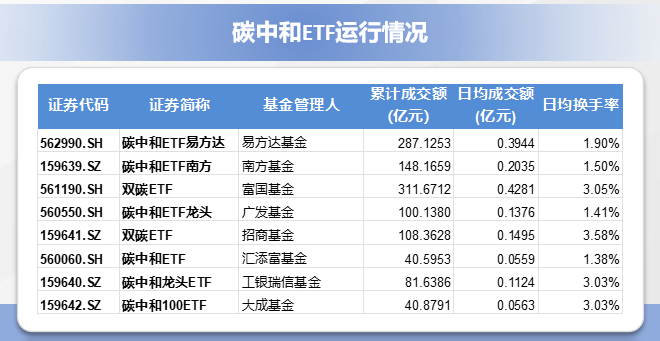
Core Viewpoint - The carbon-neutral ETFs launched by the Shanghai Environment and Energy Exchange have been operating smoothly for three years, with active trading and significant capital inflow into low-carbon sectors [1][5]. ETF Performance - Eight carbon-neutral ETFs have a cumulative trading volume of 111.858 billion yuan, with an average daily trading volume of 1.54 million yuan as of July 18, 2025 [2]. - The ETFs include various fund managers, with the highest cumulative trading volume recorded by the "Double Carbon ETF" managed by Yingguozhangguan at 31.16712 billion yuan [2][5]. - The average turnover rate for the ETFs varies, with the "Double Carbon ETF" showing a turnover rate of 3.05%, indicating good liquidity [2][5]. Fund Structure - The carbon-neutral ETFs are linked to the Shanghai Environment and Energy Exchange's carbon-neutral index, which was developed in collaboration with the Shanghai Stock Exchange and China Securities Index Co., Ltd. [4][5]. - The index utilizes a unique carbon reduction model, allowing for a broad industry inclusion and alignment with carbon neutrality pathways [4][5]. Investment Impact - The carbon-neutral ETFs have attracted over 250,000 fund holders, demonstrating significant investor interest in low-carbon investment products [6]. - The sample stocks of the carbon-neutral index have shown a significant reduction in carbon emission intensity, with an average annual decrease of 32.87% from 2016 to 2024 [6]. Industry Distribution - The weight of the ETFs is primarily concentrated in the industrial, materials, and utilities sectors, accounting for a total of 86.7% [10].
《洞见ESG》7月刊 :全国碳市场开启四周年
21世纪经济报道· 2025-07-31 13:26
Regulatory Insights - The national carbon market has seen a significant increase in both volume and price, with a transaction value exceeding 46.6 billion yuan [2] - The Ministry of Ecology and Environment highlighted the need for clearer pathways for the steel industry's green and low-carbon transition as it was included in the national carbon market this year [2] Policy Updates - Three major economic provinces are piloting the issuance of distributed green certificates, which are crucial for promoting green consumption and production [2] - The development of zero-carbon parks is accelerating, with renewable energy and digitalization companies benefiting from this trend [3] - The People's Bank of China and other regulatory bodies have included green trade and consumption in the support scope of the new green finance project directory, effective from October 1, 2025 [3] - The National Energy Administration has set mandatory consumption targets for renewable electricity, particularly for the electrolytic aluminum industry [3] Cover Article - The national carbon market has expanded to include the steel, cement, and aluminum smelting industries, covering approximately 8 billion tons of emissions, with around 3,700 key emission units expected to participate [3] Industry Insights - China's new climate goals aim to cover the entire economy and all greenhouse gases by 2035, as stated in a joint declaration with the EU [4] - The installed capacity of renewable energy in China has surpassed that of coal power, marking a significant milestone in the country's energy development [4] - 90% of large banks in China have fully disclosed their operational carbon emissions, while smaller banks are lagging behind [4] - New tea beverage companies face challenges in food safety and compliance, necessitating the integration of ESG into their strategies for long-term growth [5] - The white wine industry is increasingly looking to overseas markets for growth amid intensified domestic competition, with a reported decline in the wine index since May [6] ESG Discussions - The national carbon market's expansion is expected to add 1,500 key emission units, covering over 60% of national CO2 emissions [7] - The global focus on transition finance is growing, as traditional high-carbon industries face financing challenges while green investment continues to rise [7]
转型金融:全球气候治理下的中国机遇与挑战|封面专题
清华金融评论· 2025-07-29 09:50
Group 1 - The core viewpoint of the article emphasizes the need for a unified standard, improved data foundation, product innovation, and policy coordination to promote the development of transition finance in China, aiding in the achievement of the "dual carbon" goals [1] Group 2 - The global climate governance context highlights the necessity for financing that covers transition activities, as traditional green finance primarily supports clean energy and may not meet the substantial funding needs for high-carbon industries transitioning to low-carbon [3] - The G20 Transition Finance Framework provides guiding principles for global transition finance development, addressing issues such as defining transition activities, disclosure requirements, diversification of financial tools, incentive policies, and ensuring a just transition [6] Group 3 - In China, the rapid development of green industries under the "dual carbon" goals necessitates simultaneous low-carbon transitions in high-carbon industries to avoid bottlenecks in renewable energy demand and mitigate risks of revenue decline and potential bankruptcies in high-carbon sectors [8] - The People's Bank of China is actively promoting the development of transition finance directories, having completed initial drafts for coal power, steel, building materials, and agriculture, which outline low-carbon transition paths and standards for financial institutions [8] - Local governments in China are piloting transition finance initiatives, achieving significant progress in areas such as directory compilation, carbon account construction, and product innovation, leading to rapid growth in transition financing [8]