价值投资

Search documents
杨德龙:本轮牛市行情愈演愈烈 赚钱效应明显提升 | 立方大家谈
Sou Hu Cai Jing· 2025-08-20 11:23
Core Viewpoint - The A-share market has experienced significant gains due to low domestic interest rates, ample liquidity, policy support, and a shift of household savings into the capital market, alongside increasing expectations for a rate cut by the Federal Reserve in September [1][2][3] Market Performance - The Shanghai Composite Index has risen over 1% and surpassed 3700 points, indicating a strong upward trend and increased profitability for investors, attracting more external capital, including foreign investments [1][3] - The total market capitalization of A-shares has exceeded 100 trillion yuan, marking a historical high, with trading volumes consistently above 2 trillion yuan [4] Economic Factors - The Federal Reserve is expected to cut interest rates by 25 basis points in September, with potential further cuts by the end of the year, which could lower the benchmark rate below 4% [2][3] - The U.S. government debt has surpassed 37 trillion dollars, increasing concerns about debt repayment pressures and prompting calls for monetary easing to stabilize the economy [2] Policy Support - The Chinese government has emphasized the importance of stabilizing the real estate and stock markets, with recent meetings highlighting the need for a more inclusive and attractive capital market [3][4] - Institutional investors, including insurance funds and pension funds, have increased their allocations to equity assets, contributing to market liquidity [4] Consumer Behavior - There is a noticeable trend of household savings being redirected to the capital market, driven by low interest rates on savings accounts, with one-year deposit rates falling below 1% [4] - The shift in consumer behavior is expected to support the ongoing bull market, which is anticipated to last for two to three years, characterized by a slow and steady growth rather than rapid fluctuations [4] Technological Advancements - The fourth industrial revolution, particularly the application of artificial intelligence, is gaining momentum, with significant developments in AI models for specialized fields such as aerospace [5][6] - The humanoid robot sector is emerging as a potential new industry, attracting global attention and investment opportunities [6] Monetary Policy - The People's Bank of China has indicated a commitment to a moderately loose monetary policy, aiming to promote reasonable price recovery and stimulate consumption [7][8] - The government has set a GDP growth target of around 5% and a CPI target of 2%, with measures in place to boost consumer spending and achieve these goals [8]
航民股份:8月20日召开业绩说明会,投资者参与
Sou Hu Cai Jing· 2025-08-20 09:22
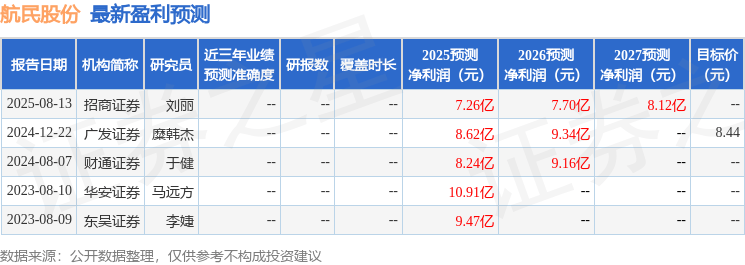
Core Viewpoint - Company reported a mixed performance in the first half of 2025, with revenue impacted by rising gold prices and declining gold jewelry sales, but managed to increase net profit due to improved product margins and cost reductions in coal and electricity [2][4]. Financial Performance - For the first half of 2025, the company's total revenue was 54.42 billion, a decrease of 2.78% year-on-year, while net profit attributable to shareholders was 3.15 billion, an increase of 5.51% year-on-year [4]. - The company's dyeing business revenue was 17.69 billion, down 8.58% year-on-year, while gold jewelry revenue reached 34.4 billion, up 0.47% year-on-year despite a 17.34% drop in sales volume [2][4]. - The second quarter of 2025 saw a revenue of 24.93 billion, up 0.91% year-on-year, and a net profit of 1.79 billion, up 5.0% year-on-year [4]. Business Strategy - The company has been focusing on optimizing its product structure, which has led to an increase in the gross margin of gold jewelry products, partially offsetting the decline in sales volume [2]. - The company has a history of stable operations and high-quality financial statements, with plans for mid-term dividends to enhance shareholder value [3]. Market Sentiment - In the last 90 days, two institutions have given buy ratings for the stock, with an average target price of 9.36 [5]. - Recent financing data indicates a net outflow of 46.855 million in the last three months, suggesting a decrease in financing balance [7].


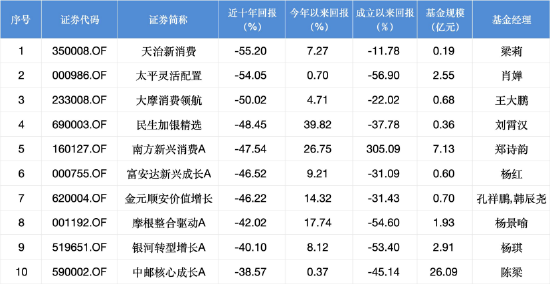
牛市也救不了的基金:太平灵活配置近十年亏损54%,十年换8将仅1人赚钱
Xin Lang Ji Jin· 2025-08-20 09:10
在A股市场沪指强势创出十年新高的背景下,权益类基金本被寄予为投资者捕捉经济增长红利的厚望。 然而Wind数据显示,过去十年间,全市场仍有154只基金收益为负,其中权益类产品达91只。这些产品 历经多轮市场周期仍未能修复净值,部分甚至仍处于深跌状态,与市场整体走势形成强烈反差。 | 近十年权益类基金跌幅 | | --- | TOP10 数据来源:Wind 截止至20250819 从单只产品看,太平灵活配置基金以近十年-54.05%的回报率,在权益类基金跌幅榜中位列第二,自 2015年2月成立以来总回报为-56.90%,意味着初始投资者至今亏损过半。 深度剖析其逐年业绩,该基金几乎完全丧失了绝对收益和相对收益能力。在2016至2018年、2021至2024 年长达数年的时间里,该基金连续出现显著亏损,尤其在2022年市场调整中单年暴跌36.51%,2024年 再度下跌19.09%。更致命的是,其几乎在每一个年度都大幅跑输业绩比较基准,在某些年份落后基准 甚至超过30个百分点,表明其"灵活配置"策略从风险控制和超额收益获取层面已全面失效。 | 生份 | 太平灵活配置 | 太平灵活配置基准 | F 300 | | - ...
富兰克林邓普顿:对港、A股看法仍偏乐观 投资宜注重选股部署
Zhi Tong Cai Jing· 2025-08-20 07:26
Group 1 - The investment outlook for Hong Kong and A-shares remains optimistic, with current valuations considered reasonable and Chinese companies benefiting from supportive policies [1] - Stock selection is emphasized over index betting, as some non-index stocks have performed strongly while certain index constituents have underperformed [1] - A bottom-up stock selection approach is adopted, focusing on valuation and structural growth without making index predictions [1] Group 2 - Two categories of stocks are recommended for balancing portfolios: quality growth stocks for long-term capital appreciation and high-dividend income stocks for defensive strength [2] - The decline of "American exceptionalism" and expectations of a weaker dollar are seen as beneficial for the performance of the Asia-Pacific stock market [2] - China is perceived to be on a clear path towards technological development, particularly in building a robust robotics industry ecosystem [2]
“踔厉奋发新征程 投教服务再出发” ——走进深交所上市公司一心堂
Quan Jing Wang· 2025-08-20 06:13
Core Viewpoint - The event "Striving for a New Journey, Investor Education Services Restart" successfully facilitated direct communication between investors and the listed company Yixin Tang, enhancing investor understanding of the company's operations and strategic development [1][4]. Group 1: Event Overview - The event was organized by Guotai Junan Securities with guidance from Shenzhen Stock Exchange, Yunnan Securities Regulatory Bureau, Yunnan Securities Industry Association, and Yunnan Listed Companies Association [1]. - Investors participated in immersive visits and face-to-face exchanges at Yixin Tang's headquarters, gaining insights into the operations of the leading pharmaceutical retail company [1]. Group 2: Company Insights - Investors toured the corporate culture honor room and logistics center, observing the efficient operation of the logistics sorting system, which highlighted the company's standardized supply chain management [2]. - Yixin Tang's Vice President and Board Secretary, Li Zhenghong, provided a comprehensive introduction to the company's listing history and core business segments, including retail, traditional Chinese medicine, healthcare, and e-commerce [3]. Group 3: Industry Analysis - The Chief Investment Advisor of Guotai Junan Securities Yunnan Branch discussed the pharmaceutical industry policies expected in the second half of 2025, analyzing industry trends and investment opportunities [3]. - During the Q&A session, investors raised questions about key annual report indicators, market expansion pace, and the progress of healthcare projects, to which Li Zhenghong responded in detail, emphasizing the company's commitment to transparency and investor relations [3]. Group 4: Future Directions - Guotai Junan Securities plans to continue organizing investor education activities, fostering communication between investors and listed companies, and promoting a healthy capital market ecosystem [4].


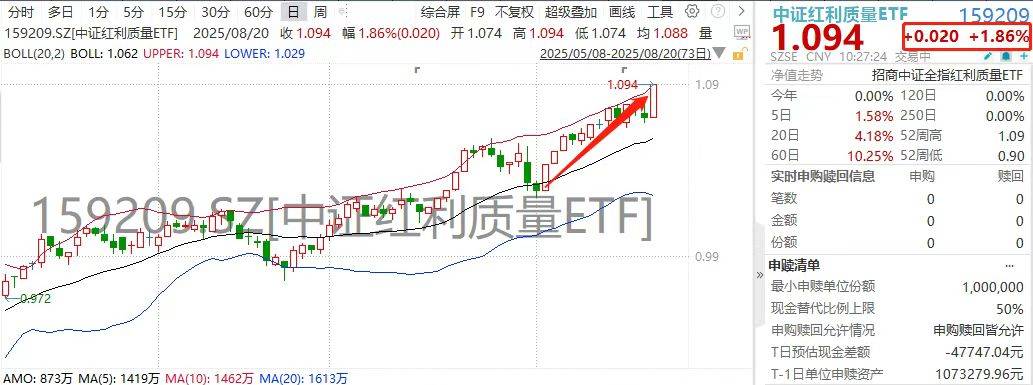
前10大权重两个涨停!中证红利质量ETF(159209)冲击第28次新高!福耀玻璃、吉比特10CM封板!
Sou Hu Cai Jing· 2025-08-20 02:39
Core Insights - The performance of high-quality stocks surged on August 20, with the CSI Dividend Quality ETF (159209) increasing by 1.77% and stocks like Fuyao Glass and Gigabit Technology hitting the upper limit of their trading range [1] Company Performance - Fuyao Glass (600660) reported a revenue of 21.447 billion yuan for the first half of 2025, representing a year-on-year increase of 16.95%. The net profit attributable to shareholders was 4.805 billion yuan, up 37.33% year-on-year. The second quarter of 2025 exceeded market expectations due to improved overseas profitability [1] - Gigabit Technology announced a net profit of approximately 645 million yuan for the first half of 2025, reflecting a year-on-year increase of 24.5%. The company plans to distribute a cash dividend of 66.00 yuan per 10 shares (including tax) to all shareholders [1] Investment Strategy - The CSI Dividend Quality ETF employs a "dividend + quality" dual-factor screening mechanism to identify high-quality companies with both "low valuation" and "high quality" competitive advantages. This investment philosophy aligns closely with Warren Buffett's value investment logic of investing in excellent companies at reasonable prices [1] - The combination of the CSI Dividend Quality ETF (159209) in the A-share market and the Hong Kong Dividend Low Volatility ETF (520550) can create a cross-market "dumbbell strategy" that balances offensive and defensive positions while diversifying risks across two markets. Additionally, the low fee structure and monthly dividends are expected to enhance long-term returns [1]

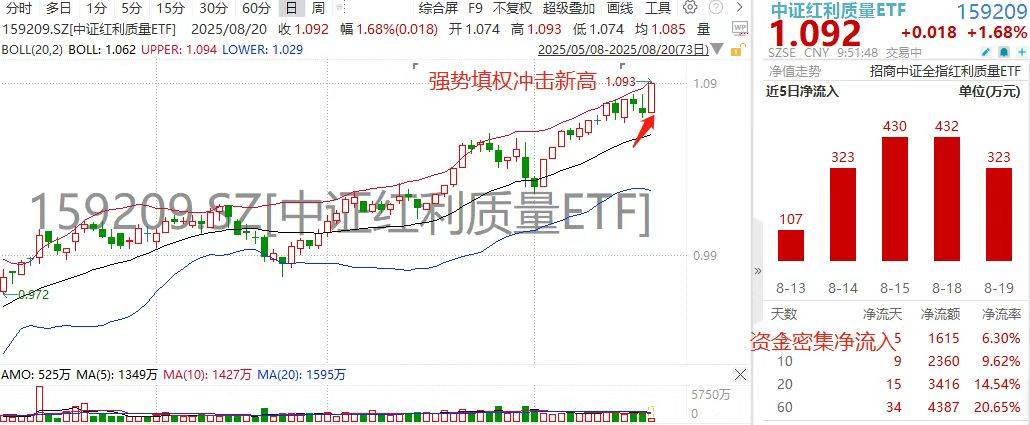
强势填权!中证红利质量ETF(159209)放量飙涨1.58%冲新高,资金连续7日汹涌加仓
Sou Hu Cai Jing· 2025-08-20 02:04
Core Insights - The Shanghai Composite Index opened lower but saw a rise, with the CSI Dividend Quality ETF (159209) increasing by 1.58%, marking its 28th new high of the year as of 9:49 AM on August 20 [1] - The CSI Dividend Quality ETF has experienced a continuous net inflow of funds for seven consecutive days as of August 19 [1] Fund Characteristics - The CSI Dividend Quality ETF employs a "dividend + quality" dual-factor screening mechanism to identify high-quality companies that possess both "low valuation" and "high quality" attributes [1] - This investment philosophy aligns closely with Warren Buffett's value investment logic of "investing in excellent companies at reasonable prices" [1] Investment Strategy - The combination of the CSI Dividend Quality ETF (159209) in the A-share market and the Hong Kong Dividend Low Volatility ETF (520550) can create a cross-market "dumbbell strategy" that balances offensive and defensive positions while diversifying risks across two markets [1] - The product design features low fees and monthly dividends, which are expected to enhance long-term returns for investors [1]
今日视点:“三投资”理念护航A股长牛
Zheng Quan Ri Bao· 2025-08-19 23:28
Group 1 - The A-share market has reached significant milestones, with the Shanghai Composite Index hitting a nearly 10-year high and the total market capitalization surpassing 100 trillion yuan [1] - Regulatory bodies have been promoting long-term capital inflow and encouraging rational, value, and long-term investment philosophies, which are crucial for the market's robust performance [1][2] - The implementation of registration system reforms and strict enforcement of delisting regulations have contributed to a more transparent and vibrant market ecosystem [1][2] Group 2 - Long-term capital, including social security funds, pensions, and insurance funds, is continuously flowing into the market, reinforcing the consensus on value investing [2] - As of the end of Q2 this year, the stock investment balance of life and property insurance companies has been steadily increasing, with foreign capital net increasing by 10.1 billion USD in domestic stocks and funds in the first half of the year [2] - The overall quality of listed companies is improving, with a focus on core business, increased R&D investment, and enhanced corporate governance, leading to stronger competitive advantages and sustainable development [2][3] Group 3 - Mergers and acquisitions are becoming a vital method for listed companies to enhance development quality and market competitiveness, with 118 companies announcing significant asset restructuring this year [3] - The awareness of returning value to shareholders is increasing, with cash dividends for A-share companies projected to reach 2.4 trillion yuan in 2024, a 9% increase from 2023 [3] - The trend of companies actively rewarding investors is gaining momentum, providing further confidence for long-term investments [3]
证券日报:“三投资”理念护航A股长牛
Zheng Quan Ri Bao· 2025-08-19 22:59
炒股就看金麒麟分析师研报,权威,专业,及时,全面,助您挖掘潜力主题机会! 转自:证券日报 并购重组是上市公司提升发展质量和市场竞争力的重要方式。Wind资讯数据显示,今年以来截至8月19 日,A股共有118家上市公司公布重大资产重组事项,产业整合活力加速释放,助力企业进一步培育新 的盈利增长点。 上市公司回报股东意识也显著增强。据中国上市公司协会披露的数据,2024年度沪深A股上市公司现金 分红总额为2.4万亿元,较2023年度增长9%;连续分红的上市公司数量逐年增多。随着2025年半年报陆 续披露,截至8月19日,已有逾百家公司披露2025年中期分红预案,A股上市公司积极回馈投资者渐成 风尚,进一步为长期投资提供信心。 ■张敏 8月18日,A股迎来两大重要里程碑:上证指数创出近10年新高,A股总市值首次突破100万亿元大关。 近年来,监管层持续推动中长期资金入市,引导树立理性投资、价值投资、长期投资的理念,为资本市 场深化改革与健康发展指明路径。笔者认为,当下A股市场的强劲表现,背后有着政策制度、资金和企 业基本面等多重支撑,也与践行"三投资"理念(理性投资、价值投资、长期投资)息息相关。 其一,制度根基不 ...
CNXC or TRI: Which Is the Better Value Stock Right Now?
ZACKS· 2025-08-19 16:41
Core Insights - Investors in the Business - Services sector should consider Concentrix Corporation (CNXC) and Thomson Reuters (TRI) for potential value opportunities [1] Valuation Metrics - CNXC has a forward P/E ratio of 4.14, significantly lower than TRI's forward P/E of 44.92 [5] - CNXC's PEG ratio is 0.57, while TRI's PEG ratio is 5.61, indicating CNXC is more favorably valued in terms of expected earnings growth [5] - CNXC's P/B ratio is 0.72 compared to TRI's P/B of 6.18, further suggesting CNXC is undervalued relative to its book value [6] Earnings Outlook - CNXC holds a Zacks Rank of 2 (Buy), indicating a positive earnings estimate revision trend, while TRI has a Zacks Rank of 3 (Hold) [3] - The stronger estimate revision activity for CNXC suggests a more favorable earnings outlook compared to TRI [7] Value Grades - CNXC has a Value grade of A, while TRI has a Value grade of F, highlighting CNXC's superior valuation metrics [6]