
多边主义

Search documents
特朗普威胁金砖国家,卢拉反驳:世界不需要皇帝
Guan Cha Zhe Wang· 2025-07-08 00:54
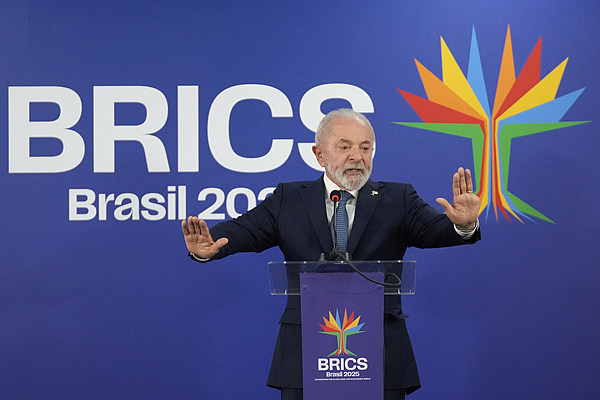
观察者网消息,金砖国家的开放合作之声在南美响起之际,美国总统特朗普又挥舞起他的关税"大刀", 甚至又一次公然向金砖国家发出威胁,这很快引发金砖国家反击。 当地时间7月7日,在金砖国家领导人里约热内卢峰会后,巴西总统卢拉接受采访时猛批特朗普的威胁, 他告诉记者:"世界已经变了,我们不需要一个皇帝。"卢拉强调,金砖国家想要从经济角度寻找另一种 全球组织方式,这正是某些人感到不安的原因。 中国外交部发言人毛宁7日下午在例行记者会上应询表示,"关于加征关税,中方已经多次阐明了立场 ——贸易战、关税战没有赢家,保护主义没有出路。" 据路透社报道,在里约热内卢举行的金砖峰会结束时,当记者问及特朗普的关税威胁时,卢拉坚定地表 示:"世界已经变了。我们不需要一个皇帝。" 2025年7月7日,巴西里约热内卢,巴西总统卢拉在第17届金砖国家峰会新闻发布会上讲话。视觉中国 卢拉再次表达了他关于全球贸易应当摆脱对美元依赖的看法。 "世界必须找到一种方式,使我们的贸易关系不必非要通过美元来进行。"卢拉在峰会结束后的记者会上 表示。 "当然,我们必须对此采取谨慎负责的态度。我们的中央银行需要与其他国家的中央银行进行讨论,"他 补充道," ...

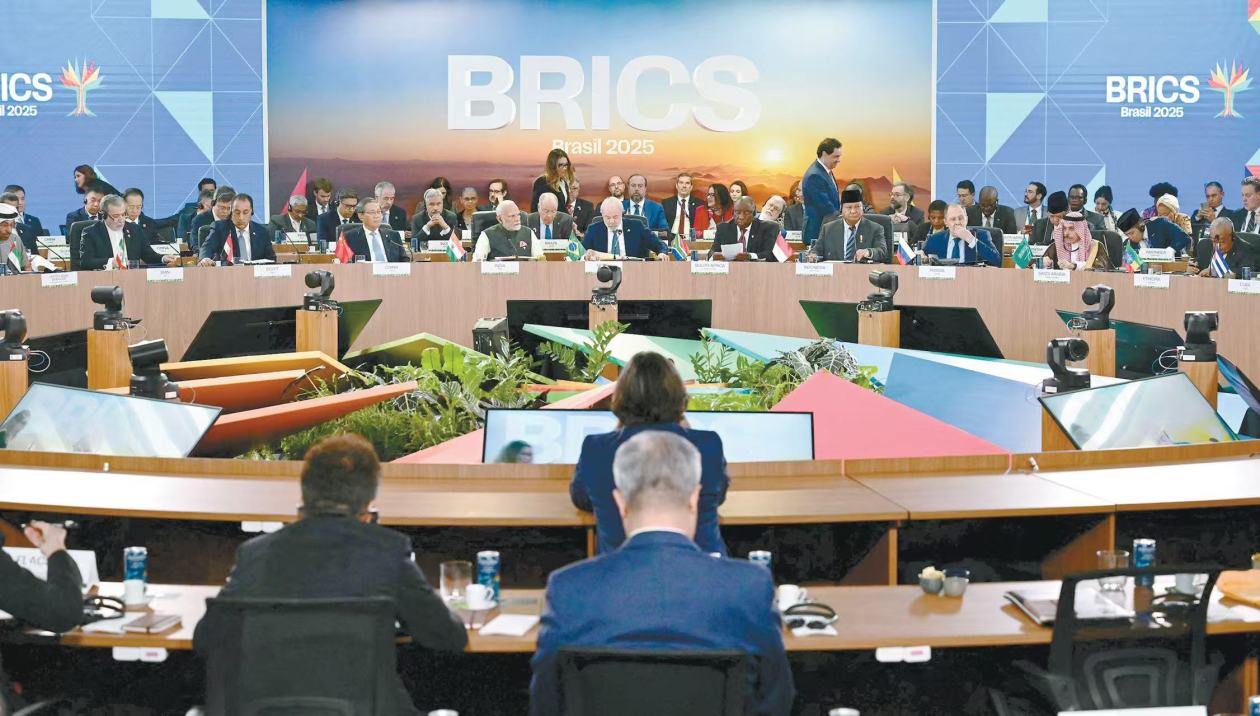
李强出席金砖国家领导人第十七次会晤第二及第三阶段会议
news flash· 2025-07-08 00:21
Core Viewpoint - The current international economic and trade order and multilateral trade system are facing severe challenges, making global economic recovery difficult [1] Group 1: International Economic Order - The "Big BRICS Cooperation" should adhere to its founding purpose, align with the needs of the times, and uphold multilateralism [1] - There is a call to promote the construction of a fair and open international economic order [1] Group 2: Global South Cooperation - The meeting aims to unite the global South to contribute more to world stability and development [1]
围绕三大支柱加强相互合作,警告单边关税违反世贸规则,里约金砖峰会共话全球治理
Huan Qiu Shi Bao· 2025-07-07 22:58
Group 1: Key Points from the BRICS Summit - The BRICS summit emphasizes the need for reform in global governance to adapt to 21st-century challenges, with a focus on multilateralism and cooperation among developing countries [1][3][5] - Brazilian President Lula criticized the rising military expenditures and the NATO decision to increase defense budgets, highlighting the need for investment in peace rather than war [3][4] - The summit resulted in the adoption of the "Rio de Janeiro Declaration," which reaffirms the commitment to multilateralism and addresses concerns over unilateral trade measures that could undermine global trade [5][6] Group 2: Initiatives and Proposals - China announced the establishment of a new productivity research center and a scholarship program aimed at fostering talent in industrial and communication sectors among BRICS nations [3][4] - Russian President Putin called for increased mutual investment among BRICS members and emphasized the importance of using local currencies for trade settlements [4][7] - The summit addressed various global issues, including artificial intelligence governance, climate change, and energy transition, showcasing a unified stance among BRICS countries [6][8] Group 3: Responses to External Pressures - The summit took place against a backdrop of U.S. tariffs and threats against countries aligning with BRICS, with officials asserting that BRICS is not an anti-U.S. coalition but a platform for cooperation [7][8] - The BRICS nations are exploring ways to reduce dependency on the U.S. dollar, with Brazil proposing a common currency for trade and investment among member states [7][8]
阿根廷前科技创新部部长菲尔穆斯:中国实践表明,经济增长与普惠共享可兼顾
Huan Qiu Shi Bao· 2025-07-07 22:39
Group 1 - The 17th BRICS summit was held in Brazil, with a series of events aimed at enhancing understanding and cooperation between China and Latin America [1] - The exhibition "Hand in Hand Across Mountains and Seas: A Decade of Sustainable Development Cooperation between China and Latin America" received positive feedback in Argentina [1] - The book "The Voice of Latin America," authored by Daniel Filmus, aims to provide insights into Latin American realities for Chinese readers [2][3] Group 2 - Latin American countries are increasingly prioritizing regional interests and strengthening relations with countries like China, moving away from historical alliances with the United States [3] - The book discusses the challenges faced by Latin American nations in economic development, regional integration, and democratic construction [3] - The root causes of poverty and inequality in Latin America are linked to colonial-era economic structures, which have not been fundamentally transformed [4] Group 3 - The concept of global South cooperation and China's development model are seen as crucial for achieving equitable economic growth in Latin America [4][5] - Latin American countries are embracing multilateralism and seeking to establish their own identity separate from U.S. influence [5] - The historical context of China-Latin America cooperation dates back to the 1980s, with significant agreements signed in the 2000s and 2010s [6][7] Group 4 - Recent collaborations between China and Argentina in biotechnology, agriculture, and space exploration have shown promising results [7] - The establishment of research centers and exchange programs highlights the deepening of scientific and technological cooperation between the two regions [7] - China's governance model and political culture are viewed as significant contributions to global development practices [7]
守护历史记忆 捍卫世界和平(和音)
Ren Min Ri Bao· 2025-07-07 22:28
Group 1 - The commemoration of the 88th anniversary of the outbreak of the Chinese People's War of Resistance against Japanese Aggression emphasizes the importance of remembering history to pave the way for future peace and development [1][4] - The event highlights China's commitment to defending justice and peace, reinforcing its determination to pursue a path of peaceful development and maintain world peace [1][4] - The exhibition titled "For National Liberation and World Peace" showcases the arduous journey of the Chinese people during the 14 years of resistance against Japanese aggression, serving as a collective memory of a history filled with suffering and glory [1][2] Group 2 - The Chinese People's War of Resistance against Japanese Aggression played a significant role in saving human civilization and safeguarding world peace, being a crucial part of the global anti-fascist war [2][3] - Historical data indicates that the Chinese forces eliminated over 1.5 million Japanese troops, accounting for more than 70% of Japan's total casualties in World War II, demonstrating the decisive impact of the Chinese battlefield on Japan's defeat [2][3] - The event calls for a correct understanding of World War II history to protect justice and maintain international order, urging the international community to oppose any denial or distortion of historical facts [3][4] Group 3 - The commemoration serves as a reminder that historical memory and truth will not fade over time, emphasizing the importance of respecting history while caring for the future of humanity [4] - China expresses its unwavering commitment to walk the path of peaceful development alongside other nations, ensuring that the light of peace continues to shine on the planet [4]
金砖国家领导人第十七次会晤里约热内卢宣言(摘要)
Xin Hua She· 2025-07-07 12:50
Group 1: Core Principles and Cooperation - The BRICS spirit emphasizes mutual respect, equality, unity, democracy, openness, inclusiveness, deepening cooperation, and consensus [1] - The expansion of BRICS includes new member countries such as Indonesia and partner countries like Belarus, Bolivia, Kazakhstan, Cuba, Nigeria, Malaysia, Thailand, Vietnam, Uganda, and Uzbekistan [1] - Initiatives like the BRICS Leaders' Climate Fund Framework Declaration and the statement on global governance of artificial intelligence highlight the commitment to addressing urgent global issues [1] Group 2: Multilateralism and Global Governance Reform - There is a commitment to reforming global governance to create a more just, fair, and effective international system, emphasizing the importance of multilateralism and adherence to international law [2] - The BRICS nations recognize the potential of a multipolar world to provide opportunities for emerging markets and developing countries [2] - The need for comprehensive reform of the United Nations Security Council to enhance representation and effectiveness is reiterated [3] Group 3: Economic and Financial Cooperation - The International Monetary Fund (IMF) must maintain sufficient resources and agility, with a focus on increasing the representation of emerging markets and developing economies [4] - Concerns are raised about the rise of trade restrictions and their negative impact on global trade and economic development [5] - The New Development Bank is recognized for its strategic role in supporting development and modernization in the Global South [8] Group 4: Climate Change and Sustainable Development - There is a strong commitment to multilateralism in addressing climate change, with calls for developed countries to provide timely and affordable climate financing to developing nations [11] - Opposition to unilateral and discriminatory trade measures under the guise of environmental concerns is emphasized [11] - The importance of achieving a just and inclusive energy transition is highlighted, with a focus on sustainable development goals [11] Group 5: Human, Social, and Cultural Development - The BRICS nations reaffirm their commitment to promoting democracy, human rights, and fundamental freedoms [13] - There is an emphasis on enhancing women's rights and leadership across various fields [13] - Collaboration in health initiatives, including vaccine research and the application of artificial intelligence in health systems, is supported [13]
外交部谈王毅访问德国、法国 共防霸权冲突和阵营对立
news flash· 2025-07-07 08:21
外交部谈王毅访问德国、法国 共防霸权冲突和阵营对立 王毅外长强调,当前国际形势变乱交织,中德、中法作为世界主要大国,理应加强战略沟通协作,共同 践行多边主义,反对单边霸凌,抵制阵营对抗,为世界注入更多确定性和可预测性。 双方要落实好元首共识,增进理解互信,保持开放合作,加强人文交流,妥处矛盾分歧,推动中德、中 法关系持续稳定发展。 今年是中欧建交50周年,当前形势下中欧加强战略合作正当其时。中方乐见法、德作为欧盟核心大国, 带动欧盟实现战略自主,树立客观、理性、正确的对华认知,妥善处理中欧经贸分歧,共同促进中欧关 系向前发展。 智通财经7月7日电,据央视新闻,外交部发言人毛宁7月7日主持例行记者会。有记者提问,王毅外长日 前结束对德国、法国的访问,发言人能否进一步介绍王毅外长的访问情况? 毛宁介绍,王毅外长访问德国期间,王毅外长同德国总理默茨举行会见,同瓦德富尔外长共同主持了第 八轮中德外交与安全战略对话,还会见了总理外交与安全政策顾问绍特尔。 访问法国期间,王毅外长会见了马克龙总统,同巴罗外长举行会谈,并共同主持第七次中法高级别人文 交流机制会议。 德方、法方领导人均表示高度重视对华关系,强调当今时代充满危 ...
外交部介绍王毅访欧情况:中欧建交50年之际加强战略合作正当时
news flash· 2025-07-07 07:27
金十数据7月7日讯,外交部发言人毛宁主持例行记者会。外交部发言人毛宁表示,王毅外长强调,当前 国际形势变乱交织,中德、中法作为世界主要大国,理应加强战略沟通协作,共同践行多边主义,反对 单边霸凌,抵制阵营对抗,为世界注入更多的确定性和可预测性。双方要落实好元首共识,增进理解互 信,保持开放合作,加强人文交流,妥处矛盾分歧,推动中德、中法关系持续稳定发展。今年是中欧建 交50周年。当前形势下,中欧加强战略合作正当其时。中方乐见法德作为欧盟核心大国,带动欧盟实现 战略自主,树立客观、理性、正确的对华认知,妥善处理中欧经贸分歧,共同促进中欧关系向前发展。 (澎湃) 外交部介绍王毅访欧情况:中欧建交50年之际加强战略合作正当时 ...
中国行我也行!印度对美态度转变,甩出大招反击,特朗普骑虎难下
Sou Hu Cai Jing· 2025-07-07 05:05
Group 1 - The U.S. strategy of using tariffs to dominate global trade is facing unprecedented challenges, particularly highlighted by the 25% tariff on global automobiles, which has sparked strong international backlash and intensified geopolitical tensions [1] - India has retaliated against the U.S. with counter-tariffs on agricultural products, leveraging its $2.8 billion automotive parts exports to the U.S. as a bargaining chip [2][4] - The U.S. Midwest agricultural states, especially those reliant on soybean and almond exports to India, are experiencing significant economic impacts, leading to decreased farmer incomes and threatening political support for the ruling party [6] Group 2 - India's actions are driven by multiple considerations, including the need to protect its economic interests and the desire to enhance its international standing by challenging U.S. tariff policies at the WTO [3][4] - The political ramifications for the U.S.-India relationship are severe, with potential congressional pushback against military cooperation projects due to trade tensions [7] - The U.S. is also adjusting its approach towards China, allowing certain exports, indicating a strategic shift to seek a "soft landing" in its trade war while recognizing China's critical role in global supply chains [9][13] Group 3 - The response from India, the EU, and Japan to U.S. unilateralism indicates a shift towards a more multilateral global trade environment, undermining the effectiveness of the U.S. strategy [15] - The U.S. is attempting to use India as a strategic partner in the Indo-Pacific to counterbalance China, while India maintains a careful balance in its foreign relations [13]
升级自贸协定,中格首轮谈判在京举行
news flash· 2025-07-07 04:35
Core Viewpoint - The second meeting of the Joint Committee for the China-Georgia Free Trade Agreement and the first round of negotiations for the agreement's upgrade took place in Beijing on July 3-4, 2023, highlighting the commitment of both countries to enhance trade and investment liberalization amidst global protectionism [1] Group 1: Agreement Upgrade Details - The China-Georgia Free Trade Agreement officially came into effect on January 1, 2018, and the current upgrade includes four chapters: sanitary and phytosanitary measures, technical trade barriers, investment, and e-commerce [1] - The upgrade is described as a comprehensive optimization and expansion of the existing agreement, aimed at deepening economic and trade relations between the two countries [1] Group 2: Strategic Implications - The Ministry of Commerce emphasized that the upgrade reflects a strong determination and practical action from both countries to promote trade and investment liberalization and to practice true multilateralism [1] - The agreement is expected to inject new momentum into the economic and trade cooperation between China and Georgia, with hopes to fully explore trade potential and enhance connectivity [1]