绿色转型

Search documents
(投资中国)阿法拉伐:在华深耕超40年 持续深化投资布局
Zhong Guo Xin Wen Wang· 2025-08-23 14:40
Core Insights - Alfa Laval has over 40 years of experience in the Chinese market and plans to deepen its investment in the region, which is expected to become its largest market globally by 2024, surpassing North America [1][2] - The Chinese government has implemented policies to attract foreign investment, creating a favorable environment for companies like Alfa Laval, which aligns with its strategic focus on renewable energy and sustainable development [1][2] - The company has expanded its investments in various locations in China, including Kunshan, Qingdao, Taicang, and Jiangyin, and has achieved significant results through continuous investment and strategic planning [2] Industry Insights - Shanxi province, as a key energy base in China, has made significant progress in energy revolution and green transformation, presenting substantial development opportunities for companies in the sector [2] - The Taiyuan Taikoo heating project, which replaced coal-fired boilers with large-scale waste heat long-distance heating, exemplifies the shift towards clean heating solutions in northern China, supported by Alfa Laval's efficient plate heat exchangers [2] - The focus on high-end manufacturing, green energy, and sustainable development in China is expected to drive future growth in the industry, with Alfa Laval aiming to enhance market expansion, capacity building, and innovation investments [2]
超万亿度电,见证中国经济转型的世界意义
Sou Hu Cai Jing· 2025-08-23 03:23
Core Insights - In July, China's total electricity consumption exceeded 1 trillion kilowatt-hours for the first time, reaching 10,226 billion kilowatt-hours, a year-on-year increase of 8.6%, reflecting the economic vitality and high-quality development of China [2][4] - The record electricity consumption is a result of both economic activity and the resilience of China's energy supply system, with foreign investment confidence in China's economy continuing to rise [2][3] Industry Analysis - The first industry saw a significant electricity consumption increase of 20.2%, indicating a trend towards agricultural modernization through the adoption of electrified equipment [3] - The second industry, particularly high-tech and equipment manufacturing, showed notable growth in electricity consumption, while traditional high-energy-consuming industries experienced a decline, highlighting the industrial economy's shift towards high-end and intelligent transformation [3] - The third industry, especially the internet services and charging services sectors, experienced a surge in electricity consumption, reflecting the expansion of the digital economy and green transportation [3] Energy Transition - The increase in electricity consumption is underpinned by a green energy transition, with renewable energy sources like wind, solar, and biomass accounting for nearly 25% of total electricity generation in July [3][4] - China's electricity consumption growth is projected to increase by 5%-6% by 2025, with total consumption expected to exceed 13 trillion kilowatt-hours by 2030, indicating a robust energy security and structural optimization [4] Global Implications - China's rapid electrification signifies that a large-scale economy can achieve growth while advancing green transformation, providing a practical example for other countries pursuing low-carbon development [5] - The optimization and cleaning of China's electricity structure enhance global climate governance and energy security, presenting a shared opportunity for sustainable growth worldwide [5]

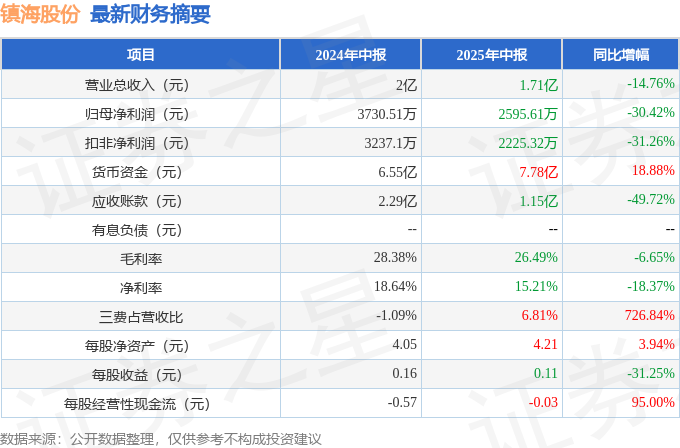
镇海股份2025年中报简析:净利润同比下降30.42%,公司应收账款体量较大
Zheng Quan Zhi Xing· 2025-08-22 22:42
Financial Performance - The company reported total revenue of 171 million yuan for the first half of 2025, a decrease of 14.76% year-on-year [1] - The net profit attributable to shareholders was 25.96 million yuan, down 30.42% compared to the previous year [1] - The gross margin was 26.49%, a decline of 6.65% year-on-year, while the net margin was 15.21%, down 18.37% [1] - The company’s accounts receivable reached 118.39% of the net profit, indicating a significant amount of receivables relative to earnings [7] Cash Flow and Financial Ratios - Operating cash flow improved by 95% due to better collection efficiency on project payments [4] - The company’s return on invested capital (ROIC) was 7.61%, which is considered average [5] - The company’s total liabilities and financial health indicators suggest a strong cash position [6] Industry Context - The petrochemical industry is crucial for the national economy, characterized by long supply chains and high capital intensity [8] - Investment in the chemical raw materials and products manufacturing sector grew by 8.6% year-on-year, while the oil and gas extraction sector saw a decline of 1.8% [9] - The industry is undergoing a transformation towards green and smart technologies, with a focus on high-quality development [8] Competitive Position - The company has a strong brand reputation and technical expertise in the petrochemical engineering sector, focusing on differentiated competition [11] - It operates in a strategic location in the Yangtze River Delta, a key area for the petrochemical industry in China [11] - The company has a robust order backlog, with contracts worth 277 million yuan yet to be fulfilled [12] Future Outlook - The company aims to maintain its existing business while exploring new opportunities in coal chemical projects and overseas markets [13][16] - The strategic focus includes enhancing operational quality and efficiency, with a dual approach of industrial operations and capital management [17]

中矿资源(002738) - 002738中矿资源投资者关系管理信息20250822
2025-08-22 13:13
Financial Performance - In the first half of 2025, the company achieved operating revenue of 326,672.53 million yuan, a year-on-year increase of 34.89% [6] - The net profit attributable to shareholders decreased by 8,912.89 million yuan, representing a decline of 81.16% compared to the same period last year [6] - Basic earnings per share were 0.1235 yuan, down 81.16% year-on-year [6] - As of June 30, 2025, total assets amounted to 1,731,156.19 million yuan, a growth of 0.69% from the end of the previous year [6] - Net assets attributable to shareholders were 1,191,496.59 million yuan, down 2.19% from the previous year [6] Rare Light Metals Segment - The rare light metals (cesium and rubidium) segment saw significant growth, with operating revenue reaching 50.43% year-on-year increase [6] - Gross profit for this segment increased by 50.15% [6] - The cesium and rubidium salt fine chemical business generated 3.11 billion yuan in revenue, a 24.93% increase year-on-year [6] - The cesium formate rental business achieved 3.01 billion yuan in revenue, growing by 107.63% [6] Lithium Battery New Energy Segment - The company sold 17,869 tons of lithium salt, a year-on-year increase of approximately 6.37% [8] - Direct sales of spodumene concentrate reached 34,834 tons [8] - A comprehensive technical upgrade of the lithium salt production line is underway, with an investment in a new project expected to yield 30,000 tons of high-purity lithium salt annually [8] Copper and Germanium Business - The company acquired a 65% stake in the Kitumba copper mine project, with a designed capacity of 60,000 tons of cathode copper per year [9] - The Kitumba project is progressing as planned, with construction of mining and processing facilities underway [9] - The company also acquired a 98% stake in the Tsumeb project, which will have a designed capacity of 33 tons of germanium ingots per year [10] Future Development Plans - The company aims to complete the Kitumba copper mine construction by 2026, targeting an annual capacity of over 100,000 tons within five years [11] - Plans to solidify its leading position in the cesium and rubidium industry while developing the Tsumeb Smelter as a multi-metal recycling center in Southern Africa [11] - The company will maintain competitive lithium salt production costs and continue to explore high-quality mineral resources globally [11]

决胜“十四五” 打好收官战|持续改善环境质量 让蓝天碧水成为生活日常
Xin Hua She· 2025-08-22 08:54
Group 1: Air Quality Improvement - The "14th Five-Year Plan" emphasizes the importance of precise pollution control, leading to a significant improvement in air quality across the country, with PM2.5 levels expected to average 29.3 micrograms per cubic meter by 2024 and good air quality days reaching 87.2% [2][3] - The steel industry, represented by Shougang's Tangshan Steel, has implemented a comprehensive approach to achieve ultra-low emissions throughout the production process, enhancing the quality of life for surrounding communities [2][3] Group 2: Water Quality Management - Zhejiang's pearl farming industry has adopted innovative practices to reduce pollution, demonstrating that green technology can enhance productivity while minimizing environmental impact [4] - By the end of 2024, over 330,000 river discharge outlets and 57,000 sea discharge outlets have been identified and addressed, with completion rates for pollution control in major river basins and coastal areas reaching 90% and 84% respectively [4][5] Group 3: Soil and Waste Management - Chongqing's waste management initiatives, including the use of AI in waste incineration, are part of a broader strategy to create a "waste-free city," processing 4,500 tons of waste daily [6] - The national rate of safe utilization of contaminated farmland has reached 92%, with significant progress in rural environmental remediation and solid waste management initiatives [6][7]
矿建公司召开2025年年中经营活动分析会—锚定目标冲刺全年任务
Zhong Guo Neng Yuan Wang· 2025-08-22 07:46
Core Insights - The company held a mid-year operational analysis meeting to summarize the first half of the year and set priorities for the second half, aiming for high-quality completion of annual goals [1][2] Group 1: Operational Performance - In the first half of the year, the company achieved 52.21% of its total cost completion target, indicating steady operational efficiency improvements [1] - Core business areas such as geological exploration, surveying, and fire rescue maintained a solid foundation, with key tasks progressing on schedule [1] - The company successfully completed emergency tasks related to energy supply, maintaining a stable safety production situation, and achieving "zero minor injuries" in exploration and rescue operations [1] Group 2: Challenges and Strategic Focus - Current challenges include safety management risks, pressure on operational indicators, and the need for further refinement in management and efficiency improvements [2] - The general manager emphasized three key requirements for the second half: recognizing achievements while addressing shortcomings, focusing on safety management and budget execution, and enhancing accountability and execution effectiveness [2] - The meeting outlined a clear direction for the company's second-half efforts, aiming to contribute to the Inner Mongolia company's "green transformation and striving for a hundred billion" strategic goal [2]
从“伤疤”到“财富”、从“砍”到“看” 绿水青山让百姓吃上“旅游饭”
Yang Shi Wang· 2025-08-22 07:42
Group 1 - The core viewpoint of the article highlights the transformation of Xuzhou Peixian from a coal mining area with severe environmental issues to a green and ecologically sustainable region, exemplified by the establishment of the Anguo Lake National Wetland Park [1][4] - The ecological restoration efforts in Peixian have involved the remediation of approximately 116 million cubic meters of collapsed land and the recovery of over 38 hectares of vegetation [7] - Since becoming a national wetland park in 2021, Anguo Lake has seen an increase in recorded wild bird species from 89 to over 140, with a wetland coverage rate of 75.84% [10] Group 2 - In Yichun, Heilongjiang, the region has shifted from logging to tourism, with the number of farmhouses increasing from 1 in 2016 to 42, following the cessation of commercial logging in 2014 [14] - The Blue Pine Lake in Baiyu County, Sichuan, is recognized for its unique geological and ecological significance, attracting research institutions for long-term observation [18]

全球化视角下的手持激光焊接市场格局与技术趋势
Sou Hu Cai Jing· 2025-08-22 06:22
Core Insights - The integration of Industry 4.0 with advanced welding technology is driving a new efficiency revolution in global manufacturing, with handheld laser welding technology emerging as a key enabling technology in this era [1][16] - By 2025, the global handheld laser welding market is expected to show distinct patterns, with China leading in large-scale adoption, Europe and the US focusing on high-value technological breakthroughs, and emerging markets becoming significant growth areas [1] Global Market Landscape - **Regional Competition and Technological Differentiation**: The market is characterized by varying levels of technological advancement and competitive strategies across different regions [3] - **Asian Market**: China has become the manufacturing hub and largest consumer market for handheld laser welding, driven by policy support, cost optimization, and industry chain collaboration. Southeast Asia, particularly Vietnam and India, is experiencing rapid demand growth due to manufacturing shifts [5] - **European and American Markets**: The focus is on high precision and high power, primarily in high-end manufacturing sectors like aerospace and automotive. However, high equipment costs and technical barriers limit market expansion [6] - **Emerging Markets**: In Latin America, particularly Mexico and Brazil, the automotive industry is driving demand for handheld welding. In the Middle East and Africa, infrastructure expansion is increasing the need for welding, with low-power handheld devices being more suitable due to power supply limitations [9] Technological Trends - **From "Tool Replacement" to "Intelligent Ecosystem"**: Handheld laser welding technology is evolving from a standalone tool to a systematic and intelligent solution, driven by the digital upgrade of global manufacturing and green transformation [10] - **Green Transformation**: Handheld laser welding offers advantages such as lower energy consumption and minimal heat-affected zones, aligning with carbon neutrality goals. Policies like the EU's Carbon Border Adjustment Mechanism are pushing manufacturers to adopt greener welding processes [12] - **System Integration**: The future of handheld laser welding involves integration into intelligent manufacturing systems, collaborating with robots, MES systems, and digital twin simulations to achieve full-process visualization and quality control [15]

欧盟首任气候官员:中国投巨资,欧洲停滞,就输了未来
Sou Hu Cai Jing· 2025-08-22 06:15
Core Viewpoint - The European Union is at risk of losing its industrial future due to hesitation in climate action, while countries like China are rapidly advancing in climate technology investments [1][5]. Group 1: Climate Challenges in Europe - Extreme weather events are increasingly impacting Europe, with significant losses estimated at nearly 500 billion euros over the past 40 years due to disasters like floods and wildfires [1][2]. - The shift in focus from climate issues to "security and competitiveness" is reversing Europe's green progress, potentially leading to severe consequences [1][2]. Group 2: Industry Response and Criticism - Major industry players, such as BP, are criticized for backtracking on climate commitments, with BP abandoning its green hydrogen project to refocus on fossil fuels [2][5]. - The EU's "Green Deal" is facing pressure from member states and industries to relax emission reduction targets, which could undermine climate progress [2][5]. Group 3: Policy and Action Urgency - The EU's Common Agricultural Policy, with an annual budget of nearly 60 billion euros, is seen as a crucial tool for driving green transformation [5]. - Urgent action is emphasized, with calls for decisive measures rather than hesitation in addressing climate change [6]. Group 4: Global Climate Cooperation - China and the EU have committed to strengthening cooperation on climate change, with China emerging as a leader in clean energy technology [7]. - China's investments in climate-friendly technologies are expected to significantly reduce global emissions, highlighting the need for Europe to keep pace [7].


融科银行:南海“冰火”变奏!可燃冰转化技术突破重塑能源安全
Sou Hu Cai Jing· 2025-08-22 05:41
Core Insights - Roc Bank highlights a significant breakthrough by a Chinese research team in the field of combustible ice, achieving efficient conversion of methane to methanol under mild conditions, which enhances China's energy security strategy [1][6] Group 1: Technological Breakthrough - The development of a nano-scale palladium catalyst allows for precise capture and activation of methane molecules, achieving a conversion efficiency of 99.7% at 70°C, reducing energy consumption by over 60% compared to traditional methods [2] - The new process simplifies the development of combustible ice from a complex chain of "extraction-transportation-conversion" to a closed-loop model of "on-site conversion-fuel output" [2] Group 2: Strategic Value - The commercialization of combustible ice in the South China Sea could significantly reduce China's energy dependence, which currently stands at over 70% [4] - The synergy between deep-sea resource extraction and local industrial conversion in Hainan is expected to lower energy costs by over 30% and mitigate transportation risks [4] - The proprietary technology developed by the Chinese team could lead to the establishment of international standards in deep-sea energy development, challenging Western technological dominance [4] Group 3: Green Transition - Methanol, derived from combustible ice, has a lower carbon emission profile compared to coal and oil, potentially reducing CO2 emissions by 120 million tons annually when developed at a scale of 50 billion cubic meters [5] - The collaboration with major companies like Sinopec and Wanhua Chemical aims to create the world's largest methanol-to-olefins production base, fostering a trillion-level green industry cluster [5]