
数字中国

Search documents
大格局·大机遇·大舞台——台胞台企积极展望“十五五”
Xin Hua She· 2025-10-26 15:56
Group 1 - The "15th Five-Year Plan" is seen as a significant opportunity for Taiwanese businesses to integrate into the broader national development framework, promoting mutual growth and sharing in national rejuvenation [1][5] - Taiwanese enterprises have experienced substantial growth, with sales figures increasing from $1 billion to $2 billion within five years, benefiting from the market potential released during the "14th Five-Year Plan" [2] - The trade volume between the two sides reached $231.16 billion in the first three quarters of the year, reflecting an 8.8% year-on-year increase, indicating strong resilience in cross-strait economic cooperation [2] Group 2 - Companies are aligning with the trend of technological innovation in mainland China, with plans to achieve sales exceeding $3 billion within three years [3] - Taiwanese investments are increasingly directed towards high-tech industries, modern services, and agriculture, optimizing investment structures to resonate with mainland China's high-quality economic development [3][4] - The emphasis on building a modern industrial system and strengthening the real economy is generating optimism among Taiwanese businesses, with expectations of significant growth in domestic sales [4] Group 3 - The "15th Five-Year Plan" is viewed as a mission for Taiwanese businesses to deepen cross-strait integration and contribute to a shared future [5] - Taiwanese enterprises are encouraged to engage in smart manufacturing and industrial internet collaborations, leveraging their unique advantages in sectors like semiconductors and cultural creativity [5] - The commitment to promoting peaceful development of cross-strait relations and national unification is seen as a guiding principle for future economic cooperation [5]
ETF市场日报|通信、芯片板块领涨!下周一有5只产品开始募集
Sou Hu Cai Jing· 2025-10-24 07:26
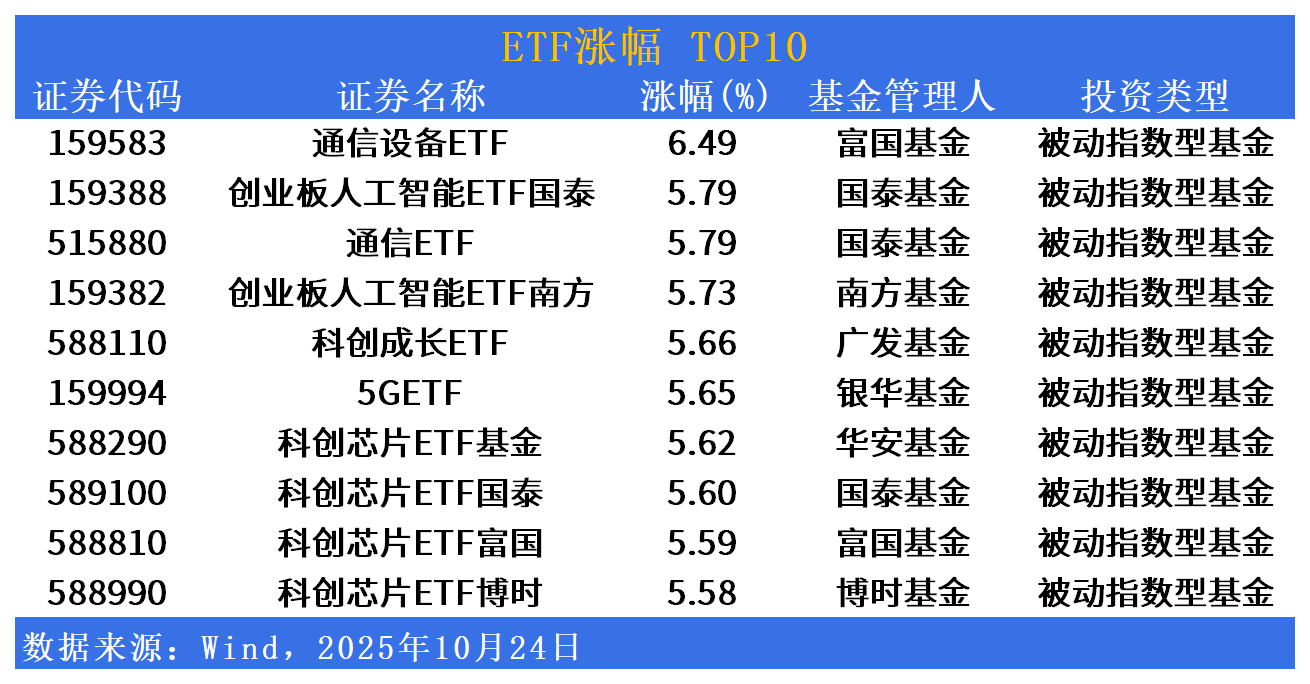
Market Performance - A-shares indices collectively strengthened, with the Shanghai Composite Index reaching a ten-year high, closing up 0.71%, Shenzhen Component Index up 2.02%, and ChiNext Index up 3.57% [1] - The total trading volume in the Shanghai and Shenzhen markets reached 1,974.2 billion [1] Sector Performance - The communication and chip sectors led the gains, with the Communication Equipment ETF rising by 6.49% and several other ETFs in the AI and chip sectors also showing significant increases of over 5% [2][3] - The core message from a high-level meeting emphasized strengthening original innovation and key core technology breakthroughs, promoting deep integration of technological and industrial innovation, and focusing on the real economy [3] ETF Trading Activity - The Short-term Bond ETF had the highest trading volume at 39.674 billion, followed by the Silver Day Benefit ETF at 27.350 billion and the Hua Bao Tian Yi ETF at 16.645 billion [6] - The turnover rate for the China-Korea Semiconductor ETF reached 240%, indicating high trading activity in this sector [7] Upcoming ETF Issuance - Five new ETFs will begin fundraising next Monday, focusing on industrial software, Hong Kong technology, photovoltaic industries, and satellite applications [8][9]

阴和俊:“十五五”规划建议部署实施一批国家重大科技任务
Zhong Guo Xin Wen Wang· 2025-10-24 07:22
Core Viewpoint - The Chinese government emphasizes the importance of technological modernization as a foundation for national modernization, with a focus on implementing major national scientific tasks during the "14th Five-Year Plan" period [1][2]. Group 1: Technological Innovation - The "14th Five-Year Plan" proposes to strengthen original innovation and tackle key core technologies, particularly in integrated circuits, industrial mother machines, and high-end instruments [1]. - The plan aims to enhance the systematic capabilities of national strategic scientific forces and support enterprises in leading innovation consortia [2]. Group 2: Education and Talent Development - The plan emphasizes the integration of education, technology, and talent development to meet the needs of scientific innovation and national strategy [2]. Group 3: Digital Economy - The initiative includes advancing the construction of a digital China by creating a secure and open national integrated data market, promoting the deep integration of the real economy and digital economy [2]. - The government plans to accelerate innovation in artificial intelligence and other digital technologies, implementing the "Artificial Intelligence+" initiative to empower various industries [2].
聚焦2025中国国际数字经济博览会|石家庄城停科技以数据赋能破解城市停车难题
Yang Shi Wang· 2025-10-24 06:52
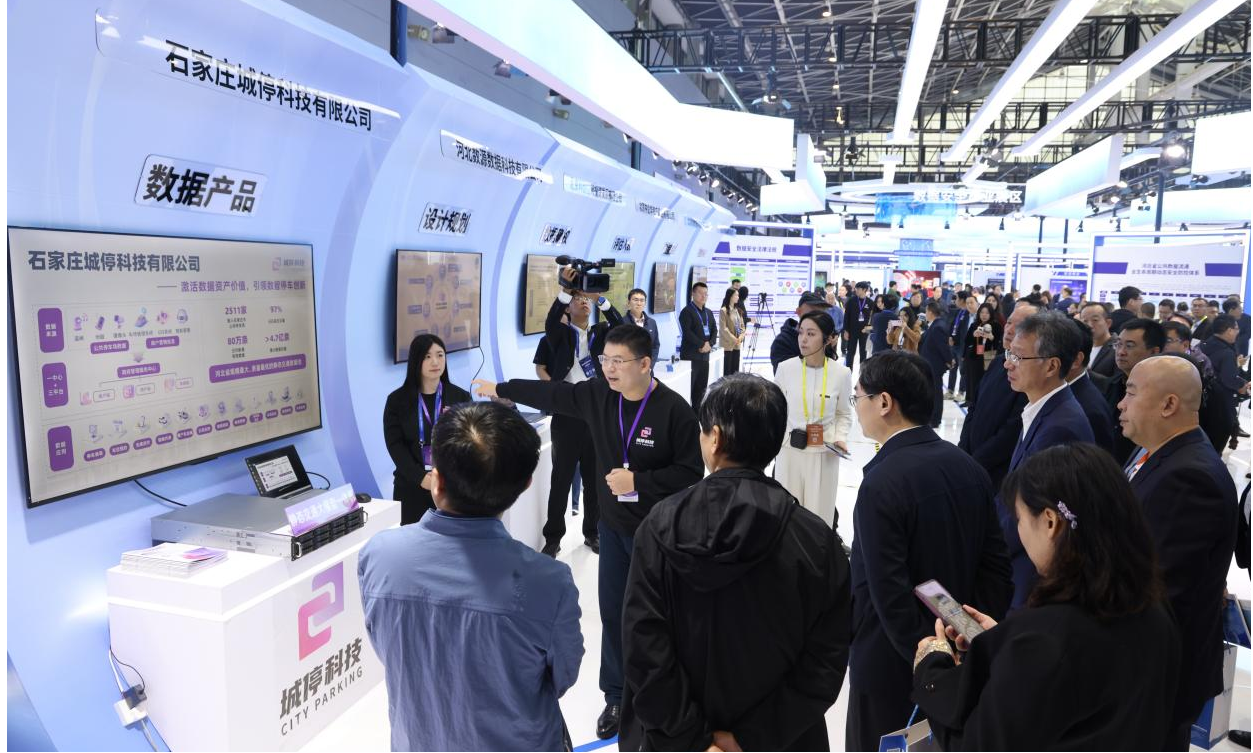
Core Viewpoint - The 2025 China International Digital Economy Expo showcased the "Urban Parking Management Platform" by Shijiazhuang Chengting Technology Co., Ltd., highlighting its innovative practices and data assetization path, contributing to the "Digital China" blueprint [1][4]. Group 1: Company Overview - Shijiazhuang Chengting Technology Co., Ltd. was established in January 2025, focusing on solving urban parking challenges as a state-owned technology enterprise [2]. - The company operates under the principle of "government-led, market-operated, and social participation," aiming to become a leading provider of smart parking solutions in China [2]. Group 2: Data Pool and Economic Value - The "Urban Parking Management Platform" has integrated 2,511 public parking lots in Shijiazhuang, covering 97% of the city's public parking resources, generating an average of 800,000 effective data entries daily, with a total data volume exceeding 470 million entries [4]. - The data pool is recognized as the largest and highest quality static traffic data pool in Hebei Province, with an economic value estimated at 87.41 million yuan, successfully completing data asset entry worth 1.03 million yuan [4]. Group 3: Innovation and Governance - The company has pioneered a "government buys services" model, providing compliant and anonymized data analysis services to various departments, supporting government decision-making while alleviating fiscal burdens [7]. - This innovative model has been recognized as a typical case in Hebei Province's "Data Element ×" competition, winning first prize and representing the province in the national finals [7]. Group 4: Youth Engagement - A youth team plays a crucial role in driving innovation at Chengting Technology, participating in key tasks such as data cleaning algorithm optimization and dynamic anonymization technology development [8]. - The company has established various training mechanisms to cultivate young talents in data governance, contributing to the professional workforce for the digital development of Hebei [8]. Group 5: Strategic Vision - The company has outlined three strategic blueprints centered on data elements: establishing a provincial parking cloud platform, creating an integrated parking and charging platform, and building a "dual carbon" platform to reduce vehicle emissions [15][17]. - These strategies are projected to generate 1.23 billion yuan in construction investment over the next three to five years, stimulating over 30 billion yuan in industrial chain collaboration and a 200 billion yuan related consumer market [19].
介绍和解读党的二十届四中全会精神,一文速览!
Xin Hua She· 2025-10-24 04:01
Core Insights - The most significant outcome of the Fourth Plenary Session of the 20th Central Committee is the approval of the "Suggestions on Formulating the 15th Five-Year Plan for National Economic and Social Development" [3] - The document consists of 15 parts and 61 articles, divided into three main sections: general overview, specific strategic tasks, and tasks related to strengthening centralized leadership [3] Economic and Social Development Goals - The main goals for the 15th Five-Year Plan include: 1. Achieving significant results in high-quality development 2. Substantially improving self-reliance in technology 3. Making new breakthroughs in deepening reforms 4. Enhancing social civilization 5. Continuously improving the quality of life for the people 6. Making major progress in building a beautiful China 7. Strengthening national security [4] Strategic Tasks - The first strategic task is to build a modern industrial system and consolidate the foundation of the real economy, with key tasks categorized as: 1. Upgrading and solidifying the foundation 2. Fostering innovation 3. Expanding capacity and improving quality 4. Enhancing efficiency [4] Technological Development - To accelerate high-level self-reliance in technology, the plan outlines four areas of focus: 1. Strengthening original innovation and tackling key core technologies 2. Promoting deep integration of technological and industrial innovation 3. Advancing education and talent development in science and technology 4. Promoting the construction of a digital China [4] Foreign Trade and Investment - The plan emphasizes four important aspects for foreign trade and investment during the 15th Five-Year Plan: 1. Actively expanding autonomous opening 2. Promoting innovative development of trade 3. Expanding bilateral investment cooperation 4. High-quality co-construction of the Belt and Road Initiative [4] Population Development - The plan focuses on three key areas for promoting high-quality population development: 1. Building a family-friendly society with supportive policies for marriage and childbirth 2. Promoting elderly care through improved policies and services 3. Encouraging older individuals to participate in the workforce and developing the silver economy [5] Political Leadership - The plan emphasizes the importance of strengthening the centralized leadership of the Party as a fundamental guarantee for advancing modernization, with strategic deployments including: 1. Improving mechanisms for implementing major decisions 2. Ensuring effective execution and communication 3. Promoting a clean political environment and combating corruption [5] Market Opportunities - The plan aims to leverage China's large market advantages to become a global hub for innovation and opportunities, attracting foreign investment and ensuring sustainable development [6]

阴和俊:全面实施“人工智能+”行动 全方位赋能千行百业
Zheng Quan Shi Bao· 2025-10-24 03:35
Core Viewpoint - The Chinese government emphasizes the importance of technological modernization as a foundation for Chinese-style modernization, aiming to enhance the overall effectiveness of the national innovation system and accelerate high-level self-reliance in technology [1] Group 1: Strategic Focus Areas - The "14th Five-Year Plan" outlines four key areas for development: strengthening original innovation and tackling core technologies, promoting deep integration of technological and industrial innovation, advancing education, technology, and talent development, and furthering the construction of a digital China [1] - The initiative to advance digital China includes building an open, shared, and secure national integrated data market to promote deep integration of the real economy and digital economy [1] - There is a focus on accelerating innovation in intelligent technologies such as artificial intelligence, enhancing the supply of computing power, algorithms, and data [1] Group 2: Implementation Actions - The comprehensive implementation of the "Artificial Intelligence +" initiative aims to empower various industries across the board [1]
中共中央新闻发布会
Zheng Quan Shi Bao· 2025-10-24 03:23
Core Viewpoint - The 20th Central Committee of the Communist Party of China has approved the "15th Five-Year Plan" which outlines significant economic and social development strategies for the upcoming period, emphasizing the importance of innovation, market integration, and sustainable growth. Group 1: Economic Development Strategies - The "15th Five-Year Plan" consists of 15 parts and 61 articles, divided into three main sections: general principles, specific strategies, and tasks to strengthen centralized leadership and promote democratic governance [2] - The plan identifies the long-term positive conditions and trends for China's economy, highlighting its strong foundation and resilience [3] Group 2: Industry and Technological Advancements - The plan aims to create new pillar industries and accelerate the development of strategic emerging industries such as new energy, new materials, and aerospace, potentially generating several trillion-level markets [4] - It emphasizes the need for forward-looking layouts in future industries, including quantum technology and sixth-generation mobile communications, which could equate to recreating a new high-tech industry in China over the next decade [4] Group 3: Market Integration and Competition - The plan proposes measures to unify market rules and eliminate local protectionism, which will help unlock the benefits of China's vast market [5] - It is projected that over 700,000 kilometers of underground pipelines will be constructed or renovated during the "15th Five-Year Plan," with an investment demand exceeding 5 trillion yuan [6] Group 4: Marine Economy and Environmental Protection - The total volume of China's marine economy has surpassed 10 trillion yuan, with initiatives aimed at enhancing marine development and ecological protection [7] Group 5: Service Sector and Trade - The plan focuses on expanding market access and opening up service sectors, aligning with international trade standards [8] Group 6: Population and Family Support - The plan includes initiatives to create a family-friendly society, optimizing support and incentive policies for childbirth and child-rearing [10] Group 7: Technological Modernization - The plan outlines a comprehensive approach to technological modernization, emphasizing the integration of education, technology, and talent development to enhance innovation capabilities [11] - It includes the implementation of the "Artificial Intelligence+" initiative to empower various industries [11]
中共中央新闻发布会
证券时报· 2025-10-24 03:16
Core Points - The article discusses the key outcomes of the 20th Central Committee's Fourth Plenary Session, focusing on the "15th Five-Year Plan" and its implications for China's economic and social development [2][3]. Group 1: Overview of the "15th Five-Year Plan" - The "15th Five-Year Plan" consists of 15 parts and 61 articles, divided into three main sections: general principles, specific strategies, and tasks to strengthen the leadership of the Party [2]. - The plan emphasizes the significance of economic and social development during the "15th Five-Year" period, building on the achievements of the "14th Five-Year" period [2]. Group 2: Economic Outlook - The long-term positive conditions and trends supporting China's economy remain unchanged, with a solid economic foundation and strong resilience [3]. - The plan aims to create new pillar industries and accelerate the development of strategic emerging industries, which could generate several trillion-yuan markets [4]. Group 3: Market Reforms - The plan proposes comprehensive measures to address "involution" competition and to unify market regulations, which will help unlock the benefits of China's vast market [5]. - It is projected that over 700,000 kilometers of underground pipelines will be constructed or renovated during the "15th Five-Year" period, requiring an investment of over 5 trillion yuan [6]. Group 4: Marine Economy - The total volume of China's marine economy has surpassed 10 trillion yuan, with initiatives to enhance marine development and ecological protection outlined in the plan [7]. Group 5: Service Sector and Trade - The plan focuses on expanding market access and opening up the service sector, aligning with international high-standard trade rules [9]. - It emphasizes innovation in trade, covering goods, services, and digital trade as key pillars for a strong trade nation [9]. Group 6: Population and Family Policies - The plan includes measures to create a family-friendly society, optimizing support and incentive policies for childbirth and child-rearing [10]. Group 7: Technological Development - The plan highlights the importance of technological modernization, proposing actions to enhance innovation capabilities and integrate technology with various industries [11]. - It aims to implement the "Artificial Intelligence+" initiative to empower multiple sectors [11].

金融业将做精做深“五篇大文章”
Zhong Guo Zheng Quan Bao· 2025-10-23 20:12
● 本报记者 石诗语 展望"十五五",多家金融机构表示,将以做精做深金融"五篇大文章"为战略支点,持续优化对重大战 略、重点领域和薄弱环节的金融支持,助力新质生产力加快发展壮大,为推进中国式现代化、建设金融 强国贡献更大力量。 金融业发挥重要作用 党的二十届四中全会提出,加快高水平科技自立自强,引领发展新质生产力。抓住新一轮科技革命和产 业变革历史机遇,统筹教育强国、科技强国、人才强国建设,提升国家创新体系整体效能,全面增强自 主创新能力,抢占科技发展制高点,不断催生新质生产力。要加强原始创新和关键核心技术攻关,推动 科技创新和产业创新深度融合,一体推进教育科技人才发展,深入推进数字中国建设。 数据显示,金融机构有效发挥融资主渠道作用,银行业保险业通过信贷、债券、股权等多种方式,为实 体经济提供新增资金170万亿元。重点领域投放精准有力,科研技术贷款、制造业中长期贷款、基础设 施贷款年均增长27.2%、21.7%、10.1%。普惠型小微企业贷款余额36万亿元,是"十三五"末的2.3倍,利 率下降2个百分点。同时,民生保障显著增强,保险业累计赔付9万亿元,较"十三五"时期增长61.7%。 金融监管总局局长李云泽 ...
学习二十届四中全会公报:公报里的“十五五”线索有哪些?
Soochow Securities· 2025-10-23 12:01
Group 1: Background and Goals of the 15th Five-Year Plan - The 15th Five-Year Plan is influenced by eight environmental changes, including three international changes: global trade relations restructuring, increased geopolitical uncertainties, and intensified global technological competition[4] - Domestic changes include a shift from reliance on external demand to internal demand, with the new economy expected to account for over 18% of GDP by 2024[4] - The plan aims for a nominal GDP growth rate of no less than 5.5% during the 15th Five-Year period, with actual GDP growth needing to be at least 4.7%[5] Group 2: Key Work Areas and Priorities - The 15th Five-Year Plan emphasizes a modern industrial system, with a focus on intelligent, green, and integrated development, and aims to maintain a reasonable proportion of manufacturing[6] - The importance of domestic demand, particularly consumption, is highlighted, with a new emphasis on the relationship between consumption and investment[7] - The plan includes a commitment to improving social welfare and advancing common prosperity, with a focus on basic, inclusive, and safety-oriented social services[8]