数智化

Search documents
又一家股份行总资产突破10万亿!
Xin Lang Cai Jing· 2026-01-13 14:16
Group 1 - The core point of the article is that Shanghai Pudong Development Bank (SPDB) has officially joined the "10 trillion club," with total assets reaching 100,817.46 billion yuan, a growth of 6.55% compared to the end of the previous year [1][11] - SPDB's total liabilities also increased to 92,573.16 billion yuan, reflecting a growth of 6.20% year-on-year [1][11] - With SPDB's entry, the number of banks in China's "10 trillion club" has expanded to nine, indicating a significant differentiation among joint-stock banks [3][13] Group 2 - In 2025, SPDB achieved a dual increase in operating efficiency and asset quality, with operating income reaching 1,739.64 billion yuan, a year-on-year increase of 1.88%, and net profit attributable to shareholders of 500.17 billion yuan, up 10.52% [7][15] - The bank's non-performing loan balance decreased to 719.90 billion yuan, down by 11.64 billion yuan from the previous year, and the non-performing loan ratio fell to 1.26%, a decrease of 0.10 percentage points [7][15] - The bank's provision coverage ratio improved to 200.72%, an increase of 13.76 percentage points from the previous year, indicating a positive trend in asset quality [8][15] Group 3 - SPDB's strategic focus on five key areas—technology finance, supply chain finance, inclusive finance, cross-border finance, and treasury finance—has contributed to its growth [8][16] - The bank is also enhancing its credit allocation to key sectors and regions, aiming for both qualitative and quantitative improvements in credit assets [8][16] - The stabilization of net interest margin is a significant indicator for the bank's future performance, pending confirmation from other banks' annual reports [8][16]


股票行情快报:中科江南(301153)1月13日主力资金净卖出174.23万元
Sou Hu Cai Jing· 2026-01-13 12:56
Group 1 - The core viewpoint of the article highlights the financial performance and stock activity of Zhongke Jiangnan (301153) as of January 13, 2026, showing a decline in stock price and mixed capital flow [1][2]. - As of January 13, 2026, Zhongke Jiangnan's stock closed at 26.24 yuan, down 0.83%, with a turnover rate of 6.91% and a trading volume of 227,600 hands, resulting in a transaction amount of 602 million yuan [1]. - In terms of capital flow on January 13, 2026, the net outflow of main funds was 1.7423 million yuan (0.29% of total transaction amount), while retail investors saw a net inflow of 1.25014 million yuan (2.08% of total transaction amount) [1]. Group 2 - For the first three quarters of 2025, Zhongke Jiangnan reported a main revenue of 364 million yuan, a year-on-year decrease of 26.28%, and a net profit attributable to shareholders of -64.249 million yuan, a year-on-year decrease of 1048.15% [2]. - The third quarter of 2025 showed a single-quarter main revenue of 124 million yuan, down 4.66% year-on-year, with a net profit attributable to shareholders of -15.8007 million yuan, an increase of 39.78% year-on-year [2]. - The company operates in electronic payment services, smart finance, and digital services, focusing on integrating various solutions to empower industries in the era of artificial intelligence [2].

万亿产业,迎利好!工信部,发布行动方案!事关工业互联网平台
券商中国· 2026-01-13 12:50
Core Viewpoint - The article discusses the recent policy support for the industrial internet sector in China, highlighting the "Action Plan for Promoting the High-Quality Development of Industrial Internet Platforms (2026-2028)" issued by the Ministry of Industry and Information Technology (MIIT) [1][2]. Group 1: Policy and Development Goals - The MIIT aims for significant progress in the high-quality development of industrial internet platforms by 2028, with over 450 influential platforms and a resource connection capability enhancement [2]. - The core industry scale of China's industrial internet is expected to exceed 16 trillion yuan by 2025, contributing approximately 2.5 trillion yuan to industrial added value [1][2]. Group 2: Platform Development Strategies - The action plan emphasizes the development of specialized, industry-specific, and collaborative platforms to enhance digital product and service supply levels [2][3]. - It includes a classification and grading system for platforms, establishing a nurturing mechanism to improve platform capabilities [2]. Group 3: Data and AI Integration - The plan encourages collaboration between platform and industrial enterprises to build specialized data sets and explore new business models like data brokerage and hosting [3][4]. - It promotes the integration of artificial intelligence into industrial internet platforms, enhancing AI literacy and skills among employees [4][5]. Group 4: Application and Market Expansion - The article highlights the need for platforms to focus on high-value industrial scenarios, developing intelligent agents for automation and smart inspections [5][6]. - It encourages large enterprises to deepen platform applications and supports small and medium-sized enterprises in digital transformation through flexible resource utilization [6]. Group 5: Investment Opportunities - The article suggests that the integration of industrial internet and AI will accelerate the digital transformation of manufacturing, presenting investment opportunities in industrial network integration and specialized services in industrial data and models [7].

北汽集团与中国物流集团达成战略合作
Zheng Quan Shi Bao Wang· 2026-01-13 11:27
Core Viewpoint - Beijing Automotive Group Co., Ltd. (referred to as "BAIC Group") has signed a strategic cooperation framework agreement with China Logistics Group Co., Ltd. to enhance collaboration in multiple core areas [1] Group 1: Logistics and Supply Chain - The partnership will leverage China Logistics' expertise to improve domestic logistics and supply chain layout, exploring resource sharing in station networks and multimodal transport [1] - Joint efforts will focus on building supporting logistics parks and expanding comprehensive international logistics services to reduce costs and increase efficiency in BAIC Group's global operations [1] Group 2: Digitalization - The two companies will collaborate to establish a logistics data platform, enhancing smart logistics and supply chain optimization, as well as the application of large models [1] Group 3: Capital and Management Innovation - The agreement includes exploring the establishment of joint ventures to optimize cost structures and enhance supply chain competitiveness [1] - There will be an emphasis on experience exchange and the development of new business growth points in management innovation and other areas [1]
从“数字化”到“数智化”:制造业如何靠数据智能决胜未来?
Sou Hu Cai Jing· 2026-01-13 10:40
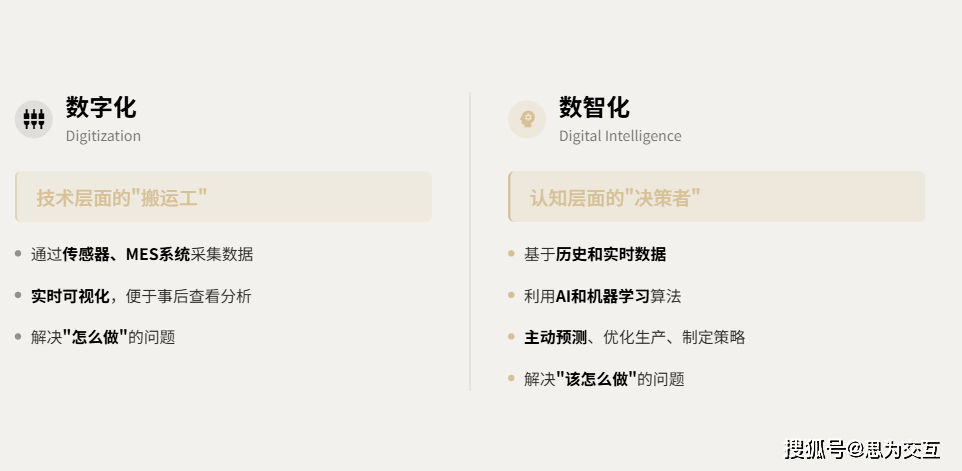
Core Insights - "Digital intelligence" has emerged as a new paradigm in manufacturing, representing a profound transformation in logic and governance structures, moving beyond mere digitization [1][6][17] Group 1: Definition and Distinction - "Digitization" refers to the process of transferring physical processes and data online, addressing the question of "how to do," while "digital intelligence" incorporates algorithms to answer "how to do it better" [3][4] Group 2: Benefits of Digital Intelligence - Cost reduction and efficiency enhancement shift from linear optimization to exponential growth, leveraging algorithmic models for significant improvements [6] - Transition from reactive maintenance to predictive maintenance, utilizing real-time data analysis to forecast equipment failures and optimize production schedules [6][8] - Full lifecycle management extends beyond production to predictive maintenance, reducing repair costs and prolonging equipment lifespan [7] Group 3: Competitive Advantages - Data becomes a new production factor, creating competitive barriers as companies accumulate data and develop algorithmic models, leading to more accurate predictive capabilities [9] Group 4: Technological Evolution - Large model technologies evolve from being mere tools to becoming partners in research, design, process optimization, and decision support [11] - Data governance shifts from isolated data silos to trusted data spaces, ensuring data quality for algorithmic outputs [12] - Ecosystem collaboration moves from independent factories to collaborative networks, fostering innovation across supply chains [13] Group 5: Strategic and Organizational Changes - Companies must update their strategic understanding, recognizing digital intelligence as a comprehensive restructuring process involving organizational flattening and business process reengineering [15] - The transition from traditional IT roles to algorithm engineers and data scientists presents a significant challenge, necessitating cross-departmental data governance [16] - Balancing technology and security is crucial, addressing data safety, intellectual property protection, and ethical concerns arising from algorithms [17]
新希望拟定增募资不超过33.38亿元 加码数智化发展
Zheng Quan Ri Bao Wang· 2026-01-13 10:29
Group 1 - New Hope plans to issue A-shares to raise up to 3.338 billion yuan for projects aimed at upgrading biosecurity and digitalization in pig farming and repaying bank debts [1] - The company aims to enhance its biosecurity, comfort, intelligence, information technology, and breeding quality through a comprehensive upgrade of existing pig farms, with a total investment of 2.92 billion yuan [1] - New Hope has established itself as a leading player in the domestic pig farming industry, achieving cumulative sales of 17.5454 million pigs and sales revenue of 23.205 billion yuan by 2025 [1] Group 2 - The Chinese government is focusing on digital agriculture and rural development, promoting the application of digital technologies in the pig farming industry, which is a key area of support [2] - The implementation of New Hope's biosecurity and digitalization project is expected to improve pig farming efficiency and management, reduce resource waste, and enhance profitability [2] - Other companies in the industry, such as Wens Foodstuff Group, are also investing in digital applications and technologies like cloud computing and AI to enhance their farming processes [2] Group 3 - Leshan Juxing Agricultural and Animal Husbandry is advancing its digital intelligence construction project, which is seen as essential for internal development and industry advancement [3] - Experts believe that technology-driven cost reduction and green farming will characterize the future of pig farming, with innovations like AI and precision feeding expected to lower costs [3] - The transformation of pig farming companies will focus on strategic restraint and technological penetration, with a shift in competition from resource ownership to data application [3]

既盯硬指标、又抓软实力,汽车业数字化转型再出发背后的近忧与远谋
Zhong Guo Qi Che Bao Wang· 2026-01-13 01:33
Core Insights - The automotive industry's digital transformation has progressed significantly over the past decade, moving from initial concepts to systematic implementation, driven by new policies that outline a comprehensive roadmap for development [2][3][4]. Group 1: Digital Transformation Overview - The digital transformation in the automotive sector is a response to global technological revolutions and industrial changes, marking it as a key area for manufacturing digitalization [3]. - The industry has shifted from a focus on incremental competition to a more substantial transformation, necessitating a choice for companies to embrace digitalization or risk obsolescence [3][4]. - The recent implementation plan by multiple government departments outlines key tasks across the entire automotive value chain, emphasizing the importance of digitalization, networking, and intelligence [2][4]. Group 2: Implementation Plan and Goals - The implementation plan sets a target for high-quality development through smart manufacturing, aiming to enhance the resilience and safety of the automotive supply chain [4][10]. - By 2027, the plan aims for deep integration of smart technologies across research, production, supply, sales, and service, with a focus on improving production efficiency and service systems [10]. - The long-term goal for 2030 is to achieve a high level of overall digitalization in the industry, emphasizing the importance of ecological collaboration and value creation [10]. Group 3: Key Actions and Tasks - The plan identifies six major actions and 15 key tasks to address current challenges in the automotive industry, providing a strong framework for policy implementation [8][11]. - It emphasizes the need for a comprehensive digital transformation system that spans the entire lifecycle of automotive production and service, breaking away from fragmented approaches [9]. - The plan introduces a "three-tier empowerment" strategy to support small and medium enterprises in digital transformation, fostering collaboration across different company sizes [9]. Group 4: Digitalization Achievements - The automotive industry has seen significant improvements in efficiency through digital tools, such as a 2000-fold increase in efficiency in autonomous driving simulations [6]. - Major automotive companies have established smart factories and digital workshops, enhancing manufacturing efficiency and product quality [6]. - Digitalization in after-sales services has standardized operations and reduced inefficiencies, contributing to overall industry improvements [6]. Group 5: Marketing and Consumer Engagement - The shift from traditional transaction-based marketing to value-driven operations has redefined relationships between automotive companies and consumers, opening new growth avenues [4][17]. - Digital marketing strategies enable companies to create precise customer profiles and deliver personalized marketing solutions, significantly improving conversion rates [4][17]. - The focus on data-driven marketing and proactive user services reflects the industry's need to adapt to diverse consumer demands in the digital age [15][17]. Group 6: Future Trends and Innovations - The plan outlines eight typical scenarios for digital transformation, including intelligent collaborative research and flexible production, which are essential for industry evolution [14]. - Predictive maintenance services, enabled by data analytics, are transforming traditional reactive service models into proactive solutions, enhancing user satisfaction and safety [18]. - The integration of data-driven services is expected to redefine automotive marketing and service models, transitioning from product-driven to value-driven approaches [17][18].
响应“人工智能+制造”行动 万兴科技以“AI+创意”助力制造业数智化发展
Zheng Quan Ri Bao Wang· 2026-01-12 12:49
Group 1 - The Ministry of Industry and Information Technology, along with seven other departments, has issued the "Implementation Opinions on the Special Action of 'Artificial Intelligence + Manufacturing'," providing a clear roadmap for the development and application of the AI industry in China [1] - Domestic technology companies, including Wanxing Technology Group Co., Ltd., are actively engaging in AI technology innovation and application, driven by favorable policies and market trends [1] - Wanxing Technology has been deepening its AI layout in recent years, empowering global creators and facilitating the digital transformation of manufacturing and other sectors from the perspective of "creative productivity" [1] Group 2 - Wanxing Technology has developed a four-in-one AI creative software and office efficiency solution targeting the productivity pain points in knowledge-intensive industries like semiconductors [1] - The company's products, such as Wanxing Brain Map, Wanxing Diagram, Wanxing Project Management, and Wanxing PDF, provide various tools for knowledge management, project management, and PDF solutions, significantly reducing costs and improving efficiency [1] - Wanxing Technology's multimedia model 2.0 and Wanxing Meow Shadow 2026 offer cutting-edge AI solutions for content creation and distribution, with the average cost of generating a 5-second 1080P video segment being one of the lowest in the industry [2] - The company has become a key software supplier for several state-owned enterprises, serving clients in various sectors including electronic manufacturing, new energy, automotive manufacturing, finance, and education [2]
浙江移动5G+创新赋能“蓝色循环”新模式
Ren Min Wang· 2026-01-12 08:01
Core Viewpoint - Zhejiang Province is innovating a multi-faceted marine plastic waste management system, focusing on comprehensive recycling and utilizing digital technology to enhance ecological protection efforts [1][3]. Group 1: Marine Plastic Waste Management - Zhejiang Province is expanding its marine plastic waste recovery efforts from just plastic bottles to include fishing nets and other marine plastic waste [1]. - The province has established a closed-loop system for collection, transportation, and disposal of marine plastic waste, leveraging local plastic recycling enterprises [1]. Group 2: Digital Infrastructure and Technology - The "Blue Sea Station" initiative employs smart technologies like facial recognition and coding traceability to track marine waste throughout its lifecycle [2][4]. - A robust 5G network has been developed to ensure stable data transmission for the "Blue Sea Station," enabling real-time data processing and future integration of AI and big data applications [2]. Group 3: Community Engagement and Economic Incentives - The "Blue Sea Station" serves as a link between environmental actions and community benefits, offering higher recycling prices (10% to 20% above market rates) to incentivize participation from fishermen and residents [3]. - The initiative has implemented a dual approach of recovery incentives and low-barrier participation to foster a community-driven marine environmental protection model [3]. Group 4: Traceability and Regulatory Compliance - The "Blue Sea Chain" digital platform utilizes 5G and IoT technologies to ensure effective monitoring and traceability of collected marine plastic waste [4][5]. - Each batch of marine plastic waste is assigned a unique QR code, allowing for real-time data tracking from collection to processing, ensuring transparency and accountability in waste management [4][5].
“数智化”领跑汽车产业“新赛程”——“经济新活力”系列评
Xin Lang Cai Jing· 2026-01-11 08:58
Group 1 - The 2025 Central Economic Work Conference emphasizes "innovation-driven development" and the expansion of "AI+" as key tasks for the economy, highlighting intelligent driving as a core application in the automotive industry and a new engine for economic growth [1] - The approval of the first batch of L3 conditional autonomous driving vehicle licenses marks a significant step from testing to commercialization in China's intelligent driving sector, with SAIC-GM-Wuling achieving a 94% localization rate in vehicle chips [2] - There is a recognition of the "bottleneck" issues in high-end chips, necessitating a focus on independent innovation and the establishment of a collaborative innovation ecosystem that integrates industry, academia, and research [2] Group 2 - Intelligent driving is a complex system that requires collaboration across various technological domains, prompting Chinese automakers to actively engage in global innovation networks and upgrade cooperation models from "one-way introduction" to "two-way empowerment" [3] - The rapid evolution of intelligent driving technology will be tested in global markets, with companies like Baidu planning to launch autonomous driving services in London by 2026, indicating a shift from "product export" to "brand export" and further to "industry export" [4] - The industry must provide technically competitive solutions while understanding local regulations and cultural contexts, aiming to transform China's experiences in intelligent driving into internationally recognized standards [4][5]