新能源汽车渗透率

Search documents
【读财报】上市车企4月销量:整车销量超182万辆 小鹏汽车、北汽蓝谷增速居前
Xin Hua Cai Jing· 2025-05-21 23:28
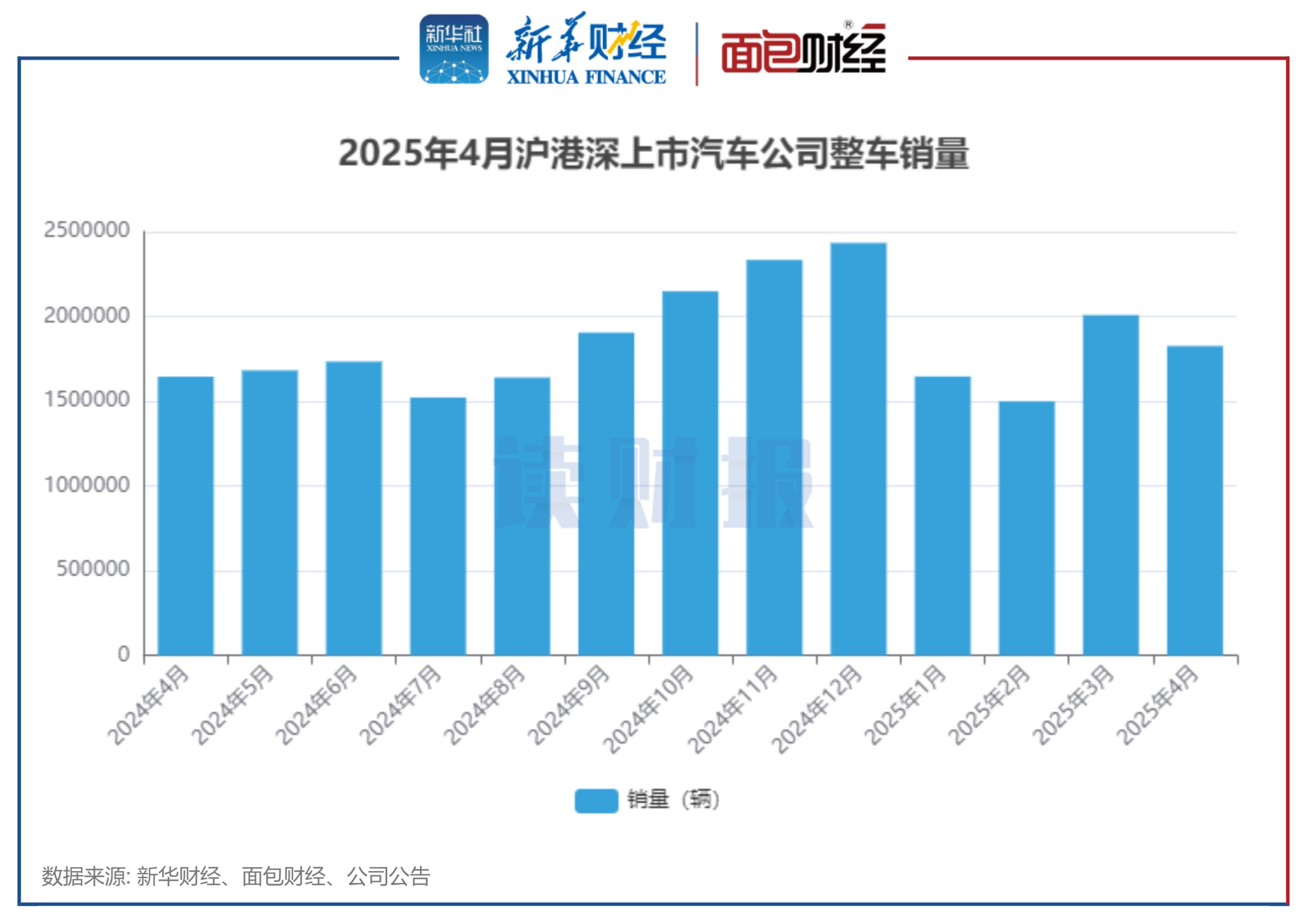
Core Insights - In April 2025, 21 A and H-share listed automotive manufacturers reported a total vehicle sales of 1.8261 million units, representing a year-on-year increase of 11.01% [2][6] - Among these, BYD, SAIC Motor, and Geely Auto ranked as the top three in sales, while XPeng Motors and BAIC Blue Valley experienced sales growth exceeding 200% [6][10] Vehicle Sales Overview - Total vehicle sales for April 2025 reached 1.8261 million units, with a month-on-month decline of 9.08% [2][6] - BYD and SAIC Motor each sold over 370,000 units, while Geely Auto sold 234,112 units, marking a significant increase of 52.75% year-on-year [7][9] New Energy Vehicle (NEV) Sales - A total of 16 companies reported NEV sales of approximately 948,200 units in April 2025, reflecting a year-on-year increase of 45.2% and a month-on-month increase of 1.05% [10][14] - The NEV penetration rate reached approximately 53.64%, the highest since the beginning of the year [10] Company-Specific Performance - BYD's April sales included 380,089 total vehicles, with pure electric and plug-in hybrid sales of 195,700 and 176,900 units, respectively [8][18] - SAIC Motor reported total sales of 376,517 units, with a year-on-year growth of 4.59% [9] - Geely Auto's NEV sales reached 125,563 units, a year-on-year increase of 144.15% [18] - XPeng Motors achieved a remarkable year-on-year growth of 273%, selling 35,045 units in April [9][16] - BAIC Blue Valley's NEV sales surged by 258.33%, reaching 10,327 units [14][16]






专访摩特中国董事总经理王远博:百年法国润滑油企业何以此时加码混动市场
2 1 Shi Ji Jing Ji Bao Dao· 2025-05-20 11:58
Core Insights - The French lubricant company Motul has launched a new hybrid-specific automotive lubricant product, marking its second significant product release in nearly a decade, coinciding with the FIA F4 Championship in Shanghai [1] - The growth of hybrid vehicle demand in China is projected to increase by 65% year-on-year in 2024, indicating a substantial market opportunity for lubricant companies [1][2] - The penetration rate of new energy vehicles (NEVs) in China has surpassed 50%, with retail and wholesale sales reaching 51.5% and 51.7% respectively by April 2025 [2] Market Demand and Trends - The demand for hybrid vehicles has seen a significant shift, with the management of Motul recognizing that the market conditions have changed dramatically since 2023, prompting the need for new product development [2][3] - A survey indicated that over 60% of users consider the environmental and sustainable aspects of lubricant products to be very important, with 34% willing to pay more for eco-friendly products [3] Competitive Landscape - The passenger car lubricant market in China is relatively stable and concentrated, with the top five companies holding over 70% of the market share, including major players like Castrol, ExxonMobil, and Shell [5] - Motul aims to differentiate itself in the market by focusing on niche products and avoiding blind expansion, emphasizing the importance of product performance validated through motorsport applications [5] R&D and Local Market Focus - The company plans to increase its R&D investment in China, recognizing the unique market dynamics and the need to adapt to local demands to stay competitive [6] - The Chinese market is viewed as a strong and unique segment in the global automotive lubricant industry, with the highest penetration rate of NEVs and a complete supply chain [6]
车厂都在强攻,但新能源份额涨不动了
3 6 Ke· 2025-05-15 01:38
Core Insights - The penetration rate of new energy vehicles (NEVs) has faced significant challenges, dropping from a peak of 53.9% in August 2022 to 41.2% in the first quarter of 2025, indicating a struggle to maintain growth after initially rapid adoption [1][3][11] - Despite aggressive market entry by various manufacturers, including traditional and new players, the NEV market is experiencing a plateau, with the competition between NEVs and traditional fuel vehicles intensifying [5][10][19] - Consumer concerns regarding battery technology, charging efficiency, and overall vehicle performance are hindering further penetration of NEVs into the market [11][15][21] Industry Trends - The NEV market saw a rapid increase in penetration rates from 15% in 2021 to 28% in 2022, and further to 36%, 48%, and finally peaking at 53.9% in August 2022 [8][10] - The market has witnessed a surge in new models, with nearly 100 new vehicles launched in a short span, predominantly in the NEV category [3][10] - The competition is not only between NEVs and fuel vehicles but also within the NEV sector itself, as various brands strive to capture market share [10][19] Consumer Behavior - A significant portion of NEV owners (over 30%) expressed regret about their purchase, indicating a potential shift back to fuel vehicles due to unresolved issues with battery life and charging speed [11][15] - The decision-making process for consumers has become more complex, involving multiple layers of consideration, including brand recognition, product comparison, and long-term cost implications [15][17] Technological Challenges - The NEV sector is facing technological hurdles, particularly in battery performance, where rapid charging can significantly reduce battery lifespan [11][21] - Traditional fuel vehicles are enhancing their appeal through smart technology, narrowing the gap in user experience compared to NEVs [19][21] Market Dynamics - The market is characterized by a dual approach, with companies like Geely pursuing both NEV and traditional fuel vehicle strategies to maintain competitiveness [21] - The historical strength of established brands in the fuel vehicle market continues to pose a challenge for NEVs, as consumer trust and brand loyalty play crucial roles in purchasing decisions [21][22]

新能源乘用车渗透率连续两个月超50%,5月车市有望平稳增长
Bei Ke Cai Jing· 2025-05-13 01:20
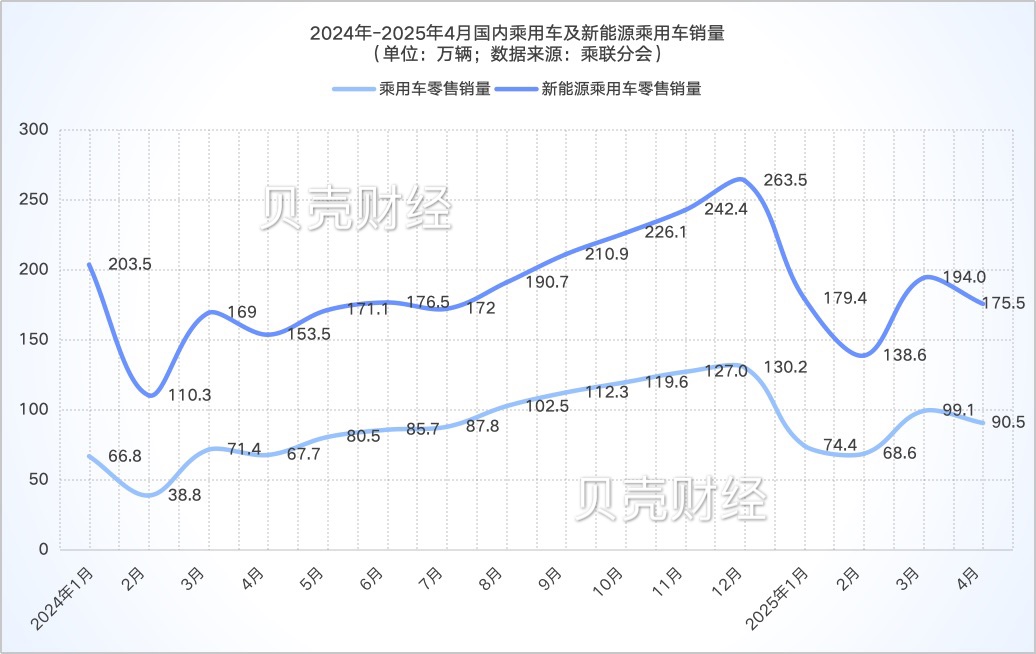
5月12日,中国汽车流通协会表示,进入4月下旬多地出台新一轮扩内需促消费政策,叠加上海国际车展开幕,众多新车集中发布并陆续上市提升了 市场关注度,带动客流量提升及订单转化率环比增长。 根据乘联分会统计的数据,4月全国乘用车市场零售175.5万辆,同比增长14.5%,环比下降9.4%;今年前4个月累计零售687.2万辆,同比增长7.9%。 "今年4月国内乘用车零售同比增速是近10年正常年份同期的最高增速,扭转了此前零售增速偏低的特征,进一步削弱汽车市场的季度周期波动特 征。"乘联分会表示,今年国家以旧换新政策启动早,补贴政策"一步到位",年初市场增长较好,车市价格竞争较为温和,行业内卷状态因市场增 长而改善。 车型降价潮降温 乘联分会发布的数据显示,今年4月仅有14款车型降价,较去年4月的41款和2023年4月份的19款数量大幅下降,体现了降价潮明显降温的特征。 "在国家促消费政策推动下,很多省市出台并逐步落实了相应的促消费政策,叠加主机厂厂补加码、金融支持、车展等线下活动的全面启动,4月车 市走势良好。随着春节前的燃油车消费潮转为节后的新能源消费潮,新能源渗透率持续提升,新能源车成为春季乘用车市场恢复的主要驱 ...
新能源乘用车周度销量报告-20250512
Dong Zheng Qi Huo· 2025-05-12 14:13
1. Report Industry Investment Rating No relevant content provided. 2. Core Viewpoints of the Report - In the 18th week of 2025 (April 28 - May 4), the retail sales of passenger cars reached 420,000, a year - on - year increase of 17.6%. The retail sales of new energy passenger cars were 203,000, a year - on - year increase of 38.4%. The new energy penetration rate was 48.4%, up 7.2 percentage points from the same period last year and down 4.6 percentage points from the previous week. Since the beginning of this year, the cumulative retail sales of passenger cars have been 6.874 million, a year - on - year increase of 4.0%, and the cumulative retail sales of new energy passenger cars have been 3.347 million, a year - on - year increase of 32.5%. The cumulative new energy penetration rate is 48.7% [2][13]. - The demand in the new energy vehicle market is clearly differentiated. Leading brands have consolidated their leading positions, but the market pattern is not fixed. New brands have brought new variables, and traditional car companies are achieving excellent performance in new energy sales [3][23]. 3. Summary According to the Catalog 3.1 Passenger Car Market Weekly Overview - **Overall Sales and Penetration Rate**: In the 18th week of 2025, the retail sales of passenger cars were 420,000, a year - on - year increase of 17.6%. The retail sales of new energy passenger cars were 203,000, a year - on - year increase of 38.4%. The new energy penetration rate was 48.4%, up 7.2 percentage points from the same period last year and down 4.6 percentage points from the previous week. Since the beginning of this year, the cumulative retail sales of passenger cars have been 6.874 million, a year - on - year increase of 4.0%, and the cumulative retail sales of new energy passenger cars have been 3.347 million, a year - on - year increase of 32.5%. The cumulative new energy penetration rate is 48.7% [2][13]. - **Sales by Power Type**: Among passenger cars, traditional fuel, hybrid, and new energy vehicles sold 196,000, 20,000, and 203,000 respectively, with year - on - year growth rates of 0.6%, 34.5%, and 38.4% respectively, accounting for 46.8%, 4.8%, and 48.4% of passenger cars. Among new energy passenger cars, pure - electric, plug - in hybrid, and extended - range vehicles sold 115,000, 64,000, and 25,000 respectively, with year - on - year growth rates of 34.0%, 31.7%, and 92.5% respectively, accounting for 56.5%, 31.3%, and 12.2% of new energy passenger cars [18]. - **Sales by Production Attribute**: Among passenger cars, self - owned and joint - venture brands sold 264,000 and 156,000 respectively, with year - on - year growth rates of 31.6% and - 0.4% respectively, accounting for 62.9% and 37.1% of passenger cars. Among new energy passenger cars, self - owned and joint - venture brands sold 187,000 and 17,000 respectively, with year - on - year growth rates of 47.3% and - 18.0% respectively, accounting for 91.9% and 8.1% of new energy passenger cars [18]. 3.2 Key New Energy Vehicle Manufacturers' Sales Analysis 3.2.1 BYD - Weekly sales were 65,000, with BYD brand selling 62,000, and Denza, Fangchengbao, and Yangwang brands selling 3,000, 2,000, and 19 respectively. Since March 2022, BYD has stopped the production of fuel vehicles and focused on new energy vehicles. Since March this year, it has released the super e - platform and launched new cars such as Denza N9, Yangwang U7, and Fangchengbao Titanium 3 [24]. 3.2.2 Geely Automobile - Weekly sales were 40,000, with 22,000 being new energy vehicles (3,000 from the ZEEKR brand), and the electrification rate reached about 55%. In 2024, the company released the "Taizhou Declaration". The Geometry brand was incorporated into the Galaxy brand. Recently, Geely acquired ZEEKR. The 2025 sales target is 2.71 million, with Geely, ZEEKR, and Lynk & Co brands targeting 2 million, 320,000, and 390,000 respectively, and the new energy vehicle sales target is 1.5 million [27]. 3.2.3 SAIC - GM - Wuling - The overall weekly sales of passenger cars were 14,000, with 12,000 being new energy vehicles, and the electrification rate was about 86%. Recently, Wuling Hongguang launched an extended - range version, and Baojun launched the "Baojun Xiangjing" with plug - in hybrid and pure - electric options, but pure - electric models still dominate in sales [35]. 3.2.4 Changan Automobile - The overall weekly sales of passenger cars were 24,000, with 11,000 being new energy vehicles, and the electrification rate was about 47%. Its new energy brands Shenlan and Qiyuan sold more than 4,000 and 3,000 respectively. In addition, Avita, a joint venture with Huawei and CATL, sold about 2,000 [40]. 3.2.5 Chery Automobile - The overall weekly sales of passenger cars were 24,000, with 7,000 being new energy vehicles, and the electrification rate was about 30%. Its new energy brands iCAR, Chery New Energy, and Zhijie (a brand under Hongmeng Zhixing) each sold about 1,000 [48]. 3.2.6 Tesla - The sales of Tesla (China) in that week were 7,324. Model 3 sold 1,987 and Model Y sold 5,337. This year, Tesla has launched multiple promotions, such as the "biggest discount package ever" for Model 3 after the Spring Festival and new promotions in April [54]. 3.2.7 New - Force Car Manufacturers - Li Auto sold 11,000, mostly L - series models. Wenjie sold about 7,000, with a significant month - on - month increase. The new car M8 was launched on April 16 and started delivery on April 20. Leapmotor, Xiaomi, and XPeng each sold about 6,000, NIO sold about 5,000, and Aion sold about 4,000 [56][57].
累计融资千亿后的比拼:宁德时代市值反超比亚迪
Di Yi Cai Jing Zi Xun· 2025-05-12 10:12
Core Viewpoint - CATL (宁德时代) is set to list on the Hong Kong stock exchange, and its market capitalization has surpassed that of its key competitor BYD (比亚迪) as it prepares for its IPO [1][2]. Group 1: Market Position and Competition - CATL and BYD together hold nearly 70% of the domestic power battery market share, with both companies focusing on expanding their overseas presence due to the lower penetration rate of new energy vehicles in international markets [1][4]. - The competition between CATL and BYD is stabilizing in the domestic market, while both companies are accelerating their international expansion efforts [4][6]. - CATL is primarily focused on battery technology research and production, while BYD operates as a comprehensive enterprise involved in electric vehicle manufacturing and various other sectors [4][6]. Group 2: IPO and Financing - CATL plans to issue 118 million shares in its Hong Kong IPO, with a maximum offering size of 156 million shares, aiming to raise approximately HKD 40 billion [2][3]. - The pricing of CATL's shares at HKD 263 reflects a high valuation, supported by expectations of future growth in the electric vehicle and energy storage sectors [3][4]. - Both CATL and BYD have raised over HKD 100 billion in cumulative financing since their respective listings, establishing a strong foundation for industry concentration and distancing themselves from competitors [7][9]. Group 3: Industry Outlook - The industry is characterized by a "scale for growth" model, where continuous investment and capacity expansion are necessary to maintain profitability [5][6]. - The competitive landscape is expected to become more intense and unpredictable, with potential changes in technology, policy, and international competition impacting the market [6][8]. - The ability to secure financing is crucial for companies in capital and technology-intensive sectors, allowing them to better navigate challenges such as price wars in the new energy vehicle market [8][9].

美国汽车关税政策受压回撤
Dong Zheng Qi Huo· 2025-05-05 13:41
周度报告——新能源汽车 美国汽车关税政策受压回撤 ★ 动态跟踪 行业数据跟踪方面,据乘联会发布,4 月 1-27 日全国乘用车新能 源市场零售 72.8 万辆,同比增长 24%,新能源市场零售渗透率 52.3%,今年以来累计零售 314.8 万辆,同比增长 33%;4 月 1-27 日,全国乘用车厂商新能源批发 84.6 万辆,同比增长 25%,新 能源厂商批发渗透率 53.9%,今年以来累计批发 369.5 万辆,同 比同期增长 38%。 新 能 源 与 新 材 料 企业端,多车企发布 4 月销量数据,比亚迪以 38 万辆的销量数 据继续稳居领先地位,吉利、零跑、小鹏等新能源销量数据抢眼。 海外市场方面,受美国汽车及零部件关税影响北美新车市场 3 月销量高增长,但关税争对汽车而非新能源汽车,因而渗透率未 出现明显变化(见图表 23-26)。压力下关税政策有所回撤,4 月 29 日发布两项行政命令,一是进口整车关税仅由 2025 年 3 月 26 日第 10908 号公告确定,不得适用其他关税(免除钢铁、铝 的单独关税,避免多项关税叠加);二是为在美国本土生产的整 车企业提供税收抵免,部分抵消其进口零部件所面 ...
快速提升新能源汽车渗透率,需要加快充电基础设施建设丨能源思考
Di Yi Cai Jing· 2025-04-28 11:53
Core Insights - High-quality charging infrastructure is essential for increasing consumer purchase willingness and meeting charging demands [1] - The penetration rate of new energy vehicles (NEVs) in China has surpassed 50% and continues to rise, necessitating proactive development of charging infrastructure [1] - The complete industrial chain in China's NEV sector supports technological innovation and enhances international competitiveness while contributing to carbon neutrality goals [1] Charging Infrastructure Characteristics - The installation of private charging piles in communities is becoming a focal point, with private charging pile ownership increasing from 232,000 in 2017 to 8.892 million by November 2024, a growth of approximately 37 times [2] - High-power charging piles are gaining more support, with over 45% of public charging piles being DC charging piles as of October 2024 [2] Rural Charging Infrastructure Development - Urban areas have high coverage of charging infrastructure, but rural areas lag behind, prompting initiatives to enhance rural charging facilities [3] - The interaction between vehicles and the grid is entering a phase of large-scale commercialization, with projects demonstrating significant energy savings [3] Challenges in Charging Infrastructure Planning - The "charging piles entering communities" initiative faces obstacles, including difficulties in installing private charging piles in densely populated areas [4] - The lack of unified charging interface standards increases the costs of large-scale deployment and complicates the establishment of shared private charging piles [5] Policy Recommendations for Charging Infrastructure Development - Establish a unified standard for charging infrastructure systems to ensure stability and safety in power supply [7] - Optimize the approval process for private charging infrastructure and promote innovative business models for shared charging piles [8] - Focus on rural areas for developing private charging infrastructure, integrating urban and rural resources [9] - Accelerate the establishment of technical standards for vehicle-grid interaction and improve pricing mechanisms [10]
雷克萨斯独资工厂落地上海
Dong Zheng Qi Huo· 2025-04-27 13:21
周度报告——新能源汽车 雷克萨斯独资工厂落地上海 ★ 动态跟踪 行业数据跟踪方面,2025 年第 16 周(2025 年 4 月 14 日至 4 月 20 日),国内乘用车零售 38.1 万辆,同比增长 9.0%;新能源乘 用车零售 20.3 万辆,同比增长 27.9%;新能源渗透率为 53.2%。 今年以来,国内乘用车累计零售 600.5 万辆,同比增长 3.1%;新 能源乘用车累计零售 290.6 万辆,同比增长 33.0%;累计新能源 渗透率为 48.4%。4 月全月来看,乘联会预计新能源零售 90 万, 渗透率 51.4%。 新 能 企业端,雷克萨斯作为第二家外商独资车企正式落地上海金山, 工厂投资额 146 亿元,首期拿地 1,692 亩,预计于 6 月开工,初 期年产能约 10 万辆,第一台车将于 2027 年生产下线。 源 与 新 全球来看,3 月全球新能源汽车销量同比增长 33.4%达 149 万辆, 1-3 月累计同比增长 35.4%达 360 万辆。3 月全球新能源渗透率为 24.2%,环比增加 1.5 个百分点。 料 ★ 投资建议 中国新能源汽车行业发展由政策驱动转向市场驱动,23 年新 ...
燃油车,今天“死守”上海车展
虎嗅APP· 2025-04-23 13:32
Core Viewpoint - The article discusses the ongoing competition between electric vehicles (EVs) and traditional fuel vehicles in the Chinese automotive market, highlighting the significant market share that fuel vehicles still hold despite the rapid growth of EVs [3][4][5]. Summary by Sections New Energy Vehicles vs. Fuel Vehicles - The Shanghai Auto Show showcases a strong focus on new energy vehicles, with brands like BYD, NIO, Li Auto, and Xpeng unveiling new models, while some manufacturers continue to support fuel vehicle development [3][5]. - According to SAIC GM's general manager, fuel vehicles are expected to maintain at least 25% market share in the future [3]. Market Data and Trends - In March, the penetration rate of new energy vehicles in China reached 54.1%, indicating a significant shift towards EVs [4]. - Despite the growth of EVs, fuel vehicles remain a substantial part of sales for traditional automakers, with companies like Geely, Great Wall, and Chery still relying heavily on fuel vehicle sales [6][9]. Financial Performance and Competitive Landscape - BYD's decision to stop producing fuel vehicles is backed by its strong control over the battery supply chain, leading to a projected gross margin of 21.02% in 2024, surpassing competitors like Li Auto (19.8%) and Tesla (17.9%) [7]. - Fuel vehicles still represent a significant portion of total sales for major automakers, with Geely's fuel vehicle sales projected to account for 59.19% of total sales in 2024 [9]. Global Market Strategy - Companies like Chery and Geely are focusing on international markets, with Chery's overseas sales in 2024 expected to reach 1.144 million units, of which over 80% will be fuel vehicles [14]. - The global automotive market still sees fuel vehicles as a dominant force, with 85% market share compared to 15% for new energy vehicles [17]. Policy and Industry Outlook - The Chinese government is expected to continue supporting the development of internal combustion engine technology alongside new energy vehicles, indicating a balanced approach to automotive development [13]. - The article suggests that fuel vehicles will remain relevant in the market, especially as electric vehicle technology continues to mature [17].