权益投资

Search documents
35亿押注中国电建太平人寿苦熬两年终“上岸”
Xin Lang Cai Jing· 2025-08-05 21:08
Core Viewpoint - The recent actions of Tibet Tianlu in reducing its stake in China Power Construction have brought renewed attention to a previously dormant investment, highlighting the significant investment by Taiping Life in China Power Construction and its recent stock performance recovery [1] Group 1: Investment Actions - Taiping Life invested 3.5 billion yuan in a private placement of China Power Construction in 2023, which initially faced a decline in stock price but has recently seen a recovery of over 30% [1] - Tibet Tianlu's reduction of its stake in China Power Construction amounted to approximately 184 million yuan, representing 4.78% of the company's audited net assets for the last fiscal year [1][6] - The transaction generated a net investment gain of about 45.75 million yuan for Tibet Tianlu, accounting for 43.87% of its audited net profit for the last fiscal year [1] Group 2: Stock Performance - As of August 5, 2023, China Power Construction's stock closed at 6.42 yuan per share, with a significant increase of over 30% in the past month [1] - The stock price had previously dropped to a low of 4.33 yuan per share in September 2024, but has rebounded strongly since July 2023 due to positive news regarding the Yarlung Tsangpo River downstream hydropower station [1] Group 3: Broader Investment Landscape - Taiping Life has expanded its investment portfolio significantly, becoming a top ten shareholder in 23 listed companies, including Zhejiang Commercial Bank and China Nuclear Power, covering sectors such as energy and finance [2][3] - The company has made substantial investments in the energy sector, including a 2.25 billion yuan investment in China Nuclear Power in 2021 [3] Group 4: Financial Performance - China Taiping's total assets exceeded 1.7 trillion HKD by the end of 2024, reflecting a growth of 14.9% year-on-year [4] - The company reported a net profit of 8.43 billion HKD for 2024, a significant increase of 36.2% compared to the previous year, largely driven by investment income [5]



两大动因支撑 险资持续加码股权投资
Zheng Quan Ri Bao Zhi Sheng· 2025-08-05 15:41
Group 1 - The establishment of Hebei Chengda Lintong Equity Investment Fund has been officially announced, with three insurance companies among its seven partners, contributing a total of 31 billion yuan, accounting for 62% of the fund [1] - China Life Insurance Co., Ltd. contributed 20 billion yuan (40%), Bank of China Samsung Life Insurance Co., Ltd. contributed 10 billion yuan (20%), and China Life Property Insurance Co., Ltd. contributed 1 billion yuan (2%) [1] Group 2 - Insurance institutions are expected to further increase their equity investment ratio, with a significant rise in private equity fund sizes this year, showing a year-on-year increase of 524.9% to approximately 25 billion yuan in the first half of the year [2] - The establishment of the Taiping War New M&A Private Fund, with an initial scale of 10 billion yuan, focuses on key areas such as state-owned enterprise reform and modern industrial system construction in Shanghai [2] Group 3 - In the first half of the year, insurance asset management institutions registered equity investment plans totaling approximately 26.8 billion yuan, reflecting a year-on-year growth of 188% [3] - The increase in equity investment by insurance institutions is driven by two main factors: declining market interest rates and supportive policies encouraging investment in strategic emerging industries [3][4] - Regulatory encouragement for insurance capital to support the real economy has led to increased investments in sectors like energy and technology [3] Group 4 - The expectation of economic recovery is likely to prompt insurance capital to continue increasing equity asset allocations to enhance returns, while maintaining a balance with debt assets for liquidity and safety [4]
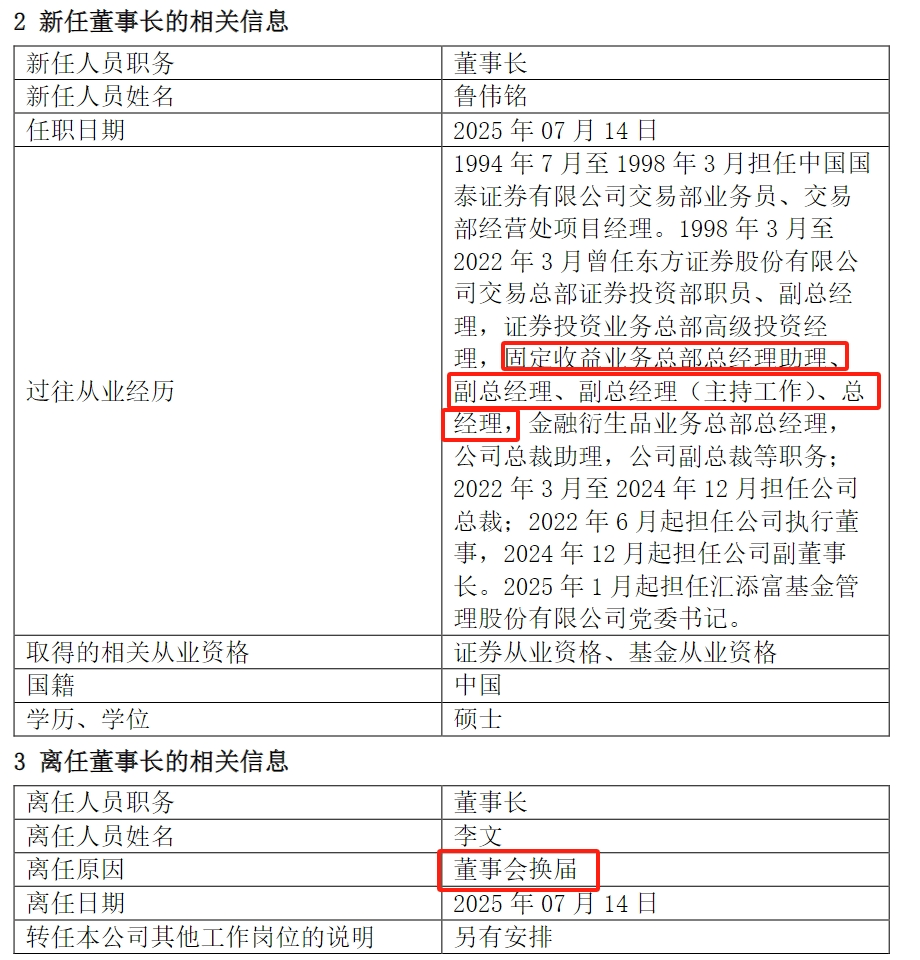
汇添富董事长换人,“权益帝国”的裂缝如何修补?
Sou Hu Cai Jing· 2025-08-04 07:36
Group 1 - The core point of the article highlights the leadership change at Huatai-PineBridge Fund Management, with the departure of long-serving Chairman Li Wen and the appointment of Lu Weiming, who has a strong background in fixed income, raising questions about the company's future direction and its status as an "equity giant" [2][3][6] - Huatai-PineBridge's non-monetary fund management scale has significantly declined, dropping from the second position in the industry in Q3 2020 to ninth place by Q2 2023 [13][26] - The company's equity products have seen a drastic reduction in management scale, with the proportion of equity-type products falling to less than 27% of total assets by Q2 2023, down from nearly 50% at the end of 2020 [11][14] Group 2 - The new chairman Lu Weiming's extensive experience in fixed income may signal a shift towards more conservative investment strategies, contrasting with the company's previous focus on equity selection [6][8] - The performance of notable fund managers at Huatai-PineBridge has been disappointing, with some funds experiencing significant losses, leading to a decline in investor confidence [15][19] - The company has faced challenges in new fund issuance, with 31 new funds launched in 2023 but with a total scale of only approximately 17.2 billion, representing only 67% of the previous year's total [23][25] Group 3 - Huatai-PineBridge's revenue and net profit have seen a sharp decline, with annual revenue dropping from approximately 9.4 billion in 2021 to about 4.8 billion in 2024, and net profit decreasing from around 3.3 billion to about 1.6 billion in the same period [27][28] - The company has faced compliance challenges, including incidents of employee misconduct in securities trading, raising concerns about internal management practices [30][31] - Despite these challenges, Huatai-PineBridge has demonstrated strengths in its research and investment platform, with some equity funds performing well, indicating potential for recovery under new leadership [32]
权益类银行理财表现亮眼 今年以来43只年化收益率为正
Zheng Quan Ri Bao· 2025-08-03 16:13
Core Viewpoint - The performance of equity bank wealth management products has been outstanding this year, with a significant number of products achieving positive annualized returns, driven by a strong capital market and supportive policies [1][2][3]. Group 1: Performance of Equity Wealth Management Products - As of August 3, 2023, out of 46 publicly offered equity wealth management products, 43 have positive annualized returns, representing a 93.48% success rate [2]. - Among the profitable products, 17 have returns exceeding 10%, accounting for 39.53% of the total [2]. - The top-performing product, "Tiangong Rikai 6 (Microplate Growth Low Volatility Index)," managed by Huaxia Wealth Management, achieved a remarkable annual return of 30.51% [2]. Group 2: Market Trends and Future Outlook - The overall market for bank wealth management products reached a scale of 30.67 trillion yuan by the end of June 2025, with fixed income products dominating at 29.81 trillion yuan [4]. - Despite the strong performance of equity products, their market share remains low, with equity products only accounting for 0.07 trillion yuan [4]. - Industry experts predict a gradual expansion of equity wealth management products, driven by policy support and improved market conditions [5]. Group 3: Investment Strategies and Recommendations - The current low interest rates on bonds are expected to lead to a shift in investor preference towards equity assets, enhancing the appeal of equity wealth management products [3][5]. - Financial institutions are encouraged to strengthen their research capabilities and innovate product offerings to meet evolving market demands [4][5]. - A strategic approach to investment is recommended, including assessing risk tolerance and diversifying asset allocation based on investment horizons [6].
中信建投:全球增长上行 把握权益投资机会
Zheng Quan Shi Bao Wang· 2025-08-03 12:46
Core Insights - The report from CITIC Securities indicates that global growth factors are on the rise, while China's economic growth factors continue to improve, supported by ongoing domestic financial easing [1] - Short-term decline in crude oil supply factors is noted [1] - It is projected that by August 2025, China will be in Phase II of the Pring Cycle, suggesting a favorable environment for stock allocation [1] - The performance tracking system for A-share listed companies reveals that the second quarter reports for the CSI 300 and CSI 500 indices exceeded expectations, with factors higher than the average of the past five years [1] - There is a recommendation to select stocks that benefit from China's endogenous economic growth and have shown unexpected performance [1]

大举入市!7月已有7家险资出手
券商中国· 2025-08-01 08:14
险资入市正在持续推进。 近日,又有两家险资出手。7月25日,弘康人寿买入3038.6万股郑州银行H股,这是弘康人寿6月以来第四次突破港交所权益变动披露线。7月28 日,平安资产以投资经理的身份买入374.25万股招商银行H股,持有该行H股比例升至16.03%。根据平安资产受托资产情况来看,此次投资背后 的委托人大概率仍是险资。 一月内7家险资出手 7月25日,弘康人寿买入3038.6万股郑州银行H股,每股均价1.3788港元,持股比例升至10.45%。短短不到一个月,弘康人寿已耗资逾亿港元买入 郑州银行H股,这对于一家小型保险公司来说并非易事。 弘康人寿的投资布局是险资持续入市的一个缩影。据券商中国记者根据公开披露信息不完全统计,一个月内已有7家险资数度出手买入标的资 产,涉及8只股票。 7月1日,利安人寿买入110万股江南水务股票,持有江南水务股票增至4699.54万股,占该上市公司总股本的比例升至5.03%。 7月3日,信泰人寿通过二级市场买入69.09万股华菱钢铁股票,持有华菱钢铁股票增至3.45亿股,占该上市公司总股本的比例升至5.00%。同日, 信泰人寿以6.7263港元的每股均价买入约3.41亿股 ...



【私募调研记录】玄元投资调研小商品城
Zheng Quan Zhi Xing· 2025-07-28 00:11
Group 1 - The core viewpoint of the news is that XuanYuan Investment has conducted research on a listed company, focusing on its talent acquisition and operational strategies to enhance competitiveness and sustainable development [1] - The company, Xiaogoods City, has introduced high-end talents and plans to continue attracting multinational management talent to build a talent pipeline [1] - Xiaogoods City has developed an action plan aimed at improving operational performance, management standards, and core competitiveness to maximize shareholder value [1] Group 2 - The import and export data from Yiwu in the first half of the year is positive, indicating strong demand for goods and the resilience of the supply chain, which supports the company's outlook for import and export growth this year [1] - The company is planning to disclose its market competitiveness strategies as needed and is working on the global digital trade center's recruitment, with the market segment set to open in October [1] - The Hangzhou base will primarily focus on Yiwu payment and the development of Chinagoods, which is progressing as planned [1] Group 3 - XuanYuan Investment, established in 2015, focuses on private equity fund management and has a team with an average of over 10 years of experience in the securities industry [2] - The investment philosophy of XuanYuan Investment is based on a dual approach of value and quantitative investment, emphasizing a comprehensive investment framework that includes macro, meso, and micro analysis [2] - The company aims to become a leading asset management firm in China, adhering to principles of knowledge, practicality, customer focus, and win-win cooperation [2]

大资金持续发力!新一轮举牌潮进行中
券商中国· 2025-07-24 03:30
Core Viewpoint - The recent surge in insurance capital's stock acquisitions, marking a new wave of investment activity, reflects a strategic shift in asset allocation and operational adjustments in response to the evolving economic landscape [2][18][19]. Group 1: Insurance Capital Activity - Insurance companies have initiated a record 21 stock acquisitions as of July 22, surpassing the total for 2021-2023 and setting a five-year high [2][10]. - The latest acquisitions include significant purchases by Zhongyin Life and Taikang Life, with Zhongyin acquiring 726,000 shares of Green Power Environmental, reaching a 5.0722% stake [7][6]. - The trend of stock acquisitions has been consistent, with four instances occurring in July alone, indicating a robust interest from various insurance firms [5][6]. Group 2: Investment Strategy and Market Conditions - The current investment strategy emphasizes high-dividend stocks and long-term equity investments, driven by a low-interest-rate environment and new financial regulations [11][18]. - The insurance sector is increasingly focusing on stable, high-yield investments to enhance returns, with a notable shift towards equities as a means to navigate low returns from traditional fixed-income assets [18][19]. - The ongoing policy support for long-term investments is expected to further expand the space for equity asset allocation among insurance companies [19][22]. Group 3: Historical Context and Future Outlook - This marks the third wave of stock acquisitions in the past decade, with previous surges occurring in 2015 and 2020, indicating a cyclical pattern in investment behavior [8][9]. - Although the current annual acquisition count has not yet surpassed the previous waves, the duration and total volume of acquisitions since 2024 have already exceeded the second wave [9]. - The focus on banking stocks remains prominent, with significant investments in major banks, reflecting their stable operations and attractive dividend yields [12][10].

中国人寿“鸿鹄实验”
Sou Hu Cai Jing· 2025-07-23 04:37
Core Viewpoint - The insurance capital private equity funds are flourishing in the industry, providing a means to smooth profit statements and reduce the erosion of solvency from equity investments. This shift is exemplified by China Life's strategic adjustments in its equity investments, moving from direct stock holdings to long-term investment platforms like the Honghu Fund [1][3][20]. Group 1: Strategic Adjustments - China Life has reduced its holdings in Hangzhou Bank, cashing out approximately 3.042 billion yuan since 2021, while simultaneously increasing its investment in the Honghu Fund, committing over 20 billion yuan to stable blue-chip stocks [1][3]. - The strategic shift involves gradually reducing high-valuation direct equity investments and reallocating to long-term equity assets that can benefit from policy incentives [3][20]. Group 2: Regulatory Support - The establishment of private equity funds by insurance capital has been accelerated by favorable regulatory policies, including a 30% reduction in solvency capital factors and exemptions from equity asset ratio limits [3][7][22]. - The "Honghu model" is changing the institutional funding landscape in the A-share market, allowing for a significant influx of long-term capital [3][16][23]. Group 3: Fund Performance - The first phase of the Honghu Fund, with a scale of 50 billion yuan, has shown promising results, achieving a net profit of 917 million yuan in 2024, translating to an annualized return of approximately 1.8% [11][12]. - The fund's investments are primarily in high-dividend stocks, which align with the insurance capital's preference for stable and liquid investments [9][10]. Group 4: Market Dynamics - The insurance sector's asset allocation is a balancing act, aiming to ensure solvency, meet annual return targets, and maintain long-term stability [17][18]. - The recent surge in private equity funds is not limited to large insurance companies; smaller firms are also beginning to explore this investment avenue [20][23].


除了银行,险资到底还喜欢哪些高股息?
表舅是养基大户· 2025-07-19 14:42
Group 1 - The article discusses the recent investment strategies of Pacific Insurance (太保) in the context of a long-term low interest rate environment, highlighting the challenges faced by traditional fixed-income assets [7][8][9] - It emphasizes the necessity for equity investments to enhance overall returns and alleviate pressure from declining interest spreads, citing the long-term annualized return of the CSI Dividend Total Return Index at approximately 14% since 2006 [15][16][21] - The shift from relative return strategies to absolute return strategies is noted, with a focus on passive investment approaches and the increasing importance of Smart Beta strategies [22][28][29] Group 2 - The article outlines the trend of insurance institutions transitioning from traditional financial investors to strategic investors, with a focus on long-term partnerships and governance in listed companies, particularly in undervalued and high-dividend sectors [30][31] - It discusses the impact of new accounting standards on financial reporting, emphasizing the need for insurance companies to carefully consider asset classification to manage volatility and ensure stable returns [33][35] - Key indicators for long-term asset allocation are identified, including sustainable competitive advantage, consistent profitability, operational stability, and shareholder return capabilities [36][37] Group 3 - Recommendations for regulatory adjustments are provided to encourage long-term capital market investments, including capital incentives for long-term equity holdings and differentiation between trading and strategic investments [40][41][42]