AI基础设施

Search documents
IREN Regains Momentum. Here's Why You Should Buy Now
247Wallst· 2025-11-19 18:21
The AI infrastructure sector is going through a rough patch, with shares of high-flyers like CoreWeave ( NASDAQ:CRWV ), Nebius Group ( NASDAQ:NBIS ) and other "neocloud†providers tumbling amid valuation fears, potential delays in hyperscaler spending, and broader market rotation away from growth names. ...


英伟达财报倒计时!关注英伟达财报对算力景气度验证,聚焦海外映射逻辑
Mei Ri Jing Ji Xin Wen· 2025-11-19 06:32
Market Overview - A-shares showed mixed performance with the ChiNext Index slightly up, while sectors like non-ferrous metals and oil & petrochemicals led the gains, and real estate, media, construction materials, and computers faced declines [1] Concept Sectors - Active concept sectors included aquaculture, lithium mining, optical module CPO, lithium extraction from salt lakes, and photolithography machines [1] ETF Performance - The cloud computing 50 ETF (516630) experienced a slight decline, with major holdings such as Shenzhou Information (000555), Deep Technology (300768), and others leading the losses, while a few companies like Zhongji Xuchuang (300308) and Shiji Information (002153) saw gains [1] Nvidia Financial Outlook - Nvidia is set to release its Q3 FY26 earnings report, with expected revenue of $55.1 billion, a 57% year-over-year increase, and data center revenue projected at $49.1 billion [2] - The adjusted gross margin for Q3 is anticipated to be 73.7%, indicating strong demand from major clients, including North American cloud service providers [2] - Nvidia's CEO emphasized a clear visibility towards achieving $500 billion in cumulative data center revenue by 2025-2026, suggesting sustained high demand in the AI infrastructure cycle [2] Investment Opportunities - The AI hardware sector is expected to maintain high growth, with potential valuation recovery opportunities linked to Nvidia's earnings report and expectations of overseas interest rate cuts [2] - Focus areas for investment include overseas computing (PCB, optical modules), domestic computing (semiconductor supply chain, storage), and consumer electronics [2] Related ETFs - The Sci-Tech Innovation 50 ETF (159783) focuses on high elasticity sectors including semiconductors, communication equipment, batteries, and photovoltaic equipment [3] - The cloud computing 50 ETF (516630) covers popular computing concepts such as optical modules & devices, computing leasing, data centers, AI servers, and liquid cooling [3]

华尔街传奇投资人 Ron Baron 重仓马斯克:赚 120 亿还不够,还要再押 10 年
3 6 Ke· 2025-11-17 02:41
Core Insights - The central theme of the 32nd Baron Investment Conference was "Changing Lives," focusing on the transformative potential of investments in innovative technologies [2] - Ron Baron, an 82-year-old legendary investor, has heavily invested in Elon Musk's ventures, with approximately 40% of his personal assets in Tesla and 25% in SpaceX, totaling around 65% of his wealth tied to Musk [3][4] - Baron estimates that his investments in Musk's companies have generated over $12 billion in profits since 2014, with $8 billion from Tesla and $4 billion from SpaceX and other projects [3][4] Group 1: Investment Philosophy - Baron emphasizes that he invests in people rather than companies, highlighting Musk's commitment and vision as key factors in his investment strategy [6][7] - He values Musk's execution ability, noting Musk's resilience during challenging times, such as Tesla's near bankruptcy and SpaceX's early rocket failures [8][10] - Baron believes in long-term investment strategies, stating that he often waits for over a decade to see returns, as exemplified by his continued investment in Tesla since 2012 [11][14] Group 2: Musk's Vision and Projects - Baron sees Musk's ventures as interconnected, creating a synergistic ecosystem rather than isolated businesses, which enhances their overall strength [15][17] - He highlights Musk's ability to withstand pressure and market fluctuations, often increasing his investments during downturns [18][20] - Baron is particularly optimistic about Musk's AI company, xAI, which he believes has the potential to redefine AI infrastructure and applications [23][31] Group 3: Future Outlook - Baron predicts that the next decade could yield five times the current investment returns, driven by the foundational infrastructure being built for AI [39][44] - He notes that current AI companies focus on application layers, while Musk is developing the underlying infrastructure necessary for widespread AI adoption [40][42] - Baron believes that if Musk can significantly reduce AI costs, it will become as ubiquitous as electricity, fundamentally changing its accessibility and utility [43][44]

AI巨头拟500亿美元入局AI基建
2 1 Shi Ji Jing Ji Bao Dao· 2025-11-15 23:32
Core Insights - The article highlights the significant investment shift towards AI infrastructure, with Anthropic announcing a $50 billion investment to build a nationwide AI infrastructure network in the U.S. [2] - This investment, while substantial, is dwarfed by competitors like OpenAI, which plans to invest approximately $1.4 trillion over the next eight years, and Meta, which aims to invest $600 billion in the next three years [2][8]. Company Overview - Anthropic, founded in 2021 by former OpenAI researchers, has recently completed a Series F funding round of $13 billion, resulting in a post-money valuation of approximately $183 billion [3]. - The company is focusing on building AI data centers in collaboration with Fluidstack, a UK-based AI cloud platform known for its large-scale GPU cluster deployments [4]. Investment Details - Anthropic's $50 billion investment will support the rapid growth of its enterprise business and long-term R&D needs, positioning the company as a key player in the U.S. AI infrastructure sector [4][5]. - The company currently serves over 300,000 enterprise clients, with the number of large clients contributing over $100,000 annually increasing nearly sevenfold in the past year [5]. Industry Context - The investment trend in AI infrastructure reflects a broader competition among major tech companies, with predictions indicating that global investments in AI and data center infrastructure could reach $5 trillion [8]. - Major players like Amazon, Google, Microsoft, and Meta are also ramping up their investments, with Amazon planning to invest $125 billion by 2025 and Google increasing its capital expenditures to between $91 billion and $93 billion [8]. Challenges and Concerns - The rapid expansion of AI infrastructure raises concerns about sustainability and potential market bubbles, particularly regarding the availability of sufficient power to support the massive energy demands of AI data centers [9][10]. - Analysts warn that the U.S. could face a power shortfall of up to 20% by 2028 due to the high energy consumption of AI data centers, which could lead to significant operational challenges [9][10].

硬蛋创新2025年前三季度收入破100亿元 同比增长42%
Zheng Quan Ri Bao Wang· 2025-11-14 13:12
Core Insights - The company reported a strong performance in Q3 2025, with total revenue exceeding 10 billion yuan, representing a year-on-year growth of 42% [1] - Operating profit reached approximately 400 million yuan, indicating a significant enhancement in profitability [1] - The growth is primarily driven by robust demand in the AI computing supply chain business and accelerated commercialization of self-developed products, particularly the System on Module (SOM) [1] Business Performance - The company is a key supplier in the AI computing supply chain, collaborating deeply with renowned chip manufacturers such as NVIDIA, Xilinx, Intel, AMD, Sandisk, and Microsoft [1] - It has achieved notable results in two core business areas: "AI infrastructure" and "AI intelligent terminals," providing high-performance GPU cluster solutions to leading internet companies like Meituan and participating in national computing infrastructure projects [1] - The company is also expanding into high-growth sectors such as humanoid robots and autonomous driving, offering customized AI solutions at the edge [1] Self-Developed Products - The self-developed SOM products have been successfully implemented in high-standard scenarios such as customs and banks, achieving mass delivery [2] - This success reflects the company's technical integration capabilities and an upgrade in its business model [2] - The company plans to continue iterating and upgrading its SOM product matrix around the next generation of AI core chips, positioning it as a core pillar for future growth [2]
微软 CEO 纳德拉:这一次工业革命,从 “AI 超级工厂”开始
3 6 Ke· 2025-11-14 00:34
Core Insights - Microsoft is building the world's first "Planet-scale AI Superfactory," which integrates multiple data centers to enhance AI model training and operation [1][6][11] - CEO Satya Nadella describes this initiative as an industrial revolution, emphasizing the transformation of knowledge work through AI [2][3] - The focus is on creating a robust infrastructure that supports AI systems rather than just developing powerful models [5][9] Group 1: AI Superfactory and Infrastructure - The Fairwater 2 data center in Atlanta features 5 million network connections and has training capabilities that are 10 times greater than what GPT-5 requires [6][11] - Microsoft aims to increase training capacity by 10 times every 18 to 24 months, with Fairwater 2 connected to a data center in Wisconsin via a 1 Petabit high-speed network [6][11] - The AI factory architecture consists of three layers: training, inference, and interface, designed to create a closed-loop system for token generation and delivery [11][20] Group 2: Redefining Data Centers - Traditional data centers are being redefined as AI power plants, focusing on continuous token output and global responsiveness [12][15] - Microsoft is restructuring four core components of its AI data centers: chip deployment logic, liquid cooling systems, network connection structures, and site selection [16][18] - The goal is to create a global AI network (AI-WAN) that allows for intelligent resource allocation across different data centers [22][23] Group 3: Strategic Decisions and Market Position - Microsoft paused the leasing of several planned data center sites to avoid becoming merely a hosting provider for a single client, aiming instead for a scalable service network [31][33] - The company is focusing on software optimization to counteract hardware costs, significantly increasing capital efficiency [34][37] - Nadella emphasizes that market share decline in certain areas is not a negative sign but rather an indication of market expansion, prioritizing overall market growth over individual share [38][41] Group 4: Long-term Vision - The overarching strategy is to build a sustainable growth system that supports AI infrastructure over the next decade, focusing on foundational elements rather than immediate product releases [43][44] - The success of AI infrastructure will be measured by its stability and seamless integration into user experiences, rather than just the strength of individual models [45][46]

大名城:全资子公司拟6.94亿元购买佰才邦19.4293%股份
Zheng Quan Shi Bao Wang· 2025-11-13 14:43
Core Viewpoint - Daming City (600094) announced the acquisition of a 19.4293% stake in Beijing Baicai Bang Technology Co., Ltd. for 694 million yuan, indicating a strategic move into the telecommunications sector focused on advanced communication solutions [1] Group 1: Company Overview - Daming City's wholly-owned subsidiary, Shenzhen Mingcheng Jinkong (Group) Co., Ltd., is set to purchase 28,876,041 shares of Baicai Bang, which represents 19.4293% of its total equity [1] - Baicai Bang is a high-tech enterprise engaged in 4G/5G/6G communication solutions, emphasizing the migration of traditional telecom network equipment to the cloud and providing SaaS services [1] Group 2: Business Focus - Baicai Bang's primary business includes integrating self-developed virtualization operating systems, MEC, and AI-RAN technologies to create simplified, intelligent, and user-friendly solutions for AI infrastructure [1] - The company aims to establish an end-to-end underlying architecture capability across the entire network [1]

思科上调全年收入指引至602亿—610亿美元
Zheng Quan Shi Bao Wang· 2025-11-13 00:20
Core Insights - Cisco reported Q1 revenue of $14.88 billion, an 8% year-over-year increase, and non-GAAP EPS of $1.00, a 10% increase, both exceeding Wall Street expectations [1] - This marks Cisco's fourth consecutive quarter of revenue growth [1] - AI infrastructure orders surged to $1.3 billion, significantly up from $800 million in the previous quarter [1] Revenue Performance - Networking business showed strong performance with a revenue growth of 15% [1] - Product orders increased by 13% year-over-year, with networking product orders achieving double-digit growth for the fifth consecutive quarter [1] Guidance Update - Cisco raised its full-year revenue guidance to between $60.2 billion and $61 billion [1]

英飞凌发布2025财年财报:营收146.62亿欧元,同比下降2%
Sou Hu Cai Jing· 2025-11-12 23:29
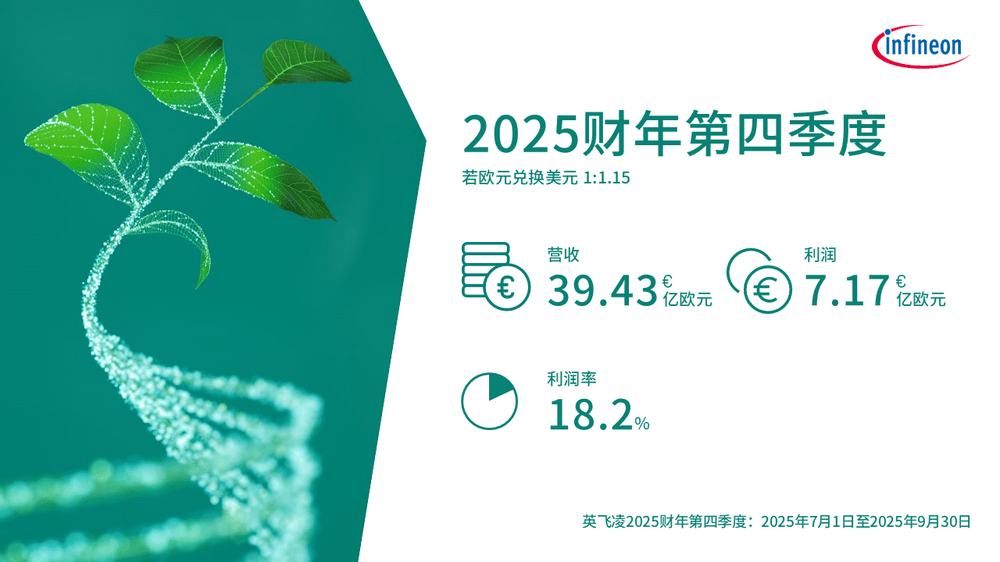
Core Insights - Infineon Technologies AG reported its Q4 and full-year financial results for FY2025, showing a revenue of €3.943 billion and a profit of €717 million with a profit margin of 18.2% [1] - For FY2025, the company recorded a total revenue of €14.662 billion, a year-on-year decline of 2%, with a profit of €2.56 billion and a profit margin of 17.5% [3] - The adjusted earnings per share for FY2025 were €1.39, while the free cash flow was negative at €1.051 billion due to the acquisition of Marvell's automotive Ethernet business [3] Financial Performance - Q4 FY2025 revenue was €3.943 billion, with a profit of €717 million and a profit margin of 18.2% [1] - FY2025 total revenue was €14.662 billion, down 2% year-on-year, with a profit of €2.56 billion and a profit margin of 17.5% [3] - Adjusted free cash flow for FY2025 was positive at €1.803 billion, while reported free cash flow was negative at €1.051 billion [3] Future Outlook - For Q1 FY2026, the company expects revenue of approximately €3.6 billion, with a profit margin projected between 14% and 19% [5] - The FY2026 outlook anticipates moderate revenue growth despite adverse currency effects, with adjusted gross margins expected between 41% and 43% and profit margins between 17% and 19% [7] - The company plans to invest around €2.2 billion, with adjusted free cash flow projected at €1.6 billion and reported free cash flow at €1.1 billion [7] - Infineon expects significant growth in demand for AI data center power solutions, projecting revenue in this area to reach approximately €1.5 billion in FY2026, with a total addressable market of €8 billion to €12 billion by the end of 2030 [7]

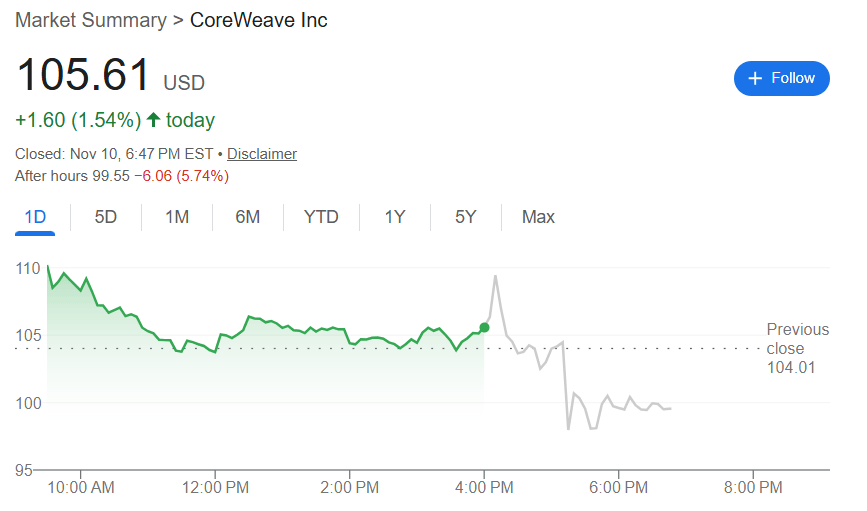
CoreWeave三季度营收13.6亿美元超预期,建设缓慢导致下调全年营收指引,股价盘后重挫6%
Sou Hu Cai Jing· 2025-11-11 03:28
Core Financial Performance - CoreWeave reported Q3 revenue of $1.36 billion, a 134% year-over-year increase, exceeding the expected $1.29 billion [3][4] - The company experienced a net loss of $110 million, significantly reduced from a net loss of $359 million in the same period last year [3][4] - Operating profit margin was only 4%, below the expected 6.5% and lower than the previous year's margin [3][4] Revenue Guidance and Order Backlog - The revenue guidance for 2025 was lowered from a previous high of $5.35 billion to a range of $5.05 billion to $5.15 billion, below analyst expectations of $5.29 billion, primarily due to delays from a third-party data center contractor [3][4] - The company's order backlog reached $55.6 billion, nearly double that of the previous quarter [4][5] - Significant contracts include a $14.2 billion six-year agreement with Meta and an expanded $6.5 billion agreement with OpenAI [4][5] Capital Expenditure and Growth Strategy - CoreWeave's CEO indicated that the company is facing constraints due to a shortage of "powered-shell" data centers for rapid deployment [5] - Following a failed acquisition of Core Scientific, CoreWeave is accelerating its own data center construction, particularly in Pennsylvania [5] - The projected capital expenditure for 2026 is expected to exceed double that of 2025's estimated $12-14 billion, raising concerns about the aggressive investment pace relative to anticipated revenue [5]