价值投资

Search documents
会员金选丨巴菲特直播课限免权益
第一财经· 2025-08-11 03:58
第一财经×星展银行 【会员金选限免权益】 从伯克希尔低调接班人阿贝尔的管理逻辑,到巴菲特 70 年致股东信中穿越牛熊的底层法 则;从破解 "认知边界" 的财富困局,到全球政策与技术革命下的投资新范式——4大内容 深度拆解价值投资核心逻辑,每一节都嵌入实战案例与趋势洞察。 ✨ 权益亮点: ↓↓↓ 回顾70年致股东信,找到巴菲特穿越7次牛熊的投资密码。 巴菲特说永远赚不到认知以外的钱,普通投资者如何对抗认知焦虑? 全球政策博弈与技术革命下的投资新逻辑。 无论你是刚入门的投资小白,还是想突破收益瓶颈的进阶者,这场由两大权威机构背书的 直播课,将用 "股神智慧" 拆解真实投资场景。 立即领取,即可锁定你的专属学习席位! 巴菲特直播课 课程采用高清视频形式呈现,每课精心制作1-1.5小时深度内容,共四节。 揭秘低调接班人阿贝尔:巴菲特为什么说他"永远不会做蠢事"? 本 次 限 免 权 益 数 量 有 限 立 即 领 取 独家联合:第一财经携手星展银行,专为会员用户申请【价值投资系统课】限时免费资 格。 ✨内容亮点: 穿越周期的能力升级:从财报解读到宏观政策分析,构建 "理论 - 工具 - 实战" 三维体系, 助你摆脱跟 ...

巨头官宣大手笔自购:2.3亿元
3 6 Ke· 2025-08-11 00:25
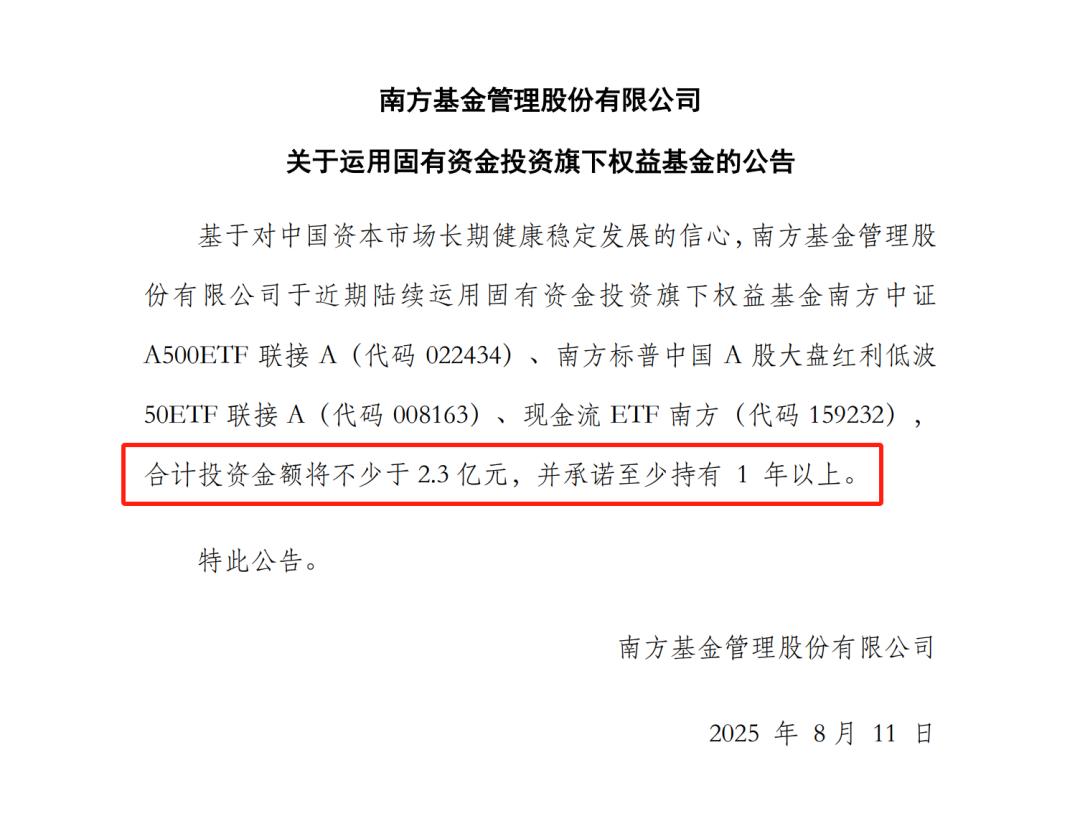
Core Viewpoint - Southern Fund demonstrates confidence in the Chinese capital market by announcing a self-purchase of its equity funds amounting to no less than 230 million yuan, reflecting a strong belief in the long-term health and stability of the market [1][2]. Group 1: Fund Self-Purchase Actions - Southern Fund has committed to investing at least 230 million yuan in its equity funds, including specific funds like the Southern CSI A500 ETF and Southern S&P China A-Share Large Cap Dividend Low Volatility ETF, with a holding period of at least one year [2]. - Other fund companies, such as ICBC Credit Suisse, Founder Fubon, and Da Cheng, have also engaged in self-purchases, indicating a broader trend among asset management institutions to invest their own capital [1][5]. - The total net subscription amount for public funds' self-purchases in equity funds (stock and mixed types) has reached 2.464 billion yuan this year, highlighting a sustained trend of self-purchase actions among fund companies [15]. Group 2: Market Confidence and Economic Outlook - The recent market recovery has led many institutions to recognize the medium to long-term investment value of the A-share market, with Southern Fund citing the strong vitality and resilience of the Chinese economy as a foundation for the capital market's long-term growth [16]. - Despite external complexities, China's GDP achieved a steady growth of 5.3% in the first half of the year, indicating a positive macroeconomic trend [16]. - The current valuation of the Chinese stock market is seen as particularly attractive, with the CSI 300 Index and Hang Seng Index trading at price-to-earnings ratios of 13.93 and 11.83, respectively, which are lower than those of major mature markets [16]. Group 3: Future Market Expectations - A fund company expressed a cautiously optimistic view on the A-share market for the second half of 2025, anticipating a three-phase upward cycle driven by policy support, technological advancements, and globalization [17]. - The market may enter a phase of adjustment after a rapid rise, but the long-term outlook remains positive, particularly in sectors such as technology, domestic demand stimulation, and financial reform [17].
不止于绝对收益!一个风控优先的基金经理与他的稳健风格打法
聪明投资者· 2025-08-10 23:53
Core Viewpoint - The article discusses the investment strategies and performance of fund manager Sheng Zhenshan, highlighting his unique approach to risk management and asset allocation in a volatile market environment [2][3][6]. Group 1: Market Environment and Fund Performance - The market has experienced significant fluctuations from early 2024 to mid-2025, with a notable drop below 2700 points and subsequent recovery [2]. - A set of equity mixed funds and ordinary stock funds was analyzed, focusing on those with a maximum drawdown of 10% and a scale exceeding 100 million, achieving returns above 8% in 2025 [2]. - Sheng Zhenshan's fund, "Industrial Bank Selected Return," achieved a maximum drawdown of 8.1% and a recovery time of only 11 days, with a return of 29.43% since its management began [3]. Group 2: Investment Philosophy and Strategy - Sheng Zhenshan emphasizes risk management as a core principle, shaped by his early experiences in unfavorable market conditions [6][20]. - His investment approach is characterized by a balanced asset allocation strategy, avoiding extreme bets and maintaining a diversified portfolio [7][11]. - The focus is on identifying undervalued assets through a dynamic valuation process, considering both growth and valuation aspects [8][9]. Group 3: Sector Focus and Asset Allocation - Sheng Zhenshan's portfolio is heavily weighted towards aviation and gold stocks, diverging from traditional sectors like energy and utilities [4]. - He adopts a supply-side perspective to assess industry cycles, prioritizing sectors with potential for capital improvement rather than those experiencing rapid growth [10][29]. - The investment strategy includes holding a diversified basket of low-correlation assets to mitigate risks and enhance returns [11][43]. Group 4: Insights on Specific Assets - The article discusses Sheng Zhenshan's views on gold, indicating a long-term bullish outlook despite short-term volatility, with a focus on the underlying asset's future value rather than immediate profits [50][52]. - In the aviation sector, he believes that current valuations are low, and the industry is nearing a recovery phase, making it an attractive investment opportunity [56][57]. - The approach to dividend stocks emphasizes the importance of sustainable earnings and dividends over mere historical performance [58][59].
Could Buying UPS Stock Today Set You Up for Life?
The Motley Fool· 2025-08-10 22:32
The shipping giant still faces difficult long-term challenges. UPS (UPS 0.18%), one of the world's largest shipping couriers, might seem like a reliable long-term investment. But over the past five years, its stock declined 40%. Even after including its reinvested dividends, it delivered a negative total return of 28%. In 2024, its daily package volume and revenue increased again as the macro environment stabilized and it negotiated a new labor contract with the Teamsters. But those higher labor and pension ...


如何穿越投资迷雾 ——读《大道至简:大师投资说》
Shang Hai Zheng Quan Bao· 2025-08-10 17:40
Core Insights - The book "大道至简:大师投资说" emphasizes a return to the essence of investing, focusing on value investment principles and localized strategies for navigating market volatility [3][4][10] Group 1: Value Investment Principles - The core of value investing is understanding that stocks represent a part of a business, and investors should analyze companies as they would their own businesses [4][10] - Long-termism is highlighted as a fundamental principle, requiring investors to maintain faith in the long-term growth potential of companies despite short-term market fluctuations [4][10] Group 2: Investment Framework - The author introduces a "three-dimensional perspective" for stock research, which includes industrial, financial, and risk perspectives [6] - The "86 system" focuses on qualitative analysis, emphasizing the selection of companies with clear business models, sustainable performance, and trustworthy management [6] - The "39 system" builds on the 86 system, advocating for contrarian investment strategies during market extremes [6] Group 3: Market Dynamics and A-Share Insights - The book addresses the high volatility of the A-share market, arguing that despite its challenges, value investing remains viable [9][10] - Historical data shows that high-quality companies like 贵州茅台 and 伊利股份 have provided substantial long-term returns, countering the notion of the A-share market being ineffective [9] Group 4: Overcoming Behavioral Challenges - The author identifies human nature as a significant barrier to successful value investing, with many investors losing direction due to short-term market movements [10][11] - Emphasizing the importance of independent thinking and emotional management, the book outlines key traits of successful value investors, including patience and decisiveness [11]






刚刚!巨头官宣大手笔自购:2.3亿元!
中国基金报· 2025-08-10 15:24
Core Viewpoint - The article emphasizes the confidence in the Chinese capital market, highlighted by Southern Fund's announcement of a self-purchase of its equity funds amounting to at least 230 million yuan, reflecting a strong belief in the long-term health and stability of the market [2][5]. Group 1: Fund Company Actions - Southern Fund has committed to investing at least 230 million yuan in its equity funds, including specific ETFs, and will hold these investments for a minimum of one year [5]. - Other fund companies, such as ICBC Credit Suisse, Founder Fubon, and Great Wall, have also engaged in self-purchases, indicating a broader trend among asset management institutions to invest their own funds [3][10][12]. - The total net subscription amount for equity funds (stock and mixed types) by public institutions has reached 2.464 billion yuan this year, showcasing a significant commitment to the market [17]. Group 2: Market Confidence and Economic Outlook - The article notes that the recent recovery in the market has led many institutions to recognize the medium to long-term investment value of A-shares, supported by China's strong economic vitality and resilience [19]. - Despite external complexities, China's GDP achieved a steady growth of 5.3% in the first half of the year, indicating a positive macroeconomic trend [19]. - The current valuation of the Chinese stock market is considered attractive, with the price-to-earnings ratios of major indices being lower than those of developed markets, presenting a good opportunity for long-term investors [19]. Group 3: Future Market Expectations - A cautious optimism is expressed regarding the A-share market for the second half of 2025, with expectations of a fluctuating upward trend driven by policy support, technological advancements, and financial reforms [20][21]. - The article outlines a three-phase upward cycle for A-shares, suggesting a positive outlook for sectors such as technology and domestic demand stimulation [21].

以合理价格挖掘高质量资产——访永赢基金权益研究部总经理王乾
Shang Hai Zheng Quan Bao· 2025-08-10 13:40
Core Viewpoint - The article emphasizes the importance of a value investment strategy that focuses on buying high-quality assets at reasonable prices while maintaining a low concentration and turnover rate in the investment portfolio [3][4][5]. Group 1: Investment Strategy - The investment framework prioritizes deep analysis of a company's long-term value, integrating asset quality, valuation levels, and fundamental trends [3][5]. - The strategy of "low concentration, low turnover" has shown advantages in recent market conditions, helping to reduce portfolio volatility through risk diversification and strict control of safety margins [5][6]. - The experience of public fund investors is closely related to volatility levels, not just absolute returns, highlighting the importance of long-term holding of quality assets [5][6]. Group 2: Market Outlook - The current macroeconomic environment necessitates a balance between asset quality and valuation safety margins, with a focus on high-quality assets in domestic demand sectors as they show increasing value [6][8]. - The A-share market is characterized by structural trends, with growth assets outperforming, particularly in sectors like AI and innovative pharmaceuticals, while cyclical stocks also present investment opportunities [7][8]. - The article outlines three main themes for the second half of the year: "anti-involution" policies promoting quality competition, structural highlights in domestic demand recovery, and the development of new productive forces [8][9]. Group 3: Sector Focus - The "anti-involution" policy is expected to shift industry competition from price wars to quality competition, benefiting midstream manufacturing and upstream raw materials sectors [8]. - The recovery of domestic demand is supported by policies that stimulate durable goods consumption and manufacturing investment, with real estate stabilization playing a crucial role [8]. - New productive forces, particularly in AI, biomedicine, and high-end manufacturing, are anticipated to provide significant investment opportunities and contribute to excess returns [9].

投资大家谈 | 杨岳斌:对风险的定义和误区
Sou Hu Cai Jing· 2025-08-10 12:10
Core Viewpoint - The article discusses the fundamental differences in the definition of risk between Wall Street and value investors, emphasizing that these differences lead to distinct investment strategies and perspectives when evaluating undervalued businesses [1][3][27]. Group 1: Definitions of Risk - Wall Street defines risk primarily as the relative volatility of a stock or portfolio, often measured by beta, which quantifies past price fluctuations [7][18]. - Value investors, on the other hand, view risk as the potential loss of principal and related returns, focusing on the intrinsic value of a business rather than its historical price volatility [6][19]. - The article highlights that the understanding of risk is crucial for making accurate investment decisions, as a misinterpretation can lead to significant financial losses [4][27]. Group 2: Investment Strategies - Value investors adopt a long-term perspective, believing that holding undervalued businesses over time reduces risk, while Wall Street often emphasizes short-term trading strategies [20][21]. - The article contrasts the "Business Picker" approach of value investors, who focus on the underlying business fundamentals, with the "Stock Picker" mentality of Wall Street, which prioritizes market trends and price movements [14][15]. - Value investors prefer concentrated investments in a few well-understood businesses, arguing that diversification can increase risk due to the complexity of managing multiple variables [22][23]. Group 3: Risk Assessment Methodologies - The article outlines Buffett's five-factor method for assessing investment risks, which includes evaluating the long-term economic characteristics of a business, the competence of its management, and the impact of inflation on purchasing power [10][11]. - This method contrasts with Wall Street's reliance on quantitative measures like beta, which may not accurately reflect the true risks associated with an investment [12][19]. - The emphasis on qualitative assessments in value investing allows for a more nuanced understanding of risk, which can lead to better investment outcomes over time [26][27]. Group 4: Conclusion - The article concludes that the differing definitions and approaches to risk between Wall Street and value investors result in fundamentally different investment philosophies, with value investors more likely to achieve long-term success by focusing on intrinsic value and business fundamentals [24][27].
投资大家谈 | 杨岳斌:对风险的定义和误区
点拾投资· 2025-08-10 11:00
Core Viewpoint - The article discusses the fundamental differences in risk perception between Wall Street and value investors, emphasizing that these differences lead to distinct investment strategies and outcomes [2][3]. Group 1: Definitions of Risk - Wall Street defines risk as the relative volatility of a stock or portfolio, often measured by beta, which focuses on historical price fluctuations [10][21]. - Value investors, on the other hand, view risk as the potential loss of principal and related returns, emphasizing the importance of understanding a business's intrinsic value and economic characteristics [9][10]. Group 2: Practical Risk Assessment - Value investing involves analyzing the inherent risks of a business, including financial leverage and the investor's ability to understand the business's economic features [13][14]. - Buffett's five-factor method for assessing risk includes evaluating the long-term economic characteristics of a business, the management's capabilities, and the business's purchase price relative to its intrinsic value [14][15][16]. Group 3: Comparison of Investment Philosophies - Value investors focus on the underlying business and its long-term competitive advantages, while Wall Street investors often prioritize short-term price movements and statistical measures [22][23]. - The article highlights that value investors prefer concentrated investments in a few well-understood businesses, whereas Wall Street advocates for diversification to mitigate risk [27][28]. Group 4: Conclusion - The article concludes that the differing definitions and approaches to risk between Wall Street and value investors lead to fundamentally different investment strategies, with value investors more likely to achieve long-term success by focusing on a few high-quality businesses [32][33].

千亿私募,持仓大腾挪!
Shang Hai Zheng Quan Bao· 2025-08-10 02:14
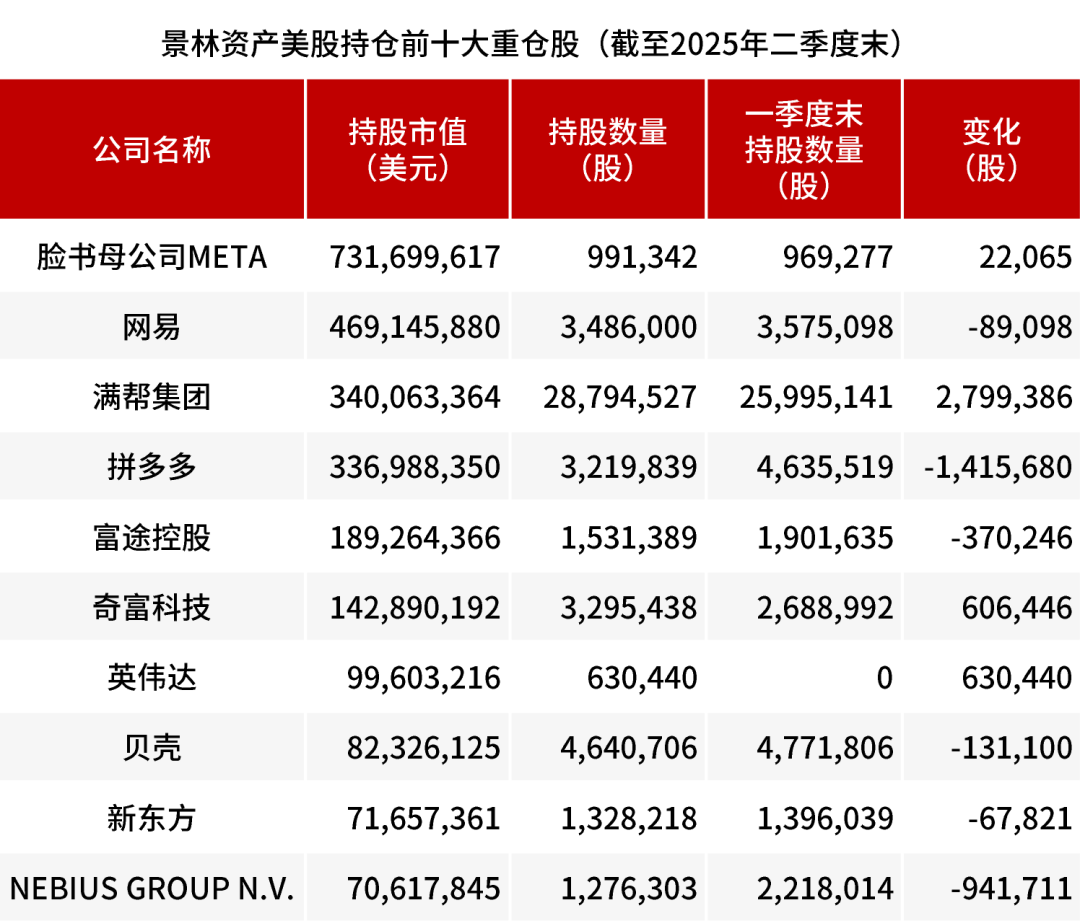
Core Viewpoint - Jinglin Asset has made significant adjustments to its portfolio in the second quarter, focusing on increasing positions in Nvidia and Manbang Group while liquidating holdings in Apple, Pfizer, Legend Biotech, and ZTO Express. The firm believes that the valuation recovery of Chinese assets may be at a midpoint, necessitating a focus on identifying new companies with strong business models and cash flows [1][11]. Group 1: Portfolio Adjustments - As of the end of Q2, Jinglin Asset held stocks in 28 companies in the US market, with a total market value of $2.874 billion [1][12]. - The top ten holdings include Meta, NetEase, Manbang Group, Pinduoduo, Futu Holdings, Qifu Technology, Nvidia, Beike, New Oriental, and Nebius Group [3][12]. - New additions to the top ten holdings are Nvidia and Nebius Group, while significant reductions were made in technology and pharmaceutical stocks [4][5]. Group 2: Specific Stock Movements - Jinglin Asset increased its stake in Nvidia, acquiring 630,440 shares after previously selling 37,800 shares in Q1, indicating a renewed confidence in the company's valuation and fundamentals [5]. - The firm completely exited positions in Apple and reduced holdings in several tech stocks, including a more than 90% reduction in Taiwan Semiconductor Manufacturing Company and significant cuts in Hesai Technology [9][12]. - In the healthcare sector, Jinglin Asset liquidated positions in Regeneron, Pfizer, and Legend Biotech, reflecting a cautious stance towards certain pharmaceutical stocks [9]. Group 3: Market Outlook - Jinglin Asset remains optimistic about Chinese assets, focusing on structural opportunities despite macroeconomic pressures. The firm emphasizes the importance of monitoring policy changes and believes that new investment opportunities will arise in emerging sectors [11]. - The firm identifies potential growth areas in new consumer trends, innovative pharmaceuticals, and hard technology innovations in China, suggesting that the recovery of Chinese asset valuations is ongoing [11].