创业

Search documents
云鲸新生
雷峰网· 2025-07-16 10:29
Core Viewpoint - The article discusses the journey of Yunji, a robotics company, highlighting its challenges, growth, and strategic decisions in the competitive landscape of consumer robotics and smart hardware. Group 1: Growth Pains - Yunji's rapid expansion from 200 to 1000 employees faced numerous challenges, including supply chain issues and market competition [6][7][8] - The company experienced a significant crisis in 2021 when a large-scale product failure occurred due to a supplier's bug, affecting multiple companies [11][12] - Yunji's transition from reactive to proactive planning marked its evolution from chaotic growth to systematic restructuring [6][10] Group 2: Product Development and Innovation - The decision to delay the launch of J1 for product refinement exemplified Yunji's commitment to quality over speed, reflecting a long-term vision [36][40] - The introduction of the Xiaoyao 002 model showcased Yunji's focus on user needs, opting for effective cleaning technology over flashy features [41][44] - The company improved its product maintenance cycle significantly, reducing the frequency from weekly to annually, enhancing user experience [44] Group 3: Organizational Changes - The shift from a matrix structure to a divisional structure allowed Yunji to enhance efficiency and reduce internal conflicts, leading to faster decision-making [32][34] - The restructuring aimed to empower independent business units, fostering a more agile and responsive organization [32][34] Group 4: Market Expansion and Strategy - Yunji recognized its late entry into overseas markets and adjusted its strategies accordingly, focusing on product alignment and market entry timing [54][60] - The company aims to synchronize domestic and international product launches to enhance competitiveness in global markets [62][63] - Key markets for Yunji include North America, Europe, and Asia, with a focus on establishing a strong presence in regions with less competition [66] Group 5: Future Outlook - Yunji's leadership emphasizes the importance of continuous adaptation and learning from past experiences to navigate future challenges [69][70] - The company is committed to becoming a leader in the home cleaning sector, focusing on delivering high-quality products and services [30][31]


从外卖单王到煎饼“卷王”,一个骑手的煎饼创业逆袭记
Qi Lu Wan Bao· 2025-07-16 09:50
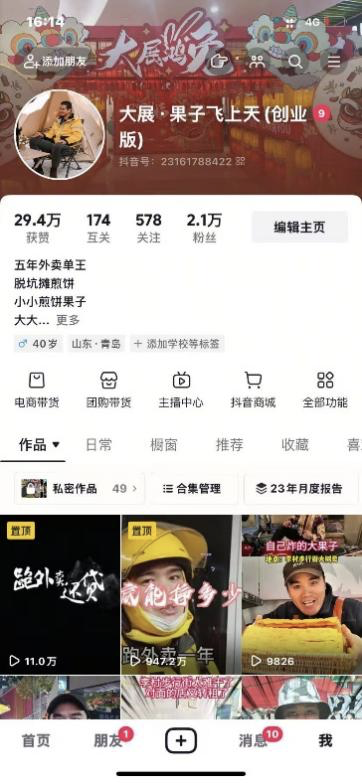
Core Insights - The article highlights the entrepreneurial journey of a young entrepreneur, known as "Da Zhan," who transitioned from being a food delivery rider to a successful owner of a pancake business in Qingdao, China [1][3]. Business Development - Da Zhan started his career as a Meituan delivery rider in 2020, gaining popularity through social media by sharing his earnings from food delivery, which helped him accumulate a significant following [1][3]. - In December 2024, he opened his first store named "Guo Zi Fei Shang Tian" in Qingdao's CBD, followed by a second store in March 2025 [3]. Product Innovation - Initially facing challenges in learning from established competitors, Da Zhan utilized his nine years of culinary experience to develop a unique recipe for his pancakes, incorporating a mix of seven whole grains and fresh ingredients [4]. - The quality of his product has been recognized by consumers, with some customers ordering over twenty times in a month [4]. Sales Growth - After launching on the "Pin Hao Fan" platform, Da Zhan's business experienced a significant increase in sales, with daily orders rising from an average of 50-60 to 150-200, peaking at 400-500 orders [4][5]. - The daily revenue from both stores has stabilized at over 1,500 yuan, a substantial increase from the initial 300 yuan when he was operating as a street vendor [5]. Market Strategy - Although the price of pancakes decreased from 12 yuan to 9 yuan on the platform, the fixed revenue per order for the business remains at 6 yuan, leading to an overall increase in revenue despite lower margins [5]. - Da Zhan emphasizes the importance of maintaining high food quality and cleanliness in his stores, ensuring a rigorous cleaning schedule [5][6]. Entrepreneurial Philosophy - Da Zhan's philosophy centers around hard work and perseverance, aiming to create a warm and inviting atmosphere in his stores, with aspirations to expand his business further [7].

十二城巡回宣介收官,粤港澳大湾区创业大赛招募全国创客
Nan Fang Du Shi Bao· 2025-07-10 09:43
Group 1 - The event "Bay Innovation Future, Gathering Talents in Guangdong-Hong Kong-Macao" successfully concluded, featuring 27 promotional activities across 12 cities, attracting over 1,500 participants [2][3] - The activities aimed to connect mainland entrepreneurs with resources in the Guangdong-Hong Kong-Macao Greater Bay Area, enhancing collaboration and innovation [3][7] - The competition focuses on five key sectors: artificial intelligence and robotics, integrated circuits and low-altitude economy, medical health and biomanufacturing, food technology and modern agriculture, and modern services and cultural creativity [8] Group 2 - The competition includes three stages: preliminary, semi-final, and national final, with the preliminary round conducted through written reviews and the latter stages through live presentations [8] - Participants can win up to 500,000 yuan in funding, along with various support services such as brand empowerment, resource connection, talent services, and entrepreneurial subsidies [8] - The event aims to foster a supportive entrepreneurial environment and facilitate deep exchanges and cooperation between mainland and Hong Kong-Macao youth [8]

中国创业签证X1:资格要求与福利——通往中国商业领域的路径
Sou Hu Cai Jing· 2025-07-09 14:36
Core Points - The Chinese Entrepreneur Visa X1 is designed for foreign entrepreneurs to establish businesses in China, offering long-term residency and tailored benefits to support their integration and success in the market [4][5]. Eligibility Requirements - Applicants must present a detailed business or innovative project plan that aligns with China's economic or technological priorities, focusing on high-tech fields, information technology, biotechnology, green energy, or other emerging industries [6][7]. - Financial stability is crucial, requiring applicants to demonstrate adequate funding to support their projects, ensuring the feasibility of their business activities in China [8]. - It is highly recommended that applicants have relevant academic or professional experience in their chosen field, including degrees, technical certifications, or prior management experience [9]. - While not mandatory, having a Chinese business partner or local endorsements can enhance the likelihood of approval, reflecting strong project feasibility and local support [10]. Benefits - The X1 visa allows for long-term residency in China, enabling entrepreneurs to focus on business growth without frequent renewals [10][11]. - X1 visa holders can bring immediate family members under dependent visas, promoting a healthy work-life balance [12]. - The visa offers flexible renewal and conversion policies, allowing entrepreneurs to adapt their residency plans based on business needs [13]. - Holding an X1 visa facilitates establishing a physical presence in China, making it easier to connect with local clients, partners, and suppliers [14]. - X1 visa holders may qualify for various government support programs, including tax benefits, grants, and subsidized workspaces [15]. Application Process - Applicants should prepare required documents, including a completed application form, valid passport copy, detailed business plan, financial statements, educational certificates, and recommendation letters [14][15]. - Once documents are ready, applications can be submitted to the nearest Chinese consulate, embassy, or visa center, potentially requiring a personal interview [16]. - After submission, the application undergoes a review process that may take several weeks, with the consulate possibly requesting additional information [17]. - Upon approval, applicants receive the visa to enter China and may need to register with the local Public Security Bureau for a residence permit [18]. - Depending on business progress, X1 visa holders can apply for renewal or convert their visa to a suitable category, such as a work visa [19]. Frequently Asked Questions - The residency period for the X1 visa typically ranges from 1 to 2 years, with options for renewal based on project needs [20]. - Immediate family members can accompany the X1 visa holder by applying for dependent visas [21]. - While a Chinese partner is not required, having one can strengthen the application [22]. - The average processing time for the X1 visa is generally between 3 to 4 weeks [23]. - The X1 visa can be converted to other visa types, such as a work visa, based on the applicant's changing residency needs [24].

创业者要活下来,最难的有三变
创业家· 2025-07-07 10:29
Group 1 - The core viewpoint emphasizes that entrepreneurs in the industry must first survive and generate profits, highlighting three critical transformations: obtaining an investment of one million, converting that one million into company revenue, and turning that revenue into one million in profit [1] Group 2 - The article promotes a course titled "Consumption Reconstruction Selected Course," which features top practical mentors from the consumer sector in Japan and China, aimed at dissecting the methodologies of major consumer giants over three days [2] - The course is priced at 12,800 yuan per person, with an early bird price of 9,800 yuan available until July 15 [3] - The event will take place in Shanghai from August 7 to August 9 [4]

Labubu爆火之后,去义乌的年轻人赚翻了
3 6 Ke· 2025-07-07 07:44
Core Insights - Yiwu has become a hub for the Z generation, with many young entrepreneurs, referred to as "Wu Piao," contributing to the Yiwu China Commodity Index through practical efforts rather than theoretical discussions [1][2] - The rise of new industries in Yiwu is driven by the increasing interest in entrepreneurship, e-commerce, and cross-border trade among young people [1][2] Group 1: Yiwu's Entrepreneurial Landscape - Yiwu has seen a significant influx of young entrepreneurs, many of whom are exploring various business opportunities, including e-commerce and social media platforms [1][2] - The city has become a breeding ground for small businesses, with a notable statistic indicating that approximately one in every two residents is a business owner, highlighting the entrepreneurial density [16][19] - The concept of "walk-broadcasting" has gained popularity, allowing new entrepreneurs to engage in live-streaming sales with minimal barriers to entry, making it an attractive option for those starting from scratch [9][11] Group 2: Personal Stories and Experiences - The journey of a local entrepreneur, who transitioned from a corporate job to running a family business and leading entrepreneurial study groups, illustrates the practical approach to business in Yiwu [2][3][4] - The entrepreneur's background in various fields, such as travel media and content marketing, has equipped her with skills that are beneficial for her current ventures [7][9] - The success of her live-streaming efforts, including selling over 1,000 products in a single session, showcases the potential for rapid growth in this business model [11][13] Group 3: Community and Cultural Aspects - Yiwu's entrepreneurial culture is deeply rooted in its history, with many young people having familial ties to the local market, fostering a sense of community and continuity in business practices [4][6] - The presence of female entrepreneurs, often referred to as "boss ladies," plays a crucial role in the local economy, with many actively engaging in learning and adapting to new technologies [16][17] - The spirit of Yiwu is characterized by a proactive and open-minded approach to business, attracting young people who are eager to innovate and capitalize on opportunities [19][20]

所有难题,根源大多在老大身上
3 6 Ke· 2025-07-07 00:55
Group 1 - The essence of entrepreneurship is the transformation of scientific achievements into knowledge and capability transfer, highlighting the current era as a unique opportunity for entrepreneurs, especially scientists [2][3] - The fundamental purpose of entrepreneurship is to create successful enterprises rather than merely personal development, emphasizing the importance of prioritizing business success over individual growth [4][5] - A mission that transcends profit is crucial for driving a company's success, as it fosters genuine belief among founders and employees, leading to a more cohesive and motivated team [6][7][8] Group 2 - Entrepreneurship is defined as the gathering of high-energy individuals into a cohesive organization that moves in a unified direction, adhering to shared principles and executing effectively [14][15] - Key elements of successful entrepreneurship include a strong mission, vision, framework, and passion, which collectively contribute to the organization's ability to attract talent and achieve its goals [32][36][38] - Meeting genuine customer needs is the most critical factor determining entrepreneurial success, necessitating a clear understanding of the target audience and the value provided by the product or service [40][41][42] Group 3 - Partners in entrepreneurship are not essential but are extremely important, as they ensure continuity and alignment with the company's mission and vision even in the founder's absence [44][45] - Trust and shared mission are vital characteristics of ideal partners, as they facilitate effective collaboration and decision-making within the organization [46][55] - Financial resources serve as a lubricant for business operations, emphasizing the importance of securing funding during favorable conditions to ensure stability and growth [57][59] Group 4 - The leader of a company is its soul, responsible for strategic thinking and direction-setting, which is essential for navigating long-term challenges and opportunities [62][66] - Maintaining a calm mindset is crucial for long-term entrepreneurial success, as entrepreneurship is often a prolonged journey requiring resilience and adaptability [69][73] - Growth is the best form of management, especially in the early stages of a company, where focusing on business development and achieving victories is more important than intricate management practices [74][79] Group 5 - Entrepreneurship acts as an amplifier for personal qualities, highlighting both strengths and weaknesses, and serves as a process of self-improvement alongside business success [81][82]
何愚×曹曦×胡博予:新造的人
36氪· 2025-07-04 10:34
Core Insights - The article discusses the importance of understanding the human element in investment, particularly in identifying and evaluating new entrepreneurs in the emerging AI and technology sectors [3][4][5] - It highlights the unique characteristics of three successful founders: Wang Ning of Pop Mart, Wang Xingxing of Yushu Technology, and Zhang Junjie of Bawang Tea, showcasing their distinct traits and the investors' perspectives on them [7][11][12] Group 1: Investment Insights - The article emphasizes the significance of recognizing the underlying qualities of entrepreneurs, such as strategic thinking and self-awareness, rather than superficial traits [15][16] - It illustrates the challenges investors face in understanding new business models and the necessity of investing time to learn about unfamiliar concepts [15][16] - The investors share their experiences of identifying "outlier" entrepreneurs who possess unique qualities that set them apart from the crowd [18][19] Group 2: Founder Characteristics - Wang Ning is described as a blend of artistic sensibility and strong business acumen, demonstrating creativity in commercial strategies [7][8][9] - Wang Xingxing is characterized as pure and focused, with a practical approach to business, driven by real market demand [11][12] - Zhang Junjie is noted for his rapid growth and transformation as a leader, showcasing a blend of personal storytelling and business insight [12][13][14] Group 3: Investor Perspectives - The investors reflect on their evaluation processes, emphasizing the importance of genuine curiosity and empathy when assessing entrepreneurs [30][31][32] - They discuss the need for simplicity in decision-making and the focus on key traits that indicate a founder's potential for success [33][34] - The article concludes with insights into how the investors' understanding of human nature has evolved through their experiences in the industry [40][41][42]

一位杭州网约车司机的自述
Hu Xiu· 2025-07-03 06:11
Core Insights - The article narrates the life story of a middle-aged woman from Zhejiang, highlighting her resilience and entrepreneurial spirit amidst various life challenges [1][2]. Group 1: Background and Early Life - The individual was born in a mountainous area of Y District, Hangzhou, and spent her childhood in Guizhou after her mother's passing [3][4][5]. - She inherited land from her family upon reaching adulthood and returned to Hangzhou to manage her inheritance [6]. Group 2: Business Ventures - Despite lacking a university degree, the individual learned accounting and chose entrepreneurship over traditional employment, believing in the value of being a business owner [7]. - Initially, her restaurant struggled with local cuisine but thrived after switching to Sichuan cuisine, showcasing adaptability in business strategy [7]. - The restaurant was a three-story establishment, and she actively engaged in staff development and menu innovation to attract customers [8]. Group 3: Challenges and Resilience - A significant fire incident led to her hospitalization for eight months, prompting her to sell the restaurant [9]. - Despite closing the restaurant, she continued to work by driving for ride-hailing services, earning a substantial daily income [11]. Group 4: Family and Influence - The individual encouraged her relatives to pursue entrepreneurship instead of traditional jobs, leading to successful ventures among her family members [13][14]. - Her brother, who learned a craft, now runs a profitable business in Yixing, demonstrating the impact of skill acquisition and entrepreneurship [14].
赞美成功,也宽容失败
Shang Hai Zheng Quan Bao· 2025-07-01 19:09
Core Viewpoint - The article highlights the entrepreneurial spirit of Zhejiang University alumni, emphasizing their resilience, pragmatism, and willingness to embrace failure as part of the innovation process [4][5][7]. Group 1: Entrepreneurial Spirit - Zhejiang University alumni are characterized by a spirit of optimism and resilience, with a focus on practical attitudes rather than empty rhetoric [5][6]. - Successful entrepreneurs from Zhejiang University, such as Duan Yongping and Shi Yuzhu, have leveraged their educational background to create impactful businesses [4][6]. Group 2: Attitude Towards Failure - The culture among Zhejiang University entrepreneurs includes open discussions about failures, which helps alleviate pressure and fosters a supportive environment [6][7]. - Acknowledging the inevitability of failure, entrepreneurs are encouraged to view setbacks as learning opportunities rather than as insurmountable obstacles [7][8]. Group 3: Supportive Ecosystem - The entrepreneurial ecosystem in Hangzhou is noted for its ability to nurture startups, with a focus on reducing the costs of trial and error for entrepreneurs [7][8]. - The article suggests that a society that embraces both success and failure can better stimulate innovation and creativity among entrepreneurs [8].