卫星互联网

Search documents
两部门:推进应急管理装备与人工智能、5G、大数据等新技术融合创新
Zhi Tong Cai Jing· 2026-01-27 03:01
Core Viewpoint - The Ministry of Emergency Management and the Ministry of Industry and Information Technology have issued guidelines to accelerate the innovation and development of emergency management equipment, emphasizing the importance of integrating advanced technologies and enhancing the capabilities of emergency management systems [1][2]. Group 1: Overall Requirements - The guidelines are guided by Xi Jinping's thoughts and aim to enhance the modernization of emergency management equipment, focusing on reform and innovation to strengthen core technology development [2]. - The approach emphasizes a demand-driven and practical orientation, targeting urgent needs in emergency management and ensuring a systematic and comprehensive planning process [2]. Group 2: Key Equipment Research and Innovation - By the end of 2027, the goal is to overcome more than 20 key core technologies, develop over 20 innovative equipment types, and promote more than 30 advanced technology applications [3]. - A mechanism for continuous collection of equipment research needs will be established to ensure timely and precise responses to frontline demands [4]. Group 3: Promotion and Application of Advanced Equipment - There will be an increased focus on equipping emergency rescue teams with advanced and applicable technologies, enhancing their capabilities in extreme scenarios [6]. - The guidelines call for the establishment of a standardized equipment system to improve interoperability and efficiency among various emergency management tools [5]. Group 4: Strengthening Support Structures - The establishment of technology innovation platforms and support for key laboratories will be prioritized to enhance research and development capabilities in emergency management equipment [8]. - Talent development initiatives will be encouraged, including partnerships with educational institutions to cultivate professionals in emergency management and equipment technology [8]. Group 5: Standardization and Normative Support - A comprehensive standardization system for emergency management equipment will be developed to improve the relevance and performance of the equipment [10]. - The guidelines advocate for the creation of a classification system for emergency management equipment to enhance its practical application [10]. Group 6: Promoting Equipment Industry Development - A platform for professional exchange and supply-demand matching will be established to foster collaboration between various stakeholders in the emergency management equipment sector [11]. - The guidelines aim to cultivate a robust ecosystem for the emergency management industry, encouraging innovation and the development of high-tech enterprises [11]. Group 7: Implementation and Coordination - Mechanisms for research, validation, promotion, and standardization of emergency management equipment will be improved to ensure coordinated efforts across different levels of government and industry [12]. - The guidelines emphasize the need for diversified funding mechanisms to support the development of emergency management equipment and industry [12].
银河航天CEO:太空新基建将带来万亿级市场爆发期!航空航天ETF天弘(159241)昨日获净申购6000万份,居同标的第一
2 1 Shi Ji Jing Ji Bao Dao· 2026-01-27 01:20
Group 1 - The aerospace sector experienced a collective decline, with the national aerospace industry index dropping by 5.29% on January 26. Notable stocks included Zhenxin Technology rising over 4% and Hangcai Co. increasing over 2%, while China Satellite, Aerospace Development, and Aero Engine Corporation faced trading halts [1] - The Tianhong Aerospace ETF (159241) recorded a trading volume exceeding 220 million yuan, with a net subscription of 60 million shares, leading among similar products. It has seen a net inflow of funds for two consecutive trading days, totaling 21.80 million yuan [1] - The Tianhong Aerospace ETF closely tracks the national aerospace industry index, which encompasses sectors such as aerospace equipment, military electronics, and cutting-edge technologies like satellite internet and large aircraft, with a significant 98.7% weight in defense and military industries [1] Group 2 - At the 2026 Beijing International Commercial Aerospace Forum, the founder and CEO of Galaxy Aerospace, Xu Ming, highlighted that new space infrastructure could lead to a trillion-dollar market boom, projecting the global space economy to reach 1.8 trillion USD by 2035. The company has successfully launched over 40 self-developed satellites [2] - Recent capital market activities in commercial aerospace have been notable, with significant IPO progress for companies like China Aerospace Science and Technology Corporation and Blue Arrow Aerospace. SpaceX aims to drastically reduce space logistics costs and achieve fully reusable Starship launches within three years [2] - Domestic policies continue to support the development of the aerospace industry, with the official release of the Jiuquan Commercial Aerospace Industry Development Plan, which clarifies the construction of national commercial aerospace launch bases. The outlook for the commercial aerospace sector is positive [2]
全球首次,通用大模型太空在轨部署成功,人形机器人直连低轨高通量卫星试验成功;商务部将启动建设国家数字贸易示范区——《投资早参》
Mei Ri Jing Ji Xin Wen· 2026-01-27 00:04
Market News - US stock indices closed higher, with the Nasdaq up 0.43%, Dow Jones up 0.64%, and S&P 500 up 0.5%. Tech stocks showed mixed results, with Apple, Oracle, and Meta rising over 2%, while Intel fell over 5%, and AMD and Tesla dropped over 3% [1] - The ICE US Dollar Index fell by 0.59% to 97.019 points. The onshore RMB against the USD closed at 6.9540, up 90 basis points from the previous trading day [1] Industry Insights - The Beijing humanoid robot innovation center successfully connected a new type of satellite, marking the first global trial of humanoid robots directly linked to low-orbit satellites. This breakthrough supports reliable communication for outdoor robotic applications and cross-industry integration [3] - The space communication industry is projected to reach between 200 billion to 400 billion yuan by 2030, with an annual compound growth rate of 10%-28%. This sector is transitioning from concept validation to large-scale application, becoming a key driver for high-quality digital economic development [3] - The "Star Computing" plan by Guoxing Aerospace aims to deploy a large model in orbit, achieving end-to-end reasoning tasks in under two minutes. This network consists of 2,400 inference satellites and 400 training satellites, targeting a total of 100,000 P-level inference computing power [4] - The Ministry of Commerce plans to innovate and develop digital trade, establishing a national digital trade demonstration zone and promoting standards for digital trade. By 2025, online retail sales in China are expected to grow by 8.6%, with cross-border e-commerce reaching 2.75 trillion yuan [5][6] Stock Movements - Yili Group plans to reduce its stake in Sun Cable by up to 21.67 million shares, not exceeding 3% of the total share capital [7] - Jianghang Equipment's shareholder plans to reduce its stake by up to 791,340 shares, representing 1% of the total share capital [7] - Shengda Bio announced a plan to reduce its stake by up to 567,090 shares, not exceeding 3% of the total share capital [7]

商业航天:“高热度”下的“冷思考”(深度观察)
Ren Min Wang· 2026-01-26 22:38
Core Viewpoint - The development of China's commercial space industry is at a critical juncture, with significant opportunities and challenges ahead, particularly in achieving reusable rocket technology and scaling up production efficiency to meet the demand for satellite launches [1][8]. Group 1: Technological Innovation - Technological innovation is the foundation for development, with a focus on improving the cost-effectiveness of rocket launches and developing reusable rocket technology [3]. - The successful launch of the Zhuque-2 rocket by Blue Arrow Aerospace marked a significant milestone as the world's first liquid oxygen-methane rocket to reach orbit, showcasing advancements in key technologies [3]. - Companies like Tianbing Technology and Galaxy Aerospace are leading in various technological advancements, including multi-satellite launches and high-performance engines [3][6]. Group 2: Efficiency Improvement - Experts estimate that over the next nine years, China needs to launch more than 25,000 satellites, with a total of over 120,000 satellites in the next twelve years to meet the demand [4]. - The industry consensus is to produce satellites in bulk, akin to automobile manufacturing, to enhance efficiency [5]. - Innovations in production lines have significantly reduced the assembly time for satellites, with some companies achieving a turnaround of 20-25 days for satellite assembly [5]. Group 3: Ecological Support - The establishment of a comprehensive commercial space industry chain at the Dongfang Spaceport in Shandong is crucial, integrating satellite manufacturing, rocket launching, and control services [7]. - Beijing has emerged as a hub for commercial space enterprises, housing over 70% of the country's commercial rocket companies, facilitating a closed-loop from rocket manufacturing to satellite utilization [7]. Group 4: Development Challenges - The commercial space industry is facing challenges in profitability, with many companies relying heavily on financing and struggling to generate revenue from launch tasks [8]. - The high cost of rocket launches remains a core constraint, with the engine and rocket body costs accounting for over 70% of total expenses [9]. - Limited launch opportunities due to a shortage of launch sites and resources are hindering the frequency of commercial launches [11]. Group 5: Policy and Market Dynamics - The Chinese government is actively promoting the development of commercial space through supportive policies, including the encouragement of satellite service applications and the establishment of a market-driven procurement model [13][15]. - The upcoming launches of several commercial rockets in 2026 are expected to further bridge the technological gap with international counterparts [15].
北京市:推动全国重点实验室集群式发展
Xin Lang Cai Jing· 2026-01-26 19:00
(来源:千龙网) 26日的发布会上,北京市科委、中关村管委会党组成员、副主任翟天瑞介绍,"十五五"时期,北京将通 过多维举措全面激活科技创新动能,推动区域创新发展提质增效。推动在京全国重点实验室集群式发 展。 为巩固科技创新策源引领优势,北京将进一步完善部市合作机制,支持国家实验室牵头承担国家科技重 大专项,跨区域整合创新资源。同时,推动在京全国重点实验室集群式发展,助力清华大学南口全国重 点实验室基地、北京大学昌平产教研融合创新中心建设,强化怀柔重大科技基础设施集群的后续建设与 开放运行。此外,还将支持高水平研究型大学开展使命导向的科技创新,承担国家及区域重大科技攻关 任务,支持中国科学院等国家科研机构在京布局,持续实施攻坚专项和先导专项。 人才是科技创新的核心支撑。翟天瑞表示,北京将大力引进战略科学家、科技领军人才及青年人才,通 过多举措强化人才培育与保障。深化"新工科"建设,鼓励高校超常规布局前沿学科、交叉学科、新兴学 科,引导市属高校新增急需紧缺学科专业和学位授予点;推动"双一流"高校有序扩大招生规模,深化产 教融合协同育人,推进工程硕博士培养改革专项试点,吸纳更多高校与科技型企业参与。同时,布局新 ...
高密度发射 我国商业航天何以迎来突破?
Xin Lang Cai Jing· 2026-01-26 18:59
Core Insights - The recent launch of 19 low-orbit satellites by China's commercial space sector marks a significant step in the country's ambition to become a "space power" as outlined in the 14th Five-Year Plan [2][8] - The rapid advancements in technology and the increasing capabilities of private space companies are driving the commercialization of space, transitioning from supplementary forces to strategic pillars [2][7] Group 1: Launch and Technology Developments - The Long March 12 rocket, used for the recent satellite launch, is China's first 4-meter single-core rocket with a near-Earth orbit capacity of at least 12 tons, supporting various launch missions [3] - Galaxy Space successfully launched its second group of self-developed low-orbit satellites, incorporating advanced technologies such as low-cost phased array antennas and automated production processes to enhance efficiency [2][3] Group 2: Reusable Rocket Technology - The development of reusable rocket technology is seen as a key factor in reducing launch costs and increasing launch frequency, with both state-owned and private enterprises collaborating on this front [5][7] - By the end of 2025, attempts at first-stage recovery tests for the Zhuque-3 and Long March 12A rockets are planned, indicating progress in this area [5] Group 3: Market and Policy Drivers - The rapid growth of China's commercial space sector is driven by favorable policies, capital investment, and technological breakthroughs, with a focus on satellite internet and 6G technology [6][7] - China has submitted applications for an additional 203,000 satellites, with major telecom operators like China Mobile and China Telecom entering the satellite constellation market [7][8] Group 4: Industry Ecosystem - The commercial space industry in China is developing a complete ecosystem from rocket and satellite manufacturing to launch services and communication operations, creating internal momentum for growth [8] - The successful integration of key technologies and the expansion of large-scale applications position China's commercial space sector to play an increasingly important role in the global space economy [8]

国泰海通 · 晨报260127|商业航天发展提速,太空光伏迎布局良机
国泰海通证券研究· 2026-01-26 14:03
Core Viewpoint - The rapid development of commercial aerospace presents significant opportunities for space photovoltaics, as solar energy is the only reliable energy source in this sector, with solar irradiance in space being 5-10 times stronger than on Earth, leading to a substantial increase in power generation [2]. Group 1: Investment Recommendations - The growth of commercial aerospace will benefit space photovoltaics, with companies leveraging cost and technological advantages in silicon and perovskite technologies for energy supply in space data centers [2]. - The current mainstream technology for space energy is gallium arsenide, but the cost and efficiency of silicon and perovskite technologies are improving, making them viable alternatives [2]. - The economic viability of developing space data centers will be crucial, with silicon components showing significant manufacturing cost advantages and perovskite components offering benefits in reducing launch costs due to their power-to-weight ratio [2]. Group 2: Market Outlook - Elon Musk's goal of deploying 100GW of AI computing power in space annually could lead to a surge in satellite demand, with an estimated increase of 680,000 satellites per year if this target is met, compared to the current global satellite inventory of just over 10,000 [3].

信科移动:已发布了系列化星载基站、星载相控阵天线等核心产品
Zheng Quan Ri Bao Wang· 2026-01-26 13:14
证券日报网讯1月26日,信科移动在互动平台回答投资者提问时表示,卫星互联网是公司战略布局方 向,目前公司已发布了系列化星载基站、星载相控阵天线等核心产品,在业内具备一定的先发优势和竞 争优势。 ...

2025年中国商业航天行业市场洞察
Tou Bao Yan Jiu Yuan· 2026-01-26 13:06
Investment Rating - The report does not explicitly state an investment rating for the industry or SpaceX Core Insights - SpaceX is recognized as a leading representative in the commercial space industry, with unique advantages such as vertical integration, cost control, and a supportive government-business collaboration model [2][3][4][5][8][12][29] Summary by Sections SpaceX's Competitive Advantages - SpaceX's vertical integration allows it to produce 85% of its core components in-house, enhancing quality control and reducing costs compared to competitors that rely on outsourcing [3] - The company has pioneered reusable rocket technology, significantly lowering launch costs to $3,000 per kilogram, compared to the global average of $10,000 to $20,000 per kilogram [4] - The Starlink project has created a closed-loop ecosystem, providing continuous demand for rocket launches while generating substantial revenue, with Starlink contributing approximately $4.178 billion to SpaceX's total revenue of around $8 billion in 2023 [5][12] Government Support and Collaboration - SpaceX has received over $15 billion in government contracts from NASA and the U.S. Department of Defense, which have been crucial for its development and financial stability [8][20] - NASA has provided extensive technical support and access to critical data, which has been instrumental in SpaceX's rapid technological advancements [21][22] - The U.S. government has established policies that favor commercial space ventures, allowing SpaceX to operate in a more favorable regulatory environment compared to its competitors [23][29] Financing and Market Position - SpaceX has demonstrated exceptional financing capabilities, raising over $10 billion through various channels, including equity financing and government contracts [12] - The company has a strong user base for Starlink, with over 4 million subscribers, contributing to its cash flow and enabling further technological development [12] - The report highlights the challenges faced by Chinese private space companies in replicating SpaceX's success due to differences in technology, policy environment, and capital market maturity [15][16] Chinese Commercial Space Industry - China's commercial space policies have gradually improved since 2015, but significant barriers remain, particularly in financing and access to critical resources [34][41] - The report notes that while there are over 400 commercial space companies in China, most are private, and many face challenges in rocket manufacturing and deployment [34] - The demand for satellite deployment in China is increasing, with plans to launch over 15,318 satellites by 2027, indicating a growing market potential [36][38]
任泽平:中国商业航天深度报告
Sou Hu Cai Jing· 2026-01-26 11:05
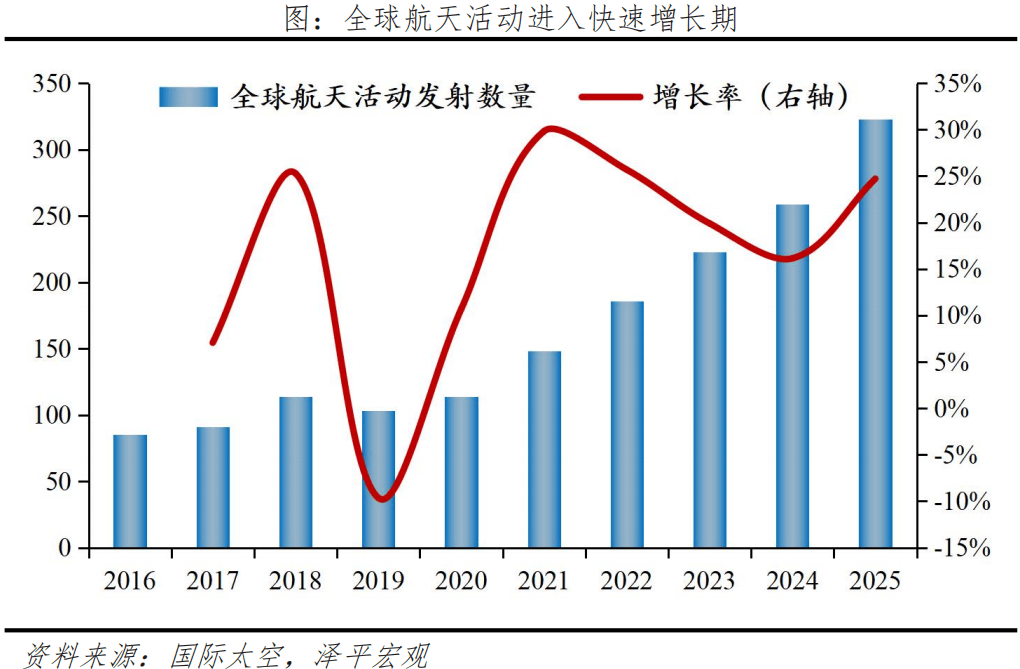
Core Insights - China's commercial space industry is accelerating rapidly, with significant advancements in launch capabilities, recovery technologies, and satellite internet infrastructure [1][2][3] Group 1: Industry Growth and Achievements - Global space launches reached a record high of 337 in 2025, a 28% increase from 263 in 2024, with a success rate of approximately 97% [6][1] - China submitted an unprecedented application for over 203,000 satellite frequency resources, marking a transition from technology validation to large-scale network deployment [1][2] - The establishment of the Commercial Space Administration in November 2025 signifies the elevation of commercial space from pilot projects to a national strategic level [2][10] Group 2: Technological Breakthroughs - The Long March 12 rocket successfully launched as the first 4-meter-class commercial rocket, enhancing low Earth orbit capacity [1][2] - The Zhuque-3 rocket completed a vertical takeoff and landing test, indicating maturity in private recovery technology [1][2] - The use of reusable rocket technology and 3D printing is identified as key cost-reduction strategies, with launch costs decreasing from 115,000 yuan/kg in 2020 to 75,000 yuan/kg in 2024 [19][1] Group 3: Future Applications and Market Potential - The low Earth orbit satellite internet market is projected to be a trillion-dollar opportunity, with SpaceX's Starlink service enabling direct mobile phone connectivity to satellites [26][29] - The potential for deploying AI data centers in space is emerging, leveraging the unique environmental advantages of space for energy efficiency and cooling [35][38] - The commercial space sector is expected to drive significant changes in global communication infrastructure, with low Earth orbit satellites providing coverage for areas lacking terrestrial networks [31][32]