
隐含波动率

Search documents
金属期权策略早报:金属期权-20251020
Wu Kuang Qi Huo· 2025-10-20 01:40
Report Summary 1. Investment Rating The report does not provide an overall investment rating for the metal options industry. 2. Core Viewpoints - For non - ferrous metals, they are in a range - bound oscillation, and a seller's neutral volatility strategy is recommended [2]. - Black metals show significant fluctuations, and a short - volatility portfolio strategy is suitable [2]. - Precious metals have a pattern of rising, breaking through, and then falling rapidly, so a spot hedging strategy is suggested [2]. 3. Summary by Sections 3.1 Futures Market Overview - Different metal futures have various price changes, trading volumes, and open interest changes. For example, copper (CU2511) closed at 84,840 with a 0.14% increase, and its trading volume was 8.05 million lots with a decrease of 1.70 million lots [3]. 3.2 Option Factors - **Volume and Open Interest PCR**: These factors describe the strength of the option underlying market and the turning points. For example, the copper option's volume PCR was 0.48 with a - 0.08 change, and the open interest PCR was 0.75 with a - 0.01 change [4]. - **Pressure and Support Levels**: From the perspective of the maximum open interest of call and put options, the pressure and support levels of each metal option are determined. For example, the pressure level of copper is 92,000, and the support level is 80,000 [5]. - **Implied Volatility**: The implied volatility of each metal option varies. For example, the flat - strike implied volatility of copper was 19.84%, and the weighted implied volatility was 24.96% with a - 0.02 change [6]. 3.3 Strategy and Recommendations - **Non - ferrous Metals** - **Copper**: Build a short - volatility seller's option portfolio strategy and a spot hedging strategy [7]. - **Aluminum**: Construct a short - neutral call + put option portfolio strategy and a spot collar strategy [9]. - **Zinc**: Create a short - neutral call + put option portfolio strategy and a spot collar strategy [9]. - **Nickel**: Build a short - bearish call + put option portfolio strategy and a spot covered - call strategy [10]. - **Tin**: Implement a short - volatility strategy and a spot collar strategy [10]. - **Lithium Carbonate**: Construct a short - bearish call + put option portfolio strategy and a spot hedging strategy [11]. - **Precious Metals (Gold)** - Build a bull - spread strategy for call options, a short - volatility option seller's portfolio strategy, and a spot hedging strategy [12]. - **Black Metals** - **Rebar**: Construct a short - bearish call + put option portfolio strategy and a spot covered - call strategy [13]. - **Iron Ore**: Build a short - bearish call + put option portfolio strategy and a spot collar strategy [13]. - **Ferroalloys (Manganese Silicon)**: Implement a short - volatility strategy [14]. - **Industrial Silicon**: Construct a short - volatility call + put option portfolio strategy and a spot hedging strategy [14]. - **Glass**: Build a short - volatility call + put option portfolio strategy and a spot collar strategy [15].
商品期权数据日报-20251017
Guo Mao Qi Huo· 2025-10-17 07:04
Report Summary 1. Report Industry Investment Rating No relevant information provided. 2. Core View No clear core view can be extracted from the given content. 3. Summary by Related Catalogs Historical Volatility - For furnace aluminum, the main price is 20975, and the price of PVC increases by 0.48%. The historical volatilities HV20, HV40, HV60, and HV120 are 10.75%, 10%, 8%, and 18.26% respectively [5]. - For Shanghai zinc, the main price is 21940, and the price of plastic decreases by 0.25%. The historical volatilities are 14.99%, 0.30%, 16.54%, and 12% respectively [5]. - For other commodities such as copper, methanol, gold, etc., similar historical volatility and price change data are provided [5]. Implied Volatility - For polycrystalline silicon, the main flat - value IV is 39% and 69% [9]. - For propylene, the main flat - value IV is 17% and 5% [9]. - Similar implied volatility data are given for other commodities like urea, short - fiber, etc. [9]. Main Flat - Value IV Quantile No detailed data summary is provided in the given content for this part. Historical Trends - For industrial silicon and iron ore, historical trends of main closing price, main flat - value implied volatility, and HV60 are presented from 2024 - 10 to 2025 - 08 [12]. - Similar historical trend data are also shown for soybean oil, rapeseed oil, crude oil, and rubber [12].
金属期权策略早报:金属期权-20251016
Wu Kuang Qi Huo· 2025-10-16 02:38
Group 1: Report Summary - The report provides a morning strategy for metal options on October 16, 2025, covering various metal options including non-ferrous metals, precious metals, and black metals [1][2]. - Overall strategies include constructing a neutral volatility - selling strategy for non - ferrous metals in range - bound markets, a short - volatility portfolio strategy for black metals with high volatility, and a spot hedging strategy for precious metals with upward trends [2]. Group 2: Underlying Futures Market Overview - The latest prices, price changes, trading volumes, and open interest changes of various metal futures are presented. For example, the latest price of copper (CU2511) is 85,160, with a price increase of 200 and a trading volume of 12.58 million lots [3]. Group 3: Option Factor - Volume and Open Interest PCR - Volume and open interest PCR data for different metal options are provided. PCR indicators are used to describe the strength of the option underlying market and the turning points of the market. For instance, the open interest PCR of copper options is 0.80, indicating strong support for Shanghai copper [4]. Group 4: Option Factor - Pressure and Support Levels - Pressure and support levels for different metal options are analyzed based on the strike prices of the maximum open interest of call and put options. For example, the pressure level of copper is 92,000 and the support level is 80,000 [5]. Group 5: Option Factor - Implied Volatility - Implied volatility data for different metal options are presented, including at - the - money implied volatility, weighted implied volatility, and historical volatility differences. For example, the weighted implied volatility of copper options is 24.96%, with a change of - 0.32% [6]. Group 6: Option Strategies for Different Metals Non - Ferrous Metals - **Copper**: Based on fundamental and market analysis, a short - volatility seller option portfolio strategy is recommended, along with a spot hedging strategy [7]. - **Aluminum/Alumina**: A neutral call + put option selling strategy is suggested, and a spot collar strategy is recommended for spot hedging [9]. - **Zinc/Lead**: A neutral call + put option selling strategy is proposed, and a spot collar strategy is provided for spot hedging [9]. - **Nickel**: A short - biased call + put option selling strategy is recommended, and a spot covered call strategy is suggested [10]. - **Tin**: A short - volatility strategy is recommended, and a spot collar strategy is provided for spot hedging [10]. - **Lithium Carbonate**: A short - biased call + put option selling strategy is proposed, and a spot hedging strategy is recommended [11]. Precious Metals - **Gold/Silver**: A bull spread strategy for call options is recommended for gold, along with a short - volatility option seller portfolio strategy and a spot hedging strategy [12]. Black Metals - **Rebar**: A short - biased call + put option selling strategy is recommended, and a spot covered call strategy is suggested [13]. - **Iron Ore**: A neutral call + put option selling strategy is proposed, and a spot collar strategy is provided for spot hedging [13]. - **Ferroalloys**: A short - volatility strategy is recommended for manganese - silicon, and no spot hedging strategy is provided [14]. - **Industrial Silicon/Polysilicon**: A short - volatility call + put option selling strategy is recommended, and a spot hedging strategy is provided [14]. - **Glass**: A short - volatility call + put option selling strategy is recommended, and a spot collar strategy is provided for spot hedging [15]. Group 7: Metal Option Charts - Price charts, option volume and open interest charts, PCR charts, implied volatility charts, historical volatility cone charts, and pressure and support level charts are provided for different metals such as copper, aluminum, and gold [17][36][146].
农产品期权策略早报:农产品期权-20251015
Wu Kuang Qi Huo· 2025-10-15 03:12
Group 1: Report Summary - The overall market situation of agricultural products shows that oilseeds and oils are in a weak and volatile state, while other products such as eggs, sugar, and corn also have their own trends [2]. - The strategy suggests constructing option - combination strategies mainly as sellers and spot hedging or covered strategies to enhance returns [2]. Group 2: Futures Market Overview - The latest prices, price changes, trading volumes, and open interest changes of various agricultural product futures are presented. For example, the latest price of soybeans (A2511) is 3,966, with a price increase of 9 and a trading volume of 8.25 million lots [3]. Group 3: Option Factor - Volume and Open Interest PCR - The volume and open - interest PCR of various agricultural product options are provided, which are used to describe the strength of the option underlying market and the turning point of the underlying market respectively. For instance, the volume PCR of soybean options is 0.53, with a change of - 0.08 [4]. Group 4: Option Factor - Pressure and Support Levels - The pressure and support levels of various agricultural product options are analyzed from the perspective of the strike prices with the largest open interest of call and put options. For example, the pressure level of soybean options is 4,000 and the support level is 3,900 [5]. Group 5: Option Factor - Implied Volatility - The implied volatility data of various agricultural product options are given, including at - the - money implied volatility, weighted implied volatility, and the difference between implied and historical volatility. For example, the at - the - money implied volatility of soybean options is 9.61% [6]. Group 6: Strategy and Suggestions Oilseeds and Oils Options - **Soybeans (A2511)**: The oil mill operating rate is about 56.57%. The implied volatility of soybean options is below the historical average. Suggested strategies include constructing a short - biased call + put option combination strategy and a long collar strategy for spot hedging [7]. - **Soybean Meal (M2511)**: The domestic supply of soybean meal has great pressure. The implied volatility is below the historical average. Strategies include a bear spread strategy for put options, a short - biased call + put option combination strategy, and a long collar strategy for spot hedging [9]. - **Palm Oil (P2511)**: The export volume of palm oil from Malaysia from October 1 - 10 increased by 19.37% compared with the same period last month. The implied volatility is declining. Suggested strategies include a short - biased call + put option combination strategy and a long collar strategy for spot hedging [10]. - **Peanuts (PK2601)**: The market price of peanut kernels is stable. The implied volatility is at a relatively high historical level. A long collar strategy for spot hedging is suggested [11]. Agricultural By - product Options - **Pigs (LH2511)**: The planned slaughter volume in October is large. The implied volatility is above the historical average. Strategies include a short - biased call + put option combination strategy and a covered call strategy for spot [11]. - **Eggs (JD2511)**: The inventory of laying hens is increasing. The implied volatility is high. Strategies include a bear spread strategy for put options and a short - biased call + put option combination strategy [12]. - **Apples (AP2601)**: The inventory of apples in cold storage is 6.79 million tons. The implied volatility is above the historical average. Strategies include a long collar strategy for spot hedging and a short - biased call + put option combination strategy [12]. - **Jujubes (CJ2601)**: The new - season jujubes are in a critical period. The implied volatility is rising. Strategies include a short - strangle option combination strategy and a covered call strategy for spot hedging [13]. Soft Commodity Options - **Sugar (SR2601)**: Typhoons have affected the sugar - cane producing areas. The implied volatility is at a relatively low historical level. Strategies include a short - biased call + put option combination strategy and a long collar strategy for spot hedging [13]. - **Cotton (CF2601)**: As of October 8, 2025, 19.6 million tons of cotton have been inspected. The implied volatility is low. Strategies include a short - biased call + put option combination strategy and a covered call strategy for spot [14]. Grain Options - **Corn (C2511)**: The market supply of corn is loose. The implied volatility is at a relatively low historical level. A short - biased call + put option combination strategy is suggested [14].
能源化工期权策略早报:能源化工期权-20251015
Wu Kuang Qi Huo· 2025-10-15 03:11
Report Summary 1. Report Industry Investment Rating - Not provided in the given content 2. Core Viewpoints - The energy and chemical sector is divided into energy, alcohols, polyolefins, rubber, polyesters, alkalis, and others. For each segment, options strategies and suggestions are provided for selected varieties. Each option variety's report includes an analysis of the underlying asset's market, research on option factors, and option strategy recommendations [8]. - Overall, a strategy of constructing option portfolios mainly as sellers, along with spot hedging or covered strategies, is recommended to enhance returns [2]. 3. Summary by Relevant Catalogs 3.1 Futures Market Overview - The report presents the latest prices, price changes, price change percentages, trading volumes, volume changes, open interests, and open interest changes of various energy and chemical futures contracts, such as crude oil, liquefied petroleum gas (LPG), methanol, etc. [3] 3.2 Option Factors - Volume and Open Interest PCR - The volume PCR and open interest PCR of different option varieties are provided, which are used to describe the strength of the option underlying asset's market and the turning point of the underlying asset's market respectively [4]. 3.3 Option Factors - Pressure and Support Levels - The pressure and support levels of different option varieties are analyzed from the perspective of the strike prices with the largest open interest of call and put options [5]. 3.4 Option Factors - Implied Volatility - The implied volatility data of different option varieties are presented, including at - the - money implied volatility, weighted implied volatility, and the difference between implied and historical volatility [6]. 3.5 Strategy and Suggestions for Each Option Variety 3.5.1 Energy - related Options - **Crude Oil**: OPEC+ started a new round of production increase of 1.65 million barrels per day in October, and the market is worried about long - term oversupply. The market shows a weak trend. Options strategies include constructing a neutral short call + put option combination strategy and a long collar strategy for spot hedging [7]. - **LPG**: The maintenance of PDH plants is stable, but the profit is declining. The market shows an oversold rebound with pressure. Options strategies include constructing a neutral short call + put option combination strategy and a long collar strategy for spot hedging [9]. 3.5.2 Alcohol - related Options - **Methanol**: The port inventory has increased, and the market shows a weak trend. Options strategies include constructing a short - biased call + put option combination strategy and a long collar strategy for spot hedging [9]. - **Ethylene Glycol**: The supply load has increased slightly, and the market shows a weak trend. Options strategies include constructing a bear spread strategy for put options, a short - volatility strategy, and a long collar strategy for spot hedging [10]. 3.5.3 Polyolefin - related Options - **Polypropylene**: The commercial inventory has increased significantly, and the market shows a weak trend. Options strategies include a long collar strategy for spot hedging [11]. 3.5.4 Rubber - related Options - **Rubber**: The inventory has decreased, and the market shows a weak consolidation trend. Options strategies include constructing a short - biased call + put option combination strategy [12]. 3.5.5 Polyester - related Options - **PTA**: The supply support is insufficient, and the market shows a weak bearish trend. Options strategies include constructing a short - biased call + put option combination strategy [12]. 3.5.6 Alkali - related Options - **Caustic Soda**: The production and inventory situation shows a weakening trend. Options strategies include constructing a bear spread strategy and a long collar strategy for spot hedging [13]. - **Soda Ash**: The inventory has increased, and the market shows a low - level weak consolidation trend. Options strategies include constructing a short - volatility combination strategy and a long collar strategy for spot hedging [13]. 3.5.7 Other Options - **Urea**: The supply capacity utilization rate has increased, and the demand has weakened. The market shows a low - level weak consolidation trend. Options strategies include constructing a bear spread strategy for put options, a short - biased call + put option combination strategy, and a long collar strategy for spot hedging [14].
金属期权策略早报:金属期权-20251015
Wu Kuang Qi Huo· 2025-10-15 03:03
Report Summary 1. Report Industry Investment Rating No relevant content provided. 2. Core Views of the Report - The metals sector is divided into non - ferrous metals, precious metals, and black metals. Different trading strategies are recommended for each type of metal based on their market conditions and option factors [2]. - For non - ferrous metals in a range - bound situation, a seller's neutral volatility strategy can be constructed; for black metals with large - amplitude fluctuations, a short - volatility portfolio strategy is suitable; for precious metals with upward trends, a spot hedging strategy can be built [2]. 3. Summary by Related Catalogs 3.1 Futures Market Overview - The report presents the latest prices, price changes, trading volumes, and open interests of various metal futures contracts. For example, the latest price of copper (CU2511) is 84,890, down 820 or 0.96% [3]. 3.2 Option Factors - **Volume and Open Interest PCR**: These indicators are used to describe the strength of the option underlying market and the turning points. For instance, the open interest PCR of copper is 0.78, with a change of 0.07 [4]. - **Pressure and Support Levels**: Determined from the strike prices with the largest open interests of call and put options. The pressure point of copper is 92,000, and the support point is 80,000 [5]. - **Implied Volatility**: It includes at - the - money implied volatility, weighted implied volatility, and the difference between implied and historical volatility. The weighted implied volatility of copper is 25.28%, with a change of 0.34% [6]. 3.3 Option Strategies for Different Metals - **Non - Ferrous Metals** - **Copper**: A short - volatility seller's option portfolio strategy is recommended to gain time - value income. The pressure level is 92,000, and the support level is 80,000 [7]. - **Aluminum/Alumina**: A short - neutral call + put option combination strategy is suggested to obtain option time - value and directional income. Aluminum's pressure level is 21,400, and the support level is 20,400 [9]. - **Zinc/Lead**: Similar to aluminum, a short - neutral option combination strategy is recommended. Zinc's pressure level is 22,600, and the support level is 21,800 [9]. - **Nickel**: A short - bearish call + put option combination strategy is proposed. The pressure level is 130,000, and the support level is 120,000 [10]. - **Tin**: A short - volatility strategy is recommended. The pressure level is 320,000, and the support level is 270,000 [10]. - **Lithium Carbonate**: A short - bearish option combination strategy is suggested. The pressure level is 100,000, and the support level is 64,000 [11]. - **Precious Metals** - **Gold/Silver**: For gold, a bull - spread call option combination strategy and a short - volatility option seller's combination strategy are recommended. The pressure level of gold is 968, and the support level is 800 [12]. - **Black Metals** - **Rebar**: A short - bearish option combination strategy is recommended. The pressure level is 3,500, and the support level is 3,000 [13]. - **Iron Ore**: A short - neutral option combination strategy is suggested. The pressure level is 850, and the support level is 750 [13]. - **Ferroalloys**: For manganese silicon, a short - volatility strategy is recommended. The pressure level is 5,900, and the support level is 5,600 [14]. - **Industrial Silicon/Polysilicon**: A short - volatility call + put option combination strategy is proposed. The pressure level of industrial silicon is 13,800, and the support level is 9,000 [14]. - **Glass**: A short - volatility option combination strategy is recommended. The pressure level is 1,380, and the support level is 1,100 [15].
贸易紧张局势升温!华尔街“恐慌指数”飙至近五个月来新高
智通财经网· 2025-10-14 22:30
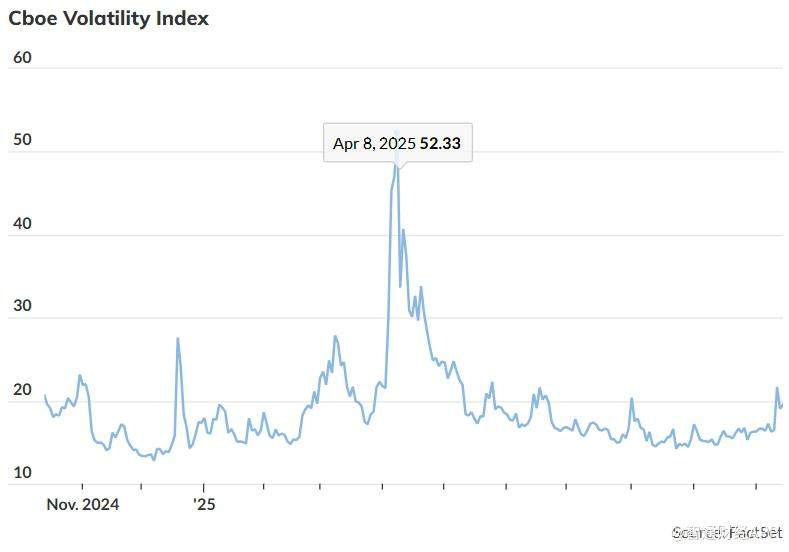
Group 1 - The VIX, known as the "fear index," surged to 22.94 points, the highest level since May 23, indicating increased investor anxiety over potential escalation in US-China trade tensions [1][4] - The long-term average of the VIX is slightly below 20 points, marking a critical threshold for market sentiment transitioning from calm to tense [4] - Since early September, a divergence between implied volatility and actual volatility has emerged, suggesting that some investors are adopting defensive strategies through options [4] Group 2 - Recent US-China trade tensions have reignited concerns, with President Trump threatening to impose 100% tariffs on all Chinese imports [7] - JPMorgan's CEO warned of credit risks expanding due to losses on loans to a subprime auto lender, indicating instability in the credit market [7] - Institutional investors, including BlackRock, have requested redemptions from a Jefferies fund that suffered significant losses due to the bankruptcy of an auto parts supplier [7]

波动率数据日报-20251014
Yong An Qi Huo· 2025-10-14 07:07
Report Summary Core View - The report provides daily volatility data, including implied volatility indices, historical volatility, and their spread trends for various financial and commodity options [3]. Details by Category Implied Volatility Index and Historical Volatility - Financial option implied volatility indices reflect the 30 - day implied volatility (IV) trend as of the previous trading day, while commodity option implied volatility indices are weighted by the IV of the two - strike prices above and below the at - the - money option of the main contract, showing the IV change trend of the main contract [3]. - The difference between the implied volatility index and historical volatility (HV) indicates the relative level of IV to HV, with a larger difference meaning higher IV relative to HV and vice versa [3]. Implied Volatility and Historical Volatility Charts - The report presents charts showing the IV, HV, and IV - HV spreads for multiple options such as 300 Index, 50ETF, 1000 Index, 500ETF, and various commodity options like corn, sugar, cotton, etc. [4]. Implied Volatility Quantile and Volatility Spread Quantile Ranking - Implied volatility quantiles represent the current level of a variety's IV in history. A high quantile means the current IV is high, and a low quantile means it is low. Volatility spread is the difference between the implied volatility index and historical volatility [5]. - The report shows the ranking of implied volatility quantiles and historical volatility quantiles for different options, including 300 Index, 50ETF, corn, PTA, etc. [6]
精华提炼!一篇让你搞懂期权交易核心指标,秒懂价格逻辑 (上篇) (第七期)
贝塔投资智库· 2025-10-14 04:00
Core Viewpoint - The article aims to explain key technical indicators used in options trading, including intrinsic value, time value, implied volatility, and historical volatility, to help new traders understand price movements and trading strategies [1][3]. Intrinsic Value - Intrinsic value is defined as the profit a buyer can make if the option is exercised at the current moment. For call options, it is calculated as the stock price minus the strike price, while for put options, it is the strike price minus the stock price [3][4]. - Examples illustrate that a call option with a strike price of 20 and a stock price of 25 has an intrinsic value of 5, making it an in-the-money option, while a put option in the same scenario has an intrinsic value of 0, categorizing it as out-of-the-money [3][6]. Time Value - Time value represents the potential for an option to increase in value before expiration, even if it currently has no intrinsic value. The longer the time until expiration, the higher the time value, making the option more expensive [8][10]. - An example shows that a call option with a longer expiration period (176 days) has a higher price (3.7) compared to a shorter one (85 days) due to increased time value [10][11]. Historical Volatility - Historical volatility measures the annualized standard deviation of stock price returns over the past month, indicating how much the stock price has fluctuated historically. A higher historical volatility suggests greater price instability [12]. Implied Volatility - Implied volatility reflects the market's expectations of future price fluctuations based on current option prices. It is a critical factor in determining option pricing, with higher implied volatility leading to higher option prices [14][15]. - The article emphasizes that implied volatility is subjective and can vary slightly across different options for the same underlying asset, influenced by market sentiment and trading activity [22][23]. Relationship Between Implied and Historical Volatility - Traders should compare implied volatility with historical volatility to assess market sentiment. A significantly higher implied volatility may indicate market exuberance or anticipated events that could affect stock prices, while a lower implied volatility suggests stability [24][25]. Conclusion - The article concludes that while technical indicators like implied and historical volatility are useful, investment decisions should primarily rely on fundamental analysis. The complexity of the market cannot be fully captured by a few indicators, and traders should be cautious of making decisions based solely on these metrics [26].
金属期权策略早报:金属期权-20251014
Wu Kuang Qi Huo· 2025-10-14 03:19
1. Report Industry Investment Rating No relevant content provided. 2. Core Viewpoints of the Report - The metal sector is divided into non - ferrous metals, precious metals, and black metals. For non - ferrous metals, a neutral volatility seller strategy can be constructed as they are in a range - bound state; for black metals with large - amplitude fluctuations, a short - volatility portfolio strategy is suitable; for precious metals with an upward - breaking trend, a spot hedging strategy is recommended [2]. 3. Summary by Related Catalogs 3.1 Futures Market Overview - Copper (CU2511) closed at 86,520, up 1,710 (2.02%), with a trading volume of 29.14 million lots and an open interest of 20.18 million lots [3]. - Aluminum (AL2511) closed at 20,975, up 115 (0.55%), with a trading volume of 19.17 million lots and an open interest of 17.09 million lots [3]. - Other metals such as zinc, lead, nickel, etc., also have detailed price, trading volume, and open - interest data presented [3]. 3.2 Option Factors - Volume and Open Interest PCR - For copper options, the volume PCR is 0.74 (up 0.40), and the open - interest PCR is 0.71 (down 0.03) [4]. - Aluminum options have a volume PCR of 1.03 (up 0.63) and an open - interest PCR of 0.84 (up 0.11) [4]. - Different metals' option volume and open - interest PCR data reflect market sentiment and potential trend reversals [4]. 3.3 Option Factors - Pressure and Support Levels - Copper's pressure point is 92,000 and support point is 80,000 [5]. - Aluminum's pressure point is 21,400 and support point is 20,400 [5]. - These levels are derived from the strike prices of the maximum open - interest call and put options [5]. 3.4 Option Factors - Implied Volatility - Copper's at - the - money implied volatility is 22.38%, and the weighted implied volatility is 24.94% (down 0.46%) [6]. - Aluminum's at - the - money implied volatility is 9.91%, and the weighted implied volatility is 12.62% (up 0.09%) [6]. - The implied volatility data helps in formulating volatility - based option strategies [6]. 3.5 Option Strategies and Recommendations 3.5.1 Non - Ferrous Metals - **Copper Options**: Construct a short - volatility seller option portfolio strategy and a spot hedging strategy [7]. - **Aluminum/Alumina Options**: Build a neutral short - call and short - put option combination strategy and a spot collar strategy [9]. - **Zinc/Lead Options**: Adopt a neutral short - call and short - put option combination strategy and a spot collar strategy [9]. - **Nickel Options**: Implement a short - bearish call and put option combination strategy and a spot covered - call strategy [10]. - **Tin Options**: Use a short - volatility strategy and a spot collar strategy [10]. - **Lithium Carbonate Options**: Apply a short - bearish call and put option combination strategy and a spot long - put and short - call strategy [11]. 3.5.2 Precious Metals - **Gold/Silver Options**: Build a bullish call spread strategy, a long - biased short - volatility option seller portfolio strategy, and a spot hedging strategy [12]. 3.5.3 Black Metals - **Rebar Options**: Use a short - bearish call and put option combination strategy and a spot covered - call strategy [13]. - **Iron Ore Options**: Adopt a neutral short - call and short - put option combination strategy and a spot collar strategy [13]. - **Ferroalloy Options**: Implement a short - volatility strategy for manganese - silicon options [14]. - **Industrial Silicon/Polysilicon Options**: Build a short - volatility short - call and short - put option combination strategy and a spot long - put and short - call strategy [14]. - **Glass Options**: Use a short - volatility short - call and short - put option combination strategy and a spot collar strategy [15].