
新能源消纳

Search documents
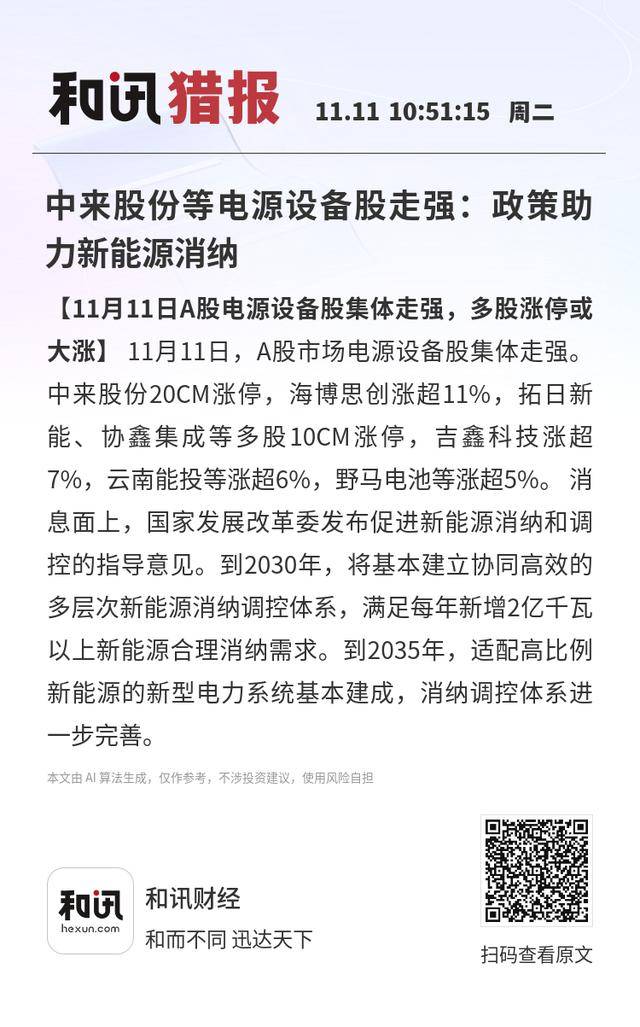
中来股份等电源设备股走强:政策助力新能源消纳
Sou Hu Cai Jing· 2025-11-11 03:42
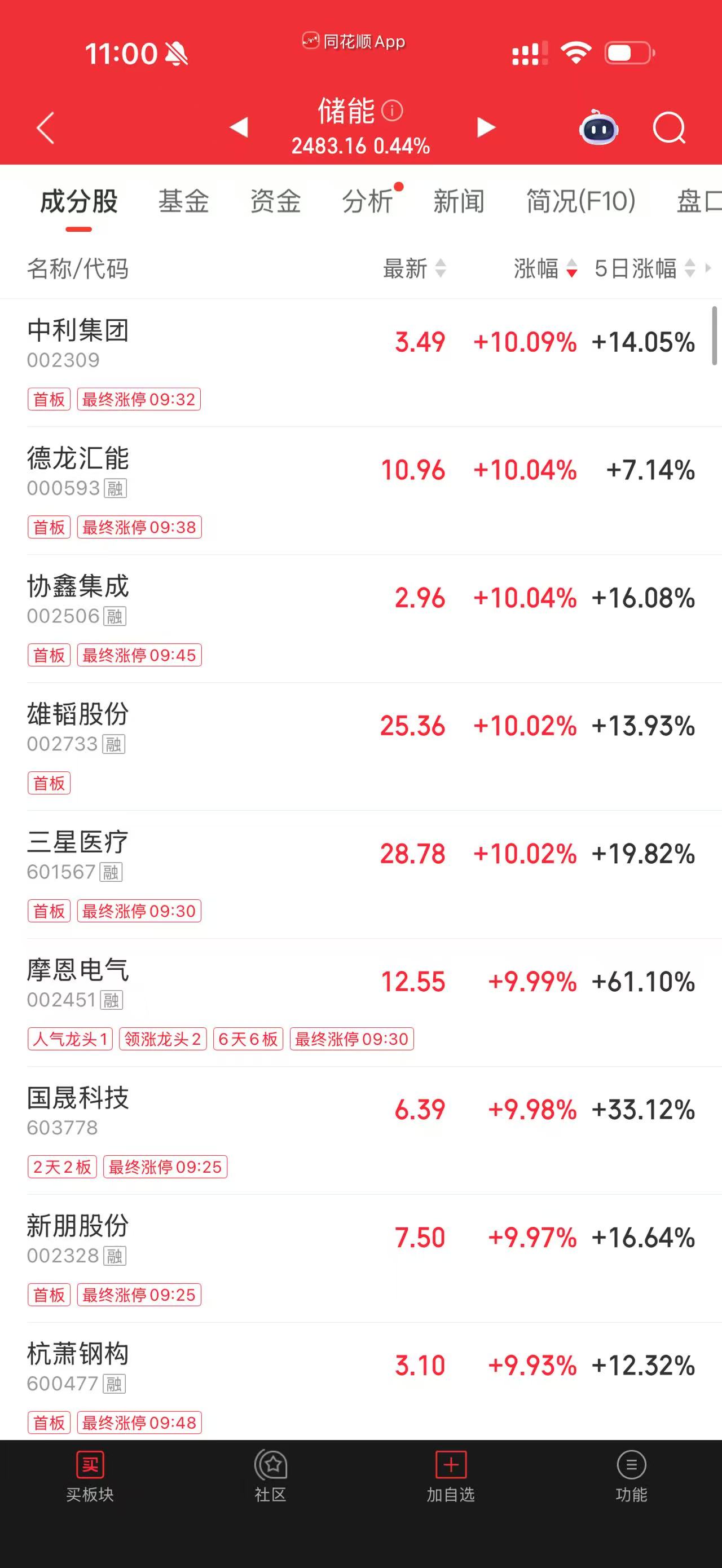
Group 1 - A-share market saw a collective surge in power equipment stocks on November 11, with multiple stocks hitting the daily limit or experiencing significant gains [1][3] - Zhonglai Co. reached a 20% limit up, Haibo Sichuang increased over 11%, and several other companies like Tuori New Energy and Xiexin Integration also saw 10% limit up [1][3] - The National Development and Reform Commission released guidelines to promote the consumption and regulation of renewable energy, aiming to establish a multi-level renewable energy consumption regulation system by 2030 [1][3] Group 2 - By 2030, the guidelines aim to meet the annual demand for reasonable consumption of over 200 million kilowatts of new energy [1][3] - By 2035, a new power system compatible with a high proportion of renewable energy is expected to be basically established, further improving the consumption regulation system [1][3]


重磅利好!这一板块多股涨停!
Zheng Quan Ri Bao· 2025-11-11 03:37
Core Viewpoint - The renewable energy sector is experiencing significant growth, driven by favorable policies and increasing demand for energy storage and photovoltaic technologies [3][4][6]. Group 1: Market Performance - On November 11, the renewable energy sector led the market with strong gains, particularly in photovoltaic and energy storage concepts [1]. - Several companies, including Zhonglai Co., Ltd. and Jieli Group, reached their daily price limits, indicating robust investor interest [1]. Group 2: Policy Impact - The National Development and Reform Commission and the National Energy Administration issued guidelines to promote the consumption and regulation of renewable energy, providing a clear implementation path for high-quality development in the sector [3][4]. - Key tasks outlined in the guidelines include enhancing the adaptability of new power systems to renewable energy and improving the national unified electricity market system [4]. Group 3: Industry Outlook - By 2030, a multi-layered renewable energy consumption and regulation system is expected to be established, ensuring efficient integration and utilization of renewable energy sources [4]. - The guidelines emphasize the importance of technological innovation in energy storage and the development of advanced renewable energy technologies, such as large-capacity long-duration storage [5][6]. Group 4: Company Insights - Companies like Tuori New Energy and GCL-Poly Energy are positioned well due to advancements in cutting-edge battery technologies and effective cost control measures [6]. - The energy storage market is seeing increased demand, with rising battery prices positively impacting the performance expectations of related stocks [6].


新华社︱国家发展改革委、国家能源局发文 分类引导新能源开发与消纳
国家能源局· 2025-11-11 03:34
此外,意见还提出大力推动新能源消纳新模式新业态创新发展,增强新型电力系统对新能源适配能力,完善促进新能源消 纳的全国统一电力市场体系,强化新能源消纳技术创新支撑,优化新能源消纳管理机制等一系列创新举措。 国家能源局有关负责人表示,近年来,我国新能源规模高速增长、占比快速提升,消纳压力持续增加,如何统筹好新能源 发展与消纳已成为能源绿色低碳转型的一项重大课题。国家发展改革委、国家能源局坚持深化改革,完善政策措施,提升 电力系统对新能源的接纳、配置和调控能力,促进新能源在大规模开发的同时实现高质量消纳。 意见还明确了2030年、2035年新能源消纳调控工作目标。其中,到2035年,适配高比例新能源的新型电力系统基本建 成,新能源消纳调控体系进一步完善,全国统一电力市场在新能源资源配置中发挥基础作用,新能源在全国范围内优化配 置、高效消纳,支撑实现国家自主贡献目标。 (王悦阳) (来源:新华社) 记者11月10日从国家能源局获悉,国家发展改革委、国家能源局发布《关于促进新能源消纳和调控的指导意见》提出,分 类引导新能源开发与消纳。 意见提出将新能源开发消纳划分为5类,进一步明确分类施策要求。分别为统筹"沙戈荒"新能 ...
新能源消纳新政落地 每年催生2亿千瓦以上增量市场
Zhong Guo Jing Ying Bao· 2025-11-11 03:06
Core Viewpoint - The National Development and Reform Commission and the National Energy Administration have issued guidelines to enhance the consumption and regulation of renewable energy, aiming for a high-quality integration of renewable energy development and consumption by 2030 and 2035 [1][2]. Group 1: Goals and Targets - By 2030, a multi-level renewable energy consumption and regulation system will be established, with new electricity demand primarily met by renewable energy generation [1]. - The new power system's adaptability will significantly improve, with the capacity to accommodate over 200 million kilowatts of new renewable energy annually [1]. - By 2035, a high-proportion renewable energy power system will be in place, enabling efficient consumption and optimal allocation of renewable energy nationwide [1]. Group 2: Development and Integration - The guidelines emphasize innovative integrated development paths, promoting the construction of zero-carbon parks and the integration of green fuels such as hydrogen, ammonia, and alcohol [2]. - There will be a focus on the fusion of renewable energy with strategic emerging industries like information technology and high-end equipment manufacturing in resource-rich areas [2]. - New business models for local renewable energy consumption will be developed, including integrated source-grid-load-storage systems and smart microgrids [2]. Group 3: System Enhancements - The new power system's adaptability to renewable energy will be enhanced by improving system regulation capabilities and optimizing renewable energy control models [2]. - A unified national electricity market system will be established to facilitate renewable energy consumption, expanding the market-oriented framework for renewable energy [2]. - Innovative pricing mechanisms will be introduced to promote renewable energy consumption [2].
深市规模最大的光伏ETF(159857)近20日涨幅17.54%傲视群雄!重磅新政激发民间投资,高端制造与新能源领域迎机遇
Sou Hu Cai Jing· 2025-11-11 02:30
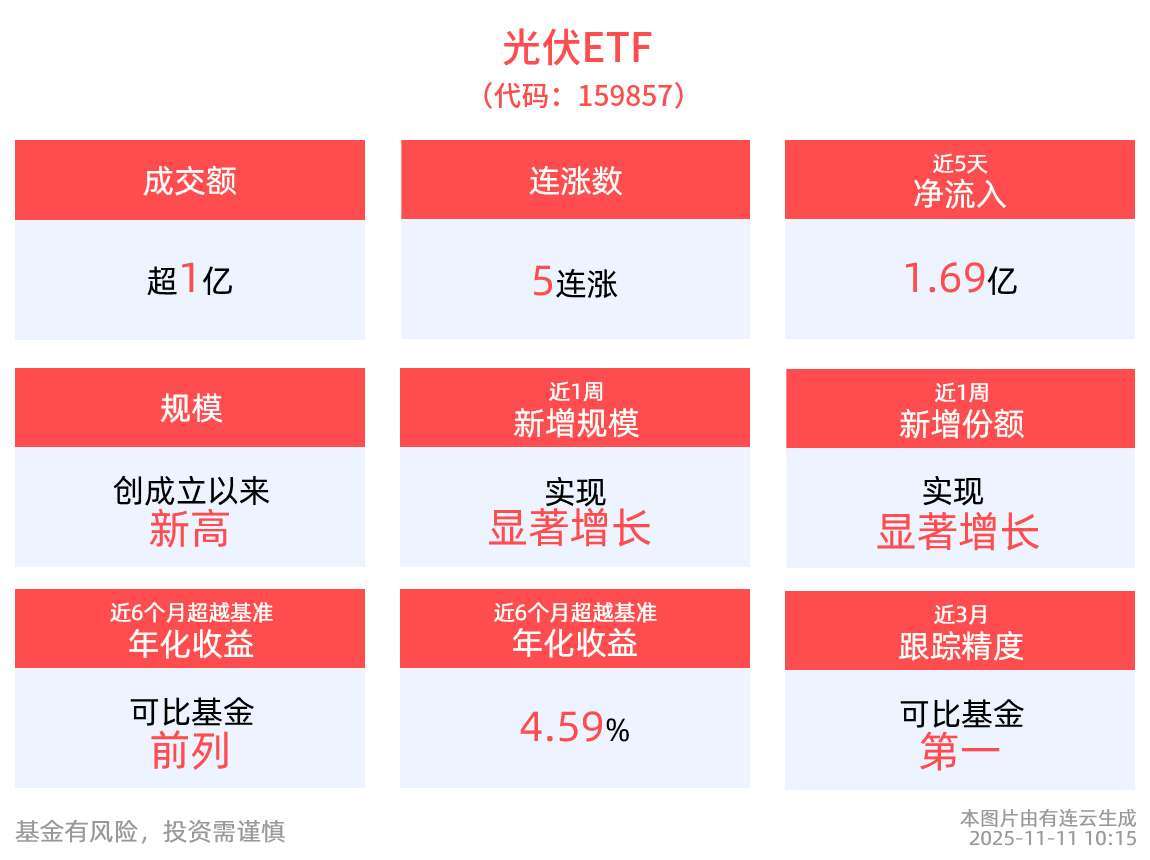
Group 1 - The core viewpoint of the news highlights the significant performance of the photovoltaic ETF (159857), which has seen a 0.87% increase, marking its fifth consecutive rise, with a trading volume of 1.53 billion yuan and a turnover rate of 5.55% [3] - The photovoltaic ETF (159857) has achieved a 17.54% increase over the past 20 days, leading among similar products, and its latest scale reached a record high of 2.712 billion yuan [3] - In the past week, the ETF's shares increased by 14.2 million, indicating substantial growth, with a net inflow of 22.984 million yuan recently [3] Group 2 - The State Council's new policies aim to stimulate private investment, particularly in high-end manufacturing and renewable energy funds, with 13 targeted policy measures to enhance private sector participation [4] - The recent guidance from the National Development and Reform Commission and the National Energy Administration emphasizes the need for increased renewable energy consumption capacity, targeting an annual addition of over 200 million kilowatts of renewable energy by 2030 [5] - Citic Securities believes that the electric equipment and renewable energy sector is at the beginning of a new cycle, with expected growth in global renewable energy installations during the 14th Five-Year Plan period, driven by high proportions of wind and solar energy integration [6]



供需偏紧,碳酸锂继续领涨新能源金属
Zhong Xin Qi Huo· 2025-11-11 02:28
投资咨询业务资格:证监许可【2012】669号 中信期货研究(新能源⾦属每⽇报告) 2025-11-11 供需偏紧,碳酸锂继续领涨新能源金属 新能源观点:供需偏紧,碳酸锂继续领涨新能源⾦属 交易逻辑:碳酸锂供需双增,供需延续偏紧格局,库存去化加快;工 业硅和多晶硅供需也偏紧,主要是受益于西南地区枯水期减产;电解 钴产量快速下滑,过剩局面缓解。中短期来看,现实供需偏好,碳酸 锂去库加快,碳酸锂领涨新能源金属,关注碳酸锂短多机会。长期来 看,硅供应端收缩预期较强,尤其多晶硅,价格重心可能抬升;锂矿 产能还处于上升阶段,但需求预期也在不断拔高,碳酸锂长期供需走 向需要重新审视。 ⼯业硅观点:枯⽔期减产叠加仓单去化,硅价⽀撑较强。 多晶硅观点:产量边际下滑,多晶硅⾼位震荡。 碳酸锂观点:需求持续超预期,股期联动锂价⼤涨。 ⻛险提⽰:供应扰动;国内政策刺激超预期;美联储鸽派不及预期; 国内需求复苏不及预期;经济衰退。 有⾊与新材料团队 研究员: 郑非凡 从业资格号F03088415 投资咨询号Z0016667 白帅 从业资格号F03093201 投资咨询号Z0020543 杨飞 从业资格号F03108013 投资咨询号 ...
两部门分类引导新能源消纳,创业50ETF(159682)盘中涨近1%,亿纬锂能等储能股走高
2 1 Shi Ji Jing Ji Bao Dao· 2025-11-11 02:20
Group 1 - The Chuangye 50 ETF (159682) experienced a mid-session increase of 0.82% with a trading volume exceeding 57 million yuan, driven by gains in component stocks such as Jiangbolong, Sungrow Power Supply, Jinlang Technology, Yiwei Lithium Energy, and CATL [1] - On November 10, the Chuangye 50 ETF recorded a decline but attracted 99.05 million yuan in capital inflow, indicating strong investor interest despite market fluctuations [1] - The ETF tracks the Chuangye 50 Index, which includes sectors such as manufacturing, information transmission, software, and technology services, with key weighted stocks including CATL, Dongfang Wealth, and others [1] Group 2 - Dongwu Securities forecasts a gradual introduction of domestic capacity compensation electricity prices and continuous growth in overseas emerging markets, predicting a 40%-50% increase in global energy storage installations next year and a compound growth rate of 30%-50% over the next three years [2] - The company maintains a positive outlook on large-scale energy storage, integrated storage solutions, and leading energy storage battery manufacturers [2] Group 3 - The National Development and Reform Commission and the National Energy Administration released guidelines to promote the consumption and regulation of new energy, focusing on large-scale development and high-quality consumption, with the aim of building a new power system compatible with high proportions of new energy [1] - Experts emphasize the importance of guiding various types of new energy development and enhancing the adaptability of the new power system, which will be crucial for large state-owned enterprises in the power generation, grid, and equipment manufacturing sectors [1]






碳酸锂:储能预期与现实双强,短期走势偏强
Guo Tai Jun An Qi Huo· 2025-11-11 02:10
Report Summary 1. Report Industry Investment Rating - The trend strength of lithium carbonate is rated as 0, indicating a neutral outlook. The strength ranges from -2 (most bearish) to 2 (most bullish), with classifications including weak,偏弱, neutral, 偏强, and strong [3]. 2. Report's Core View - The short - term trend of lithium carbonate is strong, with both the expected and actual demand in the energy storage sector being robust [1]. 3. Summary by Relevant Catalogs 3.1 Fundamental Tracking - **Futures Contracts**: For the 2511 contract, the closing price is 84,500 yuan, with a decrease in trading volume and open interest compared to previous periods. The 2601 contract has a closing price of 87,240 yuan, and its trading volume and open interest show different trends compared to historical data. For example, the trading volume of the 2601 contract on the current day is 986,569, an increase of 175,914 from the previous day [1]. - **Basis**: The basis between spot and 2511 contract is -3,750 yuan, and between spot and 2601 contract is -6,490 yuan. The difference between 2511 and 2601 contracts is -2,740 yuan [1]. - **Raw Materials**: The price of lithium spodumene concentrate (6%, CIF China) is 966 yuan, and lithium mica (2.0% - 2.5%) is 2,180 yuan. The price of battery - grade lithium carbonate is 80,750 yuan, showing an upward trend compared to previous periods [1]. - **Related Products**: The prices of various lithium - related products such as ternary materials, phosphoric acid iron lithium, and electrolytes also show different changes. For instance, the price of ternary material 523 (polycrystalline/consumer - type) is 149,325 yuan, an increase of 1,500 yuan from the previous day [1]. 3.2 Macro and Industry News - **Price Information**: The SMM battery - grade lithium carbonate index price is 80,864 yuan/ton, a daily increase of 493 yuan/ton. The average price of battery - grade lithium carbonate is 80,750 yuan/ton, up 350 yuan/ton from the previous day, and the average price of industrial - grade lithium carbonate is 78,550 yuan/ton, also up 350 yuan/ton [2]. - **Policy News**: The National Development and Reform Commission and the National Energy Administration issued a guidance on promoting new energy consumption and regulation, which aims to promote new energy consumption nearby and enhance the adaptability of the new power system to new energy, and improve the capacity price mechanism of regulatory resources [3]. - **Company News**: Ganfeng Lithium announced that the PPGS lithium salt lake project in Argentina has obtained the "Environmental Impact Assessment Report", and the project is expected to submit an application to the Argentine government in the first half of 2026. The project has about 1,507 million tons of LCE proven + controlled resources [3].

两部门联合发文力促消纳,新能源发展步入高质新阶段
CMS· 2025-11-11 02:03
Investment Rating - The report maintains a "Recommendation" rating for the industry, indicating a positive outlook for the sector's fundamentals and an expectation that the industry index will outperform the benchmark index [2][7]. Core Insights - The National Development and Reform Commission and the National Energy Administration have issued guidelines to promote the consumption and regulation of renewable energy, aiming for a high-quality development phase in the renewable energy sector [1][5]. - By 2030, a multi-level renewable energy consumption regulation system is expected to be established, ensuring efficient integration and utilization of renewable energy sources [5]. - The report emphasizes the need for differentiated strategies for various types of renewable energy to enhance policy implementation efficiency and promote new consumption models and industry upgrades [5]. Industry Overview - As of September 2025, the installed capacity of wind and solar power accounts for approximately 46% of the total energy mix, highlighting the rapid expansion of renewable energy in China [5]. - The report notes significant regional challenges in energy consumption, with wind and solar abandonment rates reaching 6.6% and 5.7% respectively in the first half of 2025, indicating severe regional consumption issues [5]. - The guidelines categorize renewable energy development and consumption into five types, including "desert" bases and offshore wind power, to optimize energy distribution and enhance local consumption [5]. Investment Recommendations - The report suggests focusing on leading national renewable energy companies such as Longyuan Power and Three Gorges Energy, as well as high-quality local offshore wind enterprises like Funiu Co. and Zhongmin Energy [5].
20cm速递|新能源赛道迎来重磅利好政策!创业板新能源ETF华夏(159368)上涨1.53%,规模同类第一
Mei Ri Jing Ji Xin Wen· 2025-11-11 02:01
Core Viewpoint - The recent guidance from the National Development and Reform Commission and the National Energy Administration aims to establish a multi-level system for the consumption and regulation of renewable energy by 2030, ensuring efficient integration and utilization of renewable energy sources [1]. Group 1: Market Performance - The ChiNext New Energy ETF (159368) opened high and rose by 1.53%, with significant gains in its holdings, including a 20% limit up for Lai Co., over 10% increase for Shuneng Electric, and over 7% for Penghui Energy [1]. - The ChiNext New Energy ETF is the largest ETF tracking the ChiNext New Energy Index, which covers various sectors including batteries and photovoltaics [2]. Group 2: ETF Characteristics - The ChiNext New Energy ETF has the highest elasticity, with a potential increase of 20%, and the lowest fee structure, with a total management and custody fee of only 0.2% [2]. - As of October 31, 2025, the ETF's scale reached 829 million, with an average daily trading volume of 90.05 million over the past month [2]. - The ETF has a significant focus on storage, with 58% of its holdings in storage and 31% in solid-state batteries, aligning with current market trends [2]. Group 3: Industry Outlook - Huatai Securities expresses optimism about the steady increase in China's electrification rate, which will be mutually reinforced by grid upgrades and the development of new storage systems, accelerating the construction of a new power system [1].

