
去美元化

Search documents
粤开宏观:人民币汇率持续升值:原因、影响及展望
Yuekai Securities· 2025-12-25 08:12
Exchange Rate Trends - The RMB to USD exchange rate appreciated by 4% in 2025, while the USD index fell by 9.7%, indicating that the depreciation of the USD is a primary driver of the RMB's strength against the USD[2] - As of December 25, 2025, the offshore RMB to USD exchange rate broke 7.0, with the onshore rate close to the same threshold[10] Factors Driving RMB Appreciation - Four main factors are driving the RMB's appreciation against the USD: the weakening USD index, a strong Chinese stock market, increased demand for currency settlement by export enterprises, and the People's Bank of China's (PBOC) guidance for a reasonable appreciation of the RMB against the USD[2] - The PBOC has utilized a counter-cyclical factor to stabilize the RMB against a basket of currencies, leading to a controlled appreciation against the USD[14] Impact on Exports - Concerns exist that the RMB's appreciation against the USD may negatively impact Chinese exports; however, the actual effective exchange rate against a basket of currencies is more critical for export performance[3] - Despite the nominal appreciation of the RMB against the USD, the nominal effective exchange rate has decreased by 3.5%, indicating a competitive pricing advantage for Chinese goods in international markets[2] Future Outlook - The RMB is expected to maintain a strong trend against the USD in 2026, with 6.8 identified as a potential key level, although there may be risks of short-term corrections[4] - Export enterprises are advised to focus on their core business and utilize foreign exchange hedging strategies to mitigate risks associated with exchange rate fluctuations[4] Risks - Potential risks include unexpected external shocks and an accelerated appreciation of the RMB beyond expectations, which could impact corporate operations and financial markets[5]
贵金属的转折点?风浪越大鱼越贵
3 6 Ke· 2025-12-25 08:07
Core Viewpoint - The precious metals market is experiencing significant volatility, with extreme bullish sentiment on one side and sudden declines on the other, indicating a potential turning point for the sector [1][2]. Short-term Disturbances - Investors should be cautious of short-term fluctuations and avoid becoming "bag holders" as the market is currently under pressure from passive fund rebalancing [5][6]. - The Bloomberg Commodity Index (BCOM) will undergo annual rebalancing from January 8 to 15, leading to a 9% sell-off pressure on silver and 3% on gold, which could disrupt the short-term market [6][8]. - Active funds are likely to preemptively reduce their positions to lock in profits before the rebalancing occurs [7]. Long-term Anchors - Despite short-term volatility, the long-term upward trend for gold remains intact, supported by four key factors [11]. - Central banks have been net buyers of gold for three consecutive years, with purchases expected to reach 1,086 tons in 2024, increasing gold's share in global reserves from 9% to 18.2% [14][16]. - The Federal Reserve's interest rate cuts are expected to support gold prices, with three rate cuts anticipated by 2025 [17][18]. - The global debt crisis, particularly in the U.S., has heightened the appeal of gold as a safe-haven asset, with U.S. debt exceeding $36 trillion [22][23]. - Retail investors currently have a low allocation to gold, with U.S. gold ETFs representing only 0.17% of private investment portfolios, indicating significant room for growth [28][30]. Market Dynamics - The current market sentiment has led to a 40% increase in silver prices within a month, driven by quantitative funds [49][50]. - The company has successfully guided its members from a price of $1,800 to $4,500, demonstrating a strong grasp of market trends [55]. - The long-term outlook for gold is optimistic, with potential targets of $5,000 by 2026 and even $10,000 by 2029, contingent on various economic factors [45][46][40].

黄金,改写历史
Xin Lang Cai Jing· 2025-12-25 07:53
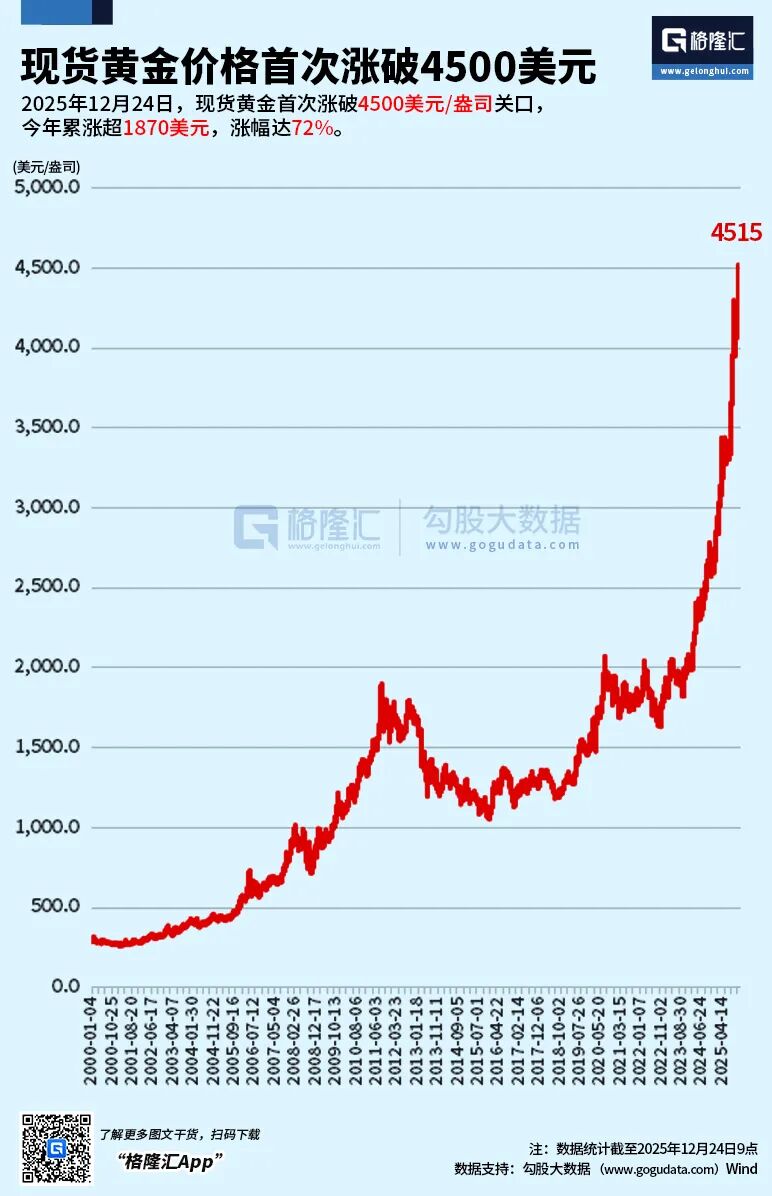
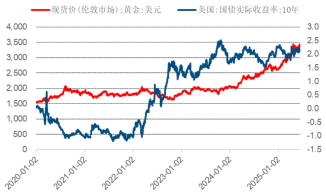
Group 1 - The core viewpoint of the articles is that gold and silver prices have reached historical highs, with gold rising over 2.3% to $4442.22 per ounce and silver increasing by 3.3% to $69.46 per ounce, marking the largest annual gains since 1979, with gold up 69% and silver up 137% for the year [1][16]. Group 2 - Several factors are driving the strength of precious metal prices, which have become widely accepted [3][18]. - One key factor is the strengthening of monetary policy expectations, as the U.S. unemployment rate rose to 4.6%, higher than the expected 4.3%, prompting a reassessment of the Federal Reserve's policy direction [4][19]. - The market's pricing probability for interest rate cuts in the first half of 2026 has increased from 52% to 78%, leading to lower actual interest rates, which reduces the holding cost of gold, a non-yielding asset [4][19]. - Another factor is the continuous decline of the U.S. dollar index, which lowers the purchasing cost of gold for non-U.S. currency holders, enhancing its attractiveness in the international market [5][20]. - Central banks are also increasing their gold reserves, with global gold demand reaching a historical high of 1313 tons in Q3 2025, supported by central bank purchases [6][21]. - As of the end of November, China's gold reserves increased to 7.412 million ounces, marking the 13th consecutive month of gold accumulation [6][21]. Group 3 - The narrative around gold pricing is undergoing a transformative change, moving beyond traditional frameworks of the U.S. dollar and actual interest rates [8][23]. - The correlation between gold prices and traditional indicators has been breaking down since 2023, indicating a shift in the pricing logic of gold [8][23]. - Gold is transitioning to a multi-factor framework that includes central bank purchases, de-dollarization, supply rigidity, and event premiums, rather than relying solely on actual interest rates and the dollar [10][24]. - The long-term upward trend of gold prices is expected to remain intact as long as core trends such as the weakening of U.S. dollar credit and the restructuring of the reserve system persist [10][24]. Group 4 - A new tax policy on gold introduced in November is expected to enhance the attractiveness of gold jewelry as an investment, while gold ETFs are becoming more appealing due to tax advantages [12][26]. - Investors are increasingly turning to exchange-traded products like gold ETFs, which do not require physical possession of gold, making them a balanced choice for ordinary investors [12][26]. - Gold ETFs and related investment products are designed to provide exposure to gold without the burden of physical ownership, thus appealing to a broader range of investors [12][26].
俄罗斯黄金运往中国,战略层面行动再升级,中方抛出118亿美债,鲁比奥对华措辞变了
Sou Hu Cai Jing· 2025-12-25 07:50
背后的逻辑不难理解:黄金作为全球公认的最终支付手段,在金融动荡时代具有不可替代的核心战略地位。尽管当前国际金价已攀升至历史高点,但包括中 国在内的诸多国家仍在加大黄金采购力度,核心目的便是稳固自身经济根基。面对全球经济复苏乏力、地缘冲突持续发酵的不确定形势,增持黄金无疑成为 中国平衡财务安全与货币稳定的关键举措,为应对潜在金融风险筑牢"压舱石"。中金公司研报指出,央行购金已成为近年来全球黄金需求的主要支撑,而中 国的持续增持,正是对这一趋势的精准把握。 与增持黄金形成鲜明对比的是,中国对美国国债的减持力度同样令人瞩目。美国财政部12月18日公布的数据显示,10月份外国投资者持有的美债规模整体下 降,其中中国当月抛售118亿美元美国国债,持仓量创下2008年以来的最低水平。这一举措直接引发外界对美国经济基本面与美元信用的广泛质疑。尽管美 国财政部长斯科特·贝森特公开声称美债的外国需求仍"非常强劲",试图稳定市场信心,但中国持续减持的实际操作,正悄然改变全球美债市场的供需格局 与游戏规则。 近年来,全球经济与政治格局正经历深刻变革,围绕美元霸主地位的争夺成为核心议题之一。这场席卷全球的"去美元化"浪潮正加速演进, ...
多家机构预期:2026年金价继续上涨
Sou Hu Cai Jing· 2025-12-25 06:58
Group 1 - The core viewpoint of the articles indicates a sustained trend in using gold to hedge against risks associated with dollar-denominated assets, with expectations for gold prices to rise further by 2026 [1] - Analysts from Schroders highlight that the U.S. is facing "policy uncertainty, fiscal fragility, and increasing investor doubts about the long-term role of U.S. Treasuries and the dollar," making gold a preferred choice for asset diversification due to its safe-haven properties and low correlation with traditional assets [1] - Goldman Sachs predicts that by the end of 2026, gold prices will reach approximately $4,900 per ounce, driven by strong structural demand from central bank purchases and cyclical support from potential Federal Reserve rate cuts [1] - JPMorgan forecasts that gold prices could rise to $5,055 per ounce by Q4 2026, with potential further increases up to $6,000 per ounce, emphasizing a clear long-term trend of gold allocation by official reserves and investors [1] - Forbes notes that global trade tensions initiated by the U.S., the rise of "de-dollarization" transactions to avoid dollar depreciation, increased demand for gold from private investors and cryptocurrency funds, and ongoing central bank purchases are significant drivers for the upward movement in gold prices [1] Group 2 - Reuters reports that the U.S. dollar index has declined by 9% since the beginning of 2025, potentially marking its worst annual performance in eight years [2] - The market widely anticipates that the new Federal Reserve chair may lean towards a dovish monetary policy stance, which could further weaken the dollar and reduce the attractiveness of dollar-denominated assets for investors [2]


贵金属的转折点?风浪越大鱼越贵!
Sou Hu Cai Jing· 2025-12-25 06:46
Core Viewpoint - The precious metals market is experiencing significant volatility, with investors facing both extreme bullish sentiment and sudden bearish movements, indicating a potential turning point for the sector [1][3]. Short-term Dynamics - There is a peak in bullish sentiment, with both the Shanghai Silver VIX and the U.S. SLV options volatility reaching historical highs, indicating crowded positions [2]. - A sudden drop in platinum spot prices has revealed stark funding divergences, suggesting that current market conditions may be a critical juncture for precious metals [3]. - Short-term players are advised to avoid high-risk positions, as chasing prices may lead to losses [6]. - A significant risk arises from a "passive rebalancing" event, with passive funds having to adjust their holdings according to indices, leading to potential selling pressure on silver (9% sell-off) and gold (3% sell-off) [8]. Long-term Fundamentals - The long-term bullish trend for gold is supported by four key factors: central bank purchases, anticipated interest rate cuts by the Federal Reserve, rising global debt levels, and increasing retail investor allocations [12][15][18]. - Central banks have consistently purchased over 1,000 tons of gold annually for three years, with projections for 2024 reaching 1,086 tons, indicating a strong foundation for gold prices [15]. - The Federal Reserve's expected interest rate cuts are anticipated to support gold prices, as historical data shows a negative correlation between the dollar and gold [18]. - The global debt crisis, particularly in the U.S., has created a demand for safe-haven assets like gold, which is viewed as a "no-liability asset" [18]. - Retail investors currently have a low allocation to gold (0.17% in U.S. gold ETFs), suggesting significant room for growth in this area, which could further drive up gold prices [18]. Investment Strategy - Short-term strategy should focus on risk management, with recommendations to reduce exposure to precious metals until after the BCOM rebalancing on January 15 [20]. - For mid to long-term investments, the strategy should involve buying on dips, as short-term fluctuations are seen as opportunities rather than threats [20]. - Suggested investment vehicles include gold-related ETFs for simplicity, diversified mining stocks for balanced exposure, and traditional base metals benefiting from manufacturing recovery [20].
多家机构预期2026年美元资产吸引力减弱 金价继续上涨
Xin Hua Wang· 2025-12-25 06:40
Group 1 - The core viewpoint of the articles indicates a sustained trend in using gold to hedge against risks associated with dollar-denominated assets, with expectations for gold prices to rise further by 2026 [1] - Analysts from Schroders highlight that the U.S. is facing "policy uncertainty, fiscal fragility, and increasing investor doubts about the long-term role of U.S. Treasuries and the dollar," making gold a preferred choice for asset diversification due to its safe-haven properties and low correlation with traditional assets [1] - Goldman Sachs projects that by the end of 2026, gold prices could reach approximately $4,900 per ounce, driven by strong structural demand from central bank purchases and cyclical support from potential Federal Reserve rate cuts [1] - JPMorgan forecasts that gold prices may rise to $5,055 per ounce by the fourth quarter of 2026, with potential further increases up to $6,000 per ounce, emphasizing a clear long-term trend of gold allocation by official reserves and investors [1] - Forbes notes that global trade tensions initiated by the U.S., the rise of "de-dollarization" transactions to avoid dollar depreciation, increased demand for gold from private investors and cryptocurrency funds, and ongoing central bank purchases are significant drivers for the upward movement of gold prices [1] Group 2 - Reuters reports that the U.S. dollar index has declined by 9% since the beginning of 2025, potentially marking its worst annual performance in eight years [2] - The market widely anticipates that the new Federal Reserve chairman may lean towards a dovish monetary policy stance, which could further weaken the dollar and reduce the attractiveness of dollar-denominated assets for investors [2]

多家机构预期2026年美元资产吸引力减弱 金价继续上涨
Xin Hua Wang· 2025-12-25 06:38
Group 1 - Multiple international financial institutions predict a continued trend of using gold to hedge against risks associated with dollar-denominated assets, with gold prices expected to rise further by 2026 [1] - Schroders analyst Patrick Brenner highlights that the U.S. is facing "policy uncertainty, fiscal fragility, and increasing investor doubts about the long-term role of U.S. Treasuries and the dollar," making gold a preferred choice for asset diversification due to its safe-haven properties and low correlation with traditional assets [1] - Goldman Sachs forecasts that gold prices will reach approximately $4,900 per ounce by the end of 2026, driven by strong structural demand from central bank purchases and cyclical support from potential Federal Reserve rate cuts [1] - JPMorgan anticipates that gold prices could rise to $5,055 per ounce by Q4 2026, with the possibility of further increases to $6,000 per ounce, indicating a clear long-term trend of gold allocation by official reserves and investors [1] - Forbes notes that global trade tensions initiated by the U.S., the rise of "de-dollarization" transactions to avoid dollar depreciation, increased demand for gold from private investors and cryptocurrency funds, and ongoing central bank purchases are significant drivers for the upward movement of gold prices [1] Group 2 - The U.S. dollar index has declined by 9% since the beginning of 2025, potentially marking its worst annual performance in eight years [2] - The market widely expects that the new Federal Reserve chairman may lean towards a dovish monetary policy stance, which could further weaken the dollar and reduce the attractiveness of dollar-denominated assets for investors [2]
多家机构预期2026年美元资产吸引力减弱金价继续上涨
Xin Hua Wang· 2025-12-25 06:38
Group 1 - The core viewpoint of the articles indicates a sustained trend of using gold to hedge against risks associated with dollar-denominated assets, with expectations for gold prices to rise further by 2026 [1] - Analysts from Schroders highlight that the U.S. is facing "policy uncertainty, fiscal fragility, and increasing investor doubts about the long-term role of U.S. Treasuries and the dollar," making gold a preferred choice for asset diversification due to its safe-haven properties and low correlation with traditional assets [1] - Goldman Sachs predicts that by the end of 2026, gold prices will reach approximately $4,900 per ounce, driven by strong structural demand from central bank purchases and cyclical support from potential Federal Reserve rate cuts [1] - JPMorgan forecasts that gold prices could rise to $5,055 per ounce by the fourth quarter of 2026, with potential further increases up to $6,000 per ounce, citing a clear long-term trend of gold accumulation by official reserves and investors [1] - Forbes notes that global trade tensions initiated by the U.S., the rise of "de-dollarization" transactions to avoid dollar depreciation, increased demand for gold from private investors and cryptocurrency funds, and ongoing central bank purchases are significant drivers for the upward movement of gold prices [1] Group 2 - The U.S. dollar index has declined by 9% since the beginning of 2025, potentially marking its worst annual performance in eight years [2] - The market widely anticipates that the new Federal Reserve chair may adopt a dovish monetary policy stance, which could further weaken the dollar and reduce the attractiveness of dollar-denominated assets for investors [2]
多家机构预期2026年黄金价格或进一步上涨
Xin Hua She· 2025-12-25 06:37
Group 1 - Multiple international financial institutions predict a continued trend of using gold to hedge against risks associated with dollar-denominated assets, with gold prices expected to rise further by 2026 [1] - Schroders analyst Patrick Brenner highlights that the U.S. is facing "policy uncertainty, fiscal fragility, and increasing investor doubts about the long-term role of U.S. Treasury and the dollar," making gold a preferred choice for asset diversification due to its safe-haven properties and low correlation with traditional assets [1] - Goldman Sachs forecasts that gold prices will reach approximately $4,900 per ounce by the end of 2026, driven by strong structural demand from central bank purchases and cyclical support from potential Federal Reserve rate cuts [1] Group 2 - JPMorgan anticipates that gold prices could rise to $5,055 per ounce by Q4 2026, with potential further increases up to $6,000 per ounce, indicating a clear long-term trend of official reserves and investor allocations towards gold [1] - Forbes notes that global trade tensions initiated by the U.S., the rise of "de-dollarization" transactions to avoid dollar depreciation, increased demand for gold from private investors and cryptocurrency funds, along with ongoing central bank purchases, are significant drivers for the upward movement of gold prices [1] - The U.S. dollar index has declined by 9% since the beginning of 2025, potentially marking its worst annual performance in eight years, with expectations that the new Federal Reserve chair may adopt a dovish monetary policy stance, further weakening the dollar and reducing the attractiveness of dollar-denominated assets [2]