
关税

Search documents
从恐慌到“金发姑娘”:反弹太猛,投资者小心“乐极生悲”?
Jin Shi Shu Ju· 2025-07-07 03:52
Core Viewpoint - The U.S. stock market has shifted from panic to optimism over the past three months, but some strategists warn that the market may be overly optimistic given the uncertainties ahead [2]. Group 1: Market Sentiment and Economic Indicators - Investors are feeling reassured by the framework agreement between the U.S. and China, leading to a generally optimistic market outlook regarding the continuation of tariff suspension measures [2]. - The S&P 500 index experienced a significant drop of nearly 19% from its record high in February to the lows in April, but rebounded sharply after the announcement of tariff suspensions [2]. - The 50-day rebound since the April 8 low has been 19.8%, marking it as the ninth largest increase for the S&P 500 since 1950, indicating potential for further gains in the coming months [3][4]. Group 2: Fiscal Policy and Debt Concerns - The recent fiscal policy changes, including a projected increase of $3.4 trillion in government debt over the next decade, have raised concerns about the sustainability of economic growth and public debt levels [3]. - Analysts are questioning whether tariff revenues, which amounted to $15.6 billion in April alone, will significantly contribute to economic growth and help mitigate public debt increases over the next ten years [3]. Group 3: Investment Strategies and Sector Focus - Some strategists suggest that the current stock market gains may have outpaced the underlying fundamentals, leading to considerations for reducing exposure in overvalued sectors, particularly small-cap stocks, industrials, and consumer discretionary [4]. - Investment recommendations include holding cash for potential market corrections or reallocating to sectors perceived as more attractive, such as technology, financials, energy, utilities, and communication services [4].

研究所晨会观点精萃-20250707
Dong Hai Qi Huo· 2025-07-07 03:11
Group 1: Overall Market Analysis - The expiration of the tariff suspension period has cooled global risk appetite. The US tax - cut bill has been passed, and countries face pressure to reach trade agreements with the US, leading to a slight decline in the US dollar index. In China, the PMI data in June continued to rise, and domestic consumption policies and the "anti - involution" emphasis have boosted domestic risk appetite. The short - term recovery of foreign markets and the appreciation of the RMB have also improved market sentiment [2]. - The overall view on asset classes is that the stock index is expected to fluctuate strongly in the short term, with cautious long positions recommended; treasury bonds are expected to fluctuate at a high level, with cautious observation recommended; in the commodity sector, black metals are expected to rebound from low - level fluctuations, with cautious long positions; non - ferrous metals are expected to fluctuate strongly, with cautious long positions; energy and chemicals are expected to fluctuate, with cautious observation; precious metals are expected to fluctuate at a high level, with cautious long positions [2]. Group 2: Stock Index - Driven by sectors such as cross - border payment, gaming, and banking, the domestic stock market continued to rise. The recovery of China's June PMI data, strengthened domestic consumption policies, and the "anti - involution" emphasis have boosted domestic risk appetite. The short - term recovery of foreign markets and RMB appreciation have also improved market sentiment. The trading logic focuses on domestic incremental stimulus policies and trade negotiation progress. Short - term macro - upward momentum has increased. It is recommended to be cautiously long in the short term [3]. Group 3: Precious Metals - The precious metals market oscillated last week. With the Middle - East cease - fire agreement, the focus shifted to the Russia - Ukraine war, and overall risk cooled in the short term. The approaching tariff deadline and the US - Vietnam agreement have increased optimistic tariff expectations. However, trade negotiations between the US and other countries are still ongoing. The better - than - expected non - farm data has cooled the expectation of interest - rate cuts, and the rebound of US bond yields has suppressed gold prices. The "Big Beautiful Act" will increase debt pressure, providing long - term support for gold. The tariff negotiation situation will be the main short - term influencing factor, and the volatility of gold is expected to rise in the short term [5]. Group 4: Black Metals Steel - The domestic steel futures and spot markets rebounded slightly last Friday, but trading volume remained low. Overseas, tariff policies need attention; domestically, the "anti - involution" policy is a factor. The news of Tangshan's production restrictions led to a rebound in the futures market, increasing speculative demand, but the off - season still affected terminal demand. On the supply side, the impact of production - restriction policies emerged, with a 1.44 - million - ton week - on - week decline in hot - metal production, while the output of finished products still increased slightly. Cost support remained strong. The steel market is expected to be strong in the short term [6]. Iron Ore - The spot price of iron ore was flat last Friday, and the futures price rebounded slightly. Hot - metal production decreased by 1.44 million tons last week after two consecutive weeks of rebound, indicating the effect of production - restriction policies. The implementation of production - restriction policies needs further attention. In terms of supply, the shipping volume decreased by 149 million tons week - on - week, and the arrival volume increased by 178 million tons. Although the second and third quarters are the peak shipping seasons, the shipping volume may decline after the end - of - quarter rush. The port inventory increased by 46.67 million tons. Iron ore is expected to be strong in the short term due to macro factors but may decline in the medium term [6]. Silicon Manganese/Silicon Iron - The spot prices of silicon iron and silicon manganese were flat last Friday. The output of five major steel products increased, and the demand for ferroalloys was fair. The price of silicon manganese 6517 in the northern market was 5480 - 5530 yuan/ton, and in the southern market, it was 5500 - 5550 yuan/ton. The futures price rebounded slightly, driving up the spot price of manganese ore. The start - up rate of silicon manganese enterprises increased by 1.13% to 40.34%, and the daily output increased by 125 tons. The inventory of silicon iron enterprises is being depleted slowly, and prices are expected to adjust narrowly in the short term. The silicon iron and silicon manganese markets are expected to fluctuate within a range in the short term [7][8]. Group 5: Non - Ferrous Metals and New Energy Copper - Tariff news is uncertain. Although Trump threatened higher tariffs, it may be a negotiation strategy. The US is likely to impose at least a 10% tariff in the long run. The non - farm data was better than expected, but the private - sector employment slowed, and the expectation of interest - rate cuts cooled. In 2025, China's refined copper output continued to increase. From January to May, the copper output reached 6.593 million tons, a year - on - year increase of 11.4%. After excluding sample expansion, the increase was still 6.7%. Despite high production, the copper inventory is in good condition, at a relatively low level [9]. Aluminum - The aluminum price fell slightly last Friday, affected by the overall decline in commodities. The weighted open interest of Shanghai aluminum decreased by 7654 lots. The LME inventory continued to increase. Domestic aluminum ingots and aluminum rods started to accumulate inventory, indicating the end of the de - stocking phase. The inventory is expected to remain stable or increase, following the seasonal trend. The warehouse receipts increased significantly [9]. Aluminum Alloy - The industry has entered the off - season, with weak growth in manufacturing orders. However, the tight supply of scrap aluminum has supported the price of cast aluminum alloy from the cost side. The price is expected to fluctuate strongly in the short term, but the upside is limited due to weak demand [9]. Tin - On the supply side, the combined start - up rate of Yunnan and Jiangxi increased by 7.13% for two consecutive weeks, although still at a relatively low level. The supply from Myanmar's Wa State is becoming more relaxed. On the demand side, the photovoltaic industry, an important downstream of tin solder, is in the off - season, with a decrease in orders. The demand for lead - acid batteries is weak, and the demand for tin - plated sheets and tin chemicals is stable. As the tin price rises, the downstream is hesitant to buy, and the inventory increased by 658 tons this week. The price is expected to fluctuate in the short term, and the upside will be restricted in the medium term due to high - tariff risks,复产 expectations, and declining demand [10][11]. Lithium Carbonate - On the supply side, there is a contradiction between strong expectations and weak reality. The "anti - involution" policy has boosted the macro - sentiment, and the price of lithium carbonate has fluctuated strongly. The price of lithium ore has rebounded significantly, but the production of lithium carbonate remains high due to reduced smelting losses. On the demand side, the output of power cells decreased in June, but the output of energy - storage cells increased significantly. In July, the production of lithium iron phosphate cathode materials and batteries increased. The current price is close to the cost of mica - integrated production, providing strong cost support [11]. Industrial Silicon - There are short - term positive impacts, and it is expected to fluctuate strongly. The start - up rate in the southwest increased last week, but the number of open furnaces in the north decreased, leading to a decline in weekly output. The "anti - involution" theme has boosted expectations [11]. Polysilicon - It is expected to fluctuate strongly in the short term, driven by the production cut of industrial silicon and the "anti - involution" theme. Due to high industry concentration, the price has greater elasticity. The supply - demand situation remains weak, and the prices of downstream silicon wafers, battery cells, and components continue to decline [12]. Group 6: Energy and Chemicals Crude Oil - OPEC+ has unexpectedly increased daily production by 548,000 barrels, and with continued production growth in South America in the second half of the year, the downward trend of oil prices is more certain. Although the short - term spot price has not been clearly affected by over - supply, it may be supported in the short term, but refinery profits may be affected after the peak - season profit period, and purchasing willingness may decline [13]. Asphalt - The oil price is running at a low level, and the asphalt price is expected to fluctuate strongly. The shipment volume has improved slightly, and the factory inventory is being depleted slowly. The basis has rebounded, and the social inventory has limited accumulation. As the demand approaches the peak season, the inventory depletion situation needs to be monitored. It will continue to fluctuate at a high level following the oil price in the short term [14]. PX - After the premium of crude oil was reversed, the strong trend of PX changed, and the overseas price weakened to $840. The PXN spread reached $250, and the industry profit declined significantly. The recovery of PTA's start - up rate will provide some support for PX, and the weakening trend of PX may be slower than that of its downstream [14]. PTA - The tightness of the spot market has been significantly relieved, the port inventory has increased, and the basis has declined. The downstream start - up rate has continued to decline to 90.2%. There is still room for the downstream start - up rate to decline, and with the downward trend of crude oil prices due to production increases, the PTA price still has some downward space [14]. Ethylene Glycol - The port inventory has been depleted to 540,000 tons. The overall start - up rate has declined, reducing supply pressure. However, the continuous decline of the downstream start - up rate will restrict further inventory depletion. The factory inventory is still being depleted steadily. It is expected to bottom out and follow the polyester sector to operate weakly in the short term [14]. Short - Fiber - The decline in crude oil prices has led to a callback in the short - fiber price. It generally follows the polyester sector to fluctuate strongly. Terminal orders are still average, and the start - up rate continues to decline. The inventory of short - fiber remains high, and inventory depletion needs to wait until the peak - season demand in late July. With the weakening cost support, it will maintain a weak - oscillation pattern following the polyester sector in the medium term [15]. Methanol - There are maintenance activities in the inland area, and the arrival volume has decreased. Downstream olefins have maintenance plans. Before the implementation of maintenance, the spot price has some support. The international start - up rate has increased significantly, and the import expectation has risen again, and the supply - demand situation is expected to worsen. It has rebounded slightly under policy disturbances, but the upside is limited, and short - selling opportunities should be monitored [15]. PP - There are both maintenance and new - capacity releases, slightly relieving the supply pressure. The downstream is in the off - season, and the demand continues to decline. The crude oil price fluctuates weakly, and the profit of oil - based production is fair. The supply - demand imbalance is prominent, and the price is expected to decline further after the new - capacity release [16][17]. LLDPE - The number of device maintenance has increased, but the overall output is higher than the same period last year. The downstream is in the off - season, and the demand continues to weaken. The balance sheet shows an expected inventory accumulation, and the price is under pressure. There is still room for cost - profit compression [18]. Group 7: Agricultural Products US Soybeans - The pricing of the US soybean planting area is settled, and the weather during the key growing period from July to August is crucial. The current hot and humid environment in the US soybean - growing areas is conducive to crop growth, and the probability of extreme drought is low. The market's expectation of a bumper harvest remains unchanged. Attention should be paid to the adjustment of the yield per unit in the July USDA supply - demand report. The "Big and Beautiful" Act in the US has supported the US soybean market. The export expectation has improved with positive trade news between China and the US, and the balance - sheet pressure has been further reduced. The CBOT soybean is expected to remain in a stable range [19]. Soybean and Rapeseed Meal - The high - start - up rate of oil mills has maintained a stable supply of soybean meal, and the market sentiment is weak. The average monthly arrival volume of imported soybeans from July to September in China may be around 1.1 million tons, and the supply pressure is difficult to relieve within the 09 - contract period. The short - term stable trend of US soybeans provides some support. The positive news of China - US soybean trade has limited impact on the upward movement of futures prices. In the fourth quarter, the import premium of soybeans and the basis of domestic soybean meal are expected to remain weak. The upward space of soybean meal within the 09 - contract period is limited [20]. Soybean and Rapeseed Oil - The "Big and Beautiful" Act in the US has extended the clean - fuel production tax credit to 2029, which is beneficial to US soybean oil and Canadian rapeseed oil. In China, the rapeseed oil port inventory is high, and the inventory is slightly decreasing. The soybean oil inventory is accelerating its recovery, and the risk of inventory accumulation is increasing. The domestic soybean and rapeseed oil markets lack independent market - moving factors in the short term and are affected by palm oil. The soybean - palm oil price remains inverted [20][21]. Palm Oil - OPEC+'s planned production increase in August may put pressure on the oil peak season, limiting the boost to international oils. In Malaysia, the production in June decreased by about 4% month - on - month, and the export may increase by 4% - 6% month - on - month. The inventory may shrink to less than 2 million tons. The positive export data in July has boosted market sentiment, but the long - term production increase and the pressure on oil prices are the main limiting factors. In China, the palm oil storage has increased, and the basis is weak. The import profit is in an inverted state, and it is expected to maintain a range - bound and strong trend [21]. Corn - The grassroots price of corn is firm, and the basis is strong. The auction of imported corn had a slightly high premium and good transactions, with limited impact on the production area. The inventory of deep - processing enterprises has decreased, and there are more shutdowns for maintenance during the off - season. Feed enterprises are using more wheat as a substitute for corn, putting pressure on the corn price in Shandong. In July, the import of corn and the substitution of wheat may affect the futures price negatively. After the seasonal substitution of wheat for feed consumption in August - September, the postponed demand will return, and the corn price is likely to rise [22]. Pork - Leading enterprises have a low willingness to increase production and reduce weight for export. The supply in July is expected to decrease due to the impact of piglet diarrhea during the Spring Festival. The supply - demand situation is weak, and the profit expectation for the peak season in August - September is low. The cost of secondary fattening has increased significantly, and the willingness to restock is low. A large - scale concentrated supply of second - fattened pigs is expected in late July and late August, which will limit the upward space of pig prices. The spot price has decreased, and the futures price is expected to decline slightly in the next period [22].
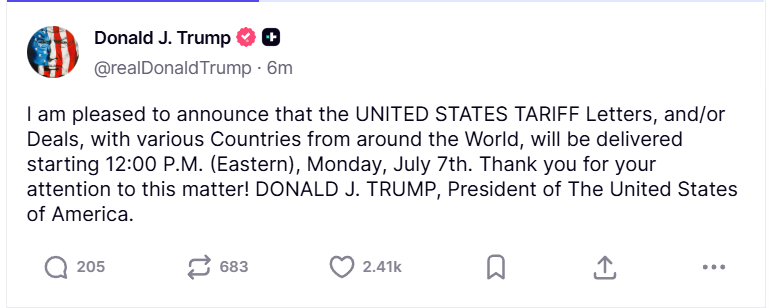
美股期货维持震荡,特朗普称将于美东时间周一中午12点发出关税信函
news flash· 2025-07-07 02:24
美国总统特朗普在真实社交发文称,我很高兴地宣布,美国与世界各国的关税信函和协议,将于美国东部时 间7月7日中午12点(北京时间周二凌晨)开始发出。 ...

关税“大限”将至 白宫暗示可能调整部分国家谈判截止日期
news flash· 2025-07-07 02:18
智通财经7月7日电,据央视新闻,美国白宫经济顾问委员会主席斯蒂芬·米兰6日在接受美国广播公司的 采访时表示,随着美国总统特朗普达成贸易协议的最后期限临近,一些与美国"真诚谈判"的国家可能会 推迟征收关税。 关税"大限"将至 白宫暗示可能调整部分国家谈判截止日期 ...
新西兰联储首席经济学家Paul Conway将于7月24日就关税问题发表讲话。
news flash· 2025-07-07 01:40
新西兰联储首席经济学家Paul Conway将于7月24日就关税问题发表讲话。 ...
华尔街到陆家嘴精选丨“大而美”法案正式生效 对投资影响几何?关税第二轮大考在即 美股多空激辩!ASIC芯片供应链迎来强劲增长周期
Di Yi Cai Jing· 2025-07-07 01:22
Group 1: Economic and Fiscal Implications - The "Big and Beautiful" Act signed by Trump includes tax cuts and significant spending measures, projecting a $4 trillion tax reduction and a $1.5 trillion spending cut over the next decade [1] - The Act is expected to increase the U.S. deficit by approximately $3.4 trillion over the next ten years, raising concerns about fiscal deficits and debt [1][2] - The Act is anticipated to create a super loose fiscal stimulus environment, potentially benefiting the economy and stock market liquidity, while negatively impacting U.S. debt and the dollar [1][2] Group 2: Market Reactions and Predictions - The Act is likely to push up U.S. Treasury yields and weaken the dollar, with increased demand for gold as a safe haven [2] - Analysts suggest that the Act may lead to a stronger recovery for the U.S. economy, although the extent remains uncertain [2] - The S&P 500 index is projected to reach 6850 points within 12 months, despite concerns over tariffs and geopolitical tensions [3] Group 3: Sector-Specific Impacts - The Act provides significant tax incentives and funding support for sectors such as chip manufacturers, energy companies, defense contractors, and real estate developers, while cutting subsidies for electric vehicles and renewable energy projects [1] - Traditional energy and military sectors are expected to benefit, while the renewable energy sector may face challenges [2] - The German stock market has shown strong performance, with military procurement plans potentially benefiting key defense manufacturers [5][6] Group 4: Oil Market Dynamics - OPEC+ has agreed to increase production by 548,000 barrels per day, exceeding market expectations, which may lead to a global oversupply risk and downward pressure on oil prices [7][8] - The strategy shift from limiting supply to increasing production aims to reclaim market share lost to U.S. shale oil [8] Group 5: AI Chip Supply Chain Growth - The global ASIC supply chain is entering a growth cycle driven by the widespread adoption of AI ASIC chips by cloud service providers like Google and Amazon [9] - Companies such as MPI, Aspeed, and Alchip are expected to benefit significantly from this trend, with MPI planning to double its production capacity [9][10]

财经综合:上周,国际油价、金价、美股均上涨
Sou Hu Cai Jing· 2025-07-07 00:59
Group 1: U.S. Stock Market Performance - The U.S. stock market experienced fluctuations due to the controversial tax and spending bill signed by President Trump, which passed through Congress amid market concerns [1] - The three major U.S. stock indices saw cumulative gains over the week, with the Dow Jones increasing by 2.30%, the S&P 500 rising by 1.72%, and the Nasdaq up by 1.62% [1] Group 2: Oil Market Dynamics - International oil prices rose last week, driven by expectations that the U.S.-Vietnam trade agreement would boost oil demand and geopolitical risks from Iran's suspension of cooperation with the International Atomic Energy Agency [2] - U.S. oil futures increased by 2.26%, while Brent crude futures rose by 0.78% [2] Group 3: OPEC+ Production Increase - OPEC+ agreed to increase oil production by 548,000 barrels per day in August, exceeding market expectations of 411,000 barrels per day, which may lead to downward pressure on oil prices due to potential oversupply [3] Group 4: Gold Market Trends - International gold prices rose by 1.68% last week, influenced by heightened market uncertainty regarding global trade and increased geopolitical tensions in the Middle East [4] Group 5: U.S. Tariff Negotiations - Investors are closely monitoring the end of the 90-day suspension period for U.S. "reciprocal tariffs," with no agreements reached with major trading partners like the EU and Japan [5] - President Trump indicated he might send multiple letters regarding tariffs, raising concerns about unilateral trade strategies and their potential impact on the global economy [5] Group 6: Federal Reserve's Monetary Policy - The Federal Reserve is set to release the minutes from its June monetary policy meeting, where it maintained interest rates, with market expectations leaning towards a high probability of a rate cut in September [6] - Economic data from major Eurozone economies, including Germany and France, will also be released, with predictions of potential rate cuts from the European Central Bank [6]