碳中和

Search documents
“NEV50@2035:多元路径与协同发展方案”主论坛举行
Hai Nan Ri Bao· 2025-09-28 01:33
Core Viewpoint - The "NEV50@2035" forum emphasizes the need for diverse technological pathways and collaborative development to achieve the goal of having 50% of global vehicles be new energy vehicles (NEVs) by 2035, addressing challenges and opportunities in the electric vehicle sector [2] Group 1: Industry Trends - The global electrification process faces challenges such as uneven regional development and diverse technological evolution, which also presents new opportunities for cross-regional collaboration and technological complementarity [2] - The automotive industry is transitioning towards intelligent and self-evolving vehicles, with smart technology becoming a key competitive factor [4] - The market structure for new energy vehicles in China is forming a "433" pattern, with hybrid, pure electric, and fuel vehicles coexisting [4] Group 2: Company Strategies - BMW aims for over 50% of its total sales to be pure electric vehicles by 2030, with China being its largest single market, indicating a commitment to local partnerships and investments [2] - Mercedes-Benz plans to produce a new pure electric GLC SUV in China by 2026, highlighting its focus on expanding its presence in the Chinese market [3] - Toyota is transforming into a mobility company, recognizing China as a crucial market for research and development [3] Group 3: Technological Innovations - Huawei identifies three waves of electric vehicle development in China: electrification of taxis and buses, passenger vehicles, and heavy-duty trucks, with the third wave currently underway [5] - The emphasis on green mobility is shifting from policy and technology-driven to user demand-driven, indicating a growing consumer interest in high-quality, worry-free travel experiences [4]
习近平主席视频致辞为全球气候治理指引方向凝聚力量
Xin Hua Wang· 2025-09-28 00:43
Group 1 - The core message of Xi Jinping's speech emphasizes China's commitment to global climate governance and its role as a leader in addressing climate change, highlighting the importance of collective action and cooperation among nations [1][2][7] - Xi Jinping announced a new round of national contributions, marking a significant milestone in China's climate action efforts, which has garnered positive reactions from international leaders and experts [4][5][6] - The speech underscores the need for fairness and respect for developing countries' rights in the global green transition, aiming to reduce rather than exacerbate the North-South divide [3][8] Group 2 - The call for international collaboration in green technology and industry is crucial for bridging the green capacity gap and ensuring the free flow of quality green products globally [3][4] - China's ambitious targets, including the goal of becoming a climate-adaptive society by 2035, are seen as both a national commitment and a model for other countries [5][6] - The speech reflects a strategic vision for global climate governance, emphasizing the importance of multilateralism and international cooperation in tackling climate change challenges [7][8]
圆满落幕,精彩内容分享!2025(第五届)液态阳光产业发展论坛
DT新材料· 2025-09-27 16:05
Core Viewpoint - The 2025 Liquid Sunshine Industry Development Forum highlighted the rapid development and scaling of the green methanol industry in China, emphasizing the transition from technology exploration to large-scale application [2][6]. Group 1: Forum Overview - The forum, hosted by DT New Energy, took place in Dalian from September 24-26, featuring over 50 experts and corporate leaders, with more than 200 representatives from various sectors [2]. - Key topics included macro trends in the green methanol industry, key technologies for large-scale production, biomass gasification, and the ecological construction and application of the green methanol industry [2]. Group 2: Key Presentations - Wang Jijie discussed the need for standards in renewable methanol that align with China's carbon neutrality goals, emphasizing the importance of a carbon trading system [12]. - Su Maohui presented the development of methanol-hydrogen electric vehicles, highlighting over 50,000 vehicles in operation and a total mileage exceeding 23 billion kilometers [15]. - Liu Ming shared Singapore's ambition to become a methanol supply hub, aiming for a million-ton scale by 2030 [18]. - Chang Fei outlined the current challenges in the commercialization of green methanol, including technological bottlenecks and infrastructure needs [21]. - Maersk's decarbonization goals were presented, focusing on the use of green methanol and innovative measures to achieve net-zero emissions [23]. Group 3: Technical Innovations - Lu Shijian discussed advancements in CO2 capture and resource utilization, showcasing applications in major energy companies [27]. - Liu Dianhua introduced a demonstration project for CO2 capture from coal-fired power plants, achieving a CO2 purity of 99.98% [30]. - Zhou Yunyun detailed Geely's comprehensive approach to green methanol production, including CO2 hydrogenation and biomass gasification technologies [32]. - Zhang Chenxi highlighted the importance of sustainable aviation fuel (SAF) in reducing carbon emissions in the aviation industry, with a pilot project already in place [34]. Group 4: Policy and Market Dynamics - He Yankang analyzed global shipping emission reduction policies and their impact on the green methanol market, emphasizing the shift from future vision to compliance necessity [58]. - The necessity and feasibility of methanol pipeline transportation were discussed, projecting a significant role for methanol in the future energy landscape [59]. - The report by Nie Chaofei focused on key technologies for low-cost transportation of green methanol [61]. Group 5: Industry Applications and Future Directions - The forum included a visit to the Dalian Port green methanol refueling center, providing insights into the practical applications of green methanol in the shipping sector [70]. - Various presentations covered the latest advancements in biomass gasification technology and the potential for renewable energy solutions [46][41].




中美印发电量差距断崖:美国4.63万亿度,印度2.03万亿,中国呢?
Sou Hu Cai Jing· 2025-09-27 11:35
Core Insights - The article discusses the global electricity generation landscape, highlighting the contrasting energy policies and production capacities of the United States, India, and China, particularly in the context of climate change and energy transition [2][5][23]. Group 1: United States Energy Landscape - In 2024, the United States generated approximately 4.63 trillion kilowatt-hours of electricity, accounting for nearly 15% of global electricity generation [5][23]. - Coal's share in the U.S. electricity generation has drastically decreased from nearly 50% in 2005 to below 15% in 2024, marking a historic low [4][5]. - Natural gas has become the dominant source of electricity in the U.S., contributing about 43% to the total generation in 2024, largely due to the shale gas revolution [4][5]. - Renewable energy sources, including wind and solar, have surpassed coal for the first time, making up over 22% of total generation, with solar energy leading the growth [7][23]. Group 2: India's Energy Challenges - India generated approximately 2.03 trillion kilowatt-hours of electricity in 2024, representing 6.5% of global generation, but only about one-fifth of China's output [13][23]. - Coal remains the dominant energy source in India, accounting for 74.4% of the electricity generation mix, despite a slow increase in renewable energy to 12.1% [15][23]. - The Indian government aims to increase the share of renewable energy to 50% by 2030, while also planning to expand coal power capacity significantly in the coming years [15][18]. Group 3: China's Energy Transition - China achieved a record electricity generation of 10.09 trillion kilowatt-hours in 2024, representing nearly one-third of global electricity generation, surpassing the combined output of the U.S. and India [23][25]. - Wind power generation in China reached approximately 991.6 billion kilowatt-hours in 2024, accounting for 9.4% of total generation, a significant increase from 1.1% in 2010 [25][28]. - The rapid growth of renewable energy in China is supported by cost advantages and policy backing, with the country being the largest manufacturer of wind power equipment globally [25][28]. - China's energy structure is shifting, with coal's share decreasing from 74% in 2000 to 43% in 2024, while clean energy sources are growing at an irreversible pace [31][33].

澳洲铁矿石巨头联手远景、徐工等中国绿色科技领军企业加速全球矿业脱碳
Xin Lang Cai Jing· 2025-09-27 08:28
Core Viewpoint - Fortescue Metals Group announced the establishment of a global decarbonization alliance during the UN General Assembly, partnering with four leading Chinese companies to accelerate global industrial decarbonization efforts [1] Group 1: Partnership and Collaboration - The alliance includes BYD, LONGi Green Energy, XCMG Group, and Envision Energy, which will integrate advanced technologies and manufacturing capabilities from China in the renewable energy sector [1] - BYD will provide electric vehicles and battery technology, LONGi Green Energy will contribute photovoltaic solutions, XCMG Group will supply zero-emission mining equipment, and Envision Energy will offer smart wind power and energy storage systems [1] Group 2: Goals and Impact - The participation of these Chinese companies is expected to significantly enhance the efficiency and economic viability of Fortescue's goal to achieve "true zero emissions" by 2030 [1] - Andrew Forrest, Executive Chairman of Fortescue, emphasized that China is rapidly expanding its green technology manufacturing scale, and collaboration with Chinese enterprises will greatly improve decarbonization efforts [1] Group 3: Significance of Chinese Technology - This collaboration marks the formal recognition of Chinese green technology companies as core players in global industrial decarbonization, showcasing China's technological strength and value in international cooperation in the carbon neutrality field [1]



培训特色项目 | 中国—东盟零碳园区未来伙伴对话
中国能源报· 2025-09-27 07:13
Core Viewpoint - The article highlights the upcoming "China-ASEAN Zero Carbon Park Future Partners Dialogue" scheduled for October 24, 2025, in Suzhou, aimed at fostering deep cooperation between China and ASEAN in the construction of zero carbon parks [1]. Group 1 - The dialogue will serve as a new platform for collaboration on zero carbon park development, addressing shared challenges in energy transition and climate change [1]. - Key discussions will focus on park planning, construction, technology, standards, and investment to accelerate the zero carbon process and enhance regional cooperation [1]. - The event will feature two major dialogues: "Narrowing the Green Gap - Policy and Mechanism Coordination" and "Accelerating the Zero Carbon Process - Technology and Model Innovation" [1]. Group 2 - Participants will include representatives from government, industry, academia, and research, as well as guests from ASEAN countries' energy and trade departments [1]. - The event aims to share experiences and insights, fostering collaboration and innovation in the field of green development [1]. - A key outcome will be the release of the "China-ASEAN Zero Carbon Park Future Cooperation Partners Initiative," establishing a long-term cooperation framework in low-carbon transformation, energy collaboration, and industrial cooperation [1].

首次覆盖全经济范围 我国提出一揽子应对气候变化目标
Yang Shi Xin Wen· 2025-09-27 03:45
Core Points - China has officially announced its 2035 Nationally Determined Contribution (NDC) at the UN Climate Change Summit, marking a new journey in addressing climate change and contributing positively to the long-term goals of the Paris Agreement [1][3] - The 2035 targets include a 7%-10% reduction in greenhouse gas emissions from peak levels, a non-fossil energy consumption share of over 30%, and a significant increase in installed capacity for wind and solar power [1][2] Group 1 - The 2035 NDC represents a historic shift from relative to absolute emission reduction targets, establishing a comprehensive action plan that includes energy and industrial transformation, as well as policy innovation [1][3] - China aims to build a climate-resilient society and has implemented the National Climate Change Adaptation Strategy 2035 during the 14th Five-Year Plan period, focusing on long-term adaptation goals and pilot projects [2][3] Group 2 - China's commitment to the 2035 NDC reflects its role as a responsible major power, enhancing global climate governance stability and confidence amid rising challenges [3][4] - The new targets are expected to generate substantial green investment and job opportunities, while also reducing global transition costs [3][4] - China has engaged in South-South cooperation on climate change with 42 developing countries, signing 54 agreements and conducting over 70 projects to enhance their climate response capabilities [3][4]
森林蓄积量达240亿立方米以上 2035年我国气候新目标解读
Xin Lang Cai Jing· 2025-09-27 03:32
Core Points - China has officially announced its 2035 Nationally Determined Contribution (NDC) target at the UN Climate Change Summit, covering all greenhouse gases across the entire economy [1] - This marks a new phase in China's response to climate change and aims to contribute positively to the long-term goals of the Paris Agreement [1] Summary by Categories Emission Reduction Goals - By 2035, China's net greenhouse gas emissions are targeted to decrease by 7% to 10% from peak levels, with aspirations to exceed these goals [1] - The new NDC represents a historic shift from relative reduction targets to absolute reduction targets [1] Energy Consumption and Production - Non-fossil energy consumption is expected to account for over 30% of total energy consumption [1] - Wind and solar power generation capacity is projected to reach over six times the capacity of 2020, aiming for 360 million kilowatts [1] Forest and Vehicle Initiatives - Forest stock is targeted to exceed 24 billion cubic meters [1] - New energy vehicles are expected to become the mainstream of new vehicle sales [1] Market and Policy Developments - The national carbon trading market will cover major high-emission industries [1] - A climate-resilient society is aimed to be fundamentally established [1] Comprehensive Action Plan - The new NDC systematically constructs a multi-dimensional action program that includes energy and industrial transformation, as well as policy tool innovation [1]
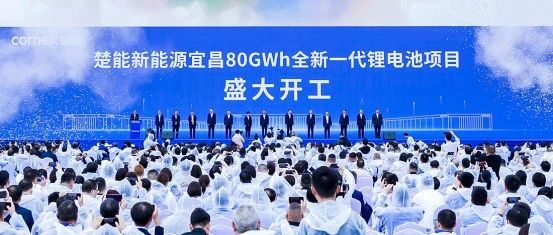
楚能新能源宜昌80GWh全新一代锂电池项目正式开工!
鑫椤锂电· 2025-09-27 01:08
Core Viewpoint - The commencement of the 80GWh lithium battery project by Chuangneng New Energy in Yichang marks a significant step in enhancing the local economy and the renewable energy sector, aiming to create a major lithium battery production base in China [1][6]. Group 1: Project Overview - The Yichang lithium battery project is the second phase of Chuangneng New Energy's industrial park, with a planned annual production capacity of 80GWh, focusing on energy storage batteries, power batteries, and Pack modules [3][8]. - The project is expected to create over 6,000 new jobs and generate an annual output value of 22 billion yuan, contributing to the optimization of the industrial structure and economic improvement in Yichang and Hubei Province [3][4]. Group 2: Leadership and Commitment - Local government leaders and Chuangneng executives emphasized the importance of the project for regional development, with commitments to support and expedite the construction process [3][6]. - Chuangneng's chairman expressed gratitude for the local government's efforts in creating a favorable business environment and highlighted the project's role in achieving the company's strategic goals [6][8]. Group 3: Future Prospects - The project is part of a broader strategy to establish Yichang as a leading hub for the lithium battery industry, with aspirations to contribute significantly to China's carbon neutrality goals and the global energy transition [8]. - The successful launch of the first phase of the project within a year showcases the efficiency of the local development model, referred to as "Yichang speed," and sets a precedent for future expansions [8].
国际锐评丨全球气候治理 中国一诺千钧
Yang Shi Xin Wen Ke Hu Duan· 2025-09-26 12:35
Group 1 - China's new round of Nationally Determined Contributions (NDCs) aims for a 7%-10% reduction in greenhouse gas emissions from peak levels by 2035, marking a significant commitment to global climate governance [1][5] - The announcement received high praise from the international community, with the BBC describing it as a "milestone commitment" and reflecting China's adherence to multilateralism and support for the United Nations [1][3] - The current global climate governance landscape is challenged by rising greenhouse gas emissions and extreme weather events, necessitating urgent international cooperation [3][4] Group 2 - The new NDCs include an absolute reduction target that covers all sectors of the economy, indicating a comprehensive approach to climate policy [5][7] - Since announcing its carbon peak and neutrality goals five years ago, China has developed the world's largest and fastest-growing renewable energy system, showcasing its commitment to a green transition [7][8] - China has mobilized over 177 billion RMB in project funding since 2016 to support other developing countries in addressing climate change, demonstrating its role as a leader in global climate action [7][8]