低波红利

Search documents
周内合计吸金近6.5亿元!红利ETF(510880)基金规模实现4连增长,最新规模创近三月新高
Xin Lang Ji Jin· 2025-09-22 08:35
Group 1 - The A-share market is experiencing increased volatility, particularly within the technology growth sector, leading to a rise in defensive demand as trading sentiment declines ahead of the upcoming holiday [1] - Since mid-August, high-dividend assets have gained attractiveness, with the Dividend ETF (510880) becoming a key focus for capital allocation [1] - The Dividend ETF (510880) has seen significant trading volume, with an average daily trading volume of 930 million yuan from September 18 to 19, doubling compared to the average daily trading volume since the beginning of the year [1] Group 2 - The Dividend ETF (510880) has reached a new high in fund size of 19.468 billion yuan, making it one of the few dividend-themed ETFs exceeding 10 billion yuan [2] - The low-volatility dividend ETF (512890) has also achieved a fund size of 20.348 billion yuan as of September 19 [2] - The anticipated interest rate cuts by the Federal Reserve are expected to benefit both A-shares and Hong Kong stocks, potentially leading to a structural market rally [2] Group 3 - The Dividend ETF (510880) has a holder count of 421,800, making it the only dividend-themed ETF with over 400,000 holders in the market [3] - The low-volatility dividend ETF (512890) and its linked funds have a combined holder count of 1.1631 million, also making it a significant player in the market [3] Group 4 - The Dividend ETF (510880) has distributed over 4 billion yuan in dividends since its inception, with a total of 42.98 billion yuan in cumulative dividends [4] - The fund has been operational for 18 years and has distributed dividends 18 times [4] Group 5 - Huatai-PB Fund, a pioneer in ETF management, has over 18 years of experience in dividend-themed index investments, managing a total of 42.444 billion yuan across its dividend-themed ETFs [5] - The "Dividend Family" includes multiple ETFs, such as the Dividend ETF (510880) and the low-volatility dividend ETF (512890) [5]
A股缩量调整成交骤降外资机构看好结构性机会
Sou Hu Cai Jing· 2025-09-19 23:18
Market Overview - A-shares experienced a contraction in trading volume, with the three major indices slightly declining and total trading volume decreasing by 811.3 billion yuan compared to the previous day [1][2] - The Shanghai Composite Index fell by 0.30% to close at 3820.09 points, while the Shenzhen Component and ChiNext Index saw minor declines of 0.04% and 0.16%, respectively [2] Policy Signals - The State Council Information Office is set to hold a press conference on September 22, 2025, to discuss the achievements of the financial industry during the 14th Five-Year Plan period, which is highly anticipated by investors for potential policy signals [1][2] Index Adjustments - The FTSE Russell index adjustments effective after the close on September 19 led to notable movements in several large-cap stocks, with stocks like BeiGene and NewEase rising, while others like China Nuclear Power and China Unicom fell [3] - The adjustments included the inclusion of stocks such as BeiGene and NewEase into the FTSE China A50 Index, reflecting international investors' structural optimism towards the Chinese market, particularly in the innovative drug and technology sectors [3] Interest Rate Cuts - The Federal Reserve's recent decision to cut interest rates by 25 basis points is expected to shift the focus from inflation control to stabilizing growth and employment, which historically has led to improved returns in domestic equity markets [4] - Analysts predict that the resumption of the Fed's rate-cutting cycle will enhance global risk appetite and improve liquidity expectations in emerging markets, benefiting both A-shares and Hong Kong stocks [4] Investment Outlook - Despite a strong performance of A-shares compared to Hong Kong stocks since late June, the market has entered a consolidation phase in September, with increased volatility [5] - Structural opportunities in technology growth, low-volatility dividends, and sectors experiencing recovery are highlighted as areas of interest, with expectations of a "policy-driven + profit improvement" support for a potential upward trend in the fourth quarter [5] - AI is anticipated to be a key market theme moving forward, with the overseas computing power industry expected to positively impact the A-share market [5]
分析人士:四季度A股市场或呈现“政策驱动+盈利改善”双向支撑下的震荡上行态势
Zhong Guo Zheng Quan Bao· 2025-09-18 23:33
Core Viewpoint - The A-share market experienced a significant pullback on September 18, with all three major indices falling over 1%, while the ChiNext index saw an intraday fluctuation of nearly 4% [1] Market Performance - The A-share market's trading volume reached 3.17 trillion yuan, marking the first time it surpassed 3 trillion yuan in 15 trading days since August 28 [1] External Influences - Analysts suggest that the Federal Reserve's potential resumption of interest rate cuts not only boosts global risk appetite but also significantly improves liquidity expectations in emerging markets [1] Investment Opportunities - The A-share and Hong Kong markets are expected to benefit from a dual advantage of improved risk appetite and foreign capital inflow [1] - Structural opportunities are identified in technology growth, low volatility dividends, and sectors experiencing a rebound in prosperity [1] Market Outlook - The fourth quarter is anticipated to show a "policy-driven + profit improvement" dual support, leading to a fluctuating upward trend in the market [1]
重要股东和董监高频出手 上市银行获增持释放积极信号
Zhong Guo Zheng Quan Bao· 2025-09-10 22:25
Group 1 - Major shareholders and executives of several banks, including Suzhou Bank, Qingdao Bank, and Nanjing Bank, have announced plans to increase their holdings in their respective banks, reflecting confidence in the future development prospects of the banks and the Chinese capital market [1][2] - Suzhou Bank's chairman and other executives plan to collectively purchase at least 4.2 million yuan worth of shares from September 8 to December 31, using their own funds [2] - Qingdao Bank's major shareholder plans to acquire between 233 million and 291 million shares, increasing their stake to between 19.00% and 19.99% within six months of the announcement [2] Group 2 - The overall performance of the banking sector has shown improvement, with a year-on-year increase in operating income and net profit of 1.0% and 0.8% respectively, indicating a recovery in the banking industry [3] - Non-interest income growth has played a significant role in supporting the improvement of bank performance [3] - Insurance capital has shown a preference for bank stocks, with over 700 stocks in the top ten circulating shareholders list, and six of the top ten heavyweights being bank stocks [4] Group 3 - The investment logic for bank stocks has shifted from a macroeconomic growth cycle to a focus on asset scarcity and stable, sustainable returns [4] - State-owned banks are viewed as core dividend assets due to their high dividends, low valuations, and defensive characteristics, while quality small and medium-sized banks can provide growth and dividend opportunities at certain stages [4]


重要股东和董监高频出手上市银行获增持释放积极信号
Zhong Guo Zheng Quan Bao· 2025-09-10 20:18
Group 1 - Recent announcements from banks such as Suzhou Bank, Qingdao Bank, and Nanjing Bank indicate that major shareholders and executives plan to increase their holdings in their respective banks, reflecting confidence in the long-term prospects of the Chinese capital market and the banks' investment value [1][2] - Suzhou Bank's chairman and other executives intend to collectively purchase at least 4.2 million yuan worth of A-shares between September 8 and December 31, funded by their own resources [1] - Qingdao Bank's major shareholder plans to acquire between 233 million and 291 million shares, increasing their stake to between 19.00% and 19.99% within six months from the announcement [1] Group 2 - Nanjing Bank's shareholder, Nanjing Gaoke, increased its stake from 8.94% to 9.00% by purchasing 7.5077 million shares between July 24 and August 4, demonstrating confidence in the bank's future development [2] - More than ten listed banks have reported similar plans for share buybacks this year, indicating a broader trend of confidence among bank executives and major shareholders regarding future growth and profitability [2] - The overall performance of the banking sector has improved, with a year-on-year increase in operating income and net profit of 1.0% and 0.8%, respectively, supported by growth in non-interest income [2] Group 3 - Insurance capital has shown a preference for bank stocks, with over 700 stocks appearing in the top ten circulating shareholders of A-share listed companies, and six of the top ten heavyweights being bank stocks [3] - The stability and quality of bank assets have attracted long-term funds, as banks provide high and stable dividend yields, making them appealing in the current "asset scarcity" environment [3] - The investment logic for bank stocks has shifted from a "growth cycle" based on macroeconomic factors to a focus on "low volatility dividends" driven by asset scarcity, with state-owned banks being core dividend assets due to their high yields and low valuations [3]

银华混改红利灵活配置混合发起式A:2025年上半年末股票仓位提升12.26个百分点
Sou Hu Cai Jing· 2025-09-05 03:35
Core Viewpoint - The AI Fund Yin Hua Mixed Reform Dividend Flexible Allocation Mixed Initiation A (005519) reported a profit of 1.1668 million yuan for the first half of 2025, with a net value growth rate of 3.88% and a fund size of 32.6497 million yuan as of the end of June 2025 [3][34]. Fund Performance - As of September 3, the unit net value was 1.168 yuan, with a near three-month net value growth rate of 0.89%, ranking 868 out of 880 comparable funds [4][7]. - The fund's six-month net value growth rate was 7.43%, ranking 771 out of 880, while the one-year growth rate was 11.99%, ranking 833 out of 880 [7]. - Over three years, the fund's net value growth rate was -26.79%, ranking 828 out of 872 [7]. Investment Strategy and Market Outlook - The fund manager indicated that the A-share market continues to exhibit a "dumbbell" pattern, with large-cap value and small-cap stocks performing well. Key sectors include defensive assets represented by banks, new consumption, innovative pharmaceutical exports, and themes like controllable nuclear fusion and autonomous driving [4]. - The report highlighted that risk assets are experiencing a volatile upward trend, with gold and equity assets showing a seesaw effect [4]. Valuation Metrics - As of June 30, 2025, the fund's weighted average price-to-earnings (P/E) ratio was approximately 9.17 times, significantly lower than the industry average of 15.75 times. The weighted price-to-book (P/B) ratio was about 0.83 times, compared to the industry average of 2.52 times [12]. - The weighted price-to-sales (P/S) ratio was approximately 1.04 times, while the industry average was 2.16 times, indicating that the fund's assets are undervalued compared to peers [12]. Growth Metrics - For the first half of 2025, the fund's weighted revenue growth rate was -0.07%, and the weighted net profit growth rate was 0.03%, with a weighted annualized return on equity of 0.09% [20]. Fund Composition and Holdings - As of June 30, 2025, the fund had a total of 1,473 holders, with a total of 27.8078 million shares held. Institutional investors accounted for 35.98% of the holdings, while individual investors made up 64.02% [37]. - The fund's top ten holdings included major banks and financial institutions such as Industrial and Commercial Bank of China, China Merchants Bank, and Ping An Insurance [42]. Trading Activity - The fund's turnover rate for the last six months was approximately 60.98%, which has been consistently below the industry average for the past year [40].


基于市场风格动量的银行股选股逻辑推演
Huafu Securities· 2025-09-02 13:07
Quantitative Models and Factor Analysis Quantitative Models and Construction - **Model Name**: Bank Stock Momentum Strategy **Model Construction Idea**: The strategy leverages the momentum of market styles to identify outperforming sub-segments within the banking sector. It assumes that the internal style rotation of bank stocks mirrors the broader market's style rotation, albeit with a lag [28][48]. **Model Construction Process**: 1. Use market-wide style momentum to determine the dominant style (e.g., growth vs. value, large-cap vs. small-cap) based on a two-month relative momentum difference exceeding 5% [48]. 2. Map the dominant market style to corresponding banking sub-segments (e.g., large-cap value, small-cap growth) [28][29]. 3. Select stocks within the identified banking sub-segment for the next month [48]. **Model Evaluation**: The model effectively captures value-style dominance in the banking sector, particularly during market-wide value-oriented phases [48]. - **Model Name**: Fundamental-Adjusted Growth Selection **Model Construction Idea**: To mitigate the downside risk of high-PB (price-to-book) stocks, the model incorporates ROE (return on equity) adjustments to prioritize high-quality fundamentals when selecting growth-oriented bank stocks [58]. **Model Construction Process**: 1. Combine PB and ROE_TTM (trailing twelve months) values into an equal-weighted scoring system [58]. 2. When the signal indicates a growth-oriented market, select stocks with high PB and strong fundamentals [58]. **Model Evaluation**: This adjustment improves annualized returns by 1.82% compared to using PB alone, demonstrating its effectiveness in balancing growth potential and risk [58]. Model Backtesting Results - **Bank Stock Momentum Strategy**: - Annualized Return: 14.45% - Annualized Volatility: 22.62% - Sharpe Ratio: 0.64 - Maximum Drawdown: 33.08% - Excess Annualized Return (vs. CSI Bank Index): 5.65% - Information Ratio (IR): 0.57 [48][49][54] - **Fundamental-Adjusted Growth Selection**: - Annualized Return: 16.27% - Excess Annualized Return (vs. CSI All Share Index): 13.20% - Excess Annualized Return (vs. CSI Bank Index): 7.33% [58] --- Quantitative Factors and Construction - **Factor Name**: Price-to-Book Ratio (PB) **Factor Construction Idea**: Low PB stocks are expected to outperform due to their value-oriented characteristics [32]. **Factor Construction Process**: 1. Divide bank stocks into quintiles based on PB values. 2. Track the performance of the lowest PB quintile over time [32]. **Factor Evaluation**: The low PB group consistently outperformed the CSI All Share Index, particularly during value-dominant market phases [32]. - **Factor Name**: Dividend Yield **Factor Construction Idea**: High dividend yield stocks are expected to provide stable returns, especially in defensive market conditions [32]. **Factor Construction Process**: 1. Divide bank stocks into quintiles based on dividend yield. 2. Track the performance of the highest dividend yield quintile over time [32]. **Factor Evaluation**: While generally effective, the factor underperformed low PB stocks in certain years, indicating weaker pricing power [32]. - **Factor Name**: Market Capitalization **Factor Construction Idea**: Large-cap stocks are expected to outperform during periods of market uncertainty due to their defensive nature [39]. **Factor Construction Process**: 1. Divide bank stocks into quintiles based on market capitalization. 2. Track the performance of the largest market-cap quintile over time [39]. **Factor Evaluation**: Large-cap stocks demonstrated strong performance, particularly after 2023, with a clear upward trend [39]. - **Factor Name**: Return on Equity (ROE) **Factor Construction Idea**: High ROE stocks are expected to outperform due to their superior profitability [39]. **Factor Construction Process**: 1. Divide bank stocks into quintiles based on ROE. 2. Track the performance of the highest ROE quintile over time [39]. **Factor Evaluation**: High ROE stocks outperformed in most years but showed limitations in certain market environments, such as 2014 [39]. Factor Backtesting Results - **PB Factor**: - Outperformed the CSI All Share Index across the entire observation period [32]. - **Dividend Yield Factor**: - Generally outperformed the benchmark but lagged behind the PB factor in specific years [32]. - **Market Capitalization Factor**: - Demonstrated a strong upward trend post-2023, consistently outperforming the benchmark [39]. - **ROE Factor**: - Achieved superior performance in years like 2012, 2017, and 2019, but underperformed in 2014 [39]. --- Composite Factor Analysis - **Composite Model**: Four-Quadrant Style Model **Construction Idea**: Combine market capitalization and PB factors to create four distinct style groups: large-cap value, large-cap growth, small-cap value, and small-cap growth [43]. **Construction Process**: 1. Divide stocks into large-cap and small-cap groups based on the top 20% and bottom 80% of market capitalization. 2. Further divide each group into high-PB and low-PB subgroups. 3. Analyze the performance of the resulting four style groups [43]. **Evaluation**: The model revealed clear style rotations within the banking sector, with small-cap value dominating in 2014-2015 and large-cap value leading post-2022 [43]. Composite Model Backtesting Results - **Four-Quadrant Style Model**: - Small-Cap Value: Outperformed during 2014-2015 - Large-Cap Value: Consistently outperformed post-2022 [43]
光大保德信基金市场快评:回调不改积极向好主基调 看好科技成长等高弹性及低波红利方向
Xin Lang Ji Jin· 2025-08-14 09:13
Group 1 - The main reason for today's market adjustment is the quick breakthrough of last year's high point in early October, leading to short-term profit-taking demands [1][2] - The adjustment does not change the overall positive trend, and it may provide valuation advantages for some quality stocks, highlighting their long-term investment value [1][2] - The current friendly funding and sentiment are likely to continue along the existing trend, with potential shifts in wealth from real estate and fixed income to equity markets [2] Group 2 - The military and communication sectors, which have seen the largest gains in August, experienced significant declines today, while the large financial sector showed resilience [2] - The formation of a MACD golden cross signal indicates a positive trend for certain stocks [3]
农银国企改革混合:2025年第二季度利润395.92万元 净值增长率5.01%
Sou Hu Cai Jing· 2025-07-18 11:00
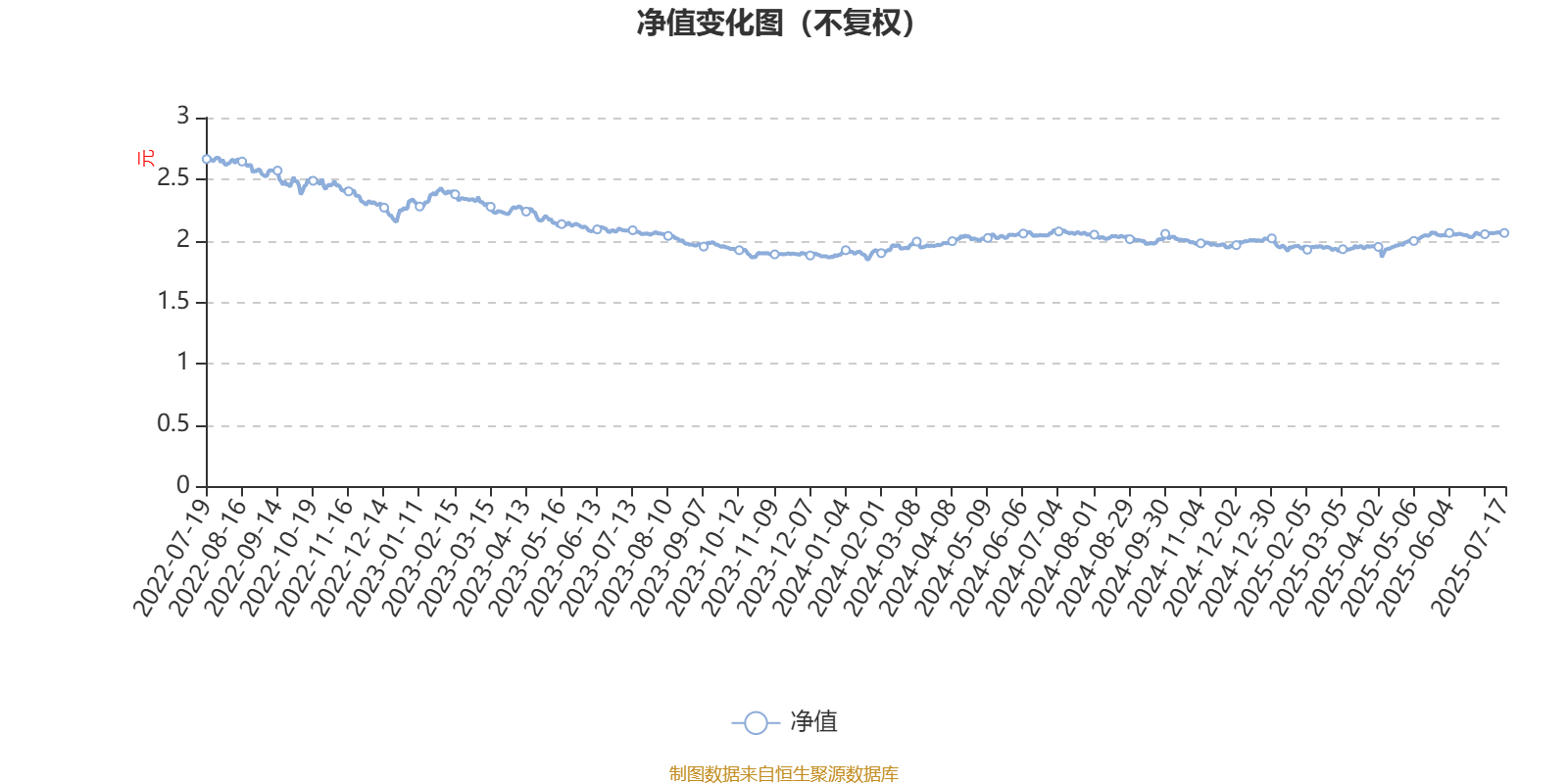
Core Viewpoint - The AI Fund Agricultural Bank State-Owned Enterprise Reform Mixed Fund (002189) reported a profit of 3.9592 million yuan for Q2 2025, with a weighted average profit per fund share of 0.098 yuan, and a net value growth rate of 5.01% during the period [2]. Fund Performance - As of July 17, the fund's unit net value was 2.062 yuan, with a fund size of 82.584 million yuan as of the end of Q2 2025 [2][15]. - The fund's performance over different time frames includes a 5.18% growth rate over the last three months, 5.48% over the last six months, 0.60% over the last year, and a -21.43% decline over the last three years [3]. Fund Management Strategy - The fund manager, Zhang Feng, maintained a neutral to low position in Q2, increasing the position to a neutral level by the end of the quarter. The overall portfolio was conservatively defensive, but new core asset selections performed well, contributing significantly to the portfolio's outperformance against the market [2]. - The fund will continue to focus on low-volatility dividend-related sectors and seek new core asset opportunities, with significant allocations in public utilities, telecommunications, banking, non-banking financials, transportation, and new consumption sectors [2]. Risk Metrics - The fund's Sharpe ratio over the last three years was -0.8684, ranking 867 out of 874 comparable funds [8]. - The maximum drawdown over the last three years was 31.2%, with the largest single-quarter drawdown occurring in Q1 2022 at 22.33% [10]. Portfolio Composition - As of June 30, the fund's average stock position over the last three years was 69.58%, compared to a peer average of 80.33%. The fund reached a peak stock position of 92.11% in Q3 2021 and a low of 42.92% in Q3 2024 [13]. - The top ten holdings of the fund as of Q2 2025 included Changjiang Electric Power, China Mobile, Chuan Investment Energy, Guotou Electric Power, SF Express, Gree Electric Appliances, Huace Navigation, GF Securities, Daqin Railway, and Bank of China [18].
奉旨吹牛 | 华泰柏瑞创新升级A前三年份额缩七成!吴邦栋干两年亏20%!
Sou Hu Cai Jing· 2025-07-09 22:25
Core Viewpoint - The article discusses the performance and management of the Huatai-PB Innovation Upgrade A fund (000566), highlighting its long-term growth but recent underperformance compared to peers. Fund Performance - The fund has achieved a total return of 247.81% since its inception over 11 years ago, with a current net value of 3.41 yuan [2][12]. - In the past year, the fund's performance has been modest, with a gain of 1.06%, while the average for similar funds was 6.12%, ranking it 1691 out of 2301 [12]. - Over the last three years, the fund has declined by 27.94%, compared to an average decline of 8.52% among peers, ranking it 1686 out of 2041 [12]. - The fund's performance over the last two years shows a decline of 18.55%, while peers gained 1.09%, ranking it 1933 out of 2152 [12]. - In the last six months, the fund gained 3.05%, while the average for similar funds was 8.27%, ranking it 1537 out of 2305 [12]. Fund Management - Fund manager Wu Bangdong took over management on June 9, 2023, and has recorded a return of -20.01% during his tenure [3]. - Wu has 7.5 years of experience primarily in equity products, managing a total of 1.38 billion yuan with an annualized return of 2.58% [3]. Market Analysis - Wu's analysis indicates that the A-share market may experience short-term volatility due to tariff uncertainties, but the long-term outlook remains positive due to domestic factors and policy reserves [4]. - The current domestic environment is seen as a source of confidence, with a focus on internal demand and technological breakthroughs [5]. Fund Size and Holdings - The fund's total shares have decreased significantly over the past two to three years, dropping from 6.38 billion shares in Q2 2022 to 1.72 billion shares in Q1 2025, a reduction of over 73% [12][13]. - The fund's holdings are diversified, with major stocks including Ningde Times, Yutong Bus, and BYD, indicating a cautious investment strategy [13].