新兴需求

Search documents
周期反转与新兴需求共振,化工板块直线拉升!
Sou Hu Cai Jing· 2026-02-06 03:08
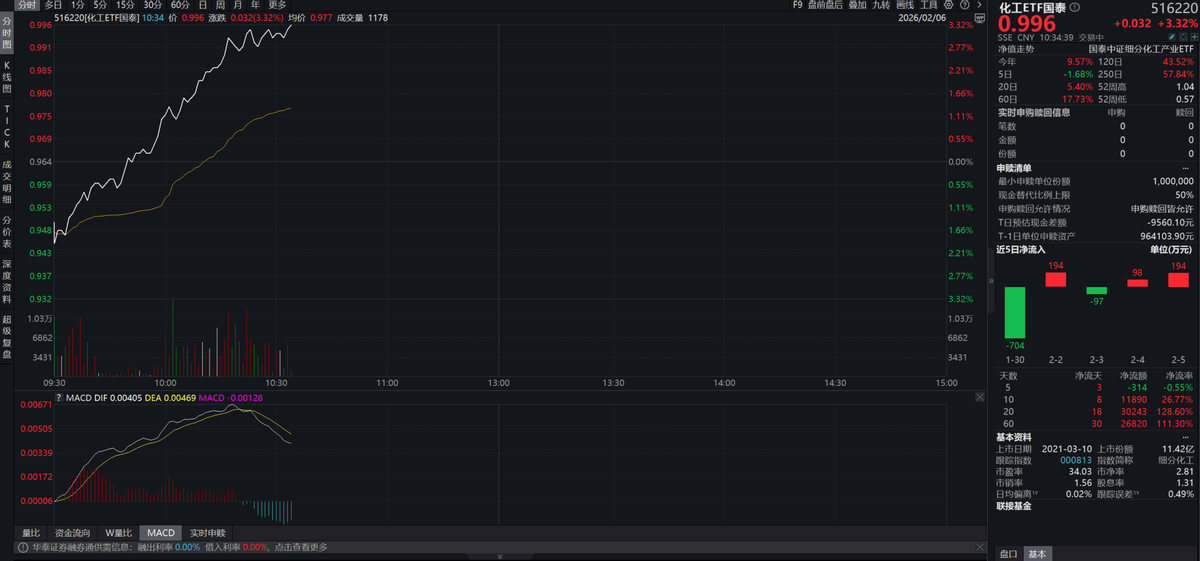
Core Viewpoint - The chemical industry is at the bottom of a long-term down cycle, with signs of a potential turning point as supply-demand dynamics improve and capital expenditure contracts [3][5]. Group 1: Industry Positioning - Multiple macro and industry indicators suggest that the chemical industry is in the bottom region of a long-term down cycle, with positive changes in supply-demand dynamics accumulating to lay the groundwork for a turning point [3]. - The price index for the chemical raw materials and chemical products manufacturing industry shows a narrowing year-on-year decline in PPI, indicating a preliminary improvement in product price pressures [3]. - The continuous decline in finished goods inventory indicates that after a prolonged period of active destocking, inventory levels have reached a low point, allowing for potential replenishment [3]. Group 2: Supply Changes - The contraction in capital expenditure is significant, with fixed asset investment growth in the domestic chemical raw materials and chemical products manufacturing industry turning negative, signaling the end of large-scale capacity expansion [5]. - The structural clearing of supply, driven by both domestic and international factors, is a key difference in this cycle compared to previous ones [9]. - Domestic policies aimed at "anti-involution" are leading to the elimination of outdated capacity, while industry leaders are optimizing competition to avoid price wars and promote profit recovery [9]. Group 3: Demand Drivers - The demand side is characterized by a dual engine of traditional recovery and emerging growth, with marginal recovery in traditional downstream sectors and strong demand from new industries like semiconductors and renewable energy [10]. - Traditional demand is expected to improve marginally, supported by policies driving demand in sectors like automotive and home appliances, despite long-term pressures in real estate [10]. - Emerging demand from sectors such as semiconductors and new energy is becoming a strong growth engine, contributing to a more diversified and healthy demand structure in the chemical industry [13]. Group 4: Investment Mapping - Investment strategies should focus on two main lines: benefiting from supply-side reforms and stable profitability in cyclical leaders, and identifying chemical new material companies with technological barriers and growth potential in emerging demand sectors [14][15]. - The chemical ETF Guotai (516220) offers an efficient tool for investors looking to capture the overall recovery trend in the chemical industry while mitigating risks associated with specific sectors and stocks [15].

国联民生:百年浮沉,商品距离“大牛市”还缺什么?
Xin Lang Cai Jing· 2026-02-01 08:46
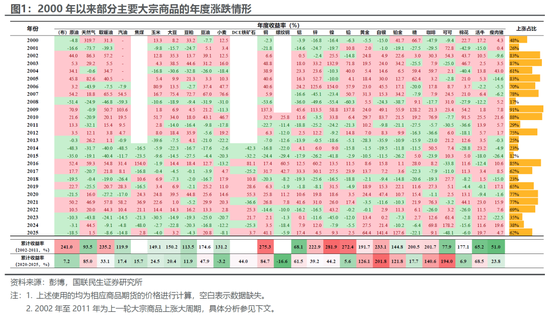
Group 1 - The current commodity price cycle, particularly for precious metals like gold and silver, is facing challenges, and the narrative surrounding the commodity price increase may still have room to develop [1][33] - The recent commodity price increase lacks breadth compared to the previous cycle from 2002 to 2011, where over 60% of major commodities experienced price increases, while the current cycle shows limited upward movement [1][33] - The report suggests that the current commodity price cycle may still be in its early stages, and further time may reveal greater upward potential [1][33] Group 2 - Since 1850, commodities have experienced five distinct upward cycles, with an average duration of approximately 12 years and an average price increase of 79% when adjusted for inflation [3][34] - The last two cycles have seen precious metals outperform, while the earlier cycles were characterized by stronger performances from energy, industrial metals, and agricultural products [5][36] - The report emphasizes the importance of analyzing the structural factors that drive these commodity cycles, including technological advancements and geopolitical tensions [6][18] Group 3 - Energy and industrial metals are considered the most stable and classic commodities, often driven by technological and industrial revolutions, as well as geopolitical conflicts [6][37] - Agricultural products have shown weaker long-term performance compared to other asset classes, often lagging behind inflation, but can excel during periods of significant supply shocks [9][41] - Gold and silver have not always been the primary focus in commodity cycles, with their significant price increases occurring mainly in the last two cycles due to the decoupling of currencies from gold standards [14][43] Group 4 - The report identifies three long-term perspectives that influence commodity cycles: war, technology, and emerging demand, highlighting that conflicts can disrupt supply chains and affect demand differently [18][19] - Technological cycles are noted to have a longer duration and can significantly impact commodity prices during their explosive and transitional phases [22][24] - Emerging demand often coincides with periods of war or technological transformation, driving commodity price increases [27][30]

资产配置系列报告:百年浮沉,商品距离“大牛市”还缺什么?
Guolian Minsheng Securities· 2026-01-30 05:08
Group 1 - The report focuses on the long-term cyclical analysis of commodities, identifying five major commodity upcycles since 1850, with an average duration of 11.8 years and an average price increase of 125% [6][12][15] - The analysis highlights that energy and metals are classic cyclical commodities, while agricultural products tend to underperform, and precious metals gained prominence only after the abandonment of the gold standard by major economies [6][12][18] - The report identifies three structural factors influencing commodity cycles: wars, technological revolutions, and emerging demand, emphasizing that not all wars positively impact commodity prices and that technological breakthroughs often coincide with commodity bull markets [6][12][42] Group 2 - The report notes that the current commodity cycle began in 2020, coinciding with a recession and a low point in commodity prices, and suggests that the ongoing technological revolution, particularly in AI, may be in its early stages [6][12][42] - It emphasizes that the current cycle lacks significant geopolitical tensions or unexpected surges in emerging demand, which are critical for sustaining commodity price increases [6][12][42] - The report also points out that the depreciation of the US dollar is a favorable factor for the current commodity cycle, while an economic recession could serve as a critical test for the cycle's strength [6][12][42] Group 3 - The report provides a detailed examination of the performance of various commodity categories during past cycles, indicating that energy and industrial metals have consistently performed well, while agricultural products have shown weaker long-term performance [18][24][31] - It discusses the historical context of agricultural products, noting that their prices have generally trended downward due to increasing agricultural efficiency, although they can perform well during significant supply shocks, such as during wartime [24][30] - The report highlights that gold and silver have not always been dominant in commodity cycles, with their significant price increases occurring primarily in the last two cycles, influenced by the decoupling of currencies from gold [31][35]
沪铝价格站上2.5万元/吨,沪金沪银双创历史新高,有色金属ETF(512400)拉涨超2%,流动性宽松与新兴需求双支撑有色金属板块价值
Xin Lang Cai Jing· 2026-01-14 02:36
Core Viewpoint - The article highlights the significant price increases in non-ferrous metals, particularly aluminum and precious metals, driven by global liquidity conditions, technological advancements, and geopolitical factors. Group 1: Non-Ferrous Metals - The non-ferrous metals ETF (512400) experienced a rise of over 2% at one point, currently up 1.87%, marking a four-day consecutive increase with a turnover of 1.7% and a transaction volume of 5.04 billion yuan [1] - The domestic aluminum price reached a historic breakthrough, with the main contract price on the Shanghai Futures Exchange surpassing 25,000 yuan per ton, setting a new record [1] - The prices of copper have also been on the rise, with copper futures exceeding 100,000 yuan per ton, indicating strong performance in the non-ferrous metals sector [1] Group 2: Precious Metals - As of January 13, the main silver contract on the Shanghai Futures Exchange rose by 5.9% to 21,004 yuan per kilogram, while the main gold contract increased by 1.01% to 1,027.18 yuan per gram, both reaching historical highs [1] - The environment of global liquidity easing is supporting the prices of precious metals, with factors such as inflation and high debt levels contributing to a bullish outlook for gold prices [2] Group 3: Market Dynamics - West Securities indicates that the rapid development of artificial intelligence and high-end manufacturing is expected to accelerate the demand for non-ferrous metals [1][2] - Geopolitical tensions are leading major countries to elevate the strategic importance of key minerals, which may result in a revaluation of commodity prices [2] - The non-ferrous metals index, which the ETF closely tracks, includes 50 listed companies from the non-ferrous metals and non-metallic materials sectors, reflecting the overall performance of the industry [2]
大宗商品市场品类走势泾渭分明
Jing Ji Ri Bao· 2026-01-11 21:46
Group 1: Market Overview - The global commodity market in 2025 exhibited a stark divergence, with precious metals experiencing a significant bull market while oil and black commodities faced oversupply issues [1] - Precious metals, particularly gold and silver, saw remarkable price increases, with gold rising over 60% and silver soaring 102% [2] - The agricultural market showed mixed results, with oilseeds benefiting from biofuel policies while grains remained subdued due to ample supply [1] Group 2: Precious Metals - Gold and silver emerged as the strongest sectors, driven by "de-dollarization" and interest rate cuts, leading to a substantial increase in gold purchases by central banks [2] - Central banks net purchased 634 tons of gold in the first three quarters of 2025, significantly above pre-2022 averages [2] - The global gold ETF holdings increased by over 700 tons, reaching a total of 3932 tons, marking a record annual growth [2] Group 3: Base Metals - Copper and aluminum prices strengthened due to a balanced supply-demand dynamic, with copper prices reaching a historical high of 13,387.5 USD/ton [3] - A projected cumulative copper mine deficit of 3.13 million tons from 2026 to 2029 is anticipated due to supply instability [3] - Demand for copper related to green transition initiatives is significant, with investments in electric grids and data centers driving consumption [3] Group 4: Oil and Black Commodities - The oil market is characterized by a significant oversupply, with a daily surplus of 1.795 million barrels expected in 2025 [4] - The black commodities sector, particularly steel, is struggling, with steel mill profitability dropping from 68.4% to 36.4% [4] - Diesel markets are experiencing strength due to reduced Russian exports, despite overall oil market challenges [4] Group 5: Agricultural Products - Oilseeds are performing well, driven by increased biofuel blending ratios in Indonesia and Brazil, leading to an 8% growth in industrial consumption [4] - Other agricultural products, such as corn and soybeans, are expected to see price declines due to favorable supply conditions [4] Group 6: Future Outlook - The commodity market is expected to continue its divergent trends into 2026, influenced by a "weak recovery and loose monetary policy" macroeconomic backdrop [6] - Strategic security, green transition, and emerging demand are identified as key structural opportunities for investment in 2026 [6] - Precious metals and core base metals are projected to maintain strong support, while the oil market is expected to remain under pressure [6][7]
长江有色:地缘溢价仍存AI新兴领域需求爆发 22日锡价或上涨
Xin Lang Cai Jing· 2025-12-22 02:50
Core Viewpoint - The current tin market is experiencing a complex interplay of long-term structural shortages and short-term industrial realities, leading to a high price environment and significant market fluctuations [2] Group 1: Market Performance - The U.S. stock indices have risen, indicating a recovery in market risk appetite, while London tin prices increased by 0.13% to $42,975 per ton [1] - The Shanghai tin futures market opened higher, with the main contract 2601 reporting a rise of 1,260 yuan per ton, reflecting a 0.37% increase [1] Group 2: Supply and Demand Dynamics - The tin market is characterized by a long-term structural shortage due to declining resource grades and lengthy new capacity cycles, exacerbated by frequent disruptions in major producing countries [2][3] - Demand is shifting from traditional consumption, which is constrained by high prices, to emerging sectors like AI and renewable energy, which are driving up the premium for tin as a "high-tech metal" [2] Group 3: Industry Chain Status - The global tin industry chain is undergoing a profound reshaping, with upstream miners gaining significant bargaining power due to resource scarcity, while midstream smelting faces pressure from high raw material costs and low processing fees [3] - Downstream demand is diverging, with traditional sectors seeking material substitutes and process optimizations, while high-end manufacturing fields maintain strong demand for high-performance materials [3] Group 4: Price Outlook - Short-term tin prices are expected to oscillate between 325,000 and 340,000 yuan per ton, influenced by the interplay of strong expectations and weak realities [4] - In the medium to long term, the scarcity of resources and the ongoing demand from AI and green energy sectors are expected to support a systematic upward shift in price levels [4]

建材行业2026年度投资策略:向内看“反内卷”显效,向外拓“新市场”机遇
CMS· 2025-12-16 09:04
Group 1 - The report highlights that the building materials industry has shown a strong performance since 2025, particularly in fiberglass, cement, and refractory materials, benefiting from significant price increases and improved supply-demand dynamics [1][12][14] - The consensus on "anti-involution" among companies has led to supply reductions or maintenance, while structural demand growth is observed in specific segments such as specialty electronic fabrics in fiberglass and overseas market expansion in cement [1][12] - The report anticipates that the building materials industry will continue to present structural opportunities in 2026, with specific focus on segments like float glass, tiles, pipes, and sanitary ware, which are still in the process of bottoming out [1][12] Group 2 - The report indicates that the cement industry is expected to see a profit recovery in 2025, with the profit turning point occurring before revenue, driven by capacity management and a decrease in coal prices [5][6][12] - The overseas market for cement is highlighted as a key growth area, with significant projects expected to contribute to earnings in 2026, such as Huaxin Cement's project in Malawi and West Cement's project in Uganda [5][6][12] - The fiberglass sector is projected to experience significant profit recovery, with multiple rounds of price increases and expanding demand from downstream applications, particularly in wind energy and electric vehicles [5][6][12] Group 3 - The report notes that the float glass sector continues to face challenges, with high inventory levels and weak demand leading to price pressures, while the industry is expected to undergo a reshuffling due to cost differentiation [6][12][25] - The report emphasizes the importance of focusing on leading companies in the building materials sector that possess strong brand competitiveness, scale advantages, and well-established distribution channels to capture dual benefits of market share growth and profit improvement [6][12][25] - Investment recommendations include focusing on leading companies in various segments such as waterproof materials, coatings, pipes, and tiles, as well as cement companies with strong cash flow and dividend commitments [6][12][25]




185亿资金追捧有色金属,有指数年内狂飙80%
2 1 Shi Ji Jing Ji Bao Dao· 2025-12-06 16:02
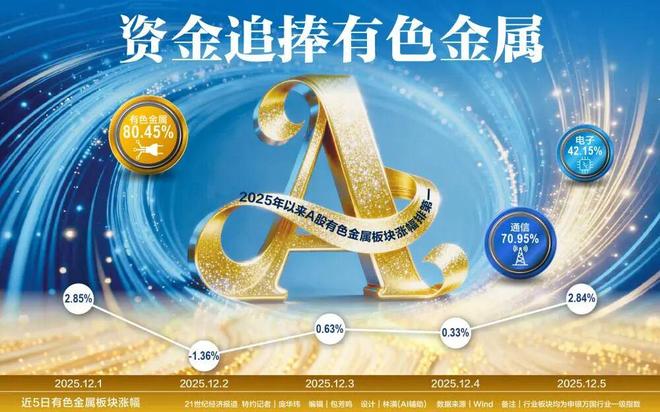
Core Viewpoint - The non-ferrous metals sector has experienced an impressive 80% increase in the Shenwan first-level industry index this year, leading all sectors in the A-share market, with a notable 5.35% rise in the first week of December [1][6]. Fund Flows and Market Dynamics - Eight thematic ETFs, including the Southern Nonferrous Metals ETF, have attracted a total of 18.5 billion yuan in investments this year, indicating strong market interest [1][6]. - The copper index has surged over 103%, reflecting a significant value reassessment driven by multiple certainties [6]. - Recent data shows a net inflow of 3.94 million yuan into the non-ferrous metals sector, with notable interest in rare earths, tungsten, and copper [7]. Sector Differentiation - The non-ferrous metals market is witnessing a divergence, with copper being the primary focus due to its essential role in new energy and AI data center construction [7][8]. - Precious metals like gold and silver are benefiting from global central bank purchases and expectations of interest rate cuts, maintaining strong independent performance [7]. - Aluminum is also gaining recognition due to supply-side constraints and demand trends towards lightweight materials [7]. Long-term Outlook - Analysts predict that the combination of emerging demands from AI, electricity, and new energy sectors, along with long-term supply constraints, will lead to better performance for basic metals like copper, aluminum, and tin by 2026 [8][10]. - The anticipated global shortage of refined copper is projected to be 270,000 tons in 2025, increasing to 580,000 tons by 2027, indicating a supply-demand imbalance [10]. Investment Sentiment - Institutional investors remain bullish on non-ferrous metals, with predictions for copper prices to range between $10,000 and $12,000 per ton by 2026 [11]. - The overall sentiment in the non-ferrous metals sector is supported by strong fundamentals and a bullish market atmosphere, suggesting potential for cross-year trends [11]. - Caution is advised regarding investment timing, as the current high market interest may lead to overvaluation risks [11].
黄金白银铜连番上涨,底层逻辑与未来前景如何?|资本市场
清华金融评论· 2025-09-30 09:41
Group 1: Gold Market Analysis - The current market is characterized by a "golden age of chaos" and an "industrial revolution," with gold remaining the core choice for de-dollarization and risk aversion [2][13] - As of September 29, 2025, gold prices reached historical highs, with London gold at $3827.37 per ounce and New York gold at $3856.38 per ounce, driven by increased demand for safe-haven assets, shifts in monetary policy, and changes in supply-demand dynamics [3][5] - The significant rise in gold prices, over 42% year-to-date, is attributed to heightened market risk aversion, expectations of Federal Reserve rate cuts, and geopolitical tensions [5][6] Group 2: Silver Market Analysis - Silver prices have surged, with London silver nearing $44 per ounce, marking a 40% increase year-to-date, driven by a recovery in the gold-silver ratio and strong industrial demand [8][9] - The dual nature of silver as both an industrial and financial asset has contributed to its price increase, particularly in sectors like photovoltaics and renewable energy [8][9] - The silver market is smaller than gold, making it more susceptible to speculative trading, which can lead to significant price volatility [10] Group 3: Copper Market Analysis - Copper prices have recently surpassed $10,000 per ton, with a nearly 20% increase this year, influenced by an expanding supply gap and surging demand from emerging sectors [12][13] - The supply gap is expected to reach 53,000 tons in 2025 and 87,000 tons in 2026, exacerbated by mining disruptions and limited production growth [12] - The structural bull market for copper is driven by long-term demand from green technologies and AI, while supply growth remains constrained [12]

龙磁科技:拟2.1亿元投建越南龙磁二期工程 加速永磁铁氧体原料本地化供应
Zhong Zheng Wang· 2025-09-16 09:33
Core Viewpoint - Longi Technology plans to invest approximately 210 million yuan in its wholly-owned subsidiary in Vietnam to enhance its permanent magnet production capacity, which is expected to positively impact the company's long-term development and operational performance [1][2]. Group 1: Investment and Capacity Expansion - The investment will fund the construction of a second phase project that adds 10,000 tons of permanent magnet ferrite wet-pressed magnetic tile capacity and 25,000 tons of pre-burned material capacity [1]. - This move aims to localize the supply of raw materials for permanent magnet ferrite, thereby extending the company's industrial chain upstream [1]. Group 2: Market Position and Product Application - Magnetic materials are crucial functional materials with extensive applications in various sectors, including automotive, home appliances, consumer electronics, 5G communications, photovoltaic inverters, and charging piles [2]. - Longi Technology focuses on the mid-to-high-end market, with over 70% of its products used in the automotive sector [2]. Group 3: Global Manufacturing and Supply Chain - The company has established production bases in Anhui, Vietnam, and Thailand, supported by a global sales network, which enhances its manufacturing capabilities and cost advantages [2]. - The rapid expansion of scale, continuous technological advancements, and stable high-quality orders contribute to maintaining a high gross margin, while the global layout mitigates geopolitical risks [2]. Group 4: Vertical Integration and Market Diversification - Longi Technology has achieved vertical integration from "magnetic powder to magnetic core to inductor," creating technical barriers at the material level and ensuring lean production processes [2]. - The product range covers various applications, including new energy vehicles, variable frequency appliances, photovoltaic energy storage, and AI servers, effectively diversifying market risks [2].