保交楼

Search documents
四大证券报头版头条内容精华摘要_2025年12月23日_财经新闻
Xin Lang Cai Jing· 2025-12-23 00:38
Group 1 - The Shanghai Futures Exchange announced adjustments to trading limits for silver futures contracts, effective from December 24, allowing a maximum of 10,000 contracts for certain participants [2][6][24] - Vanke's bond repayment grace period has been extended from 5 working days to 30 trading days, following the results of a bondholders' meeting [7][25] - The North Exchange's listed company Wuxin Tunnel Equipment has received regulatory approval for a significant asset restructuring, marking a new development phase for the company [3][20] Group 2 - The Loan Prime Rate (LPR) has remained unchanged for seven consecutive months, with the 1-year LPR at 3.0% and the 5-year LPR at 3.5%, indicating stable monetary policy [5][22][23] - Guangdong Province has established a strategic emerging industry investment fund with a registered capital of 50 billion RMB, focusing on private equity investments and asset management [10][28] - The ETF market has seen record growth in 2025, with 351 new products issued and a total issuance of 2,554.55 billion units, reflecting a significant evolution in the investment ecosystem [15][34] Group 3 - The real estate sector is actively working to ensure the delivery of sold but undelivered housing units, with over 7.5 million units reported to have been delivered as of October [13][31][32] - The public fund industry is transitioning from a focus on scale to a focus on quality, with total assets reaching 37 trillion RMB and various reforms enhancing investor experience [14][33] - The client equity of futures companies has surpassed 2 trillion RMB, with a growth rate exceeding 30% compared to the end of 2024, particularly among insurance institutions [17][35] Group 4 - The company Tianpu shares will resume trading after a successful takeover bid, with the acquirer controlling 68.29% of the shares, ensuring compliance with listing requirements [11][29] - The company *ST Dongtong is facing delisting, with the last trading day expected to be January 21, 2026, as announced by the Shenzhen Stock Exchange [12][30] - The market is witnessing a "shell protection" battle as companies strive to improve their financial structures to avoid delisting risks [8][26]
攻坚克难 房地产行业全力推进保交楼
Zheng Quan Ri Bao· 2025-12-22 16:24
Core Viewpoint - The real estate industry is accelerating the delivery of key projects to ensure housing delivery, which is crucial for protecting buyers' rights and stabilizing the market [1][2]. Group 1: Current Progress and Challenges - As of October 2023, over 7.5 million sold but undelivered housing units have been delivered nationwide, reflecting significant progress in the housing delivery initiative [1]. - Since the second half of 2021, many real estate companies faced financial pressures leading to project suspensions and delivery delays, impacting buyer confidence [2]. - By the end of 2021, approximately 24 monitored cities had unresolved projects totaling about 24.68 million square meters, representing around 10% of the total residential sales area for that year [2]. Group 2: Policy and Financial Support - The "protect housing delivery" policy was first included in a central political meeting in July 2022, establishing a framework for ongoing support [2]. - In 2022, the central bank introduced a special loan of 350 billion yuan for housing delivery, which has been pivotal in stabilizing project operations [6]. - The "white list" project loan mechanism has been implemented, with over 7 trillion yuan approved for loans, ensuring the construction and delivery of housing projects [6]. Group 3: Company-Specific Developments - Major companies like Country Garden and Sunac China have made significant progress, with Country Garden delivering over 1.8 million units since 2022 and Sunac China delivering approximately 668,000 units from 2022 to 2024 [4]. - The Bo Yu Yuan project by the Ocean Group achieved early delivery in September 2023, completing over 1,700 units ahead of schedule [3]. Group 4: Addressing Difficult Projects - Approximately 80% to 90% of sold housing has been delivered, with remaining projects facing complex issues such as tangled debt relationships and ownership disputes [8]. - In lower-tier cities, projects face longer recovery cycles and mismatched risk-return profiles, complicating the introduction of new funds [8]. Group 5: Future Directions and Industry Transformation - After completing housing delivery tasks, companies are shifting focus to long-term development, including restarting undeveloped projects and attracting new investments [9]. - The industry is moving towards a more secure and sustainable development model, with new policies like "delivery upon certification" being established [9].
4.5亿元资金如何盘活百亿元级“沉睡”资产?
Zheng Quan Ri Bao· 2025-12-20 00:04
Core Viewpoint - The revival of the "Hongkou Yuan·717" real estate project in Shanghai's Hongkou District is a significant example of how financial asset management companies (AMCs) can effectively address real estate risks and support urban development through innovative financial solutions [2][4][22]. Group 1: Project Background and Challenges - The project, originally named "Die Lian Hua," faced a halt in construction due to the developer's financial difficulties, leading to a significant urban development setback [2][3]. - The project was heavily reliant on a syndicate loan, with total debts exceeding 10 billion yuan, including over 8.2 billion yuan in guaranteed debts, which created a severe funding crisis for the developer [4][5][17]. - The project's location is strategically important, situated in a high-demand area with limited residential supply, making its revival crucial for meeting community needs and enhancing urban infrastructure [3][15]. Group 2: Government and Policy Support - The Chinese government has implemented policies aimed at stabilizing the real estate market, including the "保交楼" (ensure delivery of homes) initiative, which has provided a framework for addressing the challenges faced by real estate companies [4][16]. - Local government support was pivotal, with the establishment of a special task force to manage the risk associated with the project, highlighting the importance of coordinated efforts between various stakeholders [4][18]. Group 3: Financial Solutions and Innovations - China Orient Asset Management Co., Ltd. provided 450 million yuan in "common benefit debt" to facilitate the project's revival, marking a novel approach in the pre-restructuring phase [6][19]. - The introduction of common benefit debt allows for the preservation of both creditor and debtor interests, ensuring the continuation of operations and maximizing asset value [20][21]. - The project utilized a unique "pre-restructuring + restructuring + trust" model, which effectively balanced the interests of all parties involved and has been recognized as a significant case in the field of asset management [22][26]. Group 4: Future Implications and Industry Trends - The successful revival of the project serves as a model for future real estate recovery efforts, emphasizing the need for innovative financial strategies and collaboration among stakeholders [25][26]. - The industry is expected to see a shift towards more precise and market-driven approaches to debt resolution, with AMCs playing a crucial role in facilitating the recovery of distressed assets [23][24].
4.5亿元资金如何盘活百亿元级“沉睡”资产?——中国东方资产管理股份有限公司为房企纾困样本调查
Zheng Quan Ri Bao· 2025-12-19 16:17
Core Insights - The "Hongkou Yuan·717" real estate project in Shanghai is undergoing construction after being dormant for three years due to financial issues faced by the developer, Shanghai Jubao Real Estate Development Co., Ltd. [1][2] - China Orient Asset Management Co., Ltd. has played a crucial role in revitalizing the project by providing 450 million yuan in common benefit debt, which has helped unlock assets worth over 10 billion yuan [1][6] - The project is part of a broader effort to stabilize the real estate market in China, as highlighted in recent government meetings [1][10] Financial Context - The project was initially halted due to a debt crisis at Xiangsheng Real Estate Group, leading to a total debt exceeding 10 billion yuan, with over 8.2 billion yuan in bank guarantees [2][3] - The Shanghai government has been actively involved in addressing the financial crisis, forming a special task force to manage the risk associated with the project [3][4] Policy and Regulatory Framework - The Chinese government has introduced several policies aimed at supporting the real estate market, including the "16 Financial Measures" to ensure stable development [3][10] - The project has benefited from a pre-restructuring process that allows for asset reorganization outside of court, which has been supported by local government and judicial authorities [5][9] Innovative Financial Solutions - China Orient's approach of providing common benefit debt during the pre-restructuring phase is a pioneering move that has expedited the project's revival [6][7] - The project has implemented a trust structure to protect the interests of creditors and ensure the safety of investments, allowing for a more secure financial environment [8][9] Market Implications - The successful revitalization of the project serves as a model for future real estate recovery efforts, demonstrating the potential for market-driven solutions to address financial distress in the sector [12][13] - The case highlights the importance of collaboration among stakeholders, including developers, creditors, and government entities, to achieve successful outcomes in troubled real estate projects [12]
烂尾楼业主获房票,新模式来了?
Xin Lang Cai Jing· 2025-12-13 12:39
Core Viewpoint - Guangzhou Huangpu District has initiated a new approach to address unfinished housing projects by issuing housing vouchers to affected homeowners, marking the first time such vouchers are used for this purpose [1][10]. Group 1: Housing Voucher Implementation - The first recipient of the housing voucher is a homeowner from the Shenglong Xuefu Shangcheng project, with a voucher valued at 3.004 million yuan, which can be exchanged for a new residential unit in the Shilin Garden [1][10]. - The housing voucher operates on an "equivalent replacement" principle, allowing homeowners to offset the price of properties in the "housing source supermarket" based on their previous payments [1][10]. Group 2: Background of Unfinished Projects - The unfinished projects involved are Shenglong Xuefu Shangcheng and Shidi Changchun Teng, both of which have faced significant delays due to the developers' financial difficulties [3][12]. - Shenglong Xuefu Shangcheng was launched in 2021 with an average price of 30,000 to 31,000 yuan per square meter, but many homeowners discovered the project was stalled shortly after purchase [3][12]. Group 3: Government and Industry Response - The Ministry of Housing and Urban-Rural Development has emphasized the need for a robust approach to ensure the completion of housing projects, holding local governments, real estate companies, and financial institutions accountable [5][13]. - Experts believe that issuing housing vouchers can effectively utilize existing idle housing resources, representing a shift from traditional methods of addressing unfinished projects [5][14]. Group 4: Potential for Replication - The "housing source supermarket" includes over ten projects in Huangpu District, primarily developed by local state-owned enterprises, with some private developers involved [7][16]. - Previous applications of housing vouchers in urban renewal projects have seen significant success, with over 1,100 units sold in a recent initiative, totaling more than 8.8 billion yuan [7][16]. Group 5: Challenges and Considerations - The success of the housing voucher model hinges on the certainty of voucher redemption, which may be complicated by the financial pressures faced by the original developers [8][17]. - Experts suggest that while the model may be difficult to replicate universally, tailored solutions for specific projects could be effective, contingent on local government support for voucher redemption [8][17].

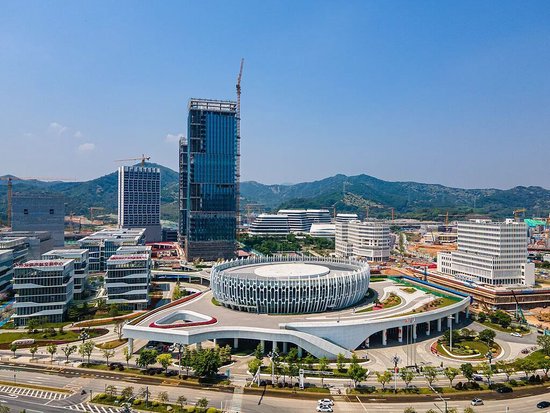
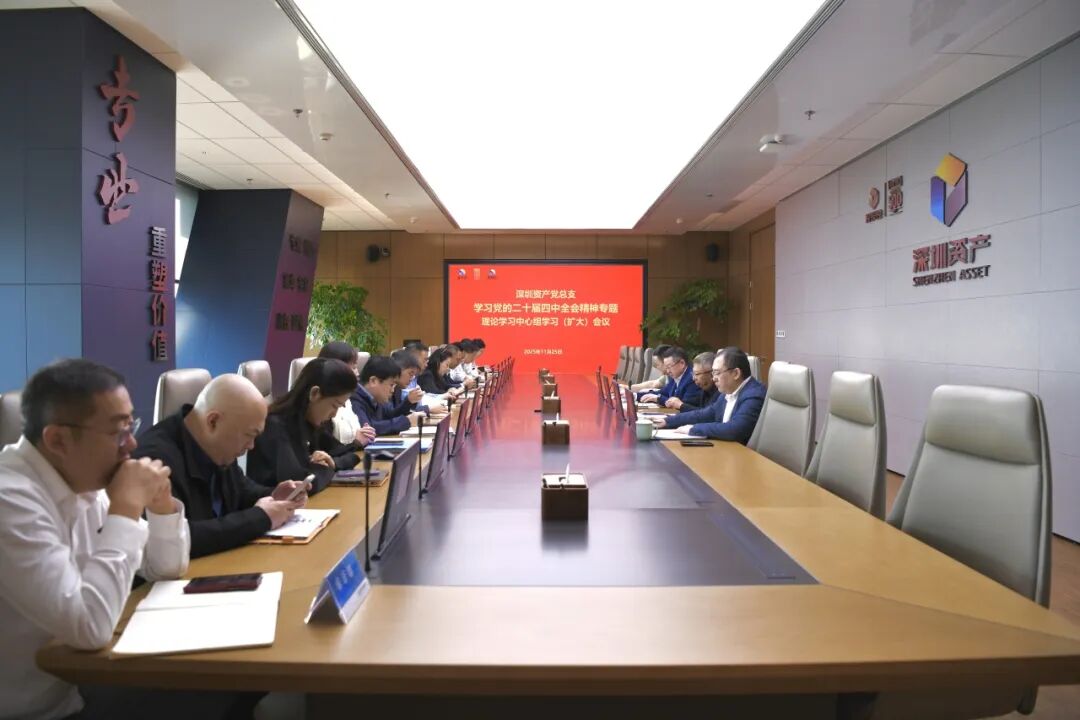
金融党建圳先行 | 深圳资产管理有限公司:党建助力金融风险化解,盘活资产彰显专业担当
Xin Lang Cai Jing· 2025-12-12 14:22
Core Viewpoint - The 20th Central Committee's Fourth Plenary Session approved the "Suggestions on Formulating the 15th Five-Year Plan for National Economic and Social Development," which sets the direction for high-quality financial development in Shenzhen [1][20]. Group 1: Political Leadership and Learning - The company prioritizes political construction, utilizing various learning methods to study Xi Jinping's latest important speeches and fostering a strong learning atmosphere through dedicated columns on their public platform [2][21]. - A structured learning matrix is established, integrating theoretical learning into daily practices, ensuring continuous engagement among party members [2][21]. Group 2: Leadership Role in Key Projects - The company plays a crucial leadership role in major project reviews and investments, ensuring alignment with national strategies and regional economic stability [5][23]. - Party members take on exemplary roles in project advancement, particularly in areas like non-performing asset management and real estate project support, contributing to high-quality economic development [5][23]. Group 3: Risk Management and Real Estate Solutions - The company actively responds to calls for real estate risk mitigation, focusing on urban renewal and policy housing, and collaborates with local governments and various departments to address challenges faced by stakeholders [9][27]. - Innovative financial solutions are implemented to restructure historical debts and attract new funding, achieving both economic and social benefits, recognized with the "2024 Best Case Award" in the national AMC industry [9][27]. Group 4: Project Revitalization and Community Support - The company engages in project revitalization efforts, employing innovative models to resolve risk conflicts, particularly in the real estate sector, and successfully isolates debt risks while achieving multi-party benefits [12][30]. - Initiatives are taken to support local governments and financial institutions, ensuring that community needs are met while promoting economic stability [12][30]. Group 5: Strategic Investment in Emerging Industries - The company embraces its political and social responsibilities by investing in emerging industries such as robotics and artificial intelligence, aligning with national strategic goals [16][34]. - Collaborative investment strategies are employed to address liquidity challenges faced by companies, enhancing the overall production capacity in Shenzhen [16][34]. Group 6: Future Directions - The company plans to continue its involvement in local financial risk management, focusing on Shenzhen's strategic emerging industries and contributing to the development of the Guangdong-Hong Kong-Macao Greater Bay Area [18][35].
招商宏观:11月经济数据怎么看?
Sou Hu Cai Jing· 2025-12-07 05:30
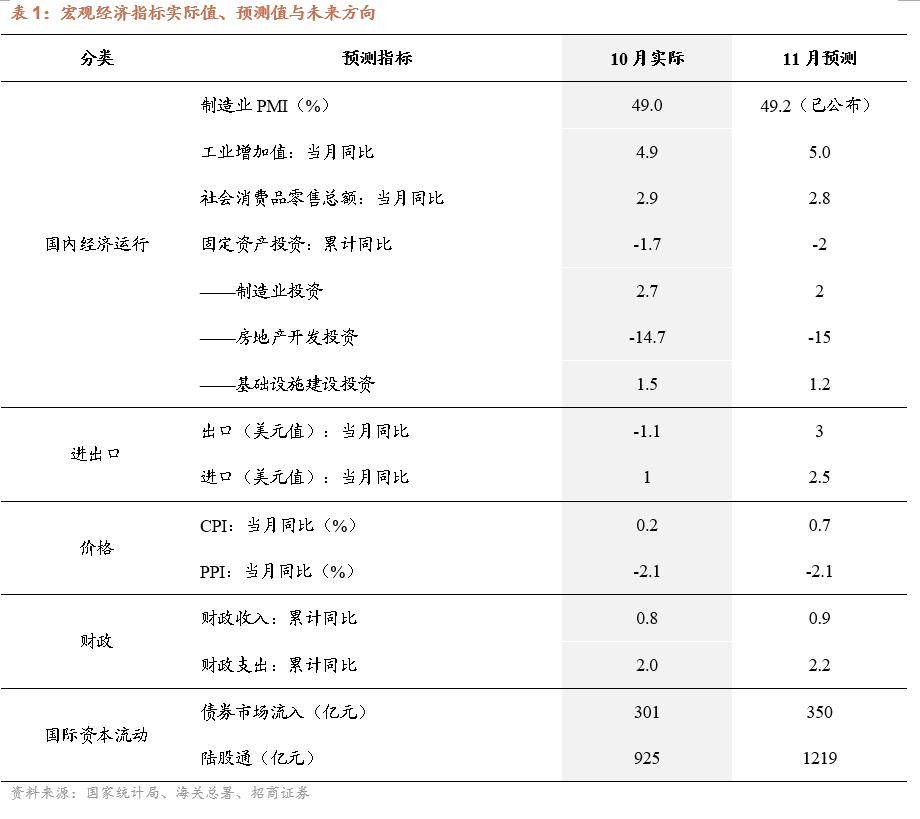
Core Viewpoint - The manufacturing PMI for November 2025 recorded at 49.2%, a slight increase of 0.2 percentage points from October, indicating marginal improvement but still within the contraction zone, reflecting a fragile recovery in the manufacturing sector [1][6] Manufacturing Sector - The production index returned to the critical point of 50.0%, but there remains a gap with the new orders index at 49.2%, indicating a supply strong and demand weak situation [1][6] - Large enterprises maintain PMI in the expansion zone, supported by major projects and infrastructure, while small and medium-sized enterprises, particularly in the downstream construction materials and home furnishings sectors, continue to perform poorly [1][6] - The new export orders index improved from 47.3 to 48.1, suggesting a boost in inquiries due to the US-China tariff truce, although actual increases may experience a time lag [1][6] Production - The industrial added value for November is expected to remain around 5% year-on-year, reflecting the resilience of China's industrial system despite a significant adjustment in the real estate sector [2][7] - The automotive manufacturing sector is expected to maintain high growth, driven by year-end production boosts, while electronics and aerospace manufacturing will also see relatively high growth rates [2][7] - In contrast, industries such as black metal smelting and non-metal mineral products continue to face negative or zero growth, heavily impacted by a sharp decline in demand for rebar and cement due to reduced new construction in real estate [2][7] Consumption - The retail sales growth for November is anticipated to remain relatively low, with the "Double Eleven" shopping festival achieving a total online sales of 1.619 trillion yuan, a year-on-year increase of 12.3% [3][8] - Essential categories like grain and personal care saw steady growth, while non-essential items like beauty and apparel relied heavily on significant discounts [3][8] - Despite strong production in the automotive sector, retail performance is disappointing, with expected year-on-year declines of 7.0% in passenger car sales due to the inability of new energy vehicle growth to offset declines in traditional fuel vehicle sales [3][8] Fixed Asset Investment - Fixed asset investment growth is expected to remain weak, primarily due to the real estate sector's ongoing challenges, with major real estate companies experiencing a 36% year-on-year drop in sales in November [4][9] - Infrastructure investment is projected to maintain low growth, with local governments being cautious about new project approvals [4][9] - Manufacturing investment is expected to sustain relatively high growth, focusing on equipment upgrades and expansion in high-tech industries, although overall demand constraints may limit expansion willingness [4][9] Trade - November export growth is expected to be around 3%, influenced by a recent US-China trade truce that reduced tariffs on certain goods [12][13] - Imports are also projected to show slight positive growth, supported by increased purchases of US agricultural products following the tariff agreement [12][13] Price Trends - November CPI is expected to be around 0.7%, influenced by weather-related supply constraints on vegetables and fruits, while pork prices continue to decline due to weak demand [16][17] - November PPI is projected to remain at -2.1%, with oil prices and industrial product prices showing signs of improvement [17][18]
碧桂园的重要公告,签名人换成了程光煜
Mei Ri Jing Ji Xin Wen· 2025-12-06 06:45
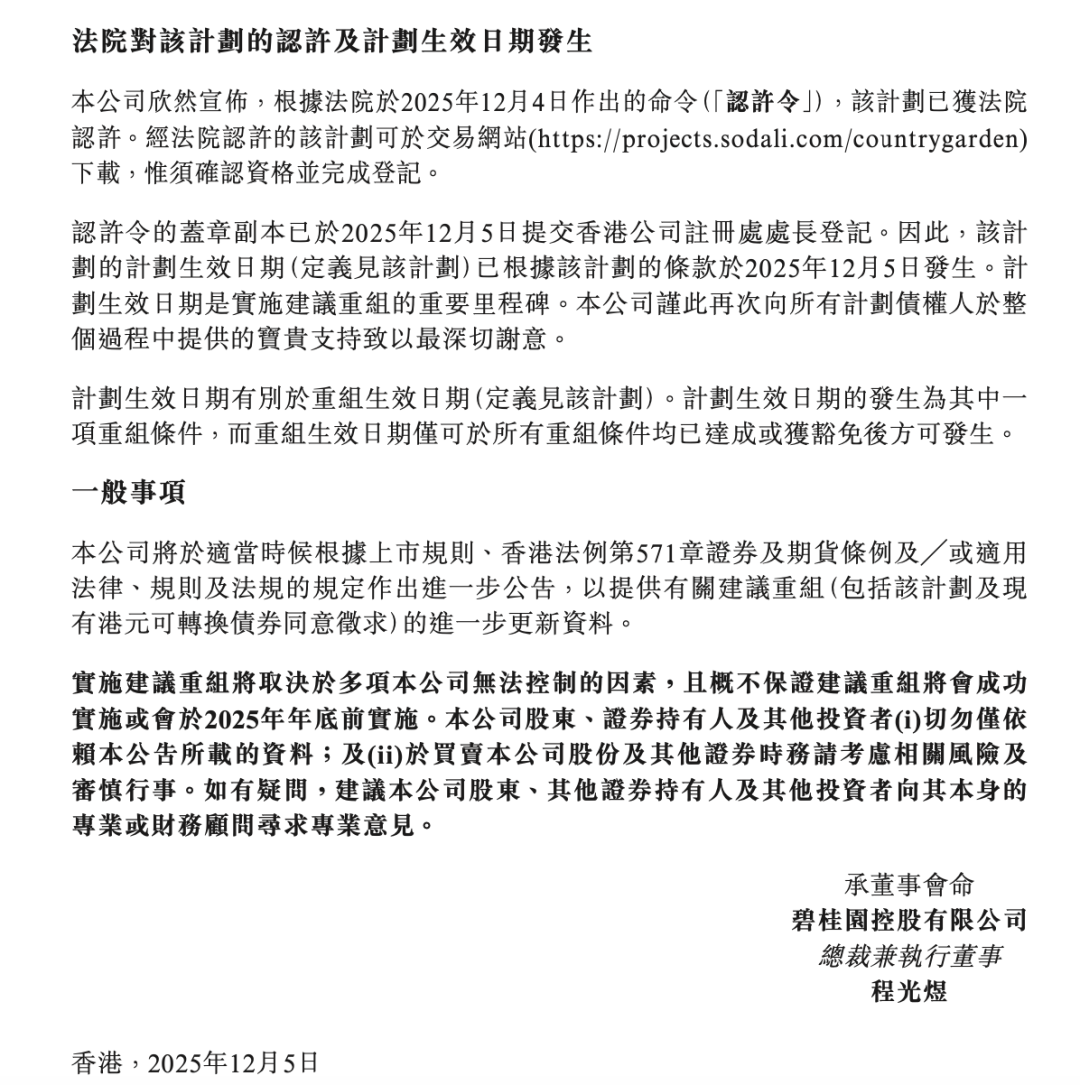
撰文|陈利 编辑|陈梦妤 封面|碧桂园视频截图 程光煜以总裁身份签发了碧桂园重要文件。 12月5日晚,碧桂园在港交所公告,(境外债务重组)计划已获法院认许,认许令盖章副本已于12月5日提交香港公司注册处处长登记。 公告显示:"计划生效日期是实施建议重组的重要里程碑。本公司谨此再次向所有计划债权人于整个过程中提供的宝贵支持致以最深切谢意。" 12月4日,《每日经济新闻》记者(以下简称每经记者)从知情人士处获悉,在当日香港高等法院举行的聆讯上,碧桂园所有境外债务重组计划获得批 准,生效条件已全部达成。 同日,碧桂园宣布重大人事变动,总裁莫斌调任为联席主席,常务副总裁程光煜接任总裁一职,主要负责承接董事会战略部署,全面统筹集团各业务板块 工作,组织搭建并落地经营管理体系,统筹本集团日常运营管控与行政管理,确保战略部署有效达成。 而就在前一日,其旗下"H16腾越2"重组方案获债权人会议通过。至此,碧桂园境内债务重组所涉的9只债券,重组方案均已获得债权人会议通过,涉及金 额约137.7亿元。 这也意味着,在境内外重组成功的合力作用下,碧桂园整体降债规模预估将超900亿元,5年内兑付压力将极大缓解。 历时329天 1 1 ...

恒大再上热搜:许家印前妻丁玉梅被冻结15亿元资产,遭全球追债。
Sou Hu Cai Jing· 2025-11-30 05:06
许家印前妻丁玉梅,最近正被一张跨国追债网牢牢困住。她存于瑞银等银行的15亿海外存款已被冻结,散落在伦敦、温哥 华、香港等地的33套豪宅也接连被法院锁定。这场针对她的资产清查风暴,不仅揭开了其背后精密的离岸资产布局,更与 恒大暴雷后数百万购房者的命运紧密相连。 时间倒回到2022年,彼时恒大债务危机已暗流涌动,多地项目停工消息频传,丁玉梅与许家印却突然"闪离"。两人没有公 开的情感纠葛,只有悄无声息的和平分手,外界几乎一致认定,这是一场为规避债务风险的"技术性离婚"——目的就是将 核心资产与恒大的债务隔离开来。 丁玉梅早早就布好了局:海外离岸公司握着股权,瑞士、新加坡的银行存着钱,加拿大、香港的豪宅写着她的名。最让人 诧异的是,2020到2021年恒大欠着一屁股债时,她关联的公司居然给她和家人分了60多亿股息。 一边是老百姓掏空积蓄买的房却成了收不到房的烂尾楼,一边是她趁着债务危机把钱转去海外,每月支取高额生活费用于 其家人开支。这种操作,难怪成了众矢之的。 丁玉梅本以为离岸公司、家族信托是"安全牌",还搞了个2.39亿的信托想隔离开债务。但现在全球监管早不是以前那样了, 她的算盘打错了。 英国法院先冻结了她瑞 ...
有大利好了?国家开始亲自下场买房,房价会开始出现上涨吗?
Sou Hu Cai Jing· 2025-11-24 16:22
房地产市场传来重大消息,国家层面正通过专项债等工具收购存量商品房,这一被形象称为"国家队进场"的操作,对市场意味着什么? 近期,一项被广泛解读为"国家开始亲自下场买房"的政策正在全国多地铺开。根据各地房交会信息和官方通知,包括张家界、杭州等多个城市相继推出收 购存量商品房用作保障房的举措。 同时,据中指研究院监测,截至2025年6月末,已有25个省市公示拟使用专项债收购闲置存量土地,总金额超4700亿元。 01 国家进场:收购存量房,一石二鸟 这些举措一方面缓解了房地产企业的库存压力,另一方面也加快了保障性住房的筹集速度,可谓一石二鸟。 02 政策背景:市场持续承压,止跌回稳成目标 国家为何选择此时"亲自下场"?理解这一问题的前提是认清当前房地产市场的现状。 从国家统计局发布的最新数据来看,2025年1—10月: 国家层面收购存量商品房并非空穴来风。2025年3月,住房和城乡建设部部长倪虹在民生主题记者会上明确表示,将 "推进收购存量商品房" 作为坚决"稳 住楼市"的四项重点任务之一。 他特别指出,今年地方政府专项债安排4.4万亿元,其中一个使用方向就是土地收储和收购存量商品房。 具体如何操作?从各地实践看, ...