债券配置

Search documents
债券ETF规模突破7000亿元 短期回调带来配置机会
Zhong Guo Zheng Quan Bao· 2025-11-09 20:08
Core Insights - The total market ETF size reached 5.74 trillion yuan as of November 9, with bond ETFs surpassing 700 billion yuan, indicating significant growth in the bond ETF sector [1][2] - Despite bond ETFs accounting for less than 13% of the total ETF market, they have experienced explosive growth, particularly in 2024, with a notable increase in new products like credit bond ETFs and sci-tech bond ETFs contributing over 330 billion yuan to the market [2][4] ETF Market Overview - As of November 9, the total number of ETFs is 1,060, with stock ETFs totaling 3.73 trillion yuan and bond ETFs totaling 706.12 billion yuan, where stock ETFs represent nearly 65% of the total market [2] - Bond ETFs have seen a rapid increase in size, crossing the 1 billion yuan mark in May 2024 and reaching over 5 billion yuan by July 2025, with the latest figure at 700.44 billion yuan [2] Investor Composition - Approximately 85% of bond ETFs are held by institutional investors, with funds being the largest group, followed by brokerages, repo accounts, insurance companies, and banks [3] Growth Drivers - The net inflow of funds into bond ETFs exceeded 420 billion yuan this year, with specific products like the Hai Fu Tong Short-term Bond ETF and the 30-year Treasury Bond ETF seeing significant inflows [4] - New products such as credit bond ETFs and sci-tech bond ETFs have contributed over 330 billion yuan to the overall growth, with many individual ETFs exceeding 100 billion yuan in size [4][5] Market Outlook - Analysts suggest that the recent resumption of government bond trading by the central bank has improved liquidity expectations and reduced interest rate risks, encouraging investors to consider bond allocation opportunities [6][7] - The sci-tech bond ETF market is expected to grow due to its underlying assets having high credit quality, making it suitable for stable portfolio configurations amid declining yields in traditional fixed-income products [5][7]
中信证券:对股市依旧可以保持乐观,配置方向上可以更加谨慎
Zheng Quan Shi Bao Wang· 2025-10-18 01:30
Core Viewpoint - The report from CITIC Securities suggests maintaining an optimistic outlook on the stock market amid an economic cycle recovery, while advising caution in investment allocation due to valuation changes [1] Group 1: Stock Market Outlook - The economic cycle is showing signs of recovery, which supports a positive sentiment towards the stock market [1] - Investors are encouraged to be more cautious in their allocation strategies due to changes in valuations [1] Group 2: Investment Recommendations - There is a focus on the non-bank sector, which is currently undervalued and experiencing rapid growth in investment performance, presenting a rebound opportunity [1] - The report highlights investment opportunities in cyclical sectors, driven by expectations of rising commodity prices in the fourth quarter [1] Group 3: Bond Market Insights - Bonds are considered to have strong allocation potential, but their valuation attractiveness remains insufficient [1] - It is recommended to wait for clearer signals from the central bank regarding a loose monetary policy before entering the bond market [1] Group 4: Commodity Market Expectations - The fourth quarter is expected to see continued strong performance in commodities, particularly in gold and non-ferrous metals, which have strong certainty [1] - For crude oil, attention should be paid to potential changes on the supply side [1]

中信期货晨报:国内商品期货多数下跌,贵金属普遍上涨-20251014
Zhong Xin Qi Huo· 2025-10-14 02:19
1. Report Industry Investment Rating - The report does not explicitly mention the industry investment rating. 2. Core Viewpoints of the Report - This week, there is a risk of increased volatility in global major asset classes. Investors are advised to maintain a strategic allocation to precious metals such as gold and be relatively cautious about risk assets such as equities next week. In the medium - term of the fourth quarter, the basic allocation view of equities > commodities > bonds is still held, and attention can be paid to potential buying opportunities for equity assets after the turmoil subsides [6]. 3. Summary by Relevant Catalogs 3.1 Macro Highlights - **Overseas Macro**: This week, focus on the new tariff threats from Trump and the marginal changes in the US government shutdown. There is a risk of further escalation of conflicts before the APEC meeting at the end of October. If the US government shutdown exceeds 30 days, it will increase the recession risk [6]. - **Domestic Macro**: China will gradually enter the period of focusing on the "15th Five - Year Plan" and tracking incremental policies. The Fourth Plenary Session of the 20th Central Committee will be held from October 20th to 23rd, and the market may start to pay attention to medium - and long - term marginal changes in the next five years. The progress and effectiveness of a batch of incremental policies such as 500 billion new policy - based financial instruments are also worth tracking [6]. - **Asset Views**: Maintain a strategic allocation to precious metals such as gold. Be cautious about risk assets such as equities next week. In the fourth - quarter medium - term, hold the view of equities > commodities > bonds and watch for buying opportunities in equity assets after the turmoil [6]. 3.2 Viewpoint Highlights 3.2.1 Financial Sector - **Stock Index Futures**: Catalyzed by technology events, the growth style is active. With crowded funds in small - cap stocks, the short - term trend is expected to be a volatile upward movement [7]. - **Stock Index Options**: The overall market trading volume has slightly declined. With the risk of insufficient liquidity in the options market, the short - term trend is expected to be volatile [7]. - **Treasury Bond Futures**: The bond market continues to be weak. Affected by factors such as policy, fundamental repair, and tariffs, the short - term trend is expected to be volatile [7]. 3.2.2 Precious Metals Sector - **Gold/Silver**: Driven by dovish expectations, with the restart of the US interest - rate cut cycle in September and increased risks to the Fed's independence, the short - term trend is expected to be a volatile upward movement [7]. 3.2.3 Shipping Sector - **Container Shipping to Europe**: As the peak season in the third quarter fades, the load is under pressure and there is a lack of upward momentum. Pay attention to the rate of freight decline in September, and the short - term trend is expected to be volatile [7]. 3.2.4 Black Building Materials Sector - **Steel Products**: Poor demand and policy disturbances. The short - term trend is expected to be volatile, and factors such as special bond issuance progress, steel exports, and iron - water production need to be monitored [7]. - **Iron Ore**: The fundamentals are relatively stable, but macro disturbances are increasing. The short - term trend is expected to be volatile, and attention should be paid to factors such as overseas mine production and shipment, domestic iron - water production, and policy dynamics [7]. - **Coke**: The first round of price increases has been implemented, and the market is temporarily stable. The short - term trend is expected to be volatile, and factors such as steel - mill production, coking costs, and macro sentiment need to be watched [7]. - **Coking Coal**: Supply decreased during the holiday, and downstream replenishment slowed down. The short - term trend is expected to be volatile, and factors such as steel - mill production, coal - mine safety inspections, and macro sentiment should be monitored [7]. - **Silicon Iron**: Supply pressure is gradually accumulating, and cost support is strong. The short - term trend is expected to be volatile, and factors such as raw material costs and steel procurement need to be considered [7]. - **Manganese Silicon**: Cost support still exists, but supply and demand are loose, and prices are under pressure. The short - term trend is expected to be volatile, and factors such as cost prices and foreign quotes should be watched [7]. - **Glass**: Supply concerns have eased, and intermediate inventories are high. The short - term trend is expected to be volatile, and spot production and sales need to be monitored [7]. - **Soda Ash**: Production has slightly decreased, and inventories are continuously being transferred. The short - term trend is expected to be volatile, and soda - ash inventories should be watched [7]. 3.2.5 Non - ferrous Metals and New Materials Sector - **Copper**: The supply - side contraction logic continues to ferment, and copper prices continue to be strong. The short - term trend is expected to be a volatile upward movement, and factors such as supply disturbances, domestic policies, and Fed policies need to be monitored [7]. - **Alumina**: The fundamentals are still weak, and the upward price is under pressure. The short - term trend is expected to be volatile, and factors such as ore resumption and electrolytic - aluminum resumption need to be watched [7]. - **Aluminum**: Boosted by macro sentiment, aluminum prices are volatile and strong. The short - term trend is expected to be volatile, and factors such as macro risks and supply disturbances need to be monitored [7]. - **Zinc**: Inventory has returned to accumulation, and zinc prices rebound with non - ferrous metals. The short - term trend is expected to be volatile, and factors such as macro risks and zinc - ore supply need to be watched [7]. - **Lead**: With supply - side disturbances and slow battery exports, lead prices rebound with non - ferrous metals. The short - term trend is expected to be volatile, and factors such as supply - side disturbances and battery exports need to be monitored [7]. - **Nickel**: The expectation of loose supply and demand remains unchanged, and RKAB quota progress is fluctuating. Nickel prices are widely volatile. The short - term trend is expected to be volatile, and factors such as macro and geopolitical changes and Indonesian policies need to be watched [7]. - **Stainless Steel**: Driven by the rise in nickel prices, stainless steel prices are volatile and rising. The short - term trend is expected to be volatile, and factors such as Indonesian policies and demand growth need to be monitored [7]. - **Tin**: Supply disturbances continue, and tin prices are volatile at high levels. The short - term trend is expected to be volatile, and factors such as the resumption of production in Wa State and demand improvement need to be watched [7]. - **Industrial Silicon**: The restart rhythm of coal and northwest production is fluctuating, and industrial - silicon prices are volatile. The short - term trend is expected to be volatile, and factors such as supply - side over - reduction and photovoltaic installation need to be monitored [7]. - **Lithium Carbonate**: The expectation of production suspension has ended, and lithium - carbonate prices are under pressure and volatile. The short - term trend is expected to be volatile, and factors such as demand and supply disturbances need to be watched [7]. 3.2.6 Energy and Chemical Sector - **Crude Oil**: Affected by macro disturbances, the fundamentals are under continuous pressure. The short - term trend is expected to be a volatile downward movement, and factors such as OPEC+ production policies and Middle - East geopolitical situations need to be monitored [8]. - **LPG**: Supply is still in excess, and the low - valuation situation is difficult to change. The short - term trend is expected to be a volatile downward movement, and factors such as crude - oil and overseas propane costs need to be watched [8]. - **Asphalt**: Spot prices are continuously falling, and asphalt futures prices are also falling. The short - term trend is expected to be a downward movement, and factors such as sanctions and supply disturbances need to be monitored [8]. - **High - Sulfur Fuel Oil**: With the expectation of increased production and geopolitical cooling, high - sulfur fuel - oil futures prices are falling. The short - term trend is expected to be volatile, and factors such as geopolitics and crude - oil prices need to be watched [8]. - **Low - Sulfur Fuel Oil**: Low - sulfur fuel oil follows the decline of crude oil. The short - term trend is expected to be volatile, and crude - oil prices need to be monitored [8]. - **Methanol**: Affected by olefins but with Iranian disturbances still existing, pay attention to arbitrage opportunities between methanol and olefins. The short - term trend is expected to be volatile, and factors such as macro energy and upstream - downstream device dynamics need to be watched [8]. - **Urea**: After the holiday, there are insufficient positive factors, and the short - term weakness continues. The short - term trend is expected to be a volatile downward movement, and factors such as the improvement of Sino - Indian relations and export expectations need to be monitored [8]. - **Ethylene Glycol**: The fundamentals have weak support and the macro sentiment is pessimistic, so prices are under pressure. The short - term trend is expected to be a volatile downward movement, and factors such as coal and oil prices, port inventory rhythm, and Sino - US trade frictions need to be watched [8]. - **PX**: Cost collapse drags down the valuation of chemical products. In a situation where supply and demand are both strong, the benefits are mainly volatile. The short - term trend is expected to be a volatile downward movement, and factors such as large - scale fluctuations in crude oil, macro abnormalities, and PTA device restarts need to be monitored [8]. - **PTA**: The supply - demand expectation has slightly improved, but costs and macro sentiment have a significant drag, so prices are under pressure. The short - term trend is expected to be a volatile downward movement, and factors such as large - scale fluctuations in crude oil, macro abnormalities, and the peak - season performance need to be watched [8]. - **Short - Fiber**: Costs drag down the absolute price, but the processing fee remains stable under stable supply and demand. The short - term trend is expected to be a volatile downward movement, and factors such as downstream yarn - mill purchasing rhythm and peak - season demand need to be monitored [8]. - **Bottle Chip**: The raw - material cost support is weak, and the low - level speculative replenishment demand supports the bottle - chip processing - fee profit. The short - term trend is expected to be a volatile downward movement, and factors such as bottle - chip enterprise production - reduction target implementation and terminal demand need to be watched [8]. - **Propylene**: Cost decline and the resurgence of tariff games lead to a weak and volatile PL. The short - term trend is expected to be a volatile downward movement, and factors such as oil prices and domestic macro factors need to be monitored [8]. - **PP**: The raw - material end collapses and there are tariff disturbances, so PP prices are falling. The short - term trend is expected to be a volatile downward movement, and factors such as oil prices and domestic and foreign macro factors need to be watched [8]. - **Plastic**: Oil prices have significantly declined, and plastic prices are weak and volatile. The short - term trend is expected to be volatile, and factors such as oil prices and domestic and foreign macro factors need to be monitored [8]. - **Styrene**: Inventory pressure is still high, and styrene prices are weak and volatile. The short - term trend is expected to be a volatile downward movement, and factors such as oil prices, macro policies, and device dynamics need to be watched [8]. - **PVC**: There is still fundamental pressure, and PVC prices are volatile. The short - term trend is expected to be volatile, and factors such as expectations, costs, and supply need to be monitored [8]. - **Caustic Soda**: The spot price is stable, and the futures price can be stopped for profit at low levels. The short - term trend is expected to be volatile, and factors such as market sentiment, production start - up, and demand need to be watched [8]. 3.2.7 Agricultural Sector - **Oils and Fats**: Pay attention to the effectiveness of the lower - level technical support. The short - term trend is expected to be volatile, and factors such as US soybean weather and Malaysian palm oil production and demand data need to be monitored [8]. - **Protein Meal**: The sentiment boost is limited, and the market continues to be volatile at a low level. The short - term trend is expected to be volatile, and factors such as weather, domestic demand, and trade wars need to be watched [8]. - **Corn/Starch**: The pressure of selling new grain is coming, and the spot price drives the futures price to decline significantly. The short - term trend is expected to be a volatile downward movement, and factors such as demand, macro factors, and weather need to be monitored [8]. - **Pig**: The planned October slaughter volume is increasing, and pig prices are under pressure. The short - term trend is expected to be a volatile downward movement, and factors such as breeding sentiment, epidemics, and policies need to be watched [8]. - **Natural Rubber**: Although the negative factors have not been realized, the market sentiment remains weak. The short - term trend is expected to be volatile, and factors such as production - area weather, raw - material prices, and macro changes need to be monitored [8]. - **Synthetic Rubber**: The range - bound pattern remains unchanged. The short - term trend is expected to be volatile, and factors such as large - scale fluctuations in crude oil need to be watched [8]. - **Cotton**: The decline of cotton prices has slowed down. Pay attention to the purchase price. The short - term trend is expected to be volatile, and factors such as demand and inventory need to be monitored [8]. - **Sugar**: Both domestic and foreign sugar prices are weak. The short - term trend is expected to be volatile, and factors such as imports and Brazilian production need to be watched [8]. - **Pulp**: The game of the virtual - to - real ratio may cause intraday fluctuations, but the effectiveness needs to be observed. The short - term trend is expected to be a volatile downward movement, and factors such as macro - economic changes and US - dollar - denominated quotes need to be monitored [8]. - **Double - Glued Paper**: The spot price is stable, and the futures price is volatile. The short - term trend is expected to be volatile, and factors such as production and sales, education policies, and paper - mill production start - up need to be watched [8].
风险偏好回升压制债券表现,回调为三四季度带来配置机遇
Xin Lang Ji Jin· 2025-07-25 10:06
Group 1 - The liquidity in the interbank market improved as the tax period effects diminished, with the central bank's net injection of 102.8 billion yuan on July 18 [1] - The central bank continued to net withdraw funds throughout the week, with a net withdrawal of 555 billion yuan on Monday and 2.477 billion yuan on Tuesday [1] - On Thursday, the funding rates increased significantly, with overnight and 7-day funding rates inverted, and the central bank net withdrew 119.5 billion yuan [1] Group 2 - The U.S. Congressional Budget Office estimated that the recent tax and spending bill signed by President Trump will increase the U.S. deficit by 3.4 trillion dollars over the next ten years [2] - The bill includes cuts to Medicaid and provisions that could lead to 10 million Americans losing health insurance by 2034 [2] - The National Association of Realtors reported a 2.7% month-over-month decline in existing home sales in June, reaching an annualized total of 3.9 million units, the lowest since September of the previous year [2] Group 3 - The National Development and Reform Commission held a meeting to discuss the "14th Five-Year Plan," emphasizing the importance of enterprise innovation and collaboration between state-owned and private enterprises [3] - The recent market trends indicate a recovery in risk appetite, impacting the performance of bonds, while the internal logic for a bullish bond market remains due to weakened financing demand and debt leverage [3] - The supply-side policies mainly affect upstream industries, while midstream and downstream sectors remain weak, suggesting potential for further easing in monetary policy [3] Group 4 - The National Development Bank ETF (159650) targets policy financial bonds, which are characterized by high credit ratings, large volumes, and good liquidity, making them attractive investment options [4] - The ETF offers good liquidity, low credit risk, and reasonable risk-return ratios, serving as a suitable tool for short-duration allocations [4]
机构的持券意愿依然较强
Huaan Securities· 2025-06-19 08:12
1. Report Industry Investment Rating No relevant content provided. 2. Core Views of the Report - Since the second quarter, the bond market has been in a sideways shock. After the double - cut in May, the interest rate increased slightly, with the 10Y Treasury bond yield rising from 1.62% to 1.72%. During this period, there are two characteristics of institutional behavior: banks' bond allocation reached a record high, and institutions' overall willingness to hold bonds is strong [3]. - In May, the bond allocation of banks reached a record high, mainly due to the peak of supply and changes in the caliber. The net financing of Treasury bonds exceeded 90 billion yuan, and commercial banks' holdings of Treasury bonds increased by over 90 billion yuan, with the increase in all bond types reaching about 1.72 trillion yuan, a record high for commercial banks. Adjusting for the caliber change, the high increase in banks' bond holdings in May may indicate that their willingness to sell bonds to adjust floating profits in the second quarter is relatively controllable [3]. - Institutions' overall willingness to hold bonds is strong, different from previous months. In previous months when interest rates rose, non - bank institutions such as broad - based funds usually reduced or decreased their bond allocation. However, in May, the bond allocation scale of broad - based funds was still significant, with a monthly托管 increase of over 90 billion yuan. Broad - based funds are showing trading characteristics of allocating to certificates of deposit, reducing holdings of Tier 2 capital bonds, buying local government bonds, and conducting band - trading on Treasury bonds and policy - financial bonds. Insurance institutions had a relatively low overall allocation scale in May, securities companies slightly reduced their positions, and foreign investors' holdings of certificates of deposit declined [4]. 3. Summary by Relevant Catalogs 3.1 Bank - to - Bank and Exchange Custody Volume Overview - In May 2025, the month - on - month increase in the bank - to - bank bond custody volume rose to 1.31%, while that of the exchange decreased to 0.59%. The bond custody volumes of the bank - to - bank market (China Central Depository & Clearing Co., Ltd. and Shanghai Clearing House) and the exchange (Shanghai Stock Exchange and Shenzhen Stock Exchange) were 166 trillion and 22 trillion yuan respectively, totaling 188 trillion yuan [12][18]. 3.2 By Bond Type 3.2.1 Interest - Rate Bonds - The overall custody scale of interest - rate bonds was 117 billion yuan, with a month - on - month increase of 1.72 trillion yuan. In May, the balances of Treasury bonds, local government bonds, and policy - financial bonds continued to increase, and the total increase of Treasury bonds and policy - financial bonds was higher than that of the previous month. The custody scale of Treasury bonds increased by 91.12 billion yuan month - on - month, local government bonds increased by 52.57 billion yuan, and policy - financial bonds increased by 28.22 billion yuan [20][21]. 3.2.2 Credit Bonds - The total custody volume of credit bonds in May was 33 trillion yuan, with a month - on - month increase of 8.61 billion yuan. The scale of short - term financing bonds and enterprise bonds continued to decline, while the scale of medium - term notes and corporate bonds continued to rise. The custody scale of enterprise bonds decreased by 2.46 billion yuan, the total custody volume of association products increased by 2.64 billion yuan, and the custody scale of corporate bonds increased by 8.43 billion yuan [20][29]. 3.2.3 Certificates of Deposit - In May, the custody scale of certificates of deposit was 22 trillion yuan, with a month - on - month increase of 26.94 billion yuan. Policy - banks and broad - based funds' holdings continued to increase, while those of commercial banks, securities companies, and insurance institutions continued to decrease, and the increase in foreign institutions' custody scale turned from positive to negative [38]. 3.2.4 Financial Bonds - In May, the custody scale of financial bonds was 12 trillion yuan, with a month - on - month increase of 22.49 billion yuan. Insurance institutions' holdings continued to decrease, while those of commercial banks, broad - based funds, securities companies, and foreign institutions continued to increase, and the increase in policy - banks' custody scale turned from negative to positive [44]. 3.3 By Institution - The custody volume of allocation - oriented investors increased significantly, while that of securities companies decreased. In May, policy - banks' holdings increased by 3.66 billion yuan, commercial banks' by 172.76 billion yuan, broad - based funds' by 92.23 billion yuan, securities companies' decreased by 15.81 billion yuan, insurance institutions' increased by 0.3 billion yuan, and foreign institutions' decreased by 9.5 billion yuan [48].

多家基金公司申报科创债指数基金,业内关注相关债券配置价值
Mei Ri Jing Ji Xin Wen· 2025-05-29 07:47
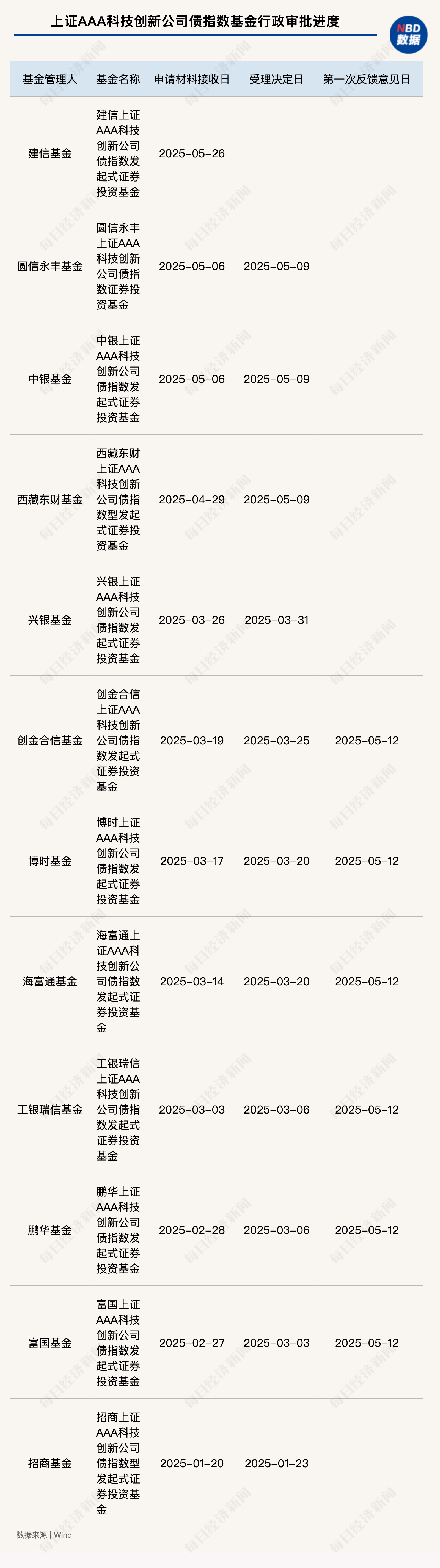
Core Viewpoint - The recent surge in applications for technology innovation bond index funds indicates a growing interest in high-quality, AAA-rated bonds, driven by their stability and low default risk [2][3]. Group 1: Fund Applications and Market Trends - Recently, the application materials for the CCB CSI AAA Technology Innovation Corporate Bond Index Fund were accepted by regulators, following similar approvals for products from other fund companies [1][2]. - A total of 12 fund companies have submitted applications for technology innovation bond index funds to the CSRC this year [1][2]. - The AAA-rated bonds have attracted significant attention due to their high credit ratings and stable annualized returns, with the CSI AAA Technology Innovation Corporate Bond Index showing a 13.65% increase since July 29, 2022, reaching a historical high of 113.69 points on May 28 [2][3]. Group 2: Market Expansion and Policy Support - The technology innovation bond market has expanded rapidly, with a total scale exceeding 2.8 trillion yuan, supported by various policy measures since the pilot program began in 2021 [3]. - Recent policy updates have broadened the range of issuers for technology innovation bonds, including private equity and venture capital firms, enhancing market liquidity and supporting corporate financing [2][3]. Group 3: Bond ETF Performance - Bond ETFs have seen significant net inflows, with the top five ETFs by net inflow in May being primarily bond-focused, indicating strong market interest in this asset class [9][12]. - The introduction of market makers has improved the average turnover rate of benchmark corporate bonds, enhancing liquidity and reducing transaction costs for investors [9][10]. Group 4: Investment Outlook - The current environment, characterized by declining deposit rates, is expected to boost demand for credit assets, making short-term rate bonds particularly attractive for investment [10].