
债券配置

Search documents
ETF组合策略月度跟踪报告(2026年02月)-20260311
Shanghai Securities· 2026-03-11 10:04
Market Overview - In February 2026, the domestic stock market indices showed mixed performance, with the CSI 1000 index rising significantly by 3.71%, while the STAR 50 index fell by 1.42%. Year-to-date, the CSI 500 index performed strongly with a gain of 15.98%, whereas the CSI 300 index lagged with a rise of only 1.74% [2][6]. - In terms of market style, small-cap stocks outperformed large-cap stocks in February, and value stocks slightly outperformed growth stocks. Year-to-date, the ChiNext index rose by 3.34%, while the CSI 1000 index increased by 12.71% [2][7]. - The best-performing sectors in February were steel (+9.52%), building materials (+7.72%), and machinery (+7.56%), while the worst performers were media (-4.22%), non-bank financials (-3.48%), and consumer services (-3.37%) [2][12]. - The bond market saw the China Bond Treasury Total Wealth Index increase by 0.26% and the China Bond Corporate Bond Total Wealth Index rise by 0.23% in February. Year-to-date, government bonds performed slightly better than credit bonds [2][7]. - In the commodity market, most domestic commodity indices fell in February, with the Nanhua Agricultural Products Index rising by 0.23% and the Nanhua Gold Index declining by 1.17%. Year-to-date, the Nanhua Gold Index increased by 17.11% [2][7]. ETF Strategy Performance - The report highlights the growing importance of ETFs as investment tools, with a focus on various strategies including style rotation, quantitative selection, global allocation, bond allocation, and asset allocation. The current ETF combinations include style rotation, global allocation, valuation-selected ETFs, and others [3][13]. - As of February 28, 2026, the Style Rotation Portfolio achieved a cumulative return of 104.86%, outperforming its benchmark by 53.29%. The annualized volatility was 19.24%, with a maximum drawdown of -22.20% [3][19]. - The 28 Rotation Portfolio recorded a cumulative return of 66.89%, exceeding its benchmark by 17.31%, with an annualized volatility of 11.26% and a maximum drawdown of -16.39% [3][26]. - The Valuation-Selected ETF Portfolio achieved a cumulative return of 190.69%, outperforming its benchmark by 141.54%, with an annualized volatility of 20.37% and a maximum drawdown of -21.42% [3][33]. - The Global Allocation Portfolio had a cumulative return of 73.57%, surpassing its benchmark by 35.07%, with an annualized volatility of 13.56% and a maximum drawdown of -28.69% [3][41]. - The Dynamic Duration Strategy Portfolio achieved a cumulative return of 20.44%, outperforming its benchmark by 3.32%, with an annualized volatility of 1.71% and a maximum drawdown of -2.38% [3][49]. - The Asset Rotation Strategy Portfolio recorded a cumulative return of 78.61%, exceeding its benchmark by 54.43%, with an annualized volatility of 10.73% and a maximum drawdown of -12.17% [3][56]. - The Asset Rotation Strategy 2.0 Portfolio achieved a cumulative return of 75.02%, outperforming its benchmark by 50.83%, with an annualized volatility of 7.44% and a maximum drawdown of -7.95% [3][64].
中金固收:结汇增加推升M2,贷款需求减弱,利好债券配置需求
Jin Rong Jie· 2026-02-14 02:57
Core Viewpoint - The report indicates a weakening support from government bond financing for social financing, leading to a slowdown in overall social financing growth, with the year-on-year growth rate dropping from 8.3% in December to 8.2% in January [1] Group 1: Social Financing and Monetary Supply - The demand for financing in the private sector remains weak, contributing to the overall sluggish growth in social financing [1] - The year-on-year growth rate of M2 increased from 8.0% in November to 9.0% in January, driven by a strong willingness of enterprises to settle in RMB and robust non-bank deposits [1] - The difference between the year-on-year growth rates of social financing and M2 is expected to influence interest rate trends, with potential further declines in bond rates anticipated [1] Group 2: Market Outlook and Investment Recommendations - Insufficient bank credit issuance since January has led to increased bond allocation, resulting in a gradual decline in medium to long-term interest rates [1] - The central bank's monetary policy easing may accelerate, suggesting further declines in bond rates are likely [1] - Despite previous concerns about potential inflation exceeding expectations in the first quarter, recent declines in industrial product prices indicate a continuation of low inflation in the domestic economy [1] - The domestic bond market is viewed positively, with recommendations for investors to actively monitor trading opportunities arising from potential discrepancies in inflation expectations after the Spring Festival [1]
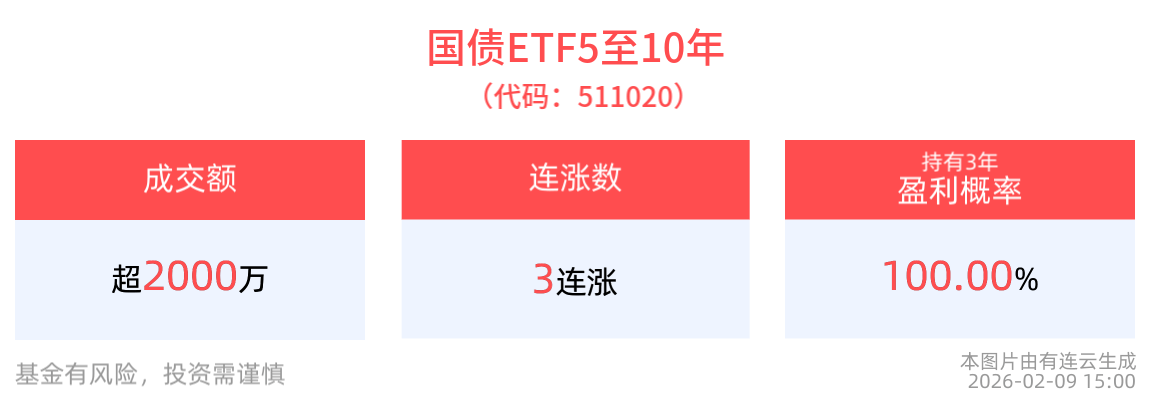
成交额超2000万元,国债ETF5至10年(511020)实现3连涨
Sou Hu Cai Jing· 2026-02-10 01:43
Group 1 - Institutions remain bullish on long-term bonds, driven by allocation strategies. From January 1 to February 6, brokerages and funds net sold over 108.6 billion yuan of ultra-long-term bonds (maturity over 20 years), compared to a net sale of only 5.7 billion yuan in the same period last year. Meanwhile, insurance funds net bought 120.6 billion yuan of ultra-long-term bonds, and rural commercial banks net bought 50 billion yuan, increasing by 55.4 billion yuan and 68.8 billion yuan year-on-year respectively [1] - Despite significant net selling by brokerages and funds, the rise in bond yields has enhanced the allocation value, prompting rural commercial banks and insurance funds to increase their holdings in ultra-long bonds. The current steep yield curve indicates that while the cost of liabilities for rural commercial banks has decreased significantly, the spread on bonds with maturities of 7 years or less is low, necessitating longer durations for better returns [1] - The People's Bank of China purchased 100 billion yuan of government bonds in January, an increase of 50 billion yuan from the previous month, which may continue at this level or higher, improving the supply-demand relationship for government bonds. Additionally, bank deposits grew well in January, and with the central bank's interest rate cuts on monetary tools, the motivation for banks to issue interbank certificates of deposit is low [1] Group 2 - As of February 9, 2026, the China Bond 5-10 Year Treasury Active Bond Index (net price) rose by 0.03%. The Treasury ETF for 5 to 10 years (511020) increased by 0.08%, marking its third consecutive rise, with the latest price at 116.1 yuan. Over the past week, the Treasury ETF for 5 to 10 years has accumulated a rise of 0.23% [3] - In terms of liquidity, the Treasury ETF for 5 to 10 years had a turnover of 1.99% during the trading session, with a transaction volume of 23.17 million yuan. Over the past year, the average daily transaction volume for this ETF has been 600 million yuan [3] - The latest size of the Treasury ETF for 5 to 10 years reached 1.166 billion yuan. The maximum drawdown for this ETF since the beginning of the year is 0.21%, with a relative benchmark drawdown of 0.08%. The recovery days after the drawdown were 5 days [3]

固定收益点评:一季度政府债发行的四大特点
GOLDEN SUN SECURITIES· 2026-01-08 12:01
1. Report Industry Investment Rating - Not provided in the content 2. Core Viewpoints of the Report - In 2026, the government bond supply increment is expected to decrease significantly, with a possible rhythm disturbance rather than a trend impact [3] - The current core pressure lies on the demand side, but the demand side is expected to improve recently [4] - The bond market may remain volatile this month, waiting for possible allocation opportunities at the end of the month [5] 3. Summary by Relevant Catalogs 3.1 First Quarter Government Bond Issuance Plan - **Treasury Bonds**: The issuance plan in Q1 2026 is similar to that of last year. The issuance scale of single - issue treasury bonds has increased this week, but whether it will continue to be large - scale needs further observation. From 2024 - 2025, the single - issue scale of general treasury bonds is usually lower in Q1 and Q4 and higher in Q2 and Q3 [8] - **Local Bonds**: The planned issuance scale in Q1 2026 may be lower than last year. The issuance rhythm is more front - loaded in January, but the planned issuance amount and net financing in February and March are expected to be lower than last year. The term structure of the disclosed areas has been shortened, but the national - level change needs further observation [13][16] 3.2 Past Government Bond Issuance Characteristics - **Rhythm**: In 2025, the issuance of general treasury bonds and special refinancing bonds was front - loaded, and the issuance rhythm of special bonds was slower than expected. This characteristic is expected to continue in Q1 2026 [23][25] - **Term**: In recent years, the issuance term of government bonds has generally lengthened, with the average duration of local bonds increasing from 11.95 years in 2021 to 15.62 years in 2025, and the issuance term of treasury bonds rising from 6.34 years in 2022 to 8.33 years in 2025 [30] 3.3 Supply Pressure as a Disturbance, Long - term Bond Demand as the Core - **Supply**: The government bond increment in 2026 is expected to decrease significantly, with the impact being more about rhythm rather than trend [33] - **Demand**: The demand for long - term bonds was insufficient at the end of 2025, but the demand side is expected to improve recently. The bond market may be volatile in January and is expected to gradually recover after the supply shock at the end of the month [33][35][36]
债券配置需求边际回暖,静待扰动因素落地
Xin Lang Cai Jing· 2025-12-29 07:33
Group 1: Monetary Policy and Market Liquidity - The central bank's net injection of liquidity was 35.7 billion yuan on December 19, followed by a net withdrawal of 183.6 billion yuan on December 22, indicating a fluctuating liquidity environment [2][15] - The central bank conducted a 400 billion yuan one-year MLF operation on December 15, with a net injection of 100 billion yuan due to 300 billion yuan of MLF maturing this month [16] - Interbank liquidity remained loose, with overnight funding rates stable and minor fluctuations in repo rates observed throughout the week [2][15] Group 2: International Monetary Policy Insights - European Central Bank Executive Board member Isabel Schnabel stated that interest rates are unlikely to rise in the foreseeable future unless unexpected events occur, which has led investors to increase bets on future rate hikes [3][16] - The Bank of Japan's recent meeting minutes indicated a consensus on the potential for future rate hikes, contingent on economic and price forecasts, while also expressing caution due to signs of weakness in the U.S. labor market [3][16] Group 3: Domestic Bond Market Trends - The total custody volume of China Central Depository & Clearing Co., Ltd. increased by 1.1 trillion yuan to 128.16 trillion yuan in November, with major institutions, excluding foreign entities and brokerages, increasing their bond holdings [4][17] - Commercial banks have resumed their role as primary bond holders, driven by high loan-to-deposit ratios, while the sentiment in the bond market has been weak, with brokerages and foreign institutions reducing their bond positions [4][17] - The demand for bond allocation is showing signs of marginal recovery, with potential increases in bank deposit growth if corporate foreign exchange settlement demand is released [4][17] Group 4: Investment Opportunities in National Development ETF - The National Development ETF (159650) focuses on interbank market national development bonds, characterized by high credit ratings, large volumes, and good liquidity, making them attractive investment targets [5][18] - The ETF offers features such as good liquidity, low credit risk, and reasonable risk-return ratios, making it a suitable tool for short-duration allocations [5][18]
中信证券:超长债仍具配置价值,建议关注短期利率超调后的配置机会
Sou Hu Cai Jing· 2025-12-22 00:48
Core Viewpoint - Recent fluctuations in long-term and ultra-long-term bonds are primarily attributed to pressure on the liability side of commercial banks, influenced by regulatory assessments and seasonal factors, while the central bank's monetary policy framework reform may gradually offset these pressures through the introduction of balance sheet expansion tools [1] Group 1 - The volatility in long-term and ultra-long-term bonds has increased, mainly due to pressures on commercial banks' liabilities [1] - Regulatory assessments and seasonal factors contribute to the current pressures faced by banks [1] - The central bank's ongoing monetary policy framework reform may provide a counterbalance to these pressures through the deployment of balance sheet expansion tools [1] Group 2 - Fiscal pressures for the next year are considered relatively manageable [1] - In a broader context of monetary easing, with interest rate cuts and reserve requirement ratio reductions still pending, ultra-long-term bonds retain certain investment significance [1] - There is a recommendation to pay attention to investment opportunities following short-term interest rate adjustments [1]

中信证券:超长债仍具配置价值 建议关注短期利率超调后的配置机会
Zheng Quan Shi Bao Wang· 2025-12-22 00:33
Core Viewpoint - Recent fluctuations in long-term and ultra-long-term bonds are primarily attributed to the pressure on the liability side of commercial banks, influenced by regulatory assessments and seasonal factors, while the central bank's monetary policy framework reform may gradually offset these pressures [1] Group 1: Market Conditions - The volatility in long-term and ultra-long-term bonds has increased, mainly due to pressures faced by commercial banks [1] - Regulatory assessments and seasonal factors contribute to the current pressures on banks' liabilities [1] Group 2: Monetary Policy Impact - The central bank's ongoing monetary policy framework reform is expected to gradually counterbalance the pressures on the banking sector [1] - The potential implementation of expansionary monetary tools, such as interest rate cuts and reserve requirement ratio reductions, remains to be seen [1] Group 3: Investment Outlook - Considering the manageable fiscal pressures anticipated for the next year, ultra-long-term bonds still hold certain investment significance in the long run [1] - There is a recommendation to pay attention to investment opportunities following short-term interest rate adjustments [1]
风险偏好或回落,债券配置需求有望回暖
Xin Lang Ji Jin· 2025-11-28 11:15
Group 1: Market Overview - The market liquidity remains ample, with the central bank's net injection of 162.2 billion on November 21 and 255.7 billion on November 24 [1] - The overnight funding rates showed slight fluctuations, with DR001 decreasing by 1 basis point to 1.31% and DR007 increasing by 1 basis point to 1.45% on November 27 [1] Group 2: Economic Indicators - Japan's Prime Minister emphasized the importance of economic stimulus for fiscal sustainability, with the current year's government bond issuance expected to be lower than last year [2] - In the U.S., September durable goods orders increased by 0.5%, surpassing expectations, while the Federal Reserve's Beige Book indicated stable economic activity across most districts, with some areas reporting slight declines [2] Group 3: Domestic Debt Market - In October, various institutions reversed their bond-holding behaviors, with a notable increase in interbank certificates of deposit, while banks reduced their bond holdings [3] - The demand for bonds from commercial banks is expected to remain high in the coming months due to the widening loan-to-deposit spread [3] - The National Development Bank ETF (159650) is highlighted as a suitable investment option due to its high credit rating, large scale, and good liquidity, making it a reasonable tool for short-duration allocations [3]
明年低波震荡,十年国债ETF(511260)或为配置核心
Mei Ri Jing Ji Xin Wen· 2025-11-20 01:22
Core Viewpoint - The bond market is expected to experience low volatility and a stable trend in 2024, primarily due to weak demand and a slow improvement in household income, indicating a longer-than-expected economic structural transition [1] Group 1: Economic Environment - The central government is expected to support structural demand during the transition, with fiscal measures increasing the deficit to stimulate economic demand [1] - The reliance on issuing long-term or ultra-long-term government bonds is highlighted, as significant increases in long-term interest rates would raise interest expenses for the fiscal department [1] - The risk of a substantial rise in bond yields is considered low under the current macroeconomic environment [1] Group 2: Interest Rate Outlook - A neutral judgment suggests a potential for around 20 basis points (BP) of interest rate cuts and 50-100 BP of reserve requirement ratio (RRR) cuts in 2024 [2] - The central tendency of interest rates is expected to decrease by 20 BP from the current 1.7%-1.8%, leading to a projected range of 1.5%-1.6% for the ten-year government bond yield [2] - The volatility in the bond market is anticipated to be lower in 2024 compared to 2023, with yields gradually declining as broader market interest rates decrease [2][3] Group 3: Fiscal Policy and Market Dynamics - The fiscal spending rhythm has shown significant differences year-on-year, with 2023 seeing a late surge in spending, while 2024 is expected to have a more proactive fiscal approach [3] - The effectiveness of fiscal measures in supporting the transition to a consumption-driven economy is under scrutiny, particularly regarding the implementation of consumer subsidies [3] - The bond market's performance will be closely tied to the pace of fiscal stimulus and inflation expectations, with two critical periods to monitor: significant fiscal spending and inflation trading phases [2][3] Group 4: Investment Opportunities - The introduction of the ten-year government bond ETF (511260) allows investors to easily access government bonds, with a duration of approximately 6.5-10 years [4] - The ETF offers high trading flexibility and is recommended for inclusion in investment portfolios during the current and upcoming favorable market conditions [4] - The bond market is seen as entering a period of low risk and high allocation value, with the ten-year government bond being particularly attractive for investors [4]
Q3债基规模下滑久期杠杆双降,机构认为债券配置价值提升
Xinda Securities· 2025-11-14 04:04
1. Report Industry Investment Rating No relevant content provided. 2. Core Viewpoints of the Report - In Q3 2025, the value of bond allocation has gradually emerged, but the trend market still needs to wait. Most high - performing funds have warned about the short - term risks in the equity market, and convertible bonds need to wait for callback opportunities [2][4]. - High - performing pure - bond funds mainly focus on controlling drawdowns, with cautious operations. High - performing hybrid bond funds focus on technology sectors such as semiconductors and AI, and adjust positions in convertible bonds [3][69]. - High - performing convertible bond funds adjust positions based on valuation changes, and believe that convertible bond valuations will remain high, and focus on the stock market's structural opportunities [4]. 3. Summary According to the Table of Contents 3.1 Market Overview - **Newly - issued bond funds**: In Q3 2025, the number of newly - issued bond funds increased, but the share of newly - issued bond funds was still at a relatively low level in recent years. The number of newly - issued bond funds increased by 17 to 88, and the issuance scale was 146.6 billion shares, slightly higher than the same period last year but still at a low level in the past five years [6][10]. - **Bond fund scale**: The overall scale of bond funds decreased slightly, but the scale of hybrid bond funds increased significantly. The scale of bond funds decreased by 0.17 trillion to 10.74 trillion. Among them, the scale of hybrid bond funds increased by 23.84% quarter - on - quarter, while the scale of medium - and long - term pure - bond funds and short - term pure - bond funds decreased [3][13][18]. 3.2 Portfolio Management - **Fund returns**: In the context of a strong stock market and a weak bond market, the returns of bond funds declined compared to Q2. Hybrid bond funds performed strongly, while medium - and long - term pure - bond funds had negative returns. The weighted average net value of bond funds rose by 0.78% [21]. - **Asset allocation**: In Q3 2025, the proportion of public funds allocated to bonds and cash decreased, while the proportion of stock allocation increased. Open - ended bond funds significantly reduced their bond allocation by 915.233 billion, and the proportion of other types of assets increased [29][30]. - **Bond type combination**: Short - term pure - bond funds continued to increase their allocation to interest - rate bonds, medium - and long - term pure - bond funds continued to increase their allocation to credit bonds, and hybrid bond funds increased their allocation to interest - rate bonds and reduced their allocation to credit bonds and convertible bonds [37]. - **Leverage and duration**: In Q3, the leverage ratios of pure - bond funds and hybrid bond funds decreased significantly, and the durations of various bond funds were reduced to varying degrees. The weighted durations of medium - and long - term pure - bond funds, short - term pure - bond funds, and hybrid bond funds decreased by 0.55 years, 0.16 years, and 0.62 years respectively [48][49]. - **Convertible bond investment**: In Q3 2025, the convertible bond positions of public funds increased, and the proportion of convertible bond positions in bond funds increased quarter - on - quarter. The positions of various rating convertible bonds increased to varying degrees, and public funds increased their positions in convertible bonds in sectors such as petroleum and petrochemicals, power equipment, and computers [57][58]. - **Investor behavior**: Most financial institutions and non - financial entities reduced their convertible bond positions in Q3, but public funds increased their positions by 9.78% [61]. 3.3 Institutional Views - **Operation strategies of high - performing funds**: In Q3 2025, pure - bond assets mainly focused on controlling drawdowns, and most high - performing pure - bond and hybrid bond funds reduced bond durations. High - performing hybrid bond funds focused on technology sectors and adjusted their positions in convertible bonds [69]. - **Market outlook**: High - performing pure - bond funds believe that the allocation value of bonds has gradually emerged, but the trend market still needs to wait. High - performing hybrid bond funds are neutral and optimistic about the bond market, long - term bullish on the A - share market but cautious in the short - term, and cautious about convertible bonds [78][79].
