
利率正常化

Search documents
日本央行委员小枝淳子明言“必须加息” 12月成关键窗口期
Xin Hua Cai Jing· 2025-11-20 06:28
Core Viewpoint - The Bank of Japan's policy adjustments will depend on a detailed assessment of economic and price trends, despite inflation gradually approaching the 2% target [1][2]. Group 1: Inflation and Economic Outlook - Potential inflation is gradually moving towards the 2% target, but there is insufficient evidence to confirm its stability [1]. - Recent inflation rates in Japan have exceeded potential inflation rates, indicating a relatively strong performance in overall prices [3]. - The Bank of Japan will monitor temporary supply-side factors, such as rising food prices, which may affect the Consumer Price Index (CPI) [3]. Group 2: Monetary Policy and Interest Rates - The Bank of Japan emphasizes a gradual approach to normalizing monetary policy, opposing hasty actions [1][2]. - There is a necessity to normalize interest rates to avoid future distortions, with a clear indication that the central bank should continue to raise policy rates based on economic activity and price improvements [2]. - The market anticipates that the Bank of Japan may raise interest rates by December 2025, with recent statements reinforcing this expectation [2]. Group 3: Currency and Market Stability - The impact of yen fluctuations on domestic prices is a significant concern, with a focus on how exchange rate stability reflects economic fundamentals [1]. - The Bank of Japan is prepared to intervene in the market through increased bond purchases and emergency operations to maintain market stability during rapid and irregular fluctuations in long-term yields [1].
日本央行委员放鹰 暗示最快或于12月加息
Xin Hua Cai Jing· 2025-11-20 03:22
Core Viewpoint - The Bank of Japan may raise interest rates as early as next month, signaling a shift towards normalizing monetary policy amid a significant depreciation of the yen against the dollar [1] Group 1: Interest Rate Normalization - Junko Koeda, a member of the Bank of Japan's policy board, emphasized the necessity of advancing interest rate normalization due to the currently low real interest rates [1] - The market anticipates that the Bank of Japan will raise interest rates by January at the latest, with Koeda's comments reinforcing expectations for potential action in December [1] Group 2: Currency Impact - Following Koeda's speech, the yen weakened further against the dollar, indicating that investors are awaiting clearer signals regarding interest rate hikes [1]
日本央行审议委员小枝淳子:必须使利率正常化 以避免未来造成扭曲
Di Yi Cai Jing· 2025-11-20 01:55
Core Viewpoint - The Bank of Japan's board member Junko Koeda emphasizes the need for interest rate normalization to prevent future distortions, citing a current potential inflation rate of approximately 2% due to robust economic indicators, a tight labor market, and a return to normal supply-demand balance [1] Economic Indicators - Recent economic indicators in Japan are reported to be generally stable, contributing to the potential inflation rate [1] - The labor market conditions are described as tight, indicating a strong demand for labor [1] - Supply-demand balance is noted to have largely returned to normal, supporting economic stability [1]
盘中暴涨1000点!日本股市突发!央行维持利率不变
Zheng Quan Shi Bao Wang· 2025-10-31 03:29
Market Performance - The Nikkei 225 index has reached a historic high, surpassing 52,000 points for the first time, with an intraday increase of over 1,000 points and a peak gain of more than 2% [1] - The Tokyo Stock Exchange index also hit a record high, with semiconductor, consumer, and electric sectors leading the gains [1] Company Highlights - Semiconductor design company Socionext saw its stock hit the limit up, with a gain of 16.72%, and is set to hold an earnings meeting on October 31, where it will announce mid-term performance up to September 30, 2025 [2] - Socionext has begun developing 3nm ADAS and customized SoCs for autonomous driving, expected to enter mass production in 2026, utilizing TSMC's N3A process [2] - Other notable stocks include Renesas Electronics and Hitachi, both rising over 9%, while Kansai Electric Power increased by over 6% [2] Economic Indicators - Tokyo's core consumer price index (CPI) for October rose by 2.8% year-on-year, exceeding the Bank of Japan's 2% inflation target for over three years [2][3] - The CPI increase was higher than the market expectation of 2.6% and up from 2.5% in September [2] Monetary Policy - The Bank of Japan decided to maintain the policy interest rate at approximately 0.5%, marking the sixth consecutive meeting without a rate change [4] - The decision was made despite predictions of a potential rate hike to curb unexpected inflation, with a vote of 7 in favor and 2 against maintaining the current rate [4] - Bank of Japan Governor Kazuo Ueda indicated that external economic uncertainties, particularly from the U.S., will be closely monitored [4][5]
植田和男“鹰”不起来?分析师:高市早苗鸽派掌权,日元套利狂欢继续
Zhi Tong Cai Jing· 2025-10-30 07:04
Group 1 - The Bank of Japan's decision to maintain its policy interest rate has reinforced market expectations for a cautious approach to monetary tightening under Prime Minister Fumio Kishida's leadership [1][2] - The outcome of the monetary policy meeting, with only two board members supporting a rate hike, is interpreted as a dovish signal, leading to a depreciation of the yen and support for Japanese government bonds [1][3] - Analysts believe that the likelihood of a rate hike before 2026 is low, given the Bank of Japan's stable inflation forecasts and voting results [1] Group 2 - Strategists from Standard Chartered and ANZ Bank emphasize that the Bank of Japan's cautious stance on monetary policy normalization may keep the yen below the 150 level against the dollar [2] - The market is closely watching for signals from Bank of Japan Governor Kazuo Ueda, particularly regarding communication with the Kishida government, which leans towards a dovish monetary policy [2] - The recent policy statement closely resembles the previous one, leading to potential disappointment among yen bulls regarding Ueda's future comments [2][3] Group 3 - The decision by the Bank of Japan aligns with market expectations for a dovish monetary policy under Kishida, potentially providing breathing room for the Japanese stock market [3] - Despite the decision slightly exceeding expectations, the support for a low-interest-rate environment continues to pressure the yen, resulting in a slight rebound of the dollar against the yen [3] - The limited opposition to maintaining the current rate, with only two members dissenting, suggests that the Bank of Japan may resume rate hikes in the coming months [3]
以史为鉴,若时隔9个月降息,美股有望开启新行情
Di Yi Cai Jing· 2025-08-26 00:13
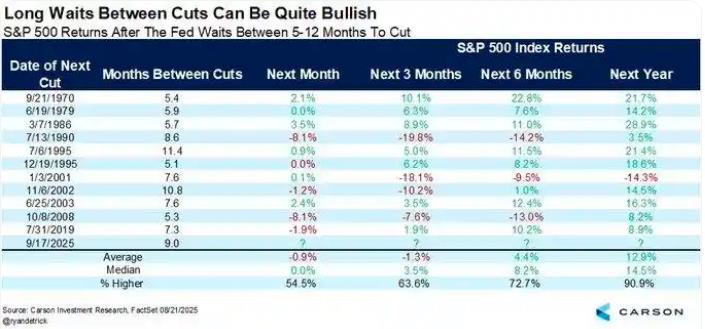
Group 1: Market Reaction to Fed Signals - The market's risk appetite was significantly boosted following Fed Chair Powell's dovish signals at Jackson Hole, with expectations of a rate cut after a 9-month pause [1][4] - Historical data shows that in 11 instances where the Fed resumed rate cuts after a 5-12 month pause, the S&P 500 index rose in 10 cases, averaging a 12.9% increase over the next year [3] Group 2: Employment and Economic Indicators - Initial jobless claims rose to 1.972 million, the highest level since November 2021, indicating potential layoffs and a softening labor market [3] - The upcoming release of the July Personal Consumption Expenditures (PCE) price index and the August non-farm payroll report will be critical for assessing inflation and employment dynamics [6] Group 3: Investment Strategies and Sector Performance - Investors are currently focused on how many times the Fed will cut rates and the pace of these cuts, with concerns about the labor market outweighing inflation worries [7] - The technology sector is facing scrutiny, with a high P/E ratio of around 30, and warnings that 95% of companies investing in AI have not seen returns [7] - Small-cap stocks, particularly those with more floating-rate debt, are expected to benefit from lower interest rates, as evidenced by the Russell 2000 index outperforming major indices [8]

美联储戴利:如果没有关税措施 将考虑进行利率正常化
news flash· 2025-06-20 20:08
Core Viewpoint - Concerns regarding the impact of tariffs on inflation are not as severe as initially announced, indicating a potential shift in monetary policy considerations [1] Group 1 - The Federal Reserve's Daly suggests that if tariff measures are not in place, the normalization of interest rates will be considered [1] - Continuous decline in inflation is viewed as positive news [1]
通胀降温太快 挪威央行突然降息 克朗应声下跌
Xin Hua Cai Jing· 2025-06-19 11:56
Group 1 - The Norwegian central bank has decided to lower the policy interest rate from 4.5% to 4.25%, marking the first rate cut since the COVID-19 pandemic, indicating increased confidence in the decline of inflation [1] - The central bank anticipates further rate cuts in 2025, with projections suggesting the policy rate could drop to just below 4% by the end of 2025 and around 3% by the end of 2028 [1] - Average mortgage rates are expected to decrease from the current 5.6% to 4.6% by 2028 [1] Group 2 - Although the central bank believes a restrictive policy is still necessary, it is now in a position to cautiously normalize interest rates while ensuring inflation returns to target levels without overly restricting the economy [2] - The central bank's governor emphasized the commitment to achieving the inflation target of 2%, with policy adjustments to be made based on economic performance [2] - Geopolitical conflicts and changes in trade policies may lead to financial market volatility, impacting both the global and Norwegian economic outlook [2]
日本释疑利率政策国际白银遇阻回落
Jin Tou Wang· 2025-06-10 02:35
Group 1 - The international silver price is currently trading below $36.30, with a recent opening at $36.72 per ounce and a current price of $36.43, reflecting a decrease of 0.83% [1] - The highest price reached today was $36.81 per ounce, while the lowest was $36.29 per ounce, indicating a short-term bearish trend in the silver market [1] - Recent data shows that Japan's Q1 actual GDP annualized contraction rate has narrowed to 0.2%, significantly improving from the initial value of -0.7%, which exceeded market expectations [2] Group 2 - The Japanese government is considering measures to strengthen fiscal credibility in response to rising government debt financing costs as interest rates increase [2] - Japan's government plans to initiate low-yield bond repurchase operations to alleviate pressure from soaring long-term bond yields, aligning with previous policies to reduce long-term bond supply [2] - Japanese investors significantly reduced their holdings in German bonds by 1.48 trillion yen in April, the highest since 2014, and also recorded the largest monthly sell-off of U.S. bonds in nearly six months, amounting to 1.07 trillion yen [2] Group 3 - The international silver price recently surged, breaking through $36.69 per ounce, marking a new high since 2012, with an intraday increase of 2.00% [3] - Key resistance levels for silver are identified at $37.00-$37.50 per ounce, with potential further challenges towards the $40 mark, while short-term support is noted at $35.50-$36.00 per ounce [3]
5月27日汇市晚评:日本央行预计下半年胀将向2%靠拢 日元延续日内跌势
Jin Tou Wang· 2025-05-27 09:37
Currency Market Overview - The Euro is maintaining significant declines around 1.1350 against the US Dollar, while the British Pound faces selling pressure below 1.3550 [1] - The Japanese Yen continues to decline, moving away from a one-month high reached earlier in the day [1] - The Australian Dollar is experiencing a pullback after reaching a year-to-date high, while the New Zealand Dollar struggles to break through the year-to-date high of 0.6030 [1] - The US Dollar is rebounding against the Canadian Dollar from a seven-month low, approaching the previous support area of 1.3750-1.3765, where bulls may face challenges [1] Economic Indicators - Germany's Gfk Consumer Confidence Index for June recorded -19.9, marking the highest level since November 2024 [2] - The German economy is expected to contract by 0.3% this year, with inflation projected at 2.1% in 2025, down from 2.2% in 2024 [3] - The European Central Bank's President Lagarde stated that US policies provide opportunities to enhance the global status of the Euro [3] - The Bank of Japan has lost its position as the world's largest creditor for the first time in 34 years, with Finance Minister Kato emphasizing the importance of currency stability reflecting fundamentals [3][4] Monetary Policy Insights - The Bank of Japan is considering adjustments to its bond issuance plan, potentially reducing the issuance of ultra-long bonds [4] - The Bank of Japan's Governor Ueda has lowered economic and inflation outlooks due to increasing uncertainties, particularly related to trade policies, but still expects inflation to gradually approach 2% in the latter half of the forecast period [4] - The Bank of Israel has maintained its interest rate unchanged for the 11th consecutive time [6] - The Swedish central bank's Deputy Governor Jansson anticipates that the recent strengthening of the Swedish Krona will continue [7] Market Expectations - A Reuters survey indicates that 36 economists expect the Bank of Korea to lower its benchmark interest rate by 25 basis points to 2.50% on May 29, with a forecast of a total reduction of 75 basis points to 2.00% by the end of Q4 2025 [7] - The General Manager of the Bank for International Settlements, Carstens, stated that central banks should not expect to stabilize inflation in a very short time frame, emphasizing the need for fiscal authorities to manage rising public debt [7] Technical Analysis - The Euro/Dollar pair shows a "inverted hammer" pattern, indicating temporary bearish pressure, with a critical support level at 1.1300 that must be broken for further declines [8] - The Pound/Dollar pair's sustained breakthrough above 1.3434/44 could signal a continuation of upward momentum, targeting levels of 1.3643/1.3748 [8] - The Australian Dollar/Dollar pair has broken out of a symmetrical triangle pattern, leading to increased volatility and upward movement, supported by a bullish trend indicated by the 20-day EMA around 0.6426 [10]