原材料价格上涨

Search documents
欧姆龙宣布涨价,涨幅最高50%!
Xin Lang Cai Jing· 2026-02-08 10:26
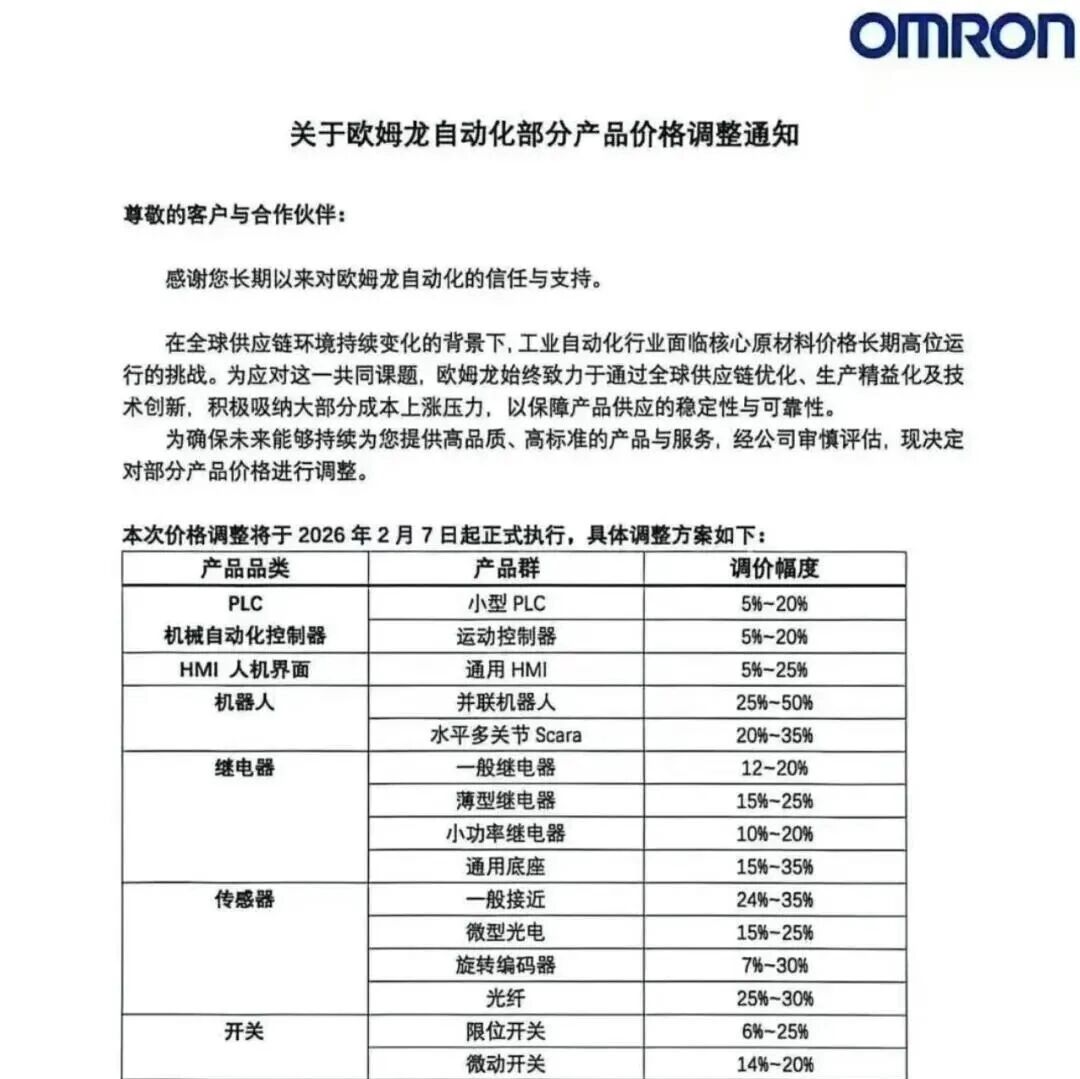
Core Viewpoint - Omron announced a price adjustment for various automation products, with increases ranging from 5% to 50%, effective February 7, 2026, due to ongoing challenges in the global supply chain and high raw material costs [1][3][7]. Group 1: Price Adjustment Details - The price increase will affect a wide range of products, including PLCs, motion controllers, robots, relays, sensors, switches, and temperature controllers [1][3]. - Specific price adjustment ranges for different product categories include: - PLCs: 5%-20% - Motion Controllers: 5%-20% - Robots: 25%-50% - Sensors: 7%-35% - Relays: 10%-25% [7][8]. Group 2: Reasons for Price Increase - The company cited the ongoing changes in the global supply chain and the long-term high prices of core raw materials as the primary reasons for the price adjustments [3][7]. - Omron has been focusing on global supply chain optimization, lean production, and technological innovation to absorb most of the cost increases while ensuring product supply stability and reliability [3][8].

欧姆龙宣布涨价!
国芯网· 2026-02-07 13:10
Core Viewpoint - Omron has announced a price increase for several products in its automation segment, with price hikes ranging from 5% to 50%, effective February 7, 2026, due to long-term high prices of core raw materials in the global supply chain [2][4][9]. Group 1: Price Adjustment Details - The price adjustments will affect various product categories, including: - Small PLCs: 5%-20% increase - Motion controllers: 5%-20% increase - General HMI: 5%-25% increase - Parallel robots: 25%-50% increase - Scara robots: 20%-35% increase - General relays: 12%-20% increase - Small power relays: 10%-20% increase - General bases: 15%-35% increase - Proximity sensors: 24%-35% increase - Miniature photoelectric sensors: 15%-25% increase - Rotary encoders: 7%-30% increase - Fiber optics: 25%-30% increase - Limit switches: 6%-25% increase - Micro switches: 14%-20% increase - Temperature sensors: 5%-10% increase [5][6]. Group 2: Reasons for Price Increase - The price increase is attributed to ongoing changes in the global supply chain, which have led to sustained high prices for core raw materials. Omron is committed to optimizing its global supply chain, improving production efficiency, and innovating technology to absorb most of the cost pressures while ensuring stable and reliable product supply [4][9].
GGII:2025年中国储能锂电池出货量630GWh 同比增幅达85%
Zhi Tong Cai Jing· 2026-02-06 11:35
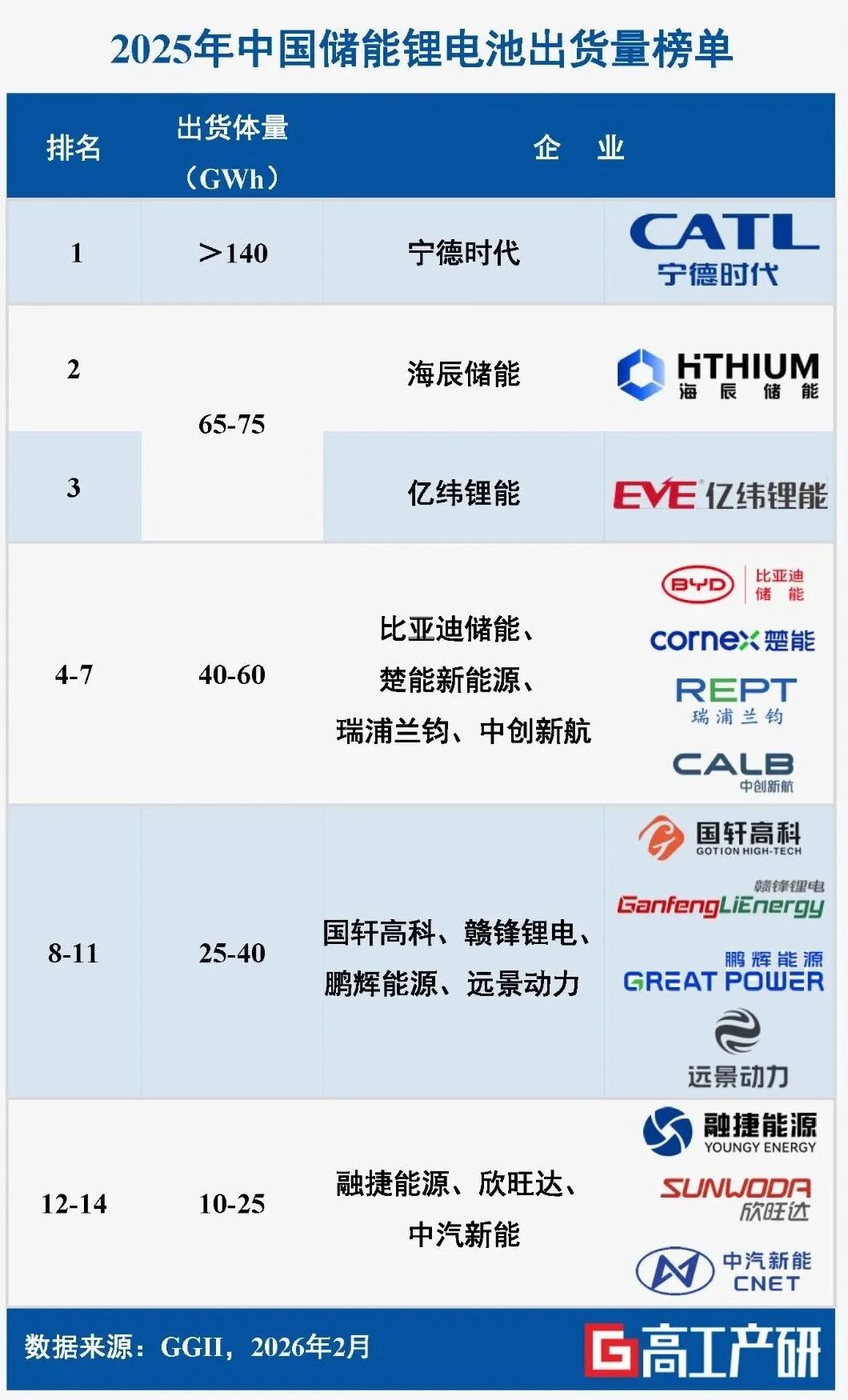
Core Viewpoint - The Chinese energy storage lithium battery market is expected to experience significant growth in 2025, with a shipment volume of 630 GWh, representing an 85% year-on-year increase, and maintaining over 90% of the global market share [1][4]. Group 1: Market Growth Drivers - The growth is driven by three main factors: the gradual exit of mandatory storage policies and the acceleration of independent storage projects in the domestic market, transitioning the industry from "passive configuration" to "active investment" [4]. - The overseas market is boosted by the U.S. installation surge, demand release in emerging markets, and the end of inventory depletion in overseas household storage, leading to strong order growth [4]. - New application scenarios, such as data centers, are contributing to the continuous increase in demand for energy storage cells [4]. Group 2: Competitive Landscape - The top 10 companies in China's energy storage lithium battery shipments for 2025 include CATL, BYD, Hicharge, EVE Energy, and others, which also rank among the top globally [1][2]. - The competition in the household storage lithium battery market in 2025 will focus on specialized production capacity and large-scale delivery capabilities, solidifying the market share and industry position of leading companies [5]. Group 3: Future Trends - In 2026, the household storage lithium battery market is expected to see a relaxation of capacity constraints, with the establishment of a dual mainline product matrix as 100Ah and 314Ah cells become standard options [4][5]. - The global supply chain layout is accelerating, with localized production becoming a key strategy to address trade barriers and raw material sourcing requirements in overseas markets [5]. - The penetration rate of large capacity cells (500+ Ah) is projected to exceed 20% in 2026, with most manufacturers expected to achieve mass production by the second half of the year [9]. Group 4: Market Projections - The energy storage battery market is anticipated to maintain a high growth trend into 2026, with an expected shipment of over 850 GWh, although capacity pressure will remain significant in the first half of the year [8][11]. - The price of energy storage cells is projected to increase by approximately 3-6 cents per Wh due to rising costs of key raw materials, which will be passed down to downstream procurement costs [12].




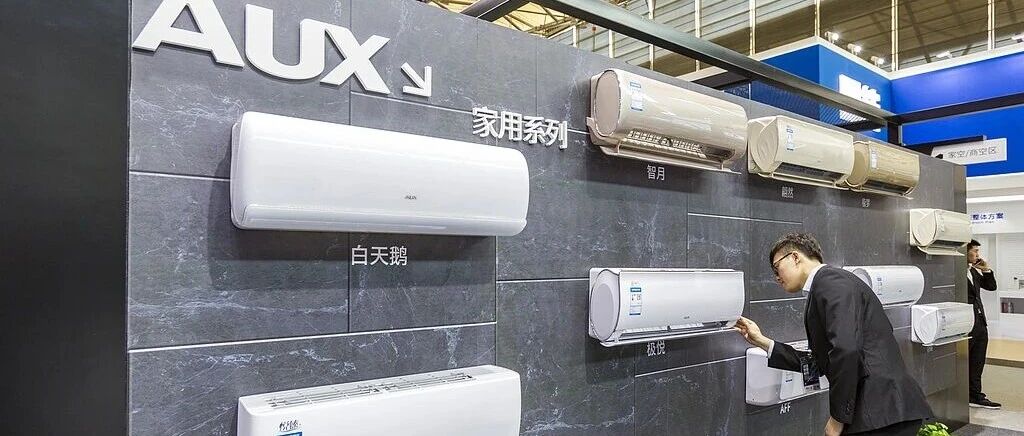
奥克斯中央空调,将提价6%-10%
财联社· 2026-02-05 08:35
Core Viewpoint - AUX Electric has announced a price adjustment for its central air conditioning products due to significant increases in raw material costs, with price hikes ranging from 6% to 10% effective March 1, 2026 [1]. Group 1: Price Adjustment Announcement - AUX Electric issued a notice regarding price adjustments for 2026, citing a substantial rise in the costs of key raw materials since early 2025 [1]. - The company reported a 40% increase in copper prices, a 20% increase in aluminum prices, and an 80% increase in refrigerant prices, leading to a surge in procurement costs and operational pressure [1]. - Orders placed before February 28, 2026, will still be honored at the original prices, providing a temporary relief for customers [1].
“围剿”中国工厂
3 6 Ke· 2026-02-05 05:27
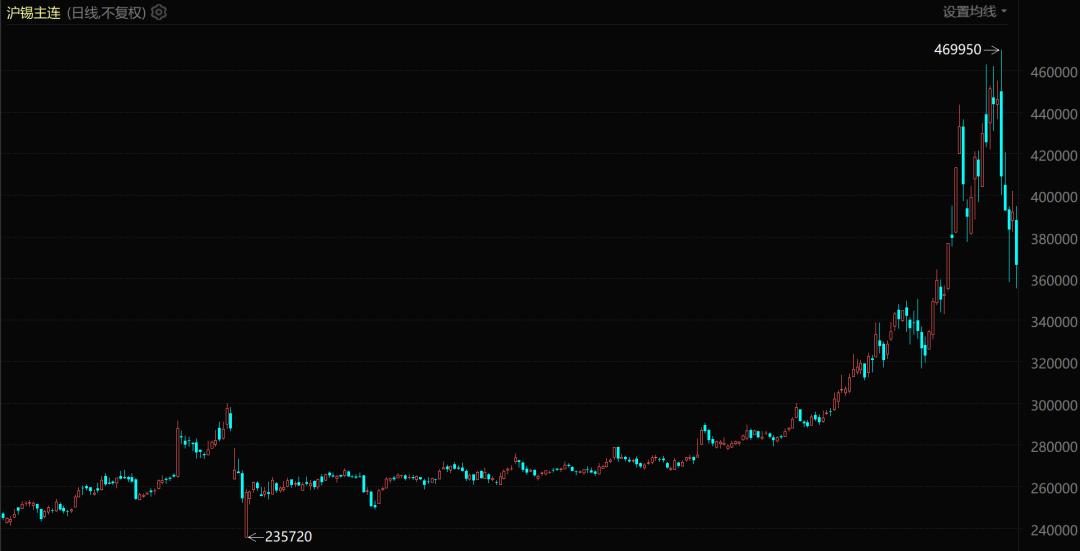
Core Viewpoint - The surge in metal prices, particularly copper, is significantly impacting downstream manufacturing industries in China, leading to squeezed profit margins for manufacturers while upstream companies benefit from rising raw material prices [3][5][9]. Group 1: Price Surge in Raw Materials - In 2025, copper prices increased by 34.34%, and the upward trend continued into 2026 [2]. - The price of lithium carbonate, essential for electric vehicle batteries, skyrocketed from 75,700 yuan per ton in January 2025 to 175,250 yuan per ton by January 23, 2026, marking a 131.4% increase [7]. - Tungsten concentrate prices surged to 520,000 yuan per ton, while tungsten carbide prices rose from approximately 300,000 yuan per ton to 1,200,000 yuan per ton [7]. Group 2: Impact on Manufacturing Industries - The home appliance industry is heavily affected by rising copper prices, with copper accounting for over 20% of the total cost of air conditioners. The copper price reached 105,020 yuan per ton in February 2026, up 42.25% from early 2025, leading to an 8.45% increase in air conditioner costs [10]. - The electric vehicle industry faces significant cost inflation, with UBS reporting that the cost increase for pure electric vehicles (BEVs) due to metal prices alone is approximately 5,600 yuan per vehicle, primarily driven by lithium price increases [12]. - The automotive industry's single vehicle gross profit was only 13,000 yuan in 2025, making it challenging for manufacturers to pass on rising costs to consumers amid fierce competition [13]. Group 3: Upstream vs. Downstream Dynamics - Upstream mining companies are experiencing explosive profit growth due to rising raw material prices, with Zijin Mining forecasting a net profit of 51 to 52 billion yuan for 2025, a year-on-year increase of 59% to 62% [8]. - In contrast, manufacturing companies are facing unprecedented cost pressures, leading to a decline in profit margins. The manufacturing sector's profit margin was only 4.7% in 2025, compared to 15.9% for the mining sector [21][19]. - The overall revenue of China's industrial enterprises has been increasing, but profit margins have been declining, indicating a challenging environment for manufacturers [19][21]. Group 4: Strategies for Survival and Growth - Many Chinese manufacturing companies are exploring ways to extend their business scope internationally, moving beyond low-end products to high-value items like electric vehicles and industrial robots [24]. - Some companies are actively integrating vertically by acquiring upstream resources, such as copper mines, to mitigate the impact of rising raw material prices [24]. - Technological advancements are also being pursued, with companies investing in alternatives to reduce dependency on expensive raw materials, such as the development of sodium-ion batteries [26].





日清食品(01475):溢满之杯
citic securities· 2026-02-04 12:20
Investment Rating - The report maintains a positive outlook on Nissin Foods, indicating strong quarterly performance and consistent sales guidance for the fiscal year 2026 [4][5]. Core Insights - Nissin Foods reported robust quarterly results with sales of 213 billion JPY and operating profit of 21.6 billion JPY for Q3 FY2026, exceeding market expectations [4]. - The company’s sales in the U.S. market grew by 5%, marking the first positive growth in five quarters, which contributed to the overall positive market reaction [4]. - Nissin's overseas sales increased by 5.3% to 75.3 billion JPY, with the Americas showing an 8.4% growth, while the Chinese market experienced a decline of 2.3% [5]. Summary by Sections Financial Performance - For Q3 FY2026, Nissin Foods achieved sales of 213.3 billion JPY (up 4.5% year-on-year) and operating profit of 21.6 billion JPY (up 14.6% year-on-year), aligning with market expectations [4]. - The company maintained its full-year guidance, projecting sales of 792 billion JPY (up 2.0% year-on-year) and core operating profit of 68.5 billion JPY (down 18.0% year-on-year) [5]. Business Segments - Nissin's overseas business, including the Americas, China, Asia, and EMEA, reported a sales increase of 5.3% to 75.3 billion JPY, with a notable operating profit margin of 12.8% [5]. - The U.S. market's sales growth was driven by a 3.8% same-store sales increase, while the Brazilian market also saw a 5% increase [5]. Market Position - As of February 3, 2026, Nissin Foods' stock price was 3,253 JPY, with a market capitalization of 5.57 billion USD [10]. - The company has a strong asset base of 812 billion JPY and is focused on maintaining a significant share of its sales from domestic operations [8].
国信证券:原材料价格上涨对白电龙头影响有限 白电排产表现有所修复
智通财经网· 2026-02-03 07:32
Core Viewpoint - Recent increases in raw material prices, particularly copper and aluminum, have raised concerns about the profitability of leading white goods companies, but historical data suggests that the negative impact on gross margins may diminish over time [1][2] Group 1: Raw Material Price Impact - Since 2008, the home appliance industry has experienced three significant raw material price increase cycles, with the impact on gross margins decreasing over time: the highest quarterly gross margin decline was 5-7 percentage points during 2009-2011, around 5 percentage points in 2016-2017, and approximately 2 percentage points from 2020-2022 [1] - In January 2026, copper and aluminum prices increased by 36.7% and 20.9% year-on-year, respectively, which is lower than the increases seen from 2020-2022, suggesting that the current raw material cost impact on white goods companies may be less severe [2] Group 2: Production and Demand Trends - In February, the total production of white goods in China reached 23.79 million units, a 22.1% decrease compared to the same period last year, with a projected 5.0% decline for January-February combined [3] - The production performance of white goods has shown signs of recovery, with the impact of the Spring Festival timing affecting February production, but cumulative growth for January-February has slightly improved [3] Group 3: Retail Market Performance - In 2025, the retail scale of China's home appliance market is expected to decline by 4.3% year-on-year to 893.1 billion yuan, with specific categories like air conditioners and refrigerators experiencing declines of 0.4% and 11.5%, respectively [4] - Small home appliances are expected to perform better, with an overall retail growth of 3.8%, indicating a relative resilience compared to larger appliances [4] Group 4: Key Data Tracking - In January, the home appliance sector experienced a relative return of -2.6%, with raw material prices for copper and aluminum increasing by 7.8% and 4.8% month-on-month, respectively [5] Group 5: Investment Recommendations - Recommended stocks in the white goods sector include Midea Group, Haier Smart Home, TCL Smart Home, and Hisense Home Appliances, while TCL Electronics and Hisense Visual are recommended in the black goods sector [6]


原材料价格上涨对白电龙头影响有限,白电1-2月排产增速环比改善
Zhong Guo Neng Yuan Wang· 2026-02-03 02:01
Core Viewpoint - Recent increases in copper and other raw material prices have raised concerns about the profitability of leading white goods companies. However, historical analysis shows that the negative impact of rising raw material costs on gross margins has gradually diminished, and these companies are expected to maintain profitability through structural adjustments and cost savings [2]. Group 1: Raw Material Price Impact - Since 2008, the home appliance industry has experienced three significant raw material price increase cycles, with the impact on gross margins decreasing over time. During the 2009-2011 cycle, the maximum quarterly gross margin decline for leading white goods companies was 5-7 percentage points; in the 2016-2017 cycle, it was around 5 percentage points; and in the 2020-2022 cycle, it was limited to a maximum of 2 percentage points [2]. - In January 2026, the average monthly closing prices for copper and aluminum on the SHFE increased by 36.7% and 20.9% year-on-year, respectively. This increase is lower than that observed during the 2020-2022 period, suggesting that the current impact on white goods companies may be less severe, with an expected gross margin decline of less than 2 percentage points [2]. Group 2: Production and Demand Trends - In February, the total production of white goods in China reached 23.79 million units, a year-on-year decrease of 22.1%. The cumulative production for January and February is expected to decline by 5.0%. Compared to the over 10% decline in production in Q4 2025, the production performance of white goods has shown signs of recovery [3]. - The production of air conditioners, refrigerators, and washing machines has seen varying declines, with air conditioners down 31.6% year-on-year, refrigerators down 17.0%, and washing machines down 3.2%. The cumulative decline for January and February is 10.3%, 6.4%, and 2.4%, respectively. The impact of the Spring Festival has pressured production, but the cumulative growth rate has slightly improved [3]. Group 3: Retail Market Performance - In 2025, the retail scale of China's home appliance market was 893.1 billion yuan, a year-on-year decline of 4.3%. The retail sales of air conditioners, refrigerators, and washing machines decreased by 0.4%, 11.5%, and 4.6%, respectively. However, small home appliances performed better, with an overall retail sales increase of 3.8% [4]. - The market performance in January showed a relative return of -2.6% for the home appliance sector. The prices of copper and aluminum increased by 7.8% and 4.8% month-on-month, while cold-rolled steel prices decreased by 0.5% [4]. Group 4: Investment Recommendations - Recommended investments in the white goods sector include Midea Group, Haier Smart Home, TCL Technology, and Hisense Home Appliances. For the black goods sector, TCL Electronics and Hisense Visual are recommended, while for small appliances, Stone Technology, Bear Electric, and Xinbao Co. are suggested [5].
家电行业 2026 年 2 月投资策略:原材料价格上涨对白电龙头影响有限,白电 1-2 月排产增速环比改善
Guoxin Securities· 2026-02-02 11:09
Core Views - The report maintains an "Outperform" rating for the home appliance industry, indicating a positive outlook despite challenges from rising raw material prices and market competition [1][5][11]. Raw Material Price Impact - Recent increases in copper and aluminum prices have raised concerns about the profitability of leading white goods manufacturers. However, historical analysis shows that the negative impact of raw material cost increases on gross margins has diminished over time. For instance, during previous cycles from 2008 to 2022, the maximum quarterly gross margin decline for leading white goods companies was 5-7 percentage points in 2009-2011, around 5 percentage points in 2016-2017, and only about 2 percentage points in 2020-2022. The current price increases are expected to have a lesser impact, with an anticipated gross margin decline of less than 2 percentage points [1][17][18]. Production and Demand Trends - In January and February 2026, the total production of white goods in China was 23.79 million units, reflecting a year-on-year decline of 22.1%. However, the cumulative production decline for the first two months is expected to be around 5%. The production performance has shown signs of recovery compared to a more than 10% decline in Q4 2025. The demand is expected to stabilize due to the effects of national subsidy policies [2][24]. Retail Market Performance - The retail market for home appliances in China is projected to decline by 4.3% in 2025, with a total retail scale of 893.1 billion yuan. Specific categories such as air conditioners and refrigerators are expected to see declines of 0.4% and 11.5%, respectively, while small kitchen appliances are expected to grow by 3.8% [2][31]. Investment Recommendations - The report recommends several companies for investment based on their performance and market position. For white goods, companies like Midea Group, Haier Smart Home, TCL Home, and Hisense Home Appliances are highlighted. In the small appliance sector, Stone Technology, Bear Electric, and New Treasure are recommended. For black goods, TCL Electronics and Hisense Visual are suggested [3][12][50]. Company Earnings Forecasts - The report provides earnings forecasts for key companies, indicating that Midea Group is expected to have an EPS of 5.84 yuan in 2025 and 6.43 yuan in 2026, with a PE ratio of 13 for 2025. Haier Smart Home is projected to have an EPS of 2.27 yuan in 2025 and 2.53 yuan in 2026, with a PE ratio of 11 for 2025 [4][50].

科达利:原材料价格上涨对公司会有一定影响
Zheng Quan Ri Bao Zhi Sheng· 2026-01-30 11:41
Group 1 - The core viewpoint of the article is that the company KedaLi acknowledges the impact of rising raw material prices on its operations and outlines strategies to mitigate this effect [1] Group 2 - The company plans to expand production capacity as a response to the rising costs of raw materials [1] - KedaLi aims to innovate its technology and improve production processes to counteract the impact of increased raw material prices [1] - The company will also enhance its management practices to further reduce the adverse effects of raw material price hikes [1]