和而不同

Search documents
从刀兵相见到文化相融
Xin Lang Cai Jing· 2025-12-26 16:58
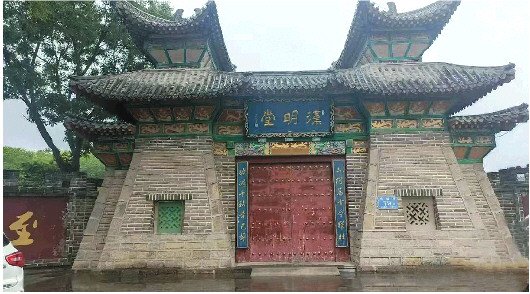
Core Viewpoint - The article discusses the historical significance of the meeting at Jiagu Valley in 500 BC between the states of Qi and Lu, highlighting how it transformed from a potential diplomatic crisis into a cultural victory, reflecting the complex interplay of geography, economy, and ideology in shaping Chinese civilization [2]. Group 1: Historical Context - The meeting at Jiagu Valley was a critical event in the long-standing rivalry and eventual cultural integration between the states of Qi and Lu, showcasing their differing philosophies and approaches to governance [3][6]. - The meeting was marked by tension, as Qi's strategy involved using the military might of the conquered Lai people to intimidate Lu, which was countered by Confucius's diplomatic skills [4][5]. Group 2: Diplomatic Maneuvers - Confucius, serving as the chief advisor, prepared for potential conflict by advocating for military readiness alongside diplomatic efforts, demonstrating a blend of cultural and military strategy [4]. - During the meeting, Confucius effectively used rhetoric to elevate the discussion to a moral and civilizational level, challenging Qi's actions and ultimately leading to the withdrawal of the Lai soldiers [5]. Group 3: Cultural Differences - The article outlines the fundamental cultural differences between Qi and Lu, with Qi emphasizing pragmatism and economic development, while Lu focused on ritual, ethics, and moral governance [6][7]. - The clash of these cultural values was evident during the meeting, where Qi's casual approach to entertainment was seen as a violation of the solemnity of the occasion by Confucius [7]. Group 4: Long-term Implications - The aftermath of the meeting saw Lu not only avoid disaster but also reclaim lost territories, marking a significant diplomatic victory for Confucius and Lu [5]. - The ongoing cultural dialogue between Qi and Lu, exemplified by the establishment of the Jixia Academy, facilitated a deeper integration of their philosophies, leading to the emergence of a more sophisticated cultural synthesis known as "Ren-Zhi" culture [8].

长线思维下的文明演变及体制韧性
经济观察报· 2025-12-24 10:24
Group 1 - The core idea of the article emphasizes the need to awaken long-term awareness among voters and shareholders, integrating long-term elements into social contracts and performance evaluation systems for corporate leaders [2][3] - Long-termism focuses on historical scales of centuries or even millennia, addressing the evolution of civilization, resilience of national systems, and long-term prosperity [2][4] - The article advocates for promoting long-term thinking as a starting point to address significant challenges facing humanity today [2][5] Group 2 - The "Axial Age" concept introduced by philosopher Karl Jaspers highlights the independent development of four major civilizations, laying the foundation for human society [4] - The fusion of Greek and Hebrew civilizations, referred to as "Two希文明," played a crucial role in the Renaissance, religious reform, and the birth of modern thought and science [4][5] - The article discusses the liberation from "theocracy" and "monarchy" as pivotal moments that shaped modernity and modern civilization [7][10] Group 3 - The Renaissance marked the beginning of humanism, shifting societal focus from the divine to human-centered values, fostering individual freedom and dignity [7][8] - The Reformation initiated by Martin Luther challenged the Catholic Church, leading to the establishment of religious freedom and the principle of state sovereignty [8][11] - Enlightenment thinkers contributed to the development of modern values such as freedom, equality, and democracy, which became foundational to modern education and governance [11][12] Group 4 - The article highlights the importance of institutional resilience in navigating significant changes and challenges, using the United States, Japan, and Argentina as case studies [18][27] - The U.S. has demonstrated strong institutional resilience, successfully adapting to major changes since the Industrial Revolution, while Japan and Argentina faced significant economic challenges [20][25] - The concept of "institutional resilience" is proposed as a key factor in understanding national competitiveness and long-term growth [27][29] Group 5 - The article suggests that China's long-term policies since the reform and opening up in 1978 have contributed significantly to its economic achievements [29][30] - It emphasizes the need for China to continue leveraging long-term thinking to address global challenges and contribute to future developments [30]

文质彬彬·每日好词语 | 求同存异
Xin Lang Cai Jing· 2025-12-19 23:34
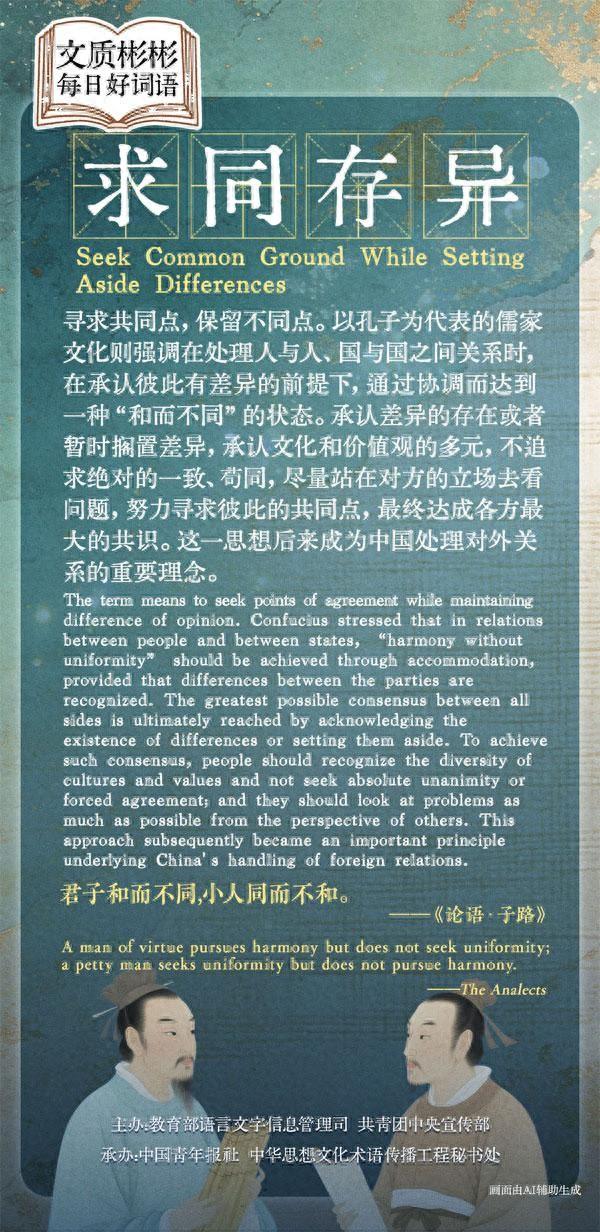
君子和而不同小人同而不和。 《读语 · 于路》 Seek Common Ground While Setting Aside Differences 寻求共同点,保留不同点。以孔子为代表的儒家 文化则强调在处理人与人、国与国之间关系时, 在承认彼此有差异的前提下,通过协调而达到 种"和而不同"的状态。承认差异的存在或者 暂时搁置差异,承认文化和价值观的多元,不追 求绝对的一致、苟同,尽量站在对方的立场去看 同题,努力寻求彼此的共同点,最终达成各方最 大的共识。这一思想后来成为中国处理对外关 系的重要理念。 The term means to seek points of agreement while maintaining difference of opinion. Confucius stressed that in relations between people and between states, "harmony without uniformity" should be achieved through accommodation, provided that differences bet ...
文明互鉴论坛发布《澳门倡议》,为全球提供“和而不同”东方智慧
2 1 Shi Ji Jing Ji Bao Dao· 2025-12-18 09:02
(原标题:文明互鉴论坛发布《澳门倡议》,为全球提供"和而不同"东方智慧) 南方财经 21世纪经济报道记者田静 澳门报道 12月17日,为期两天的首届"文明互鉴国际论坛"在澳门闭幕。论坛期间发布了《文明互鉴与传承创新: 澳门倡议》(下称《澳门倡议》)重要成果文件,为全球文明对话贡献了澳门智慧与方案。 本次论坛汇聚了近10个国家及地区的超过50名代表,涵盖政府部门、国际组织及顶尖专家学者。围 绕"文明互鉴与传承发展"这一核心主题,与会者通过逾20场专题演讲与学术交流,展开了多层次、宽领 域的深度对话。 《澳门倡议》立足澳门"以中华文化为主流、多元文化共存"的独特发展定位,明确提出以澳门为纽带、 以文化遗产为见证、以对话为桥梁,推动不同文明相互欣赏、和谐共生、合作共赢。倡议内容涵盖五方 面:立足全球视野,推动文明对话与经验共享;弘扬开放包容,深化互学互鉴与人文交流;珍视文化遗 产,促进传统智慧与现代发展相融合;聚焦代际传承,支持青年成长与数字化创新;共建文明对话平 台,积极践行全球文明倡议。 中国社会科学院学部委员、中国历史研究院副院长李国强指出,澳门文化史可追溯至6000多年前,而近 400多年的中西文明交流互鉴 ...
特稿丨宝船作序 文化和鸣——中非文明对话续写时代新篇
Xin Hua She· 2025-12-15 06:46
Core Viewpoint - The article emphasizes the historical and cultural significance of the Zheng He treasure ship model as a symbol of Sino-African dialogue and cooperation, highlighting the long-standing relationship between China and Africa through cultural exchanges and mutual understanding [1][2][5]. Group 1: Historical Context - Zheng He, a Chinese navigator from the Ming Dynasty, made seven voyages to the West, reaching the eastern coast of Africa and the Red Sea, which marked a significant chapter in the history of Sino-African cultural exchanges [1]. - The treasure ship model gifted by former Seychelles President James Michel symbolizes the enduring legacy of these exchanges and the principles of equality, mutual respect, and dialogue [2][5]. - Archaeological findings in Kenya and Tanzania reveal that Chinese artifacts, such as Tang Dynasty porcelain, predate Zheng He's voyages, indicating a long history of interaction between the two civilizations [2][3]. Group 2: Modern Implications - The principles of "harmony in diversity" and "mutual respect" are highlighted as essential for contemporary Sino-African relations, contrasting with the colonial narratives of Western exploration [5][9]. - The establishment of the "Future Port" in Kilwa, built by Chinese enterprises, represents modern cooperation and development between China and Africa [3]. - The upcoming 2026 "Year of Sino-African Cultural Exchange" aims to strengthen ties through various cultural activities, fostering deeper connections between the peoples of both regions [8]. Group 3: Academic and Cultural Collaboration - Joint archaeological projects, such as the Sino-Kenyan collaboration on prehistoric studies, are reshaping the understanding of human origins and promoting a more inclusive narrative in global history [6][9]. - Increased academic cooperation and think tank exchanges are enhancing development practices and fostering a shared vision for modernization that respects cultural uniqueness [9]. - The upcoming events, including the first United Nations "International Day of Civilizational Dialogue," emphasize the importance of dialogue in achieving peace and mutual understanding [6][8].
长线思维下的文明演变及体制韧性
Jing Ji Guan Cha Wang· 2025-12-13 02:28
Group 1 - The article emphasizes the importance of long-term thinking in addressing significant global challenges and the need to integrate long-term elements into social contracts and corporate performance evaluations [2] - It discusses the historical evolution of civilizations, particularly the "Axial Age," which laid the foundation for human development and the emergence of modernity [3][4] - The fusion of Greek and Hebrew civilizations, referred to as "Two希文明," played a crucial role in the Renaissance, the Reformation, and the Enlightenment, leading to the establishment of modern market economies and societal structures [4][5] Group 2 - The article highlights the liberation from "theocracy" during the Renaissance, which shifted societal focus from divine authority to human-centered values, fostering individual freedom and modern humanism [5][6] - It notes that the Reformation initiated by Martin Luther challenged the Catholic Church's authority, leading to the establishment of religious freedom and the principles of state sovereignty [6][7] - The development of modern science and the Industrial Revolution were driven by the interplay between the Renaissance, the Reformation, and the Enlightenment, significantly advancing human progress [7][10] Group 3 - The article outlines the constraints of "monarchy" in Hebrew civilization, where laws governed society, limiting the power of kings and establishing a system of checks and balances [8][9] - It discusses the significance of the Magna Carta in 1215, which marked the beginning of legal limitations on monarchs and the establishment of the principle that no one is above the law [9][10] - Enlightenment thinkers contributed to the evolution of modern democratic values, which laid the groundwork for contemporary governance and societal norms [9][11] Group 4 - The article addresses the resilience of national systems in the face of historical economic challenges, highlighting the importance of adaptability and self-correction in maintaining competitiveness [15][26] - It contrasts the experiences of the United States, Japan, and Argentina, illustrating how systemic resilience has influenced their economic trajectories [18][24] - The concept of "systemic resilience" is proposed as a critical factor for understanding national competitiveness in a rapidly changing global landscape [26][27] Group 5 - The article emphasizes China's long-term policy approach since the reform and opening-up in 1978, which has significantly contributed to its economic achievements [27][28] - It suggests that China can leverage long-term thinking to address global challenges and contribute to sustainable development in the future [28]

联播+|从松园琴音到岷江碧水
Yang Shi Wang· 2025-12-07 00:17
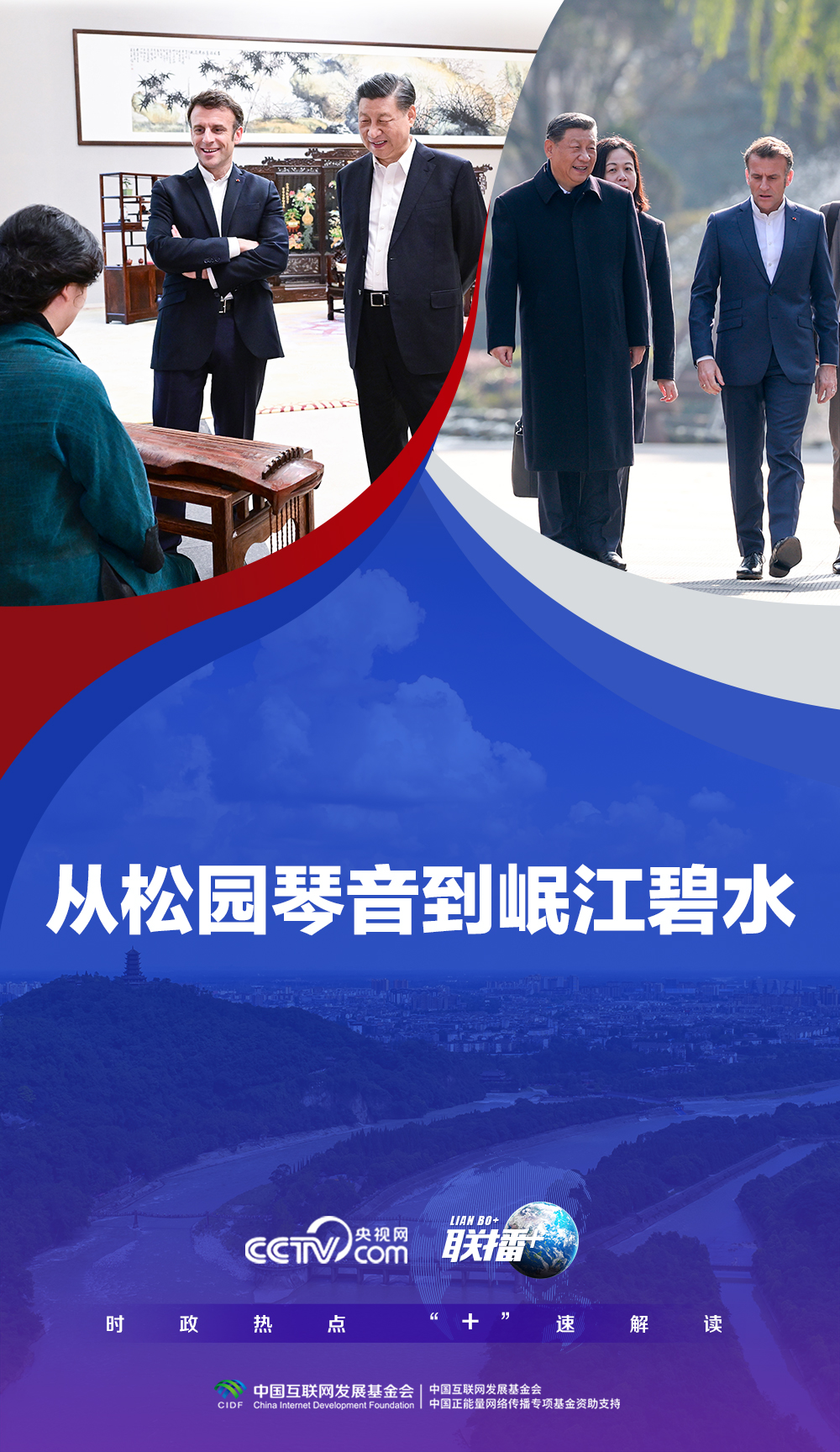
Core Viewpoint - The informal meeting between President Xi Jinping and President Emmanuel Macron at Dujiangyan highlights the importance of cultural exchange and mutual understanding between China and France, using water as a metaphor for cooperation and dialogue [4][6][10]. Group 1: Historical and Cultural Significance - Xi Jinping introduced the historical significance of the Dujiangyan irrigation system, emphasizing its role in water management and its reflection of the spirit of the Chinese people [5][9]. - The meeting draws parallels between the ancient wisdom of water management in China and the resilient spirit of the French people, suggesting a shared understanding and respect between the two nations [9][12]. Group 2: Philosophical Insights - The concept of "Tian Ren He Yi" (the unity of nature and humanity) is highlighted as a guiding principle in governance and water management, showcasing its relevance in contemporary practices [11][12]. - The dialogue emphasizes that both nations can learn from each other's historical experiences and philosophies, particularly in addressing complex global challenges [18]. Group 3: Future Cooperation - Both leaders expressed a commitment to enhancing dialogue and cooperation, aiming to contribute to global peace and stability through mutual respect and understanding [17][18]. - The discussions reflect a broader vision of collaboration that transcends cultural differences, with an emphasis on shared goals for prosperity and development [10][18].
中国学|马豪恩:中国式现代化为何对拉美国家具有借鉴意义?
Zhong Guo Xin Wen Wang· 2025-10-18 07:58
Core Viewpoint - The development experience of China is seen as a valuable reference for Latin American countries, particularly in the context of new productive development policies needed to escape low growth traps and address global geopolitical challenges [1]. Group 1: Insights on China - The importance of understanding China through original Chinese literature rather than Western interpretations is emphasized, as it provides a clearer perspective on contemporary China [2]. - The cultural similarities between Argentina and China are highlighted, suggesting that despite geographical distance, both nations share values such as respect for ancestors, family, and education [4]. Group 2: Chinese Modernization - Chinese modernization is defined as a unique, multi-faceted process that encompasses economic, social, political, technological, and cultural advancements, with a focus on long-term national development goals [6]. - The emphasis on a people-centered economic policy in China, which prioritizes social welfare, poverty alleviation, and environmental protection, is noted as a significant reference for Latin American countries exploring their own modernization paths [5][6]. Group 3: Belt and Road Initiative - The Belt and Road Initiative is recognized for its role in enhancing connectivity in Latin America, which is crucial for activating economic potential in both urban and rural areas [8]. - Over 20 Latin American countries have signed cooperation memorandums with China under the Belt and Road Initiative, indicating its importance in regional economic development [8]. Group 4: Bilateral Cooperation - The potential for higher quality cooperation between Argentina and China is discussed, particularly through technology transfer, which could enhance Argentina's ability to process agricultural and mineral products for export [10].
东西问丨汉学家薄国强:在骑行中感知文化中国
Zhong Guo Xin Wen Wang· 2025-10-01 08:44
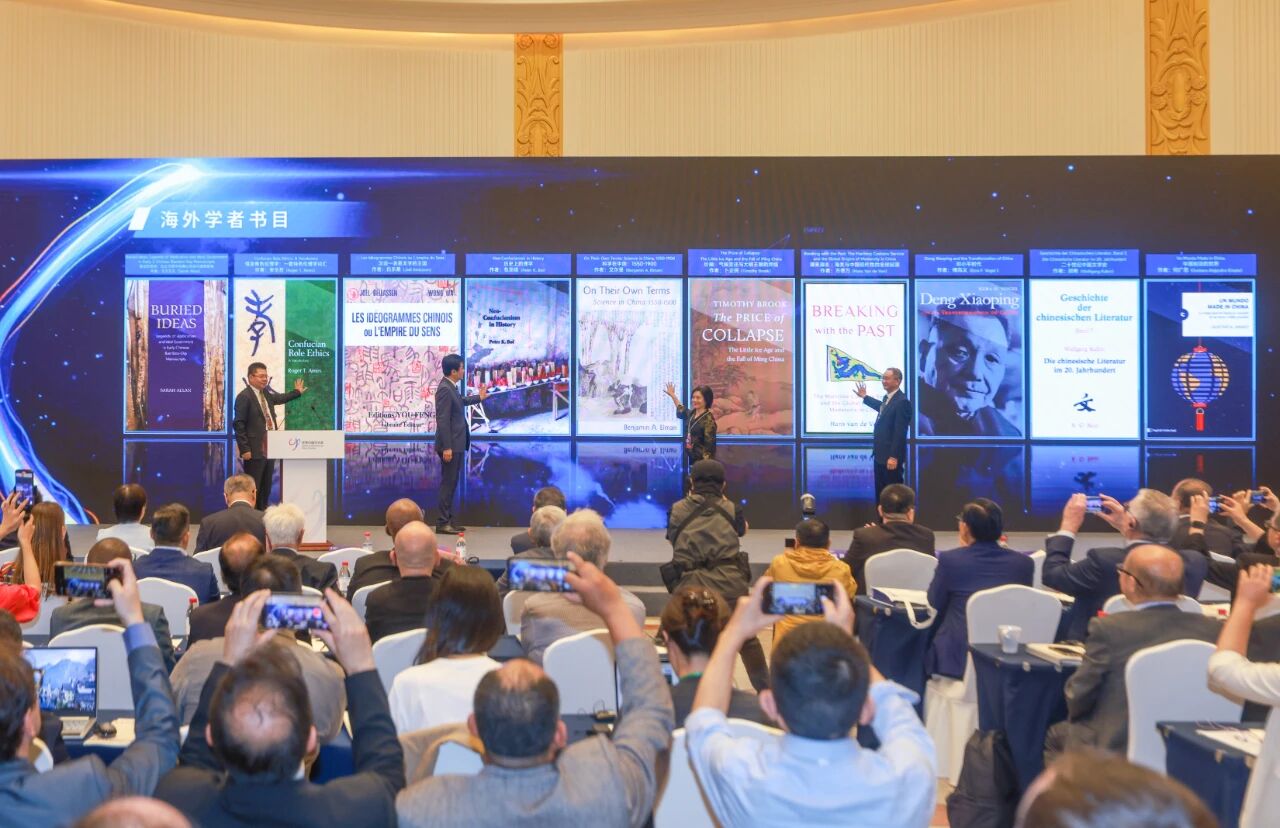
Core Viewpoint - The interview with Roland Boer highlights the significance of cycling as a means to explore and understand Chinese culture, emphasizing the importance of personal experience in comprehending contemporary China [3][5][12]. Group 1: Cycling Experience and Cultural Insights - Boer has cycled extensively across various regions in China, including Beijing, Shanghai, and Hebei, using cycling as a way to engage with local communities and observe rural revitalization efforts [3][5]. - His cycling journeys allow him to experience life in China from a unique perspective, often leading to interactions with friendly villagers and insights into local economic developments, such as the growth of the homestay economy [5][8]. Group 2: Cultural Preservation and Innovation - Boer discusses the dual nature of culture, which requires both stable transmission and creative transformation, citing examples of traditional craftsmanship being revitalized through modern design [8][12]. - He emphasizes the importance of innovative practices in preserving traditional culture, such as the collaboration between local artisans and modern industries to attract younger generations [8][12]. Group 3: Understanding China - Boer stresses that to truly understand contemporary China, one must experience it firsthand, as many Western perspectives lack depth due to the authors' limited engagement with the country [9][12]. - He highlights the growing availability of translated works by Chinese scholars, which can provide more accurate insights into Chinese society and philosophy [9][12]. Group 4: Technology and Cultural Development - Boer addresses the impact of new technologies like artificial intelligence on cultural industries, arguing that these tools should be viewed as opportunities for creative enhancement rather than threats [12][14]. - He notes that the integration of technology into cultural practices can lead to new forms of economic development and cultural expression [12][14]. Group 5: Australia-China Relations - Boer points out the cultural and economic ties between Australia and China, noting that Mandarin is the second most spoken language in Australian households [14]. - He advocates for Australia to adopt China's philosophy of "harmony in diversity" to foster better relationships among its multicultural population [14].

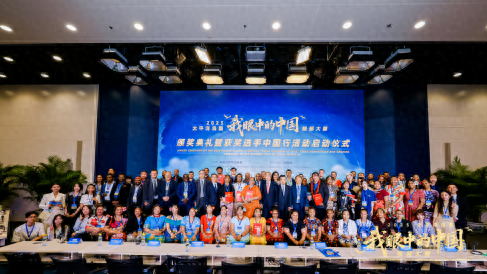
2025年太平洋岛国“我眼中的中国”视频大赛颁奖典礼暨获奖选手中国行活动启动在京举行
Huan Qiu Wang· 2025-09-21 03:01
Core Points - The event "My View of China" video competition aims to enhance cultural exchange between China and Pacific Island countries, serving as a platform for youth dialogue and friendship [1][3][5] - The competition received over 200 entries from 10 Pacific Island countries, with a significant online reach of over 15 million views [14] Group 1 - The event was hosted by the China Public Diplomacy Association and supported by Global Times, marking an important milestone in China-Pacific Island cultural exchanges [1] - Liu Biwei, Vice President of the China Public Diplomacy Association, emphasized the competition as a bridge for mutual understanding and friendship between the two regions [3] - Qian Bo, Special Envoy for Pacific Island Affairs, highlighted the historical ties between China and the Pacific Islands, tracing back thousands of years [5] Group 2 - Tadewus Kambane, Ambassador of Papua New Guinea to China, noted that the competition reflects the deepening friendship between China and Pacific Island nations [7] - Shi Ding, Executive Editor of Global Times, mentioned that the competition allows Pacific Islanders to witness China's vibrant development while showcasing their own stunning natural beauty [9] - The gold medal winner, Bran Kiangali, expressed the importance of showcasing the warm connections between people beyond just infrastructure and trade [11] Group 3 - The event featured a blend of traditional culture and modern technology, including hands-on experiences with Chinese cultural elements and performances by smart robots [12] - Following the award ceremony, winners will visit various regions in China, such as Shandong and Fujian, to further experience China's diverse charm [15]