季节性规律

Search documents
全线避险,黄金历史新高!
Wind万得· 2025-09-02 23:09
Market Overview - The US stock market opened lower on the first trading day of September, with all three major indices declining, indicating increased caution among investors after the summer holiday [1][3] - Gold prices surged by 1.6% to $3,532 per ounce, reflecting strong market risk aversion amid multiple uncertainties, including trade policy changes and rising long-term Treasury yields [1] Index Performance - The Dow Jones Industrial Average fell by 249.07 points, a decrease of 0.55%, closing at 45,295.81 points [3][4] - The S&P 500 index dropped by 0.69%, closing at 6,415.54 points [3][4] - The Nasdaq Composite Index experienced the largest decline, down 0.82% to 21,279.63 points [3][4] Treasury Yields - US Treasury yields rose, with the 2-year yield increasing by 2 basis points and the 10-year yield rising by 4 basis points [5] - The 10-year US Treasury yield reached 4.27%, while the 30-year yield briefly surpassed 4.97%, creating significant headwinds for the stock market [7] Sector Analysis - The recent market pullback has primarily affected previously leading technology stocks, with Nvidia down approximately 2%, and Amazon and Apple each declining nearly 1% [7] - Investors are choosing to take profits amid weakening economic data and unclear Federal Reserve interest rate paths, as well as high valuations [7] Legal and Policy Uncertainty - A recent court ruling declared many tariffs imposed during the Trump administration as illegal, prompting concerns about potential refunds of billions in tariff revenue, which could worsen the already strained fiscal situation [7] - This legal uncertainty has led investors to reassess the US government's fiscal capacity and policy stability, contributing to a shift of funds into the bond market [7] Seasonal Trends - Historically, September has been a weak month for the S&P 500, with an average decline of 4.2% over the past five years and over 2% in the last decade [8] - Despite a strong performance in August, where the S&P 500 reached five historical highs, the optimism did not fully carry into September [8] Employment Data and Fed Policy - Investors are closely watching the upcoming non-farm payroll report for August, which will assess the resilience of the US labor market and may influence the Federal Reserve's policy decisions [9] - Current market expectations suggest a 90% probability of a 25 basis point rate cut by the Federal Reserve in September [11][12] Commodity Outlook - Most institutions remain bullish on gold, with forecasts suggesting prices could reach $3,600 per ounce by the end of next year [15] - In contrast, the outlook for oil prices appears limited, with expectations that OPEC+ will maintain current production levels amid concerns of oversupply [15]


“散户歇了,机构满了”,美股9月风暴将至?
华尔街见闻· 2025-08-07 11:05
Group 1 - The core viewpoint of the article highlights that despite the recent rise in the U.S. stock market, key support forces are showing signs of weakening, leading to potential risks in September [1][21] - Retail investors have been a significant driving force behind the recent rebound in the U.S. stock market, with net buying occurring on 27 out of the last 28 trading days [4][20] - Systematic funds, which have injected over $365 billion into global markets in the past 75 trading days, are nearing their capacity limits, which may reduce their role as stabilizing buyers [9][12] Group 2 - Historical data indicates that retail trading activity typically peaks in June and July, then declines in August, reaching its lowest point in September, suggesting a loss of a key buying force [6][16] - The article warns of a "support vacuum" as retail buying wanes and institutional buying exhausts, particularly in September, which is historically the worst-performing month for the S&P 500 index [2][17] - Despite strong earnings reports, with 85% of companies exceeding expectations, these positive factors may not be enough to counteract the dual pressures from funding and seasonal trends [20][21] Group 3 - The article emphasizes that the market's ability to withstand negative macroeconomic news will be significantly weakened, preparing investors for potential higher volatility [3][21] - The article also notes that volatility control strategies may see a slowdown in buying demand due to recent increases in volatility, while risk parity strategies are returning to historical levels [13][14]

“散户歇了,机构满了”,美股9月风暴将至?
美股IPO· 2025-08-07 04:39
Core Viewpoint - The market may enter a "support vacuum period" as retail buying wanes and institutional buying exhausts, coinciding with historically poor performance in September [2][4]. Group 1: Retail Investor Dynamics - Retail investors have been a significant driving force behind the recent rebound in U.S. stocks, with net buying occurring on 27 out of the last 28 trading days [3]. - Historical data indicates that retail trading activity peaks in June and July, typically slowing down in August and reaching its lowest point in September [7][18]. Group 2: Institutional Investor Trends - Systematic funds have injected over $365 billion into global equity markets over the past 75 trading days, marking the fastest buying pace since the COVID-19 pandemic [11]. - The buying frenzy among systematic funds is nearing its end, with positions expected to be fully exposed by September, limiting their capacity for further accumulation [13]. - Strategies such as CTA, Risk Parity, and Vol-Control are showing reduced ability to increase equity exposure, which could amplify any selling pressure once these buyers withdraw from the market [13][14][15]. Group 3: Seasonal Market Risks - September is historically the worst month for the S&P 500, with increased market volatility typically observed during this period [18]. - Despite strong earnings reports, with 85% of companies exceeding expectations, these positive factors may not be sufficient to counteract the dual pressures from funding dynamics and seasonal trends [20]. Group 4: Analyst Perspective - The recent warning from Scott Rubner is a continuation of his previous analysis, which predicted a "high then low" market pattern, suggesting that the market is evolving as anticipated towards a risk window [24].

【金十期货热图】甲醇价格与MTO利润有何关联?如何用MTO利润指标来指导交易?一图了解。
news flash· 2025-07-24 12:16
Core Viewpoint - The MTO (Methanol to Olefins) profit is significantly influenced by various factors including methanol prices, demand for olefin products, policies, and seasonal patterns, with a strong negative correlation to methanol prices [4][7][8]. Group 1: MTO Profit Calculation and Influencing Factors - MTO profit is calculated based on the cost structure, where 70-80% of costs are attributed to energy consumption and raw materials, with methanol prices being a critical component [5][7]. - The cost of producing 1 ton of polypropylene (PP) requires 3 tons of methanol, and catalyst costs also contribute to overall expenses [5]. - Key factors affecting MTO profit include: 1. Methanol prices, which are influenced by coal and natural gas prices, with a significant portion of methanol in China being coal-derived [7]. 2. Demand for olefin products, particularly from the packaging and automotive sectors, which can drive PP prices [8]. 3. Policies and environmental regulations, such as carbon taxes and subsidies for green methanol projects, which can impact production costs and profitability [8]. 4. Seasonal patterns, where winter months typically see higher methanol prices and reduced MTO profits, while summer months may lead to increased profits due to lower methanol prices and higher demand [9]. Group 2: Production Strategies and Market Dynamics - Companies may adopt different production strategies based on MTO profit levels, such as increasing raw material procurement during high-profit periods and reducing operational rates during negative profit periods [10]. - Seasonal trading strategies can be employed by investors, such as going long on profits during summer months and shorting during winter months, reflecting the cyclical nature of MTO profitability [10].

瑞银六月投资提醒:市场看似盘整,这些因子轮换机会别错过!黄金七月会起飞!
Sou Hu Cai Jing· 2025-06-18 09:31
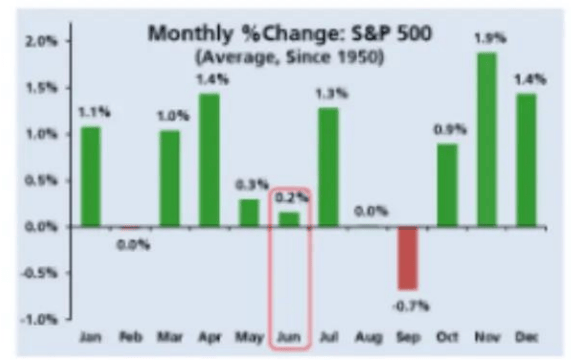
Group 1 - June is typically a month of consolidation across various asset classes, including currencies, commodities, and stocks [1] - Historically, the S&P 500 index shows a slight increase of 0.2% in June since 1950 [2] - The first week of June tends to perform strongly, stabilizing in the middle of the month, and then declining towards the end [4] Group 2 - June has been identified as a month with significant factor rotation, with quality, momentum, and size factors performing well, while value factors lag [8] - If seasonal patterns hold, June is expected to favor high-quality large-cap growth stocks, which are positioned at the intersection of all factor tilts [10] Group 3 - The European quality factor may rebound in June, as seasonal factors support long/short quality factor strategies [11] - The healthcare sector has historically performed well in June, with an average increase of 0.8% relative to the S&P 500 index [13] Group 4 - The biotechnology sector is particularly strong seasonally, suggesting that going long on the biotechnology index (XBI) may be the best strategy for the healthcare sector in June [15] - Historically, gold performs poorly in June but marks the end of a seasonal downturn, with significant improvement expected in July [15][17]

机构:需求萎缩 6月建筑钢材季节性规律难打破
news flash· 2025-05-29 09:24
Core Viewpoint - The construction steel market in June is expected to face downward pressure due to weak demand and seasonal trends, with a historical tendency for prices to decline more often than rise during this month [1] Market Price Trends - As of May 28, the average price of construction steel in China is 3117 yuan/ton, reflecting a decrease of 2.53% compared to the end of April [1] - Historical data from 2000 to 2022 shows that in June, construction steel prices have increased 10 times and decreased 12 times, indicating a higher likelihood of price drops [1] Supply and Demand Dynamics - The supply side of the construction steel market is expected to experience slight pressure in June, while demand remains weak [1] - The cost focus is shifting downward, and market expectations are generally pessimistic, leading to a lack of significant positive support for prices [1]
Doo Financial揭示季节性规律:年末美元为何总是‘习惯性走强’?
Sou Hu Cai Jing· 2025-04-29 12:04
Core Viewpoint - The article discusses the seasonal strength of the US dollar in December, driven by multiple factors including corporate cash repatriation, institutional portfolio rebalancing, and central bank liquidity management [1][3]. Group 1: Corporate Cash Repatriation - Corporate cash repatriation is identified as a primary driver of dollar strength, exemplified by Apple's repatriation of $240 billion in cash before December 15, which significantly impacted the forex market [3]. - This annual capital flow phenomenon is framed within the context of the US tax code, specifically Section 965, which has created a predictable pattern in currency markets [3]. Group 2: Institutional Portfolio Rebalancing - Institutional investors' portfolio adjustments contribute to market volatility, as seen when Norway's sovereign fund reduced its emerging market equity holdings by 5% in favor of US Treasuries, leading to a 2.3% depreciation of the Brazilian real against the dollar [3]. - The scale of cross-border capital flows in December is typically 40% higher than the monthly average, indicating a significant seasonal impact on the forex market [3]. Group 3: Central Bank Liquidity Management - Central bank liquidity management plays a crucial role, with the Federal Reserve utilizing reverse repurchase agreements (RRP) to regulate dollar supply, exemplified by a $300 billion liquidity withdrawal in December 2022 [3]. - This strategy has led to a notable increase in overnight interest rates, demonstrating the Fed's influence on market expectations through deliberate liquidity adjustments [3]. Group 4: Seasonal Patterns and Market Volatility - Seasonal patterns are not isolated; research indicates that when the dollar's seasonal strength coincides with Federal Reserve meetings, exchange rate volatility can increase to three times the normal level [5]. - Investors are advised to monitor corporate overseas cash estimates and sovereign fund holdings at the end of November to navigate the capital flow dynamics effectively [5].