
小核酸技术

Search documents
布局慢病领域前沿疗法 中国生物制药拟出手12亿元收购赫吉亚生物
Zheng Quan Ri Bao· 2026-01-13 13:44
Core Viewpoint - China National Pharmaceutical Group Co., Ltd. (China Biopharmaceutical) announced a total acquisition of Hangzhou Hejiya Biopharmaceutical Co., Ltd. for RMB 1.2 billion, aiming to enhance its capabilities in the small interfering RNA (siRNA) drug development sector [1][2]. Group 1: Acquisition Details - The acquisition price for Hejiya Biopharmaceutical is set at RMB 1.2 billion [1]. - Hejiya Biopharmaceutical specializes in the research and development of innovative siRNA drugs, focusing on significant clinical value in the treatment of metabolic diseases, cardiovascular diseases, and neurological disorders [1]. Group 2: Strategic Importance - The acquisition is expected to strengthen China Biopharmaceutical's core competitiveness in the siRNA field and expand its presence in the global market for chronic disease treatment, which is valued in the trillions [2]. - The merger will leverage the existing clinical development and commercial expansion experience of China Biopharmaceutical, providing strong momentum for sustainable growth and long-term value creation for shareholders [2]. Group 3: Innovation and Future Prospects - Hejiya has successfully overcome delivery technology bottlenecks for siRNA drugs across multiple tissues, achieving long-lasting gene silencing effects with a single administration [1]. - The collaboration is anticipated to accelerate drug development processes and expand the application of siRNA technology to address unmet medical needs in various disease areas [2].

全球小核酸药物爆发-国内快速进入临床阶段
2026-01-12 01:41
Summary of Key Points from Conference Call Records Industry Overview - The small nucleic acid drug industry is experiencing rapid growth, with significant advancements expected in 2026, particularly in delivery technologies for non-liver areas such as the nervous system and fat [1][2] - The collaboration between Novartis and Alnylam on Inclisiran has resulted in the first small interfering RNA (siRNA) product with annual sales exceeding $1 billion, indicating strong market potential for small nucleic acid drugs [1][6] Core Insights and Arguments - Alnylam's upcoming key data on its nervous system delivery pipeline and Ionis's APOE3 drug is anticipated to validate the commercial potential of small nucleic acid drugs in chronic disease markets [1][2] - Capital and technological breakthroughs are driving more first-tier market companies to go public, with companies like Rebio, Bowang, and Elite Bio already in the IPO queue [1][2] - International clinical data from companies like LPA, GBTL3, and HPV are expected to catalyze further development in the small nucleic acid sector [1][2] Company-Specific Developments - **Rebio**: Focused on a major product, coagulation factor XI, with a market potential estimated to reach $10 billion, half of which is expected from atrial fibrillation indications. The company plans to co-develop this product [1][9] - **Yuekang Pharmaceutical**: Actively expanding in the small nucleic acid field with several pipelines obtaining IND approvals in both China and the U.S. The company anticipates significant sales growth in 2027 [1][10] - **Frontier Bio**: Has a promising product targeting IgA nephropathy, with plans to submit a dual-target IND application in 2026 [1][11] - **Bitbio and Fuyuan Pharmaceutical**: Both companies are making strides in the small nucleic acid space, with Bitbio focusing on differentiated molecular design and Fuyuan covering a broad patent and pipeline landscape [1][12] Technological and Collaborative Advances - Chinese companies have established over $2 billion in platform collaborations with international giants, indicating strong capabilities in small nucleic acid technology and patent protection [1][13] - Continuous optimization of small nucleic acid modification and delivery technologies is expected to further propel industry growth [1][13] Additional Important Insights - The small nucleic acid drugs are categorized into ASO (antisense oligonucleotides) and siRNA, each with distinct mechanisms and advantages, such as longer half-lives and lower immunogenicity [1][3][4] - Key stages in the development of small nucleic acid drugs include sequence screening, chemical modification, and delivery methods, with a focus on liver-targeted delivery and exploration of non-liver delivery methods [1][5]
瑞博生物正式登陆港交所:市值超120亿港元,磐霖资本十年六轮支持耐心陪伴
IPO早知道· 2026-01-09 03:44
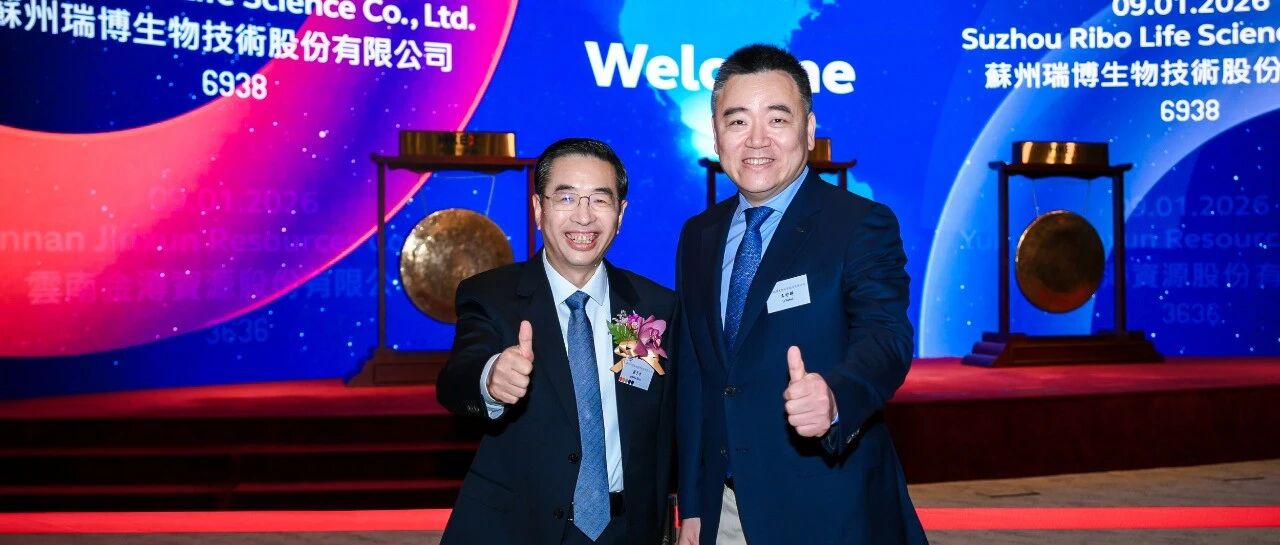
Core Viewpoint - Suzhou Ribo BioTechnology Co., Ltd. (Ribo Bio) officially listed on the Hong Kong Stock Exchange on January 9, 2026, with a market capitalization exceeding HKD 12 billion, marking a significant milestone in China's small nucleic acid drug industry [3][5]. Company Overview - Founded in 2007, Ribo Bio is a global leader in the research and development of small interfering RNA (siRNA) drugs and one of the earliest pioneers in this field in China [3][4]. - The company has established a comprehensive small nucleic acid drug technology platform that supports all stages of drug development, from early research to commercialization [4]. Technology and Product Pipeline - Ribo Bio has developed the RiboGalSTARTM platform based on proprietary intellectual property and clinically validated GalNAc delivery technology, with a rich product pipeline in cardiovascular, metabolic, liver, kidney diseases, and other therapeutic areas, advancing multiple products into clinical phases II and III [4][6]. Investment Journey - Ribo Bio has received investments from numerous well-known institutions, with Panlin Capital being a significant early investor since 2015, providing crucial funding during challenging times for the company [4][6]. - Panlin Capital's investment strategy focuses on identifying innovative drug development companies addressing unmet clinical needs, aligning with Ribo Bio's mission [6][7]. Milestones and Achievements - The successful IPO of Ribo Bio represents a key achievement for Panlin Capital, following their previous success with another biotech company, highlighting their commitment to supporting the long-term development of China's innovative drug industry [5][8]. - Ribo Bio's journey from a scientific laboratory to the global capital market illustrates the potential of small nucleic acid technology as a new wave in modern pharmaceuticals, capable of targeting intracellular proteins and addressing significant clinical needs [6][7].

利好不断!这一板块多股拉涨!龙头股开年涨幅近70%
Zheng Quan Ri Bao Wang· 2026-01-08 03:57
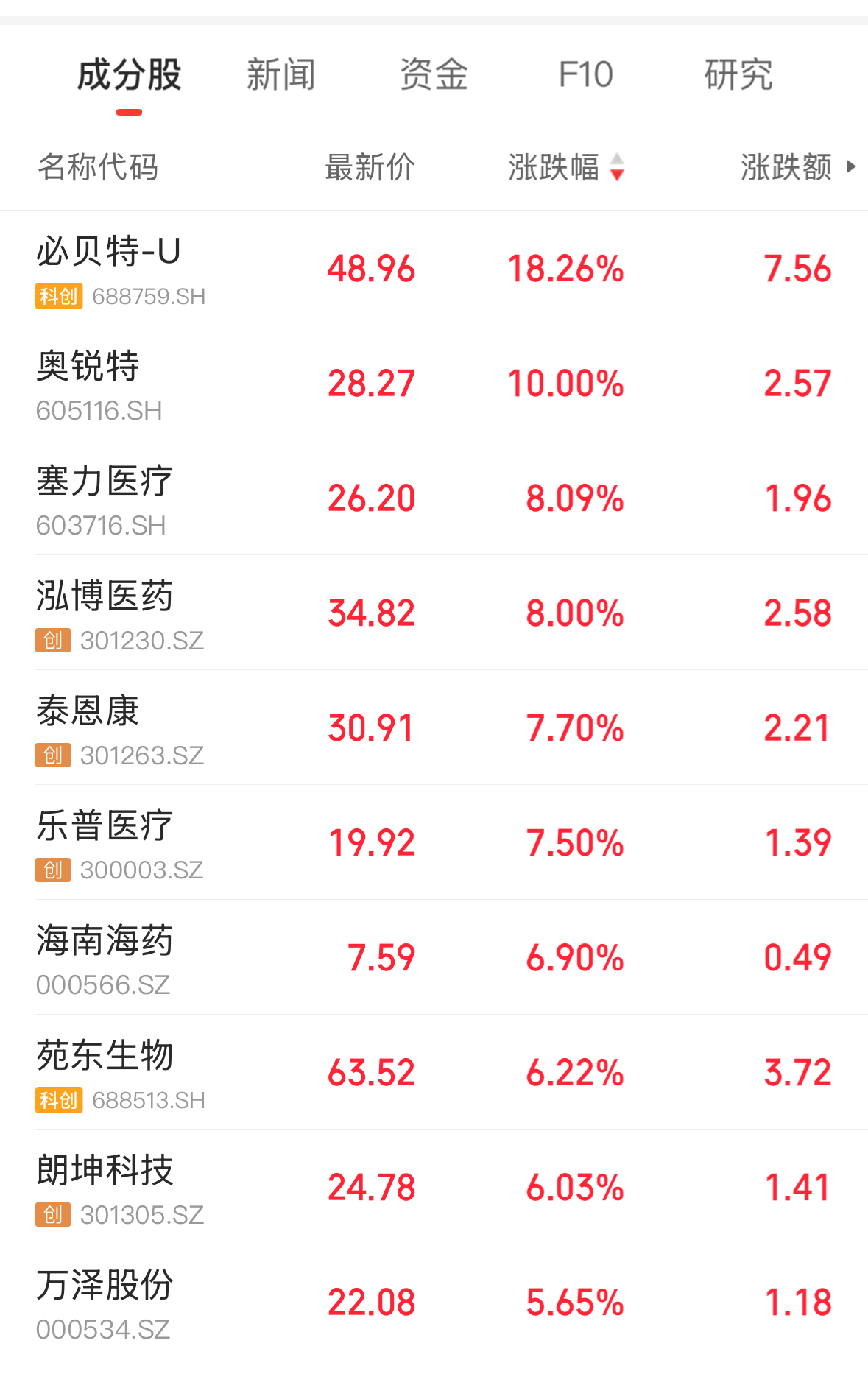
Core Viewpoint - The innovative drug sector has experienced a strong rally since the beginning of 2026, driven by favorable policies, improving fundamentals, and a recovering capital market [1][4]. Group 1: Market Performance - The innovative drug concept sector in A-shares has seen a continuous rise, with multiple stocks, including Hainan Haiyao and Beibete-U, reaching their daily limit [1]. - Since the start of 2026, the innovative drug sector has recorded four consecutive days of gains, with over ten stocks rising more than 20% in four trading days, and Beibete-U's stock price has increased by nearly 70% [1][2]. Group 2: Policy and Regulatory Environment - The National Medical Products Administration (NMPA) has optimized the review and approval process for urgently needed foreign drugs, encouraging simultaneous global research and application in China [3]. - In 2025, China approved 76 innovative drugs for market entry, surpassing the 48 approved in 2024, marking a historical high [3]. Group 3: Industry Drivers - The recent rally in the innovative drug sector is attributed to several factors, including the implementation of new national medical insurance drug lists, which support the sales and market promotion of innovative drugs [4]. - The sector is also benefiting from advancements in cutting-edge fields such as ADC and small nucleic acids, attracting capital interest [4]. Group 4: Investment Focus - The investment focus for 2026 is shifting towards overseas expansion and emerging technologies, with an emphasis on business development (BD) as a long-term trend for Chinese innovative drugs [5]. - Companies with rapid milestone achievements in BD are expected to attract more market attention and investment opportunities [5].


小核酸技术逐渐成熟,关注科创创新药ETF(589720)、创新药ETF国泰(517110)
Mei Ri Jing Ji Xin Wen· 2026-01-08 01:31
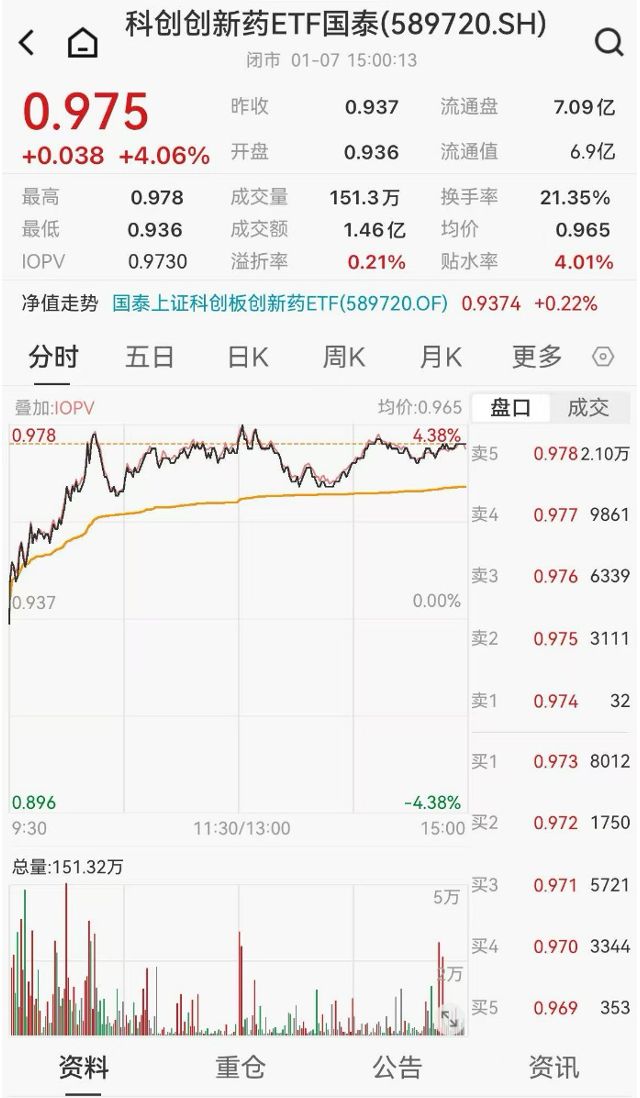
Group 1 - The innovative drug sector has shown strong performance, with the Kexin Innovative Drug ETF (589720) rising by 4.06% and the Guotai Innovative Drug ETF (517110) increasing by 2.80% [1] - Arrowhead Pharmaceuticals announced mid-term data from its Phase 1/2a clinical trials for two RNAi-based weight loss drugs (ARO-INHBE and ARO-ALK7), indicating potential in improving body composition and safety, addressing unmet needs in current obesity treatments [5] - The innovative drug sector is becoming more attractive after a correction, with significant commercial potential seen in small nucleic acid drugs, and the upcoming listing of Rebio Biotech on the Hong Kong stock market is expected to further boost market sentiment [5] Group 2 - Future expectations include breakthroughs in GLP-1 indications, small nucleic acid drugs, and ADCs, with short-term focus on opportunities related to brain-computer interfaces and small nucleic acids [6] - Key industry events such as the JPM conference in mid-January and the ASCO annual meeting in May are anticipated to disclose clinical data, with commercial companies expected to perform well during earnings periods [6] - The Kexin Innovative Drug ETF (589720) and Guotai Innovative Drug ETF (517110) are recommended for focusing on innovative drug companies in the biopharmaceutical and chemical pharmaceutical sectors, reflecting the overall health of the innovative drug industry [6]
1月7日盘后播报
Sou Hu Cai Jing· 2026-01-07 11:55
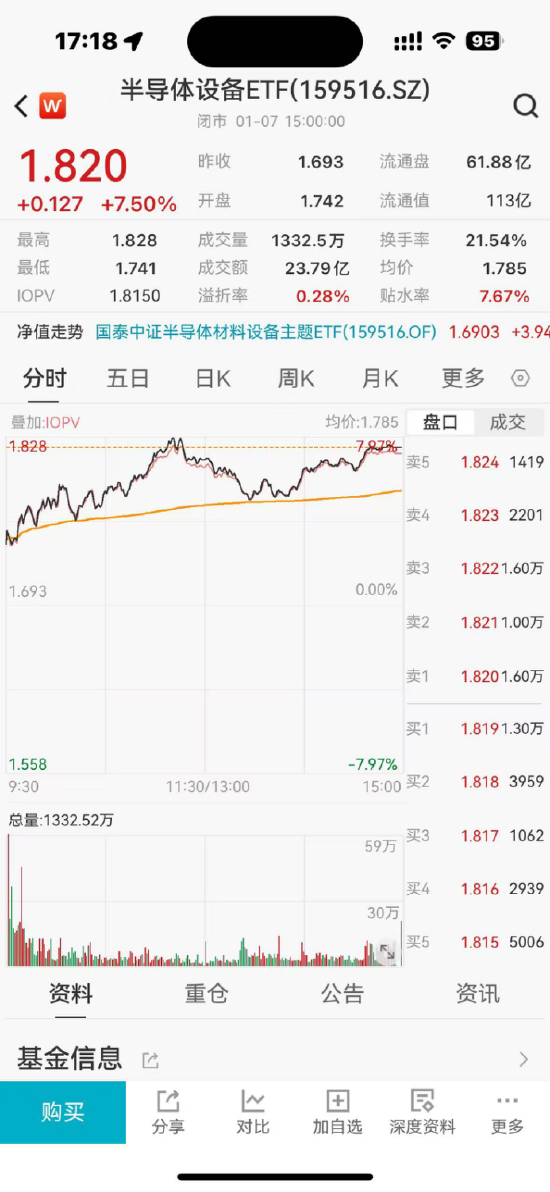
Market Overview - The A-share market experienced fluctuations today, with the Shanghai Composite Index rising by 0.05% to 4085.77 points, marking a 14-day consecutive increase [1] - The Shenzhen Component Index increased by 0.06%, the ChiNext Index rose by 0.31%, and the Sci-Tech Innovation Index saw a gain of 1.53% [1] - The total trading volume in the Shanghai and Shenzhen markets reached 2.85 trillion yuan, an increase of 47.6 billion yuan compared to the previous trading day [1] Sector Performance - The semiconductor equipment sector led the market, with the semiconductor equipment ETF (159516) closing up by 7.50% [1] - The coal sector saw significant gains, with the coal ETF (515220) rising by 3.80% [2] - The innovative drug sector performed well, with the Sci-Tech Innovative Drug ETF (589720) increasing by 4.06% and the Guotai Innovative Drug ETF (517110) rising by 2.80% [2] Investment Insights - The semiconductor equipment sector is supported by dual catalysts of storage expansion and advanced process expansion, making it attractive for investors to consider opportunistic buying [1] - The innovative drug sector is showing improved cost-effectiveness following a correction, with significant commercial potential for small nucleic acid drugs [2] - The coal sector is benefiting from seasonal inventory replenishment, with positive sentiment driven by news of capacity reductions [2] Bond Market - The bond market remains weak, with the ten-year government bond ETF (511260) slightly down by 0.13% [3] - There is no clear improvement in the bond market, and the current focus is on earning certain coupon income [3] - The central bank has not shown an urgent attitude towards interest rate cuts, and market expectations for increased buying scale have not materialized [3]
ETF日报:在煤价悲观预期有所扭转后,煤炭板块的估值弹性有望显现,关注煤炭ETF
Xin Lang Cai Jing· 2026-01-07 11:53
Market Overview - The A-share market experienced fluctuations today, with the Shanghai Composite Index rising by 0.05% to 4085.77 points, marking a 14-day consecutive increase [1][13] - The Shenzhen Component Index increased by 0.06%, the ChiNext Index rose by 0.31%, and the Sci-Tech Innovation Index climbed by 1.53% [1][13] - The total trading volume in the Shanghai and Shenzhen markets reached 2.85 trillion yuan, an increase of 47.6 billion yuan compared to the previous trading day [1][13] - The market sentiment was neutral, with nearly 3200 stocks declining [1][13] Sector Performance - The semiconductor equipment sector led the market, with the Semiconductor Equipment ETF (159516) achieving a significant increase of 7.50% [1][13] - Other strong performers included coal, innovative pharmaceuticals, and technology-related sectors, while software, securities, and Hong Kong stocks saw the largest declines [1][13] - The coal sector surged in the afternoon, with the Coal ETF (515220) rising by 3.80% [19][21] Semiconductor Equipment Sector - The Semiconductor Equipment ETF (159516) continued its strong performance, marking three consecutive days of gains and reaching a new high [1][16] - The Ministry of Commerce announced export controls on dual-use items to Japan, which may strengthen the logic of domestic substitution amid increasing Sino-Japanese tensions [1][16] - The ETF's underlying index PE TTM was reported at 94.81x, placing it in the 78.06% percentile since its inception, indicating a relatively low valuation compared to other semiconductor indices [4][16] Innovative Pharmaceuticals Sector - The innovative pharmaceutical sector showed strong performance, with the Sci-Tech Innovation Pharmaceutical ETF (589720) rising by 4.06% and the Guotai Innovative Pharmaceutical ETF (517110) increasing by 2.80% [4][16] - Arrowhead Pharmaceuticals reported promising mid-stage clinical trial data for two RNAi-based weight loss drugs, indicating potential for addressing unmet needs in obesity treatment [5][17] - The sector is expected to benefit from upcoming key conferences and the potential for breakthroughs in GLP-1 indications and small nucleic acid drugs [6][18] Coal Sector Insights - Recent reports indicated that 26 coal mines were removed from the supply guarantee list, reducing capacity by 19 million tons, which may have limited immediate impact but boosted market sentiment [21] - The coal sector is anticipated to enter a new cycle in 2026, with potential for a slight increase in coal prices and continued dividend advantages for leading companies [21]
东阳光药(06887) - 自愿性公告HECN30227(靶向乙型肝炎病毒的siRNA药物)的I期临...
2026-01-05 11:08
香 港 交 易 及 結 算 所 有 限 公 司 及 香 港 聯 合 交 易 所 有 限 公 司 對 本 公 告 的 內 容 概 不 負 責,對其準確性或完整性亦不發表任何聲明,並明確表示,概不對因本公告全部 或任何部分內容而產生或因倚賴該等內容而引致的任何損失承擔任何責任。 SUNSHINE LAKE PHARMA CO., LTD. 廣 東 東 陽 光 藥 業 股 份 有 限 公 司 (在中華人民共和國註冊成立之股份有限公司) (股份代號:6887) 自願性公告 HECN30227(靶向乙型肝炎病毒的si RNA藥物)的 I期臨床及小核酸平台研發進展的公告 本 公 告 由 廣 東 東 陽 光 藥 業 股 份 有 限 公 司(「 本 公 司 」, 連 同 其 附 屬 公 司 統 稱「 本 集 團」)自願刊發。 關於小核酸技術平台 本 集 團 自 2022 年 起 進 軍 小 核 酸 領 域 , 構 建 了「 靶 點 發 現 - 序 列 設 計 與 合 成 - 化 學 修 飾 - 遞 送 技 術 - 生 物 學 評 價」的 全 鏈 條 研 發 平 台 , 研 發 實 力 已 躍 居 國 內 第 一 梯 隊 。 ...
创新药崛起与投资逻辑深度解析
雪球· 2025-12-23 08:27
Core Insights - The pharmaceutical industry is viewed as a high-quality long-term investment sector, benefiting from policy guidance and technological innovation, leading to opportunities for breakthroughs and ecological restructuring [1] Group 1: Rise of Chinese Innovative Drugs - The rise of domestic innovative drugs is attributed to the return of Chinese scientists post-2008, regulatory reforms in 2015, and the emergence of new therapeutic areas from 2017-2018, culminating in a strong global competitive position for Chinese products [4][5] - Talent supply, cost efficiency, and operational effectiveness are key advantages for Chinese pharmaceutical companies, with the proportion of top-tier pharmaceutical publications increasing from 5% in 2018 to 18% in 2024, and preclinical R&D costs being 30%-50% of those in overseas markets [4][5] - Regulatory changes in 2015 shifted the focus from high-priced generics to innovative drugs, enhancing industry efficiency due to a large market and concentrated talent [5] Group 2: Focus on High-Potential Molecules and Core Indications - Future high-potential molecules in China are expected to focus on engineered antibodies, particularly PD-1 bispecific antibodies, which have significant sales potential in oncology [7] - Two PD-1 bispecific antibodies, AK112 and IBI3653, are highlighted for their potential to achieve sales exceeding $10 billion, targeting major cancer markets [7][8] Group 3: Investment Strategies in the Pharmaceutical Sector - The pharmaceutical industry is characterized by high competition and risk, necessitating a strategic investment approach that includes focusing on biotech for high-risk, high-reward opportunities, and bio-pharma for stable growth [10][11] - Companies are categorized into three types: Biotech (high-risk, early-stage), BioPharma (integrated R&D and sales), and MNC Pharma (large, stable growth), each with distinct investment attributes [11] Group 4: AI's Role in Pharmaceutical R&D - AI is recognized for its potential to enhance efficiency in drug development, particularly in data management, but cannot replace the complex and costly human clinical trials [14] - The impact of AI on the pharmaceutical industry is limited, primarily serving to improve efficiency rather than fundamentally transforming the drug development process [14] Group 5: Valuation and Market Dynamics - Current valuations of innovative drugs in China are considered reasonable, with some leading companies experiencing significant valuation adjustments recently [16] - The U.S. pharmaceutical market shows a clear distinction in valuations between small and large companies, with opportunities arising from companies with promising clinical data but lower market capitalizations [16] Group 6: Future Directions in Innovative Drug Technologies - The future focus in the pharmaceutical industry is expected to shift towards tumor technology applications in chronic diseases and the maturation of small nucleic acid technologies, which are anticipated to surpass traditional methods [17][18] - The next core direction in innovative drugs is expected to be small nucleic acid/RNA drugs, which are projected to have significant commercial potential over the next two decades [18][19]

招商证券:医药板块创新药产业链仍是主线 重点关注小核酸等技术方向
智通财经网· 2025-12-19 02:49
Group 1: Pharmaceutical Sector - The innovation drug sector is expected to be the main focus, with particular attention on small nucleic acid technology and its accelerated development by 2026 [1][2] - The pharmaceutical industry is driven by supply creating demand, with significant trends observed from 2018 to 2024, including breakthroughs in PD-1, ADC technology, and new generation immunotherapy [2] - Key companies to watch in the pharmaceutical sector include Heng Rui Medicine, Hansoh Pharmaceutical, China National Pharmaceutical Group, and others involved in small nucleic acid and weight loss drug development [2] Group 2: CXO and Upstream Life Sciences - The CXO sector is expected to see continued improvement in fundamentals and valuation recovery, with a focus on companies like WuXi AppTec and Kanglong Chemical [3] - Upstream life sciences are benefiting from improved domestic research conditions, with companies like BGI Genomics and Bidu Pharmaceutical showing positive performance trends [3] - The raw material drug sector is entering a bottom price range, with companies that have quality clients and orders likely to see improved profit margins [3] Group 3: Medical Devices - The medical device sector is anticipated to benefit from improved hospital demand and inventory optimization, with a potential turning point in 2026 [4] - High-value consumables are expected to gain from collective procurement, enhancing domestic production capabilities [4] - Key players in the medical device sector include Mindray Medical, United Imaging Healthcare, and others [4] Group 4: Healthcare Consumption - The healthcare service sector is under pressure in 2025, but a mild recovery is expected in 2026, particularly in essential medical services and products [5] - Traditional Chinese medicine is projected to stabilize and grow, with a focus on OTC and prescription drug innovations [5] - The pharmacy sector is experiencing increased concentration due to regulatory changes, with companies like Yifeng Pharmacy and Dazhong Pharmacy showing improved performance [5]
