市场避险

Search documents
中证A500ETF大跌2.32%,科创板100ETF大跌3.87%点评
Sou Hu Cai Jing· 2025-10-17 10:48
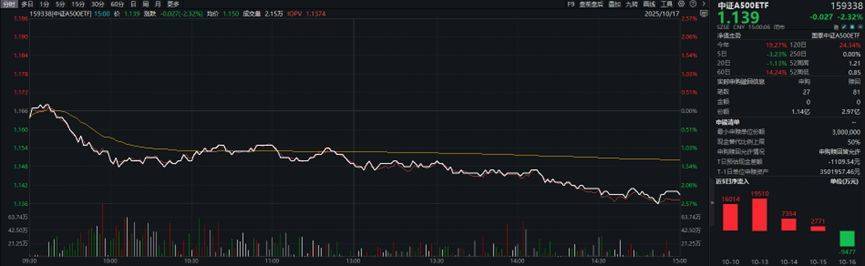
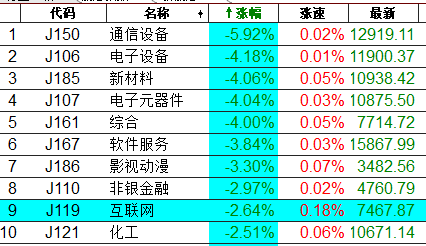
Core Viewpoint - The A-share market experienced a collective decline, with major indices falling significantly, indicating a cautious market sentiment ahead of important events [1][3]. Market Performance - As of the close on October 17, the Shanghai Composite Index fell by 1.95%, the Shenzhen Component Index by 3.04%, and the ChiNext Index by 3.36%. The total market turnover reached 1.95 trillion yuan, an increase of 5.7 billion yuan compared to the previous trading day [1]. Reasons for Decline - The market's decline is attributed to several factors, including profit-taking ahead of significant events and a shift in market style from growth to value. Investors are cautious as key meetings and policy announcements approach, leading to short-term selling pressure [3]. - Historical patterns suggest that investors often choose to realize profits and reduce positions before major events, which can trigger temporary market adjustments [3]. - Since October, there has been a noticeable shift from growth stocks to value stocks, with the relative advantage of growth styles diminishing. The transition from small-cap growth sectors to large-cap value sectors is becoming more pronounced [3]. Market Outlook - The current market adjustment reflects a combination of risk aversion and structural switching pressures, without indicating a trend reversal. Attention should remain on the latest policy statements and the progress of style switching [5]. - The trend of structural switching is expected to continue, with limited downside potential for the market. The strong performance of the yuan this year has positively influenced market risk appetite [6][7]. - The upcoming important meetings and the Federal Reserve's recent shift to a rate-cutting cycle may lead to further foreign capital inflows into the A-share market, potentially boosting market sentiment [8]. Investment Focus - Given the ongoing style switch, investors are encouraged to focus on balanced large-cap indices and dividend products, such as the China Securities A500 ETF and the Shanghai Composite Index ETF, as well as dividend-focused ETFs [10].

金银暴涨突遭闪崩,大扫荡开始了?还敢上车吗?
Sou Hu Cai Jing· 2025-10-14 14:41
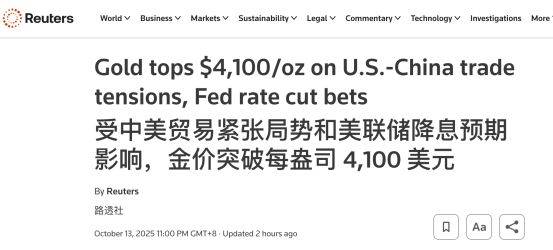
Core Viewpoint - The recent surge in gold and silver prices is attributed to a combination of geopolitical tensions, market dynamics, and supply shortages, leading to a "perfect storm" in the precious metals market [1][2][3]. Group 1: Price Surge Factors - Gold prices have increased by over $700 per ounce, approximately 20%, while silver prices have risen by over $13 per ounce, around 30% since September 1 [1]. - The escalation of the U.S.-China trade war, including threats of increased tariffs and export controls, has heightened market tensions, driving investors towards gold as a safe haven [2]. - The U.S. government shutdown has contributed to rising gold prices by creating political uncertainty and delaying key economic data, which raises concerns about the stability of the U.S. economy and the dollar [3]. Group 2: Silver Market Dynamics - The silver market is experiencing significant upward pressure due to similar factors as gold, compounded by a historic shortage in the physical silver market [4][5]. - Since mid-2021, the inventory in the London silver market has decreased by one-third, with current free-flowing amounts down 75% from mid-2019 levels, leading to a severe physical squeeze [5]. - The borrowing rate for silver in London surged from 5% to 42.72% in a month, indicating a critical shortage of physical silver [5]. Group 3: Future Price Predictions - Standard Chartered Bank has raised its 2026 gold price forecast from $3,875 to $4,488 per ounce, while Bank of America and Societe Generale predict gold could reach $5,000 per ounce, suggesting at least a 20% upside potential [7]. - The silver market is expected to reach a record price of $65 per ounce by 2026 due to supply shortages [7]. - The dynamics of the silver market are compared to a "guerrilla warfare" scenario, where the flow of silver from New York to London is crucial for addressing the current shortages [7][12]. Group 4: Market Volatility - Recent trading has shown extreme volatility, with significant price fluctuations observed in both gold and silver markets, indicating heightened market activity and uncertainty [11]. - The London silver price experienced a sharp drop from a historical high of $53.45 per ounce to $50.65 per ounce, reflecting the intense market dynamics at play [11][10]. - The ongoing battle for market positions suggests that volatility may continue to increase, impacting both gold and silver prices [11].
水涨船高!跟随金价创新高,美国政府黄金储备价值突破1万亿美元
智通财经网· 2025-09-29 12:38
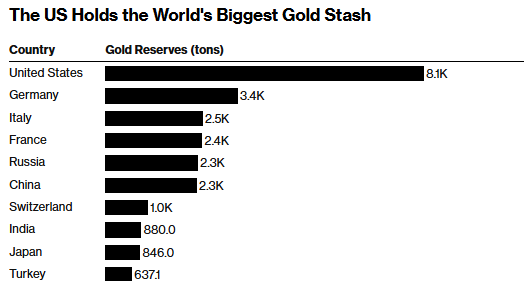
Core Insights - The value of the U.S. Treasury's gold reserves has surpassed $1 trillion, which is over 90 times the amount listed on the government's balance sheet [1] - Gold prices have reached a historic high, exceeding $3,824.50 per ounce, with a 45% increase this year [1] - The rise in gold prices is attributed to market volatility driven by trade wars, geopolitical tensions, and concerns over a potential government funding crisis in the U.S. [1] Group 1 - The official value of U.S. gold reserves, based on a 1973 Congressional price standard of $42.22 per ounce, is approximately $11 billion [1] - The increase in gold prices has been supported by inflows into ETFs and the Federal Reserve's resumption of interest rate cuts [1] - Speculation arose earlier this year regarding the potential revaluation of gold reserves at market prices, which could yield hundreds of billions in revenue for the government, although this idea was later denied by Treasury Secretary Becerra [1][2] Group 2 - Unlike most countries, the U.S. government directly holds gold reserves rather than the central bank, with the Federal Reserve holding gold certificates corresponding to the value of the Treasury's gold [2] - Updating the value of these reserve assets to current prices could result in approximately $990 billion flowing into the U.S. Treasury [2] - This potential revaluation could have significant implications for the financial system, increasing liquidity and extending the process of reducing the Federal Reserve's balance sheet [2] Group 3 - The U.S. is not the first country to consider adjusting the valuation of its gold reserves, as Germany, Italy, and South Africa have made similar decisions in recent decades [5] - A significant portion of the U.S. gold reserves is stored in a deep vault near Fort Knox, Kentucky, with additional reserves located at West Point, Denver, and a Federal Reserve building in lower Manhattan [5] - Conspiracy theories regarding the existence of gold reserves at Fort Knox have circulated, particularly influenced by comments from former President Trump and billionaire Elon Musk [5]
黄金攻上3508破纪录!惊人预测指向4000,领峰环球紧急提醒交易良机
Sou Hu Cai Jing· 2025-09-04 03:15
Group 1 - The core viewpoint of the articles highlights a historic surge in gold prices, which recently broke the $3500 mark, driven by multiple factors including Federal Reserve interest rate cut expectations and geopolitical tensions [1][2][3] - The Federal Reserve's anticipated rate cut of 25 basis points has significantly lowered the opportunity cost of holding gold, contributing to the price increase [1] - The unprecedented conflict between the White House and the Federal Reserve has raised concerns about the stability of the financial system, further catalyzing the rise in gold prices [1] - Escalating conflicts in the Middle East have led to a surge in market risk aversion, prompting investors to flock to gold as a safe haven [1] - Global central bank demand for gold remains strong, providing solid support for gold prices, with expectations that the bull market for gold is far from over [2] Group 2 - Multiple financial institutions are optimistic about gold prices, with UBS raising its target for gold prices in the first half of 2026 to $3700 per ounce, and Bank of America predicting prices could reach $4000 per ounce [3] - The company "Lingfeng Global" is offering comprehensive support to investors through live analysis and trading strategies, aiming to help them capitalize on the current gold market opportunities [3] - The recent price surge is viewed as just the beginning of a larger market trend, encouraging immediate action from investors to seize this rare wealth opportunity [3]
0902:动荡的英国债市,纪录新高的金价!
Sou Hu Cai Jing· 2025-09-02 15:58
Market Performance - Asian stock markets are underperforming, but the decline is somewhat mitigated by the performance of European and American markets [2] - Major indices such as the CAC, DAX, and S&P 500 have shown declines, with the DAX down by 2.00% and the S&P 500 down by 1.17% [3] Economic Indicators - The UK’s long-term borrowing costs have reached their highest level since 1998, driven by concerns over the economic outlook [3] - The yield on the UK 30-year government bond has surged to 5.68%, impacting the GBP/USD exchange rate [4] Gold Market Insights - Gold prices have reached a record high of $3,514.17 per ounce, driven by increased safe-haven demand amid market volatility [4] - Morgan Stanley's report indicates that multiple factors, including a potential Fed rate cut and ETF inflows, are expected to support gold and silver prices, with a year-end target for gold set at $3,800 per ounce [10]
中国收盘后,世界唯有黄金上涨
Xin Lang Cai Jing· 2025-08-30 00:43
Group 1 - The Chinese stock market managed to maintain gains on Friday, while other markets, including US stocks, experienced declines. The dollar and Bitcoin also fell, but gold prices rose significantly [2] - The recent US PCE data for July met market expectations, reinforcing the anticipation of a Federal Reserve rate cut in September. However, the market reacted with a risk-averse approach, favoring gold as a traditional safe-haven asset instead of riskier assets [2] - Despite the Chinese stock market's rise, Wall Street analysts remain skeptical, questioning the sustainability of the rally. There is a notable inflow of funds, but overall positions are not high, indicating lingering doubts about the Chinese economy [2] Group 2 - September is historically a challenging month for trading, with increased volatility expected as trading volumes recover. The market sentiment is shifting from anxiety in August to potential fear in September [3] - A report titled "Global Market Strategy: September Outlook" is highlighted, addressing key questions about the future of A-shares, risks in US stocks, and the potential for gold prices to reach $4000 [3] - The report includes an exclusive analysis of the Chinese stock market, suggesting that the market's secrets are not reflected in price charts but can be understood through cyclical insights [4]
特朗普又出对华贸易损招?8月22日,中美经贸传来最新消息
Sou Hu Cai Jing· 2025-08-22 22:06
Core Viewpoint - The financial storm triggered by the Federal Reserve's meeting minutes reflects a complex interplay of political and economic factors, impacting global investor sentiment and market stability [1][15]. Group 1: Federal Reserve's Meeting Minutes - The meeting minutes released ambiguous signals, acknowledging signs of weakness in the job market while emphasizing inflation risks, leading to a sharp decline in market expectations for a rate cut [3][9]. - The stock market, particularly technology giants, experienced significant losses, with market capitalization evaporating by tens of billions overnight [3]. Group 2: Political Interference - President Trump's public criticism targeted Federal Reserve Governor Lael Brainard, accusing her of past mortgage mismanagement, which is seen as an attempt to pressure her resignation and weaken the cautious stance on rate cuts [4][5]. - This intervention challenges the independence of the Federal Reserve, indicating a desire to exert political control over monetary policy [4]. Group 3: Market Reactions - The uncertainty created by the conflict between the President and the Federal Reserve led to a decline in the dollar, while gold prices surged as investors sought safe-haven assets [6]. - Some investors anticipated the turmoil and began positioning themselves for potential rate cuts while also implementing risk management strategies [11]. Group 4: Economic Implications - Trump's strategy to influence the Federal Reserve's personnel aims to align monetary policy with his political and economic interests, but the independence of the Federal Reserve is deeply rooted and not easily undermined [9][13]. - The current economic landscape, characterized by high inflation and a weak job market, complicates the feasibility of rate cuts [9].

黄金基金ETF(518800)盘中飘红,多重逻辑继续支撑金价
Mei Ri Jing Ji Xin Wen· 2025-08-06 05:54
Group 1 - The short-term market faces significant uncertainty due to unclear tariff and monetary policies, while the medium-term outlook suggests a continued weakening of the US economy and a clear direction towards interest rate cuts [1] - Recent high short-term price increases may be digested, with renewed recession concerns arising from tariff policy normalization and weaker-than-expected non-farm data, leading to heightened expectations for interest rate cuts and increased market risk aversion [1] - The long-term outlook remains bullish for gold, supported by multiple factors including geopolitical conflicts, a weakening dollar, expectations of interest rate cuts, and ongoing gold purchases by non-US central banks [1] Group 2 - The Gold ETF (518800) tracks the spot price of gold (Au99.99 contract) and is designed to reflect real-time price changes of high-purity gold, providing a convenient tool for investors to hedge against inflation risks [1] - Investors without stock accounts can consider the Guotai Gold ETF Link A (000218) and Guotai Gold ETF Link C (004253) as alternative investment options [1]
银行股,又新高了!
格隆汇APP· 2025-06-23 10:29
Core Viewpoint - The Chinese stock market has entered a new adjustment phase since June 13, with the banking sector showing resilience while new consumption stocks face significant declines [1][2]. Market Performance - The A-share banking sector has risen nearly 4% over six days, ranking first among all industries, and has been on an upward trend for two and a half years, nearing the peak of the 2007 bull market [1]. - The overall market turnover has decreased significantly, with recent trading days seeing around 1.1 trillion yuan, down from 1.5 trillion yuan [1]. New Consumption Sector - The new consumption sector has experienced a sharp decline since June 5, with leading companies like Zhongchong Co. and Chaohongji seeing drops exceeding 20% [2]. - The market's previous optimism around new consumption stocks has been undermined by a lack of fundamental support and high valuations, leading to a prolonged adjustment phase [6]. Economic Indicators - Recent data from the National Bureau of Statistics shows that retail sales in May grew by 6.4% year-on-year, surpassing market expectations, with the "trade-in" category growing by 34% [3]. - The strong retail sales data suggests that the need for stimulus measures may diminish, impacting the outlook for new consumption stocks [3]. Liquidity Conditions - There are signs of tightening liquidity in Hong Kong, with the Hong Kong Monetary Authority intervening to manage currency fluctuations, which could affect the performance of Hong Kong stocks [5]. - The previous liquidity support that fueled the rise of new consumption stocks is reversing, contributing to the sector's decline [5]. Investment Shifts - Investors initially expected to shift from new consumption stocks to technology stocks, but this has not materialized due to overall market conditions and low trading volumes [7]. - The banking sector is expected to remain a safe haven for investors, with significant interest from institutional players [16]. Sector Analysis - The A-share market's dividend sectors are categorized into four main areas: resource, financial, natural monopoly, and broad consumption [8]. - The oil sector has seen a recent surge, with Brent crude oil prices rising nearly 20% since June 11, but concerns about geopolitical tensions may lead to volatility [9][10]. - The coal sector has underperformed, with a 12% decline this year due to falling prices and weak demand from the real estate sector [14]. Strategic Outlook - Given the current market conditions, a conservative approach is recommended, with a focus on reducing positions and waiting for better opportunities [19]. - The banking sector is highlighted as a potential area for investment, despite its declining fundamentals, due to the support from state-owned entities [16].

贵金属蓄势待发,有色ETF基金(159880)红盘震荡,机构:重点关注战略小金属投资机会
Sou Hu Cai Jing· 2025-06-10 06:00
Group 1 - The core viewpoint of the articles highlights the strong performance of the non-ferrous metal sector, particularly in light of increasing gold reserves and heightened market risk aversion due to global conflicts and inflation data [1][2] - As of May 30, 2025, the top ten weighted stocks in the non-ferrous metal industry index accounted for 51.92% of the total index, indicating a concentration of investment in key players such as Zijin Mining and Northern Rare Earth [2] - The China Central Bank has increased its gold reserves to 7.383 million ounces as of the end of May, marking the seventh consecutive month of gold accumulation, which reflects a strategic move amidst global economic uncertainties [1] Group 2 - The non-ferrous ETF fund closely tracks the non-ferrous metal industry index, which includes 50 securities that are prominent in terms of scale and liquidity, providing a benchmark for the overall performance of listed companies in the sector [1] - The article suggests focusing on investment opportunities in strategic minor metals such as gallium, germanium, tungsten, and antimony, as their price trends are showing divergence [1]