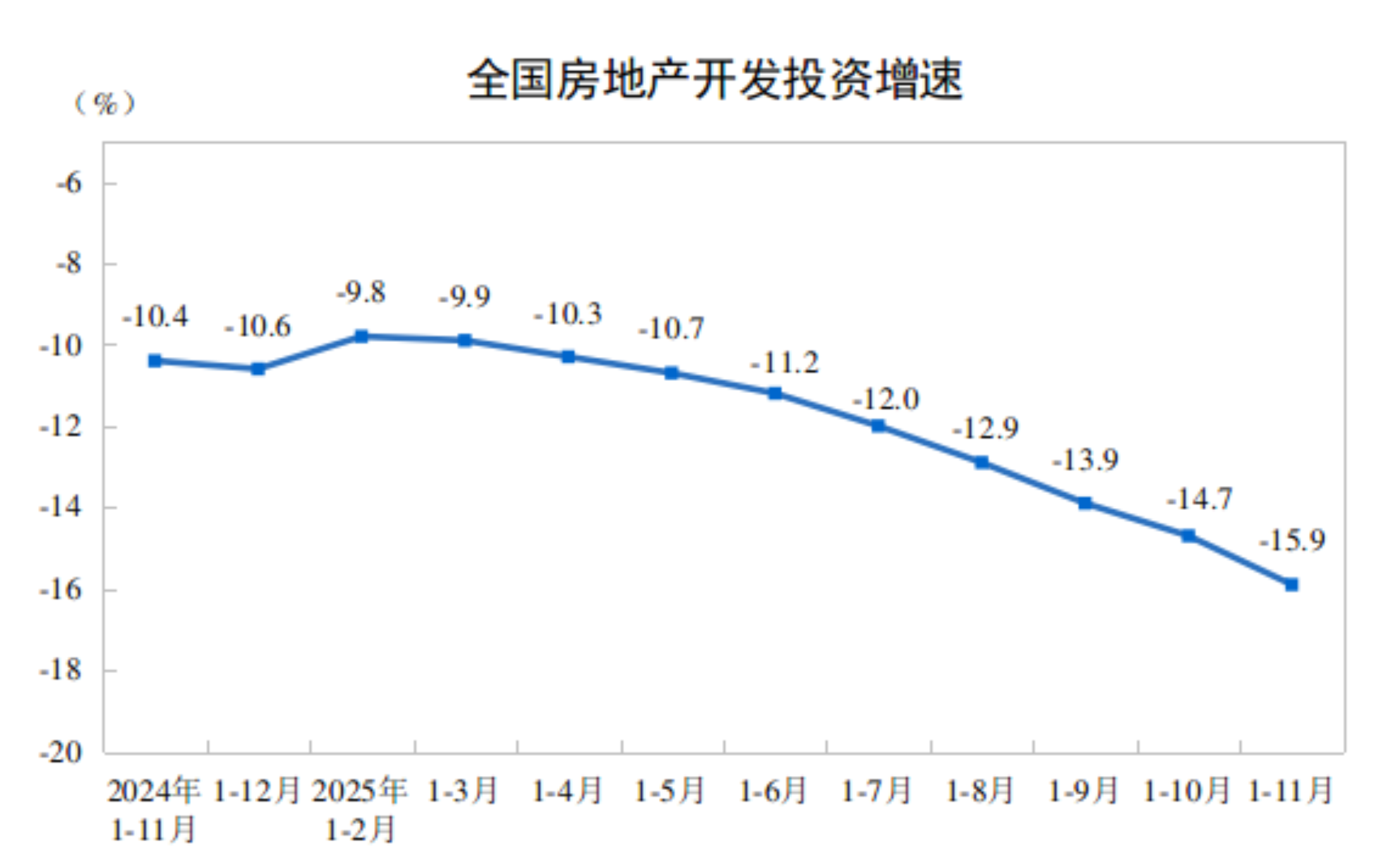
房地产开发投资

Search documents
国家统计局:2025年全国固定资产投资(不含农户)485186亿元,比上年下降3.8%
Zheng Quan Shi Bao Wang· 2026-01-19 02:13
Core Insights - The National Bureau of Statistics reported a decline in national fixed asset investment (excluding rural households) to 48,518.6 billion yuan in 2025, a decrease of 3.8% compared to the previous year [1] - Excluding real estate development investment, national fixed asset investment fell by 0.5% [1] Investment by Sector - Infrastructure investment decreased by 2.2% [1] - Manufacturing investment saw a slight increase of 0.6% [1] - Real estate development investment experienced a significant decline of 17.2% [1] Real Estate Market - The sales area of newly built commercial housing reached 88,101 million square meters, down 8.7% [1] - The sales value of newly built commercial housing was 83,937 billion yuan, a decrease of 12.6% [1] Investment by Industry - First industry investment grew by 2.3% [1] - Second industry investment increased by 2.5% [1] - Third industry investment declined by 7.4% [1] - Private investment fell by 6.4%, and when excluding real estate development investment, private investment decreased by 1.9% [1] High-tech Industry - In high-tech industries, investment in information services and aerospace equipment manufacturing grew by 28.4% and 16.9%, respectively [1] Monthly Trends - In December, fixed asset investment (excluding rural households) decreased by 1.13% month-on-month [1]
统计局:2025年,全国房地产开发投资82788亿元,比上年下降17.2%
Hua Er Jie Jian Wen· 2026-01-19 02:05
市场有风险,投资需谨慎。本文不构成个人投资建议,也未考虑到个别用户特殊的投资目标、财务状况或需要。用户应考虑本文中的任何 意见、观点或结论是否符合其特定状况。据此投资,责任自负。 风险提示及免责条款 统计局:2025年,房地产开发企业房屋施工面积659890万平方米,比上年下降10.0%。其中,住宅施工 面积460123万平方米,下降10.3%。房屋新开工面积58770万平方米,下降20.4%。其中,住宅新开工面 积42984万平方米,下降19.8%。房屋竣工面积60348万平方米,下降18.1%。其中,住宅竣工面积42830 万平方米,下降20.2%。 2025年,新建商品房销售面积88101万平方米,比上年下降8.7%;其中住宅销 售面积下降9.2%。新建商品房销售额83937亿元,下降12.6%;其中住宅销售额下降13.0%。 2025年末, 商品房待售面积76632万平方米,比上年末增长1.6%,比11月末回落1.0个百分点。其中,住宅待售面积 增长2.8%。 ...
国家统计局:2025年全国房地产开发投资82788亿元 比上年下降17.2%
Guo Jia Tong Ji Ju· 2026-01-19 02:04
(文章来源:国家统计局) 国家统计局:2025年,全国房地产开发投资82788亿元,比上年下降17.2%;其中,住宅投资63514亿 元,下降16.3%。 ...
2025年1—11月份全国房地产市场基本情况 - 国家统计局
Guo Jia Tong Ji Ju· 2025-12-29 09:36
Core Insights - The real estate development investment in China from January to November reached 78,591 billion yuan, showing a year-on-year decline of 15.9% [1][12] - Residential investment accounted for 60,432 billion yuan, down 15.0% compared to the previous year [1][12] Group 1: Construction and Development - The total construction area for real estate development was 656,066 million square meters, reflecting a decrease of 9.6% year-on-year [3][12] - The new construction area was 53,457 million square meters, down 20.5%, with residential new construction area at 39,189 million square meters, a decline of 19.9% [3][12] - The completed construction area was 39,454 million square meters, down 18.0%, with residential completed area at 28,105 million square meters, a decrease of 20.1% [3][12] Group 2: Sales and Inventory - The sales area of new commercial housing was 78,702 million square meters, down 7.8% year-on-year, with residential sales area decreasing by 8.1% [4][12] - The sales revenue from new commercial housing was 75,130 billion yuan, a decline of 11.1%, with residential sales revenue down 11.2% [4][12] - As of the end of November, the inventory of unsold commercial housing was 75,306 million square meters, a reduction of 301 million square meters from the end of October [6][12] Group 3: Funding Situation - The total funds available to real estate development enterprises amounted to 85,145 billion yuan, down 11.9% year-on-year [7][12] - Domestic loans contributed 13,149 billion yuan, a decrease of 2.5%, while foreign investment was 23 billion yuan, down 24.6% [7][12] - Self-raised funds were 30,628 billion yuan, down 11.9%, and personal mortgage loans were 11,786 billion yuan, a decline of 15.1% [7][12] Group 4: Market Sentiment - The real estate development prosperity index (National Housing Prosperity Index) stood at 91.90 in November, indicating a lower level of market sentiment [8][12]

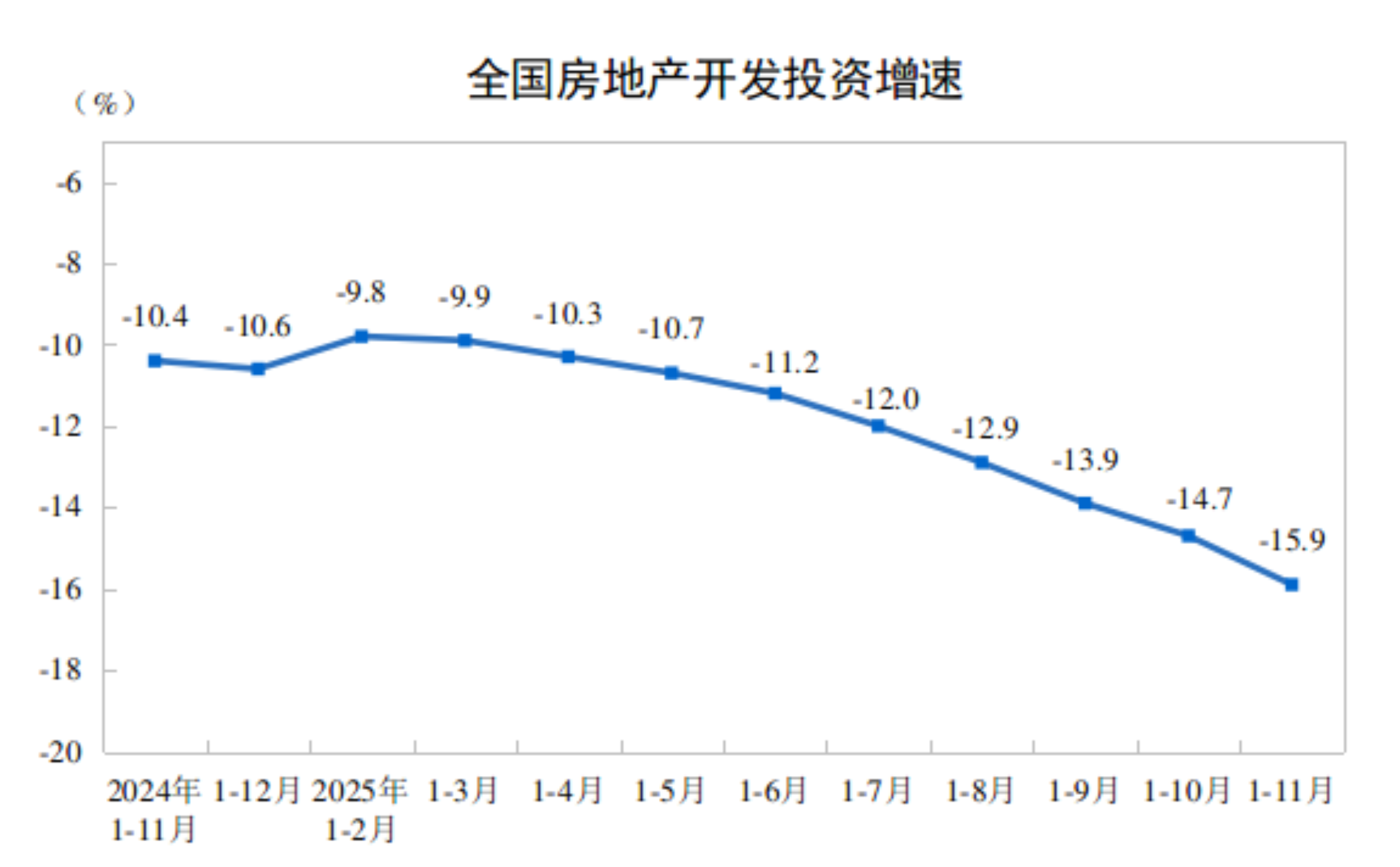
钢材:原料发动补库,钢价触底反弹
Yin He Qi Huo· 2025-12-19 09:59
Group 1: Report Industry Investment Rating - Not provided in the report Group 2: Core Viewpoints of the Report - The steel price is expected to show a volatile and moderately strong trend due to raw material restocking. The iron - water output may recover next week, and the steel cost is supported. Although the seasonal decline of building material demand exists, the manufacturing demand still provides support. Short - term exports continue to be high, and the steel price presents a volatile and moderately strong trend [7]. - The trading strategies include maintaining a volatile and moderately strong trend for unilateral trading, suggesting to short the hot - rolled coil to rebar spread and short the hot - rolled coil to coking coal ratio for arbitrage, and suggesting to wait and see for options [7]. Group 3: Summaries by Related Catalogs Chapter 1: Steel Market Summary and Outlook Summary - **Current Situation**: This week, the iron - water output declined, and the five major steel products continued to reduce production, but the reduction speed slowed down. Rebar production increased while hot - rolled production decreased rapidly. The total steel inventory decreased at an accelerated pace, with the social inventory depletion faster than the factory inventory. Rebar demand improved month - on - month, but hot - rolled demand declined rapidly due to temperature and capital conditions [4][7]. - **Outlook**: Next week, the iron - water output may recover as blast furnace profits have been repaired. The supply of coal mines may shrink due to environmental protection, and steel mills have restocking expectations. The cost of steel is supported. The steel price shows a volatile and moderately strong trend due to raw material restocking. Follow - up attention should be paid to coal mine safety inspections, overseas tariffs, and domestic macro and industrial policies [7]. Chapter 2: Price and Profit Review Summary - **Spot Prices**: The summary price of rebar in Shanghai was 3300 yuan (+30), and the summary price of hot - rolled coil in Shanghai was 3280 yuan (+40) [11]. - **Profits**: The flat - rate electric furnace profit in East China was - 54.26 yuan (+3), and the valley - rate electric furnace profit was +111 yuan (+3). Long - process steel maintained a small profit [4][29]. Chapter 3: Important Domestic and Overseas Macroeconomic Data Summary - **Real Estate Data**: From January to November 2025, the national real estate development investment was 785.91 billion yuan, a year - on - year decrease of 15.9%. The sales prices of new commercial residential buildings in first, second, and third - tier cities showed varying degrees of decline [31]. - **Fixed - Asset Investment**: From January to November 2025, China's fixed - asset investment (excluding rural households) was 4.44035 trillion yuan, a year - on - year decrease of 2.6%. The growth rate continued to decline rapidly month - on - month [31][36]. - **Social Financing**: In November, the new social financing was 248.88 billion yuan, a year - on - year increase of 6.87%. The new RMB loans were 39 billion yuan. The government bonds and corporate bonds financing provided strong support, but the long - term investment demand of enterprises was insufficient, and the consumer and mortgage credit willingness of residents still needed to be boosted [35][36]. Chapter 4: Steel Supply, Demand, and Inventory Situation Summary - **Supply**: The daily average iron - water output of 247 steel mills was 226.55 million tons (- 2.65), and the capacity utilization rate of 49 independent electric arc furnace steel mills was 34.9% (+0.4). The small - sample rebar production was 181.68 million tons (+2.90), and the small - sample hot - rolled coil production was 291.91 million tons (- 16.8) [4][54][60]. - **Demand**: The small - sample rebar apparent demand was 208.64 million tons (+5.55), and the small - sample hot - rolled coil apparent demand was 298.28 million tons (- 13.69). The building material demand was affected by temperature and funds, and the manufacturing demand still had support. The export of steel products continued to be high in the short term [4]. - **Inventory**: The rebar inventory decreased by 26.96 million tons in total, with the factory inventory decreasing by 1.26 million tons and the social inventory decreasing by 25.7 million tons. The hot - rolled coil inventory decreased by 6.37 million tons in total, with the factory inventory decreasing by 0.61 million tons and the social inventory decreasing by 5.76 million tons [4].
1—11月份全国房地产开发投资78591亿元 同比下降15.9%
Feng Huang Wang· 2025-12-16 00:46
Real Estate Development Investment Completion - In the first eleven months, national real estate development investment reached 78,591 billion yuan, a year-on-year decrease of 15.9% (on a comparable basis) [3] - Residential investment amounted to 60,432 billion yuan, down 15.0% [3] - The total construction area for real estate development was 656,066 million square meters, a decline of 9.6% year-on-year [3] - The new construction area was 53,457 million square meters, down 20.5%, with residential new construction area at 39,189 million square meters, a decrease of 19.9% [3] - The completed area was 39,454 million square meters, down 18.0%, with residential completed area at 28,105 million square meters, a decline of 20.1% [3] New Commodity Housing Sales and Inventory Situation - In the first eleven months, the sales area of new commodity housing was 78,702 million square meters, a year-on-year decrease of 7.8%, with residential sales area down 8.1% [4] - The sales revenue of new commodity housing reached 75,130 billion yuan, a decline of 11.1%, with residential sales revenue down 11.2% [4] - By the end of November, the inventory of commodity housing was 75,306 million square meters, a decrease of 301 million square meters compared to the end of October, with residential inventory down 284 million square meters [8] Real Estate Development Enterprises' Fund Availability - In the first eleven months, the funds available to real estate development enterprises totaled 85,145 billion yuan, a year-on-year decrease of 11.9% [9] - Domestic loans amounted to 13,149 billion yuan, down 2.5%, while foreign investment was 23 billion yuan, a decline of 24.6% [9] - Self-raised funds were 30,628 billion yuan, down 11.9%, and pre-sale deposits and advance payments were 25,098 billion yuan, a decrease of 15.2% [9] - Personal mortgage loans reached 11,786 billion yuan, down 15.1% [9] Real Estate Development Prosperity Index - In November, the real estate development prosperity index (National Real Estate Prosperity Index) was recorded at 91.90 [12]
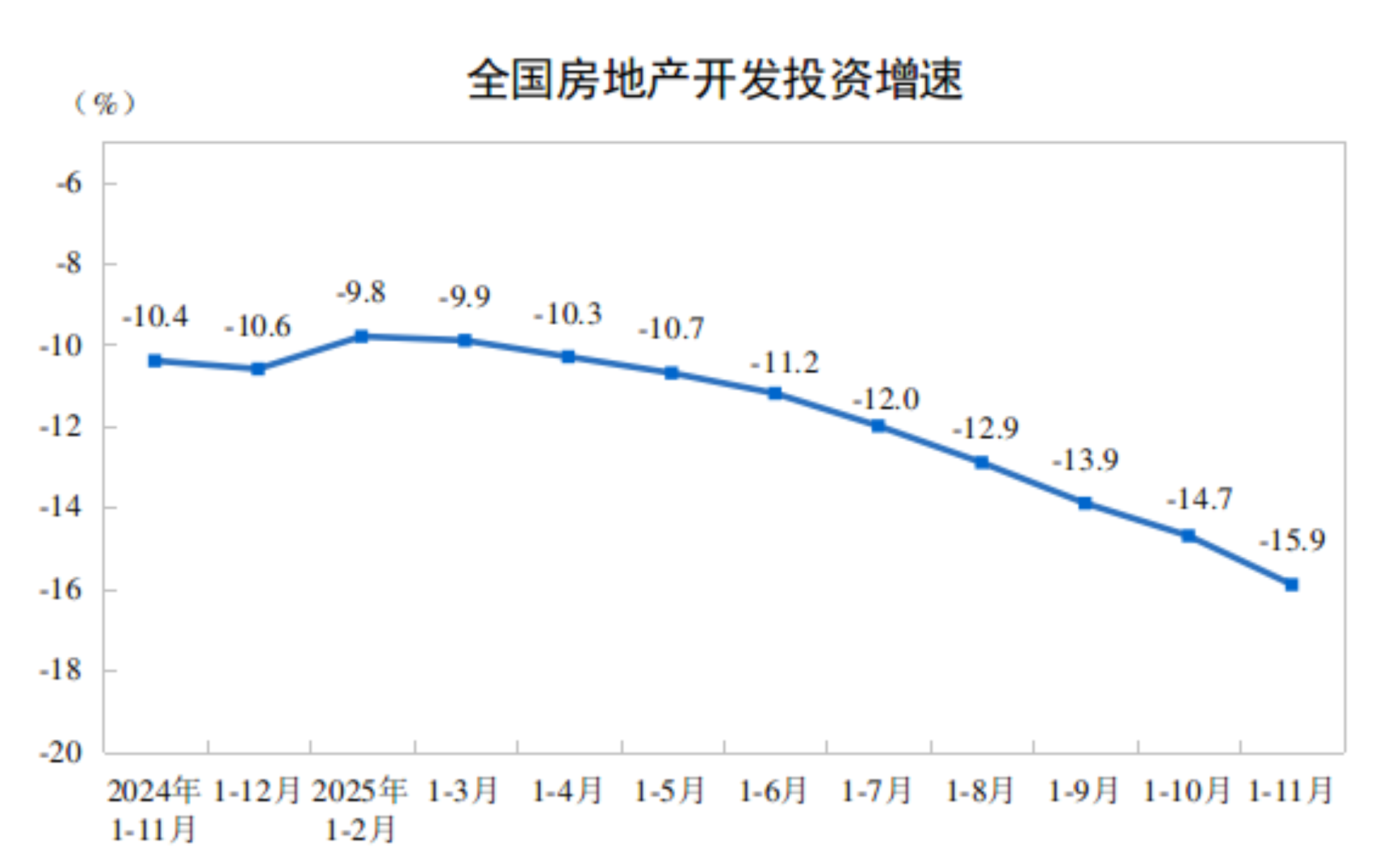
国家统计局:1—11月份全国房地产开发投资78591亿元
Xin Hua Cai Jing· 2025-12-15 05:42
Group 1 - The core viewpoint of the articles indicates a significant decline in China's real estate development investment and related metrics for the first eleven months of the year, reflecting ongoing challenges in the sector [1][2][3] Group 2 - From January to November, total real estate development investment reached 78,591 billion yuan, a year-on-year decrease of 15.9% [1] - Residential investment amounted to 60,432 billion yuan, down 15.0% year-on-year [1] - The total area of housing under construction was 656,066 million square meters, a decline of 9.6% compared to the previous year [1] - New housing starts totaled 53,457 million square meters, down 20.5%, with residential new starts at 39,189 million square meters, a decrease of 19.9% [1] - The completed housing area was 39,454 million square meters, down 18.0%, with residential completions at 28,105 million square meters, a decline of 20.1% [1] Group 3 - New commercial housing sales area reached 78,702 million square meters, a year-on-year decrease of 7.8%, with residential sales area down 8.1% [1] - The sales revenue of new commercial housing was 75,130 billion yuan, down 11.1%, with residential sales revenue decreasing by 11.2% [1] - By the end of November, the unsold commercial housing area was 75,306 million square meters, a reduction of 301 million square meters from the end of October [1] Group 4 - Real estate development enterprises' available funds totaled 85,145 billion yuan, a year-on-year decline of 11.9% [2] - Domestic loans amounted to 13,149 billion yuan, down 2.5%, while foreign investment decreased by 24.6% to 23 billion yuan [2] - Self-raised funds were 30,628 billion yuan, down 11.9%, and deposits and advance payments fell by 15.2% to 25,098 billion yuan [2] - Personal mortgage loans reached 11,786 billion yuan, a decrease of 15.1% [2] Group 5 - The real estate development prosperity index, known as the "National Real Estate Prosperity Index," stood at 91.90 in November [3]
国家统计局:1-11月,全国固定资产投资(不含农户)同比下降2.6%,制造业投资增长1.9%
Sou Hu Cai Jing· 2025-12-15 03:01
Economic Overview - In the first eleven months of 2025, national fixed asset investment (excluding rural households) reached 444,035 billion yuan, showing a year-on-year decline of 2.6% [3] - Excluding real estate development investment, national fixed asset investment grew by 0.8% [3] Sector Analysis - Infrastructure investment decreased by 1.1% year-on-year [3] - Manufacturing investment increased by 1.9% [3] - Real estate development investment saw a significant decline of 15.9% [3] Real Estate Market - The sales area of newly built commercial housing was 78,702 million square meters, down 7.8% year-on-year [3] - The sales amount of newly built commercial housing was 75,130 billion yuan, a decrease of 11.1% [3] Investment by Industry - Investment in the primary industry grew by 2.7% year-on-year [3] - Investment in the secondary industry increased by 3.9% [3] - Investment in the tertiary industry declined by 6.3% [3] - Private investment fell by 5.3% year-on-year; when excluding real estate development investment, private investment decreased by 0.7% [3] High-Tech Industry - In high-tech industries, investment in information services grew by 29.6% year-on-year, while investment in aerospace and equipment manufacturing increased by 19.7% [3] Monthly Trends - In November, fixed asset investment (excluding rural households) experienced a month-on-month decline of 1.03% [3]

国家统计局:1—11月 全国房地产开发投资78591亿元 同比下降15.9%
Guo Jia Tong Ji Ju· 2025-12-15 02:42
国家统计局发布的数据显示,1—11月份,全国房地产开发投资78591亿元,同比下降15.9%;其中,住宅投资60432亿元,下降15.0%。 一、房地产开发投资完成情况 1—11月份,全国房地产开发投资78591亿元,同比下降15.9%(按可比口径计算,详见附注6);其中,住宅投资60432亿元,下降15.0%。 1—11月份,房地产开发企业房屋施工面积656066万平方米,同比下降9.6%。其中,住宅施工面积457551万平方米,下降10.0%。房屋新开工面积53457万平 方米,下降20.5%。其中,住宅新开工面积39189万平方米,下降19.9%。房屋竣工面积39454万平方米,下降18.0%。其中,住宅竣工面积28105万平方米, 下降20.1%。 二、新建商品房销售和待售情况 1—11月份,新建商品房销售面积78702万平方米,同比下降7.8%;其中住宅销售面积下降8.1%。新建商品房销售额75130亿元,下降11.1%;其中住宅销售 额下降11.2%。 全国新建商品房销 20 10 -2.6 -2.1 -2.8 0 -2.9 I -3.0 -3.2 -3.8 -5.1 -12.9 -- 14.3 ...