
折叠屏手机

Search documents
库克不装了?一台苹果折叠屏=一辆宏光MINI
Sou Hu Cai Jing· 2026-01-29 02:16
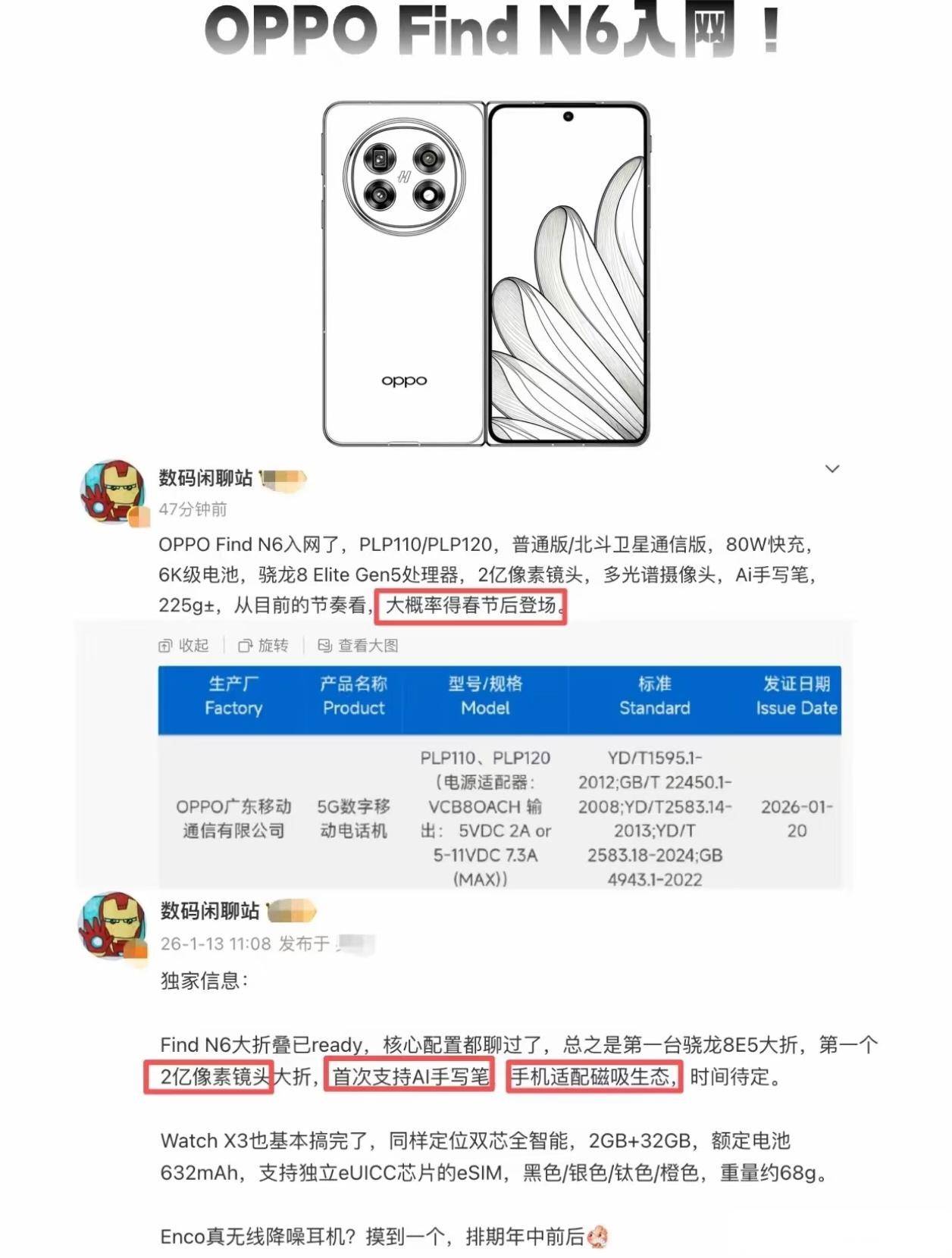
Group 1 - Apple is expected to release the iPhone 18 Pro series and the first foldable iPhone, both priced above 10,000 yuan, in September [1][7] - The foldable iPhone may reach prices exceeding 20,000 yuan due to fluctuations in raw material costs, positioning it as a high-end product [1] - Apple has reportedly studied OPPO's foldable technology but has not achieved better results, leading to speculation about the timing of its own foldable release [1] Group 2 - OPPO is set to launch its Find N6 foldable phone, which features advanced specifications including a Snapdragon 8 Elite Gen 5 processor, a 200-megapixel camera, and a 6000mAh battery [1][5] - The Find N6 is expected to debut with a unique no-fold crease technology, potentially giving it a competitive edge over Apple's offering [2][5] - The smartphone market is anticipated to see increased competition, particularly in the high-end segment, as multiple domestic manufacturers are expected to release new models in September [7]


三星三折叠屏手机美国售价2899美元 将于1月30日上市
Xin Lang Cai Jing· 2026-01-27 14:55
Core Viewpoint - Samsung Electronics is set to launch its first tri-fold smartphone, the Galaxy Z TriFold, in the U.S. on January 30, priced at $2,899, significantly higher than any other smartphone in the market [1][4]. Pricing and Sales Strategy - The Galaxy Z TriFold's price is notably higher than Samsung's own Galaxy Z Fold 7, which retails for $2,000, and is on par with Apple's top-tier iPhone 17 Pro Max [1][4]. - The device will be sold exclusively through Samsung's official website and experience stores, with no availability through major carriers like Verizon, T-Mobile, and AT&T [1][4]. Product Specifications - The TriFold can unfold into a 10-inch tablet, with a minimum thickness of 3.9 mm and a folding lifespan of 200,000 times [3][6]. - The U.S. version will feature 512GB of storage and will only be available in black [3][6]. - The device was initially launched in South Korea on December 2, priced at 3.59 million KRW (approximately $2,450 at that time) [3][6]. Market Position and Reception - Early reviews highlight the device's large inner screen, which offers a more immersive experience for movies and videos compared to other foldable models like the Fold 7 and Google Pixel 10 Pro Fold [3][6]. - However, the TriFold's weight of 309 grams (0.68 pounds) and its thickness when folded are seen as significant drawbacks [3][6]. - The software capabilities of the device are often viewed as not sufficiently mature given its premium pricing, positioning the Galaxy Z TriFold as a niche luxury item rather than a mass-market product [3][6]. Competitive Landscape - Apple is expected to release its first foldable iPhone later this year, focusing on eliminating visible creases on the inner screen [3][6].

iPhone降价,破纪录了
3 6 Ke· 2026-01-26 23:59
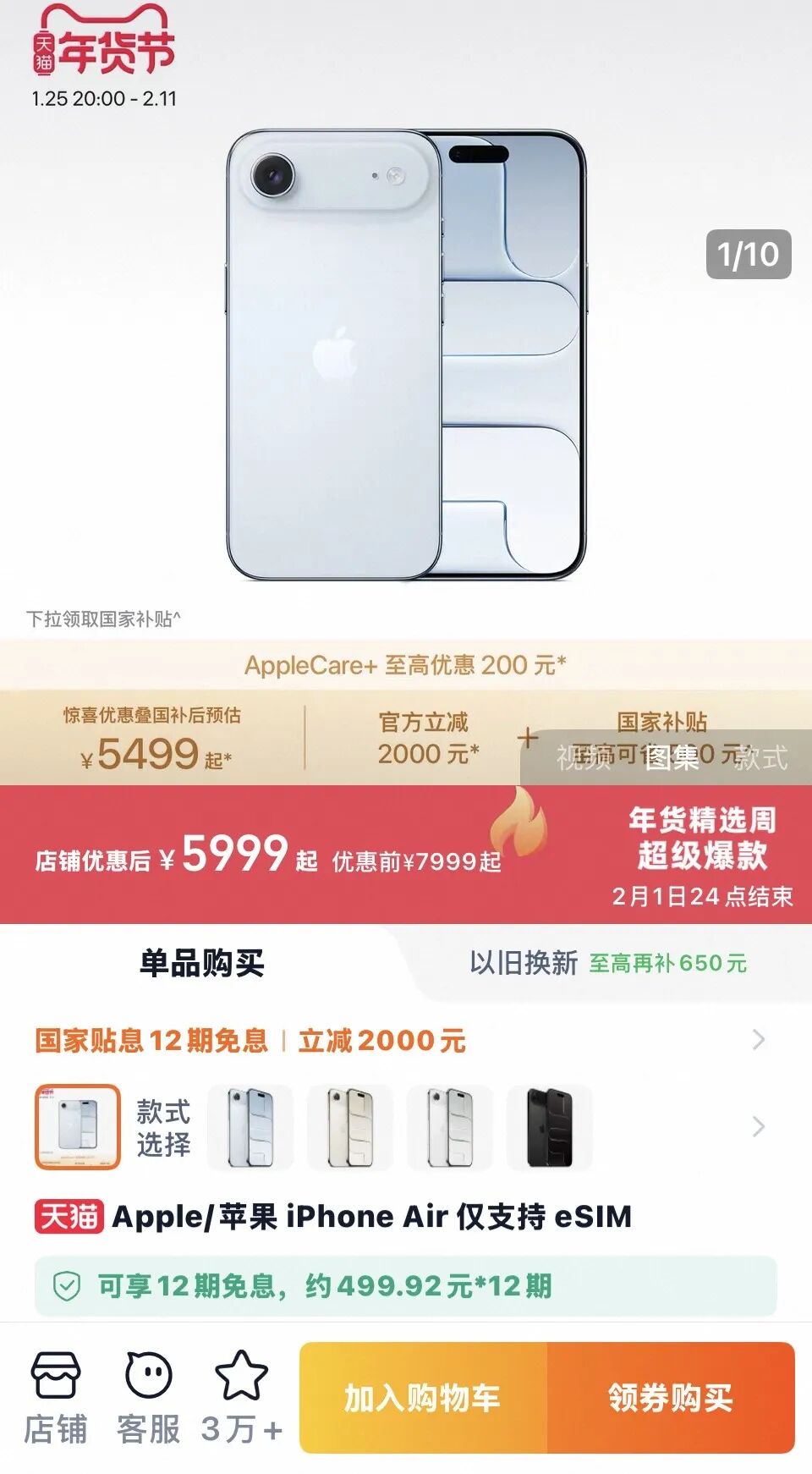
Core Viewpoint - The iPhone Air, released only three months ago, has become a focal point due to a significant price drop, with a reduction of 2000 yuan, bringing the starting price to 5499 yuan after regional subsidies [1][3]. Group 1: Market Performance and Consumer Response - The iPhone Air's market performance has been disappointing, leading to the dismantling of several production lines by Apple suppliers [3][9]. - The device has not resonated with the majority of consumers, as its lightweight design appeals to a niche market rather than the broader audience [4][10]. - The iPhone Air's initial sales were overshadowed by the iPhone 17 series, which dominated sales rankings during the same period [4][8]. Group 2: Product Features and Consumer Expectations - To achieve its slim profile of 5.6 mm and weight of 165 grams, the iPhone Air compromised on key features, including a smaller battery capacity of 3149 mAh and a single camera setup [5][7]. - Consumers are increasingly unwilling to pay flagship prices for devices that lack high-end specifications, leading to a perception of the iPhone Air as a "downgraded" option [8][9]. - The high initial price of 7999 yuan, which is comparable to other flagship models with superior specifications, has further hindered its appeal [8][9]. Group 3: Industry Trends and Competitor Actions - The smartphone market is witnessing a shift, with many manufacturers, including Xiaomi and OPPO, canceling lightweight model projects in response to consumer feedback [9][10]. - Competitors are adopting a more balanced approach, offering lightweight models with better specifications at lower price points, which has proven more successful in the market [13][19]. - The iPhone Air's lack of success does not indicate a failure in the lightweight category, as the industry continues to explore innovations in design and functionality [20][21].
全球每三台手机就有一台广东造 广货“粤来粤强”驶入快车道
Nan Fang Du Shi Bao· 2026-01-19 13:52
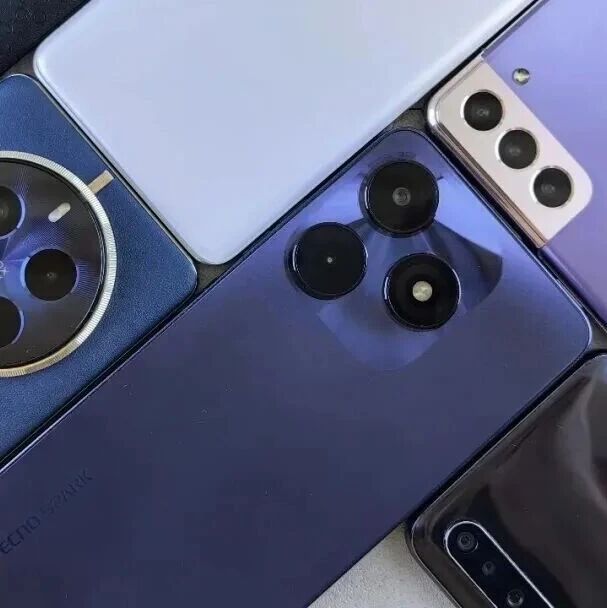
Core Viewpoint - The Guangdong smartphone industry is experiencing significant growth and transformation, establishing itself as a global leader in smartphone manufacturing and innovation, with local brands gaining substantial market share both domestically and internationally [1][2][11]. Group 1: Industry Overview - Guangdong is the most important cluster for the smartphone industry in China, leading in scale, production, and export, with a projected revenue of 1.9618 trillion yuan in 2024, accounting for 38.7% of the province's new generation electronic information industry revenue [2]. - In 2024, Guangdong's smartphone production reached 683 million units, representing 40.9% of the national total, while exports amounted to 205 million units, also leading the country [2]. - The smartphone industry in Guangdong has evolved from a manufacturing hub to a global innovation leader, with local brands capturing 38% of the global market share by 2025 [2][12]. Group 2: Brand Performance - Major Guangdong brands like Huawei, OPPO, and vivo dominate both domestic and international markets, with Huawei's global shipment reaching 48.4 million units in 2024, capturing one-third of the high-end market [3]. - OPPO's global shipments reached 104.8 million units in 2024, with its Reno series leading in the $400-$600 price segment [3]. - By 2025, six Guangdong brands are expected to be among the top ten in the global smartphone market, with market shares of 9% for vivo, 8% for Transsion, and 7% for OPPO [2]. Group 3: Global Expansion Strategies - Guangdong smartphone brands are increasingly focusing on international markets, particularly in Southeast Asia and Latin America, leveraging cultural similarities and existing market experiences for efficient penetration [4][5]. - OPPO's gradual global expansion strategy began in Thailand and has since included Indonesia and Vietnam, with plans to enter European markets [5]. - vivo's strategy emphasizes deep localization, establishing a significant retail network in Indonesia and expanding into various regions since 2014 [5]. Group 4: Technological Innovation - Guangdong smartphone companies are at the forefront of technological innovation, with significant investments in R&D, particularly in chip technology and fast charging [11]. - Huawei's self-developed Kirin 9000S chip achieved a 65% self-sufficiency rate in 2024, while OPPO's 125W fast charging technology leads globally in patent numbers [11]. - The rise of AI smartphones, with brands like Huawei and vivo integrating advanced AI capabilities, marks a new era in the industry [12]. Group 5: Manufacturing and Supply Chain - Guangdong's smartphone manufacturing ecosystem is robust, with a high concentration of electronic component manufacturers, accounting for 28% of China's total [7]. - The region's strong supply chain allows for rapid assembly and production, with average production cycles as short as 48 hours in Dongguan [9]. - Major manufacturers like Foxconn and local firms have adopted advanced manufacturing techniques, enhancing efficiency and production capabilities [8][9].

2025手机大战:华为赢销量,苹果守利润,米OV被夹击
首席商业评论· 2026-01-19 05:09
Core Viewpoint - The smartphone market in 2025 is characterized by intense competition and differentiation, with Apple and Samsung maintaining their dominance while other brands like Huawei, Xiaomi, vivo, and OPPO face significant challenges [5][9]. Global Market Summary - The global smartphone market saw a 1.9% growth in 2025, with total shipments reaching 1.26 billion units. Apple and Samsung accounted for nearly 40% of the market share, with shipments of 247.8 million (up 6.3%) and 241.2 million (up 7.9%) respectively [6][7]. - Xiaomi, vivo, and OPPO experienced mixed results, with Xiaomi's shipments declining by 1.9% to 165.3 million, while vivo and OPPO saw slight increases and decreases in their market positions [6][7]. Chinese Market Summary - In China, the smartphone market saw a slight decline of 0.6% in 2025, with total shipments of 28.46 million units. Huawei reclaimed the top position with 46.7 million units (16.4% market share), narrowly surpassing Apple at 46.2 million units (16.2% market share) [8][10]. - The competition among the top five brands in China is fierce, with Huawei, Apple, and vivo closely contesting for market share, while Xiaomi and OPPO lag behind [8][10]. Competitive Dynamics - Huawei's success is attributed to its self-developed Kirin chips and the growing maturity of its HarmonyOS ecosystem, which enhances user experience across devices [15][19]. - Apple, despite losing the annual championship, demonstrated strong brand loyalty and market presence, particularly in the high-end segment, achieving a 21.1% market share in Q4 2025 [12][17]. - The competition among Xiaomi, vivo, and OPPO is marked by varying strategies, with Xiaomi focusing on global expansion and automotive ventures, while vivo maintains a stable domestic presence and OPPO struggles with market share [21][24]. Future Outlook - The smartphone market is expected to face challenges in 2026, with predictions of a 3-4% decline in overall shipments. However, the high-end market is projected to grow, leading to increased competition and differentiation based on cost and technology [26][28]. - Key trends for 2026 include the rise of foldable phones and AI integration, with companies like Apple and Huawei preparing to enhance their product offerings in these areas [29][32]. - The market will likely see a consolidation of power among leading brands, with those possessing strong brand equity and technological capabilities gaining a competitive edge [33].
炸场!iPhoneFold渲染图流出,库克藏了5年的折叠王终于要来了
Sou Hu Cai Jing· 2026-01-17 02:09
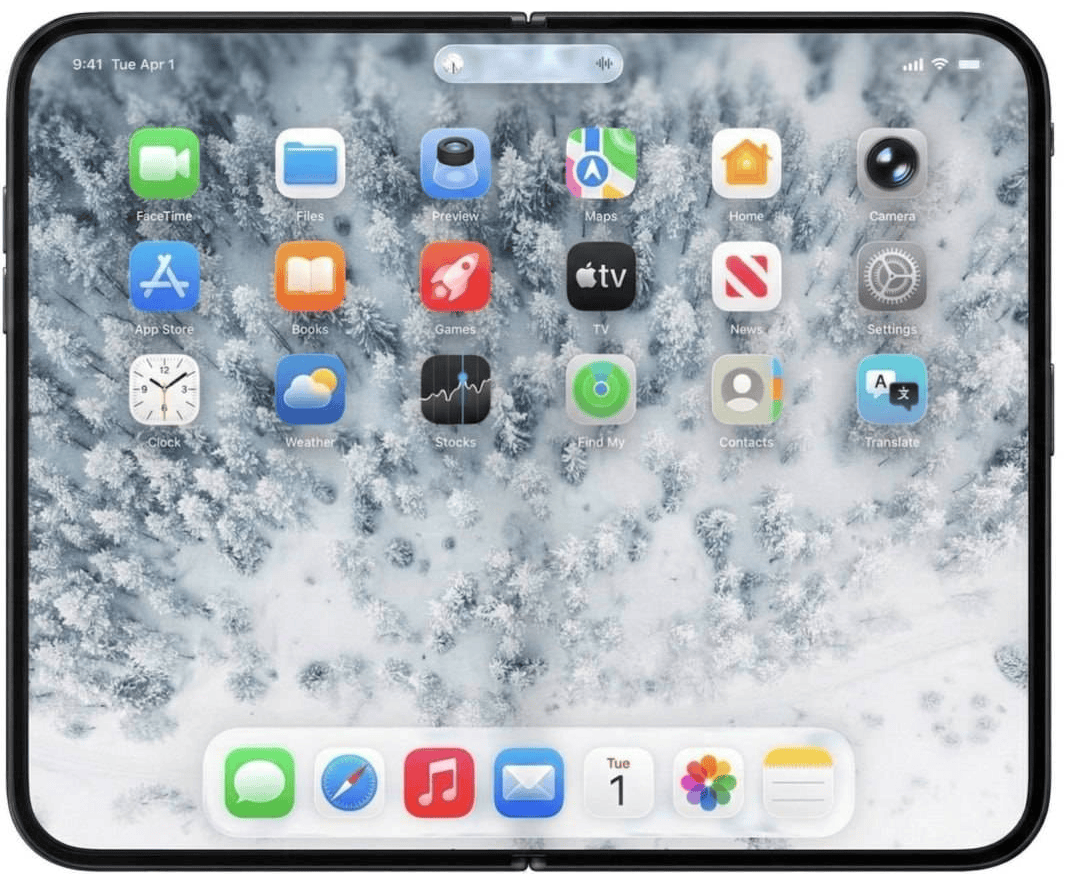
Core Viewpoint - The unveiling of Apple's first foldable flagship iPhone, the iPhoneFold, marks a significant shift in the high-end smartphone market, showcasing Apple's commitment to innovation after nearly five years of development [1][3]. Product Launch Strategy - Apple has adopted a disruptive product release strategy for this year, launching the iPhone17e in the first half and focusing on the iPhone18Pro series and the highly anticipated iPhoneFold in September, while delaying the standard iPhone18 to 2027 [3]. - This staggered release aims to maximize attention on the iPhoneFold, positioning it as the standout product in the smartphone market [3]. Design and Features - The iPhoneFold features a horizontal book-style fold design, maintaining Apple's minimalist aesthetic, with an outer screen size of approximately 5.2-5.3 inches and an inner screen of around 7.6 inches, providing an impressive visual experience [3][5]. - It incorporates a liquid metal hinge, a technology developed by Apple over 15 years, which is expected to eliminate creases and enhance durability [5]. Technical Specifications - The iPhoneFold will feature a new generation of screens supplied by Samsung, with a peak brightness of over 2000 nits and a foldable lifespan, alongside the new A20Pro chip manufactured using TSMC's 2nm process, promising a 15% performance boost and 30% improved energy efficiency [5]. - A customized iOS27 system will be introduced, focusing on seamless dual-screen interaction and ecosystem collaboration, addressing the industry's perception of foldable screens as mere gimmicks [5]. Pricing and Market Position - The iPhoneFold is expected to be positioned in the ultra-high-end market, with a starting price likely above 15,000 yuan, facing initial production and yield challenges that may lead to supply shortages [8]. - Despite the high price, demand from loyal Apple fans and high-end users is anticipated to remain strong, indicating a potential turning point for the foldable smartphone market as Apple enters the fray [8].
去年中国智能手机市场出货约2.85亿台 华为登顶
Zheng Quan Ri Bao· 2026-01-14 15:42
Core Insights - The global smartphone market experienced a 2.3% year-on-year growth in Q4 2025, reaching 336.3 million units, with total shipments for the year at 1.26 billion units [1] - In China, smartphone shipments in 2025 were approximately 285 million units, a decline of 0.6% year-on-year, with Huawei regaining the top position in market share [1] - The smartphone industry is expected to face challenges in 2026, including rising costs and market share pressures, leading to potential reshuffling among domestic manufacturers [1] Market Performance - Huawei led the Chinese smartphone market in 2025 with shipments of 46.7 million units, followed closely by Apple and Vivo with 46.2 million and 46.1 million units, respectively [1] - The top five manufacturers (Huawei, Apple, Vivo, Xiaomi, and OPPO) accounted for 79.4% of the total market share in China, indicating intensified competition [1] Market Trends - Mid-to-high-end brands dominated the shipment rankings, reflecting a trend towards increased market concentration and consumer willingness to pay for differentiated experiences [2] - The storage market is expected to see price increases of 40% to 50% in Q1 2026, further impacting the cost structure of smartphone manufacturers [2] Strategic Responses - Apple is adopting a "more quantity for less price" strategy, while Chinese manufacturers are targeting the ultra-high-end market with new product launches [3] - Companies are reducing shipments of low-end models to maintain profitability amid rising costs [3] Innovation and Growth - The integration of artificial intelligence into smartphones is becoming a key focus for manufacturers, with new models emphasizing AI capabilities as core selling points [4] - Companies like Huawei, Vivo, and Xiaomi are investing in AI and collaborating with internet giants to establish differentiated advantages in the AI ecosystem [4] Industry Adaptation - The Chinese smartphone industry is adjusting to export market fluctuations by establishing overseas factories and transitioning to high-tech, high-value core segments [6] - The resilience of the Chinese smartphone market is evident in its shift from pursuing scale benefits to exploring technological advantages [6]

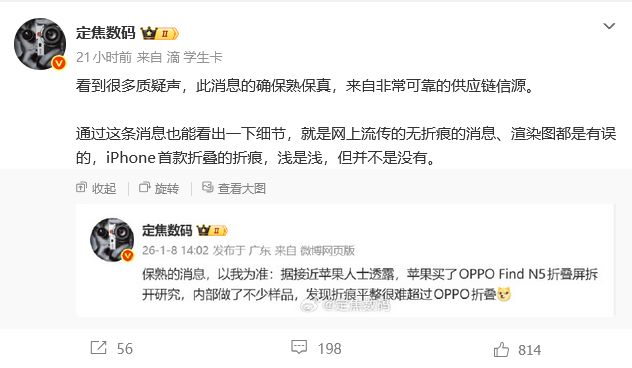
苹果被曝买国产折叠屏拆解研究,仍难消除折痕
Guan Cha Zhe Wang· 2026-01-13 08:44
Group 1 - Apple is reportedly developing its first foldable iPhone, tentatively named "iPhone Fold," with a potential release in fall 2026 and a price exceeding $2000 (approximately 14,000 RMB) [3] - The iPhone Fold is expected to feature a book-style design similar to the Galaxy Z Fold 6, with a main screen size of 7.74 inches and an outer screen size of 5.49 inches [3] - Apple is exploring various hinge solutions to eliminate the "crease" issue commonly associated with foldable screens, indicating a strong focus on technological differentiation in the competitive foldable market [5][7] Group 2 - The OPPO Find N5, which Apple has reportedly disassembled for research, is set to be a direct competitor to the iPhone Fold, highlighting the need for Apple to surpass existing hardware standards [5][7] - Market research from Counterpoint Research indicates that global foldable smartphone shipments are expected to grow by 14% year-on-year in Q3 2025, reaching a historical high for the category [8] - Samsung leads the foldable smartphone market with a 64% share in Q3, showing a 32% increase in shipments compared to the previous year, while Huawei and Motorola follow with 15% and 7% market shares, respectively [8]
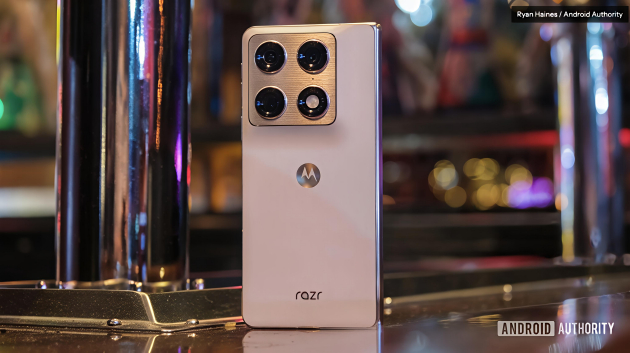
博主发出连环三问:表示对摩托罗拉全新折叠屏Razr Fold存在一些担忧
Xin Lang Cai Jing· 2026-01-08 02:10
Core Viewpoint - Motorola's new foldable smartphone, Razr Fold, was unveiled at CES 2026, but there are significant concerns regarding its software capabilities, camera performance, and market timing [1][3][19]. Software Experience - The software experience is critical for foldable phones, and Motorola's ability to optimize its software for the 8.1-inch display is in question. The company lacks the extensive experience that competitors like Google and Samsung have in this area [5][6][22]. - Motorola's previous product, Moto Pad 60 Pro, had weak system update commitments, raising concerns about the software maturity of Razr Fold [6][23]. - The current software is considered the least mature aspect of the device, with limited hands-on experience available prior to CES [6][23]. Camera Performance - The camera setup for Razr Fold is expected to be a significant challenge, as the company may struggle to adapt its existing camera technology from smaller devices to a larger foldable format [9][10][27]. - Competitors like Pixel 10 Pro Fold and Galaxy Z Fold 7 have faced camera issues, and Motorola's lack of experience in this segment raises doubts about its ability to deliver a competitive camera system [10][28]. - The camera's effectiveness in a larger device format is uncertain, and there are concerns that Motorola may not take bold steps to innovate in this area [11][28]. Market Timing - The timing of Razr Fold's release is questioned, as it enters a market where competitors like Google and Samsung have established products. The potential launch coincides with Apple's first foldable iPhone, creating a challenging competitive landscape [12][30]. - Motorola's strategy appears to rely heavily on branding and design elements, such as Pantone color collaborations, which may not be sufficient to attract users away from established competitors [16][31]. - The success of Razr Fold is heavily dependent on addressing unknown factors such as system updates, charging speed, and screen durability, which remain unanswered [31][33].
吉利发布全域AI 2.0,消费电子ETF(561600)盘中蓄势
Xin Lang Cai Jing· 2026-01-08 02:04
Core Viewpoint - The consumer electronics sector is experiencing mixed performance, with notable developments in AI technology and structural growth opportunities for key manufacturers and suppliers [1] Group 1: Market Performance - As of January 8, 2026, the CSI Consumer Electronics Theme Index (931494) decreased by 0.22%, with component stocks showing varied performance [1] - Chip Yuan Co. (688521) led the gains with an increase of 3.34%, while Luxshare Precision (002475) saw the largest decline at 3.81% [1] - The Consumer Electronics ETF (561600) fell by 0.16%, with the latest price at 1.26 yuan [1] Group 2: Industry Developments - On January 7, Geely Automobile Group unveiled its AI 2.0 technology system at the 2026 Consumer Electronics Show (CES) in Las Vegas, introducing the G-ASD (Geely Afari Smart Driving) system [1] - Geely plans to launch high-speed L3 and low-speed L4 autonomous driving features to the market by 2026 [1] - According to Jinyuan Securities, the consumer electronics sector saw a weekly increase of 0.93%, with the components and assembly sub-sector rising by 1.04%, indicating a recovery in certain parts of the industry chain [1] Group 3: Index Composition - The CSI Consumer Electronics Theme Index comprises 50 listed companies involved in component production and electronic device design and manufacturing [2] - As of December 31, 2025, the top ten weighted stocks in the index accounted for 54.35% of the total, including Luxshare Precision (002475) and Cambricon Technologies (688256) [2]