流量变现

Search documents
从微信到抖音,你的流量去哪了?揭秘企业新活法
Sou Hu Cai Jing· 2026-01-17 04:16
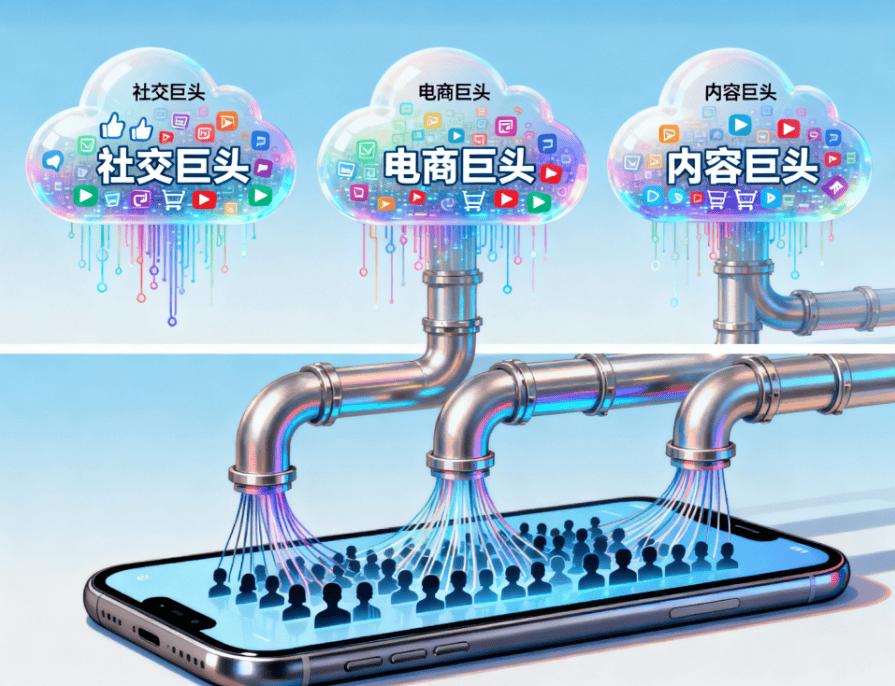
Core Insights - The article discusses the dominance of major apps like WeChat, Douyin, and Alipay in capturing user attention and traffic, highlighting their user bases of over 1 billion for Douyin and TikTok, approximately 1.2 billion for Alipay, and WeChat's status as a lifestyle tool [1][4]. Group 1: User Attention and Competition - There is an ongoing battle for user time and attention among major platforms, which create closed ecosystems through social, content, e-commerce, and financial services to retain users [4]. - For ordinary businesses, acquiring traffic has become increasingly expensive, making it feel like they are working for these platforms [4]. Group 2: Private Traffic and User Engagement - The concept of "private traffic" is gaining traction, referring to user pools that businesses can repeatedly and freely reach, such as communities and app users, which are more stable and cost-effective compared to public traffic [7]. - A trusted user is considered more valuable than numerous casual followers, emphasizing the importance of building a loyal user base [7]. Group 3: Super App Concept - The idea of a "super cloud app" is introduced, which serves as an expandable ecosystem capable of aggregating users, monetizing traffic, and enhancing user engagement through content and activities [9]. - Such an app can integrate advertising systems for revenue generation, with a daily active user base of around 40,000 potentially generating nearly 1 million yuan in three months through ad placements [10]. Group 4: CPS E-commerce Model - The CPS (Cost Per Sale) model allows users to earn commissions by purchasing products through the app, creating a participatory distribution ecosystem that enhances user activity and loyalty [10]. - The app can connect with major e-commerce platforms, ensuring compliance and secure transactions while offering various versions to meet different business needs [10]. Group 5: Sustainable Business Model - A successful enterprise app should function as a self-sustaining traffic pool and monetization platform, helping businesses gather scattered users and maintain interaction through content and activities [11][12]. - The future of business will focus on managing internal traffic rather than relying solely on external platforms, creating a closed loop of customer acquisition, retention, monetization, and promotion [14].

罗永浩拒绝和解!网友:锤子倒闭、老罗负债,都怪王自如的评测
Xin Lang Cai Jing· 2026-01-03 03:12
Core Viewpoint - The ongoing feud between Luo Yonghao and Wang Ziru has resurfaced, with Luo's recent comments indicating a firm stance against reconciliation, highlighting the deep-seated nature of their rivalry [1][3]. Group 1: Historical Context - The conflict began in 2014 during a critical review of Luo's Smartisan T1 phone by Wang, which led to a highly publicized debate that escalated tensions between the two [1][3]. - Wang Ziru's critical evaluation is perceived by many as a significant factor contributing to the decline of Smartisan, resulting in Luo accumulating substantial debt [4][6]. Group 2: Public Perception - Many netizens view Wang Ziru as the "culprit" behind the downfall of Smartisan, believing that a reconciliation would be seen as a betrayal of Luo's past and his supporters [4][6]. - The emotional investment from the audience reflects a blend of nostalgia for Smartisan and sympathy for Luo's struggles, projecting these feelings onto the ongoing feud [4][6]. Group 3: Diverging Perspectives - Wang Ziru adopts a more commercial approach, viewing the feud as a means to generate traffic and engagement, while Luo remains committed to his principles and brand reputation [6][7]. - The contrasting motivations—Luo's focus on integrity versus Wang's emphasis on flow and engagement—create a fundamental barrier to any potential reconciliation [7]. Group 4: Outcomes of the Feud - The current situation suggests that while Wang Ziru may have gained traffic, Luo Yonghao has maintained his reputation for authenticity, yet both remain entangled in the narrative of their rivalry [9]. - The ongoing debate raises questions about the nature of discussions in the tech industry, whether they should prioritize product integrity or leverage for traffic [9].

抖音直播篮球联赛,短视频平台做体育赛事要闯过多少难关? | 声动早咖啡
声动活泼· 2025-12-26 09:02
Core Viewpoint - The article discusses the shift in sports broadcasting rights in China, highlighting the transition from traditional high-value contracts to new partnerships, particularly the CBA's decision to collaborate with Douyin instead of continuing with Migu [3][4]. Group 1: CBA and Broadcasting Rights - CBA's previous partnership with Migu began in 2018, with a five-year contract worth over 2 billion yuan, the largest in CBA history [5]. - Migu aimed to reduce the renewal price for the new season from 2 billion to approximately 750 million yuan, indicating a significant drop in perceived value [5]. - The lack of other bidders at the same price point led to Migu's continued dominance in CBA's new media broadcasting, conflicting with CBA's goal of expanding influence through multi-platform cooperation [5]. Group 2: Market Dynamics and User Engagement - The willingness of domestic sports event viewers to pay remains lower than that for films and variety shows, with free broadcasts struggling to attract audiences [6]. - A report indicated that Tencent Video's weekly active users were about five times that of Tencent Sports, emphasizing the competitive landscape [6]. - Traditional giants are scaling back on sports rights, as seen with Tencent's reduced investment in NBA and the transfer of Bundesliga rights to smaller companies [6]. Group 3: Douyin's Strategy and User Base - Douyin has over 800 million daily active users, with 470 million showing interest in sports, positioning it well for free CBA broadcasts to attract a larger audience [7]. - The platform's approach includes integrating sports content with user-generated content (UGC), enhancing viewer engagement through interactive features [8]. - Douyin's unique selling proposition is "watch CBA for free," leveraging influencers for real-time commentary and product sales during broadcasts [9]. Group 4: Challenges Ahead for Douyin - Douyin's success in monetizing sports content will depend on converting viewers into consumers, a challenge highlighted by issues with influencer compliance for live broadcasts [10]. - Viewer feedback indicates that the experience on Douyin may not match that of Migu, with complaints about the lack of commentary and real-time statistics during games [11]. - A comprehensive content ecosystem is necessary for Douyin to retain viewers, as seen with established platforms like ESPN and Migu, which offer a variety of related programming [12].

寻求更多手机厂商合作,豆包准备隔山打牛
3 6 Ke· 2025-12-25 23:37
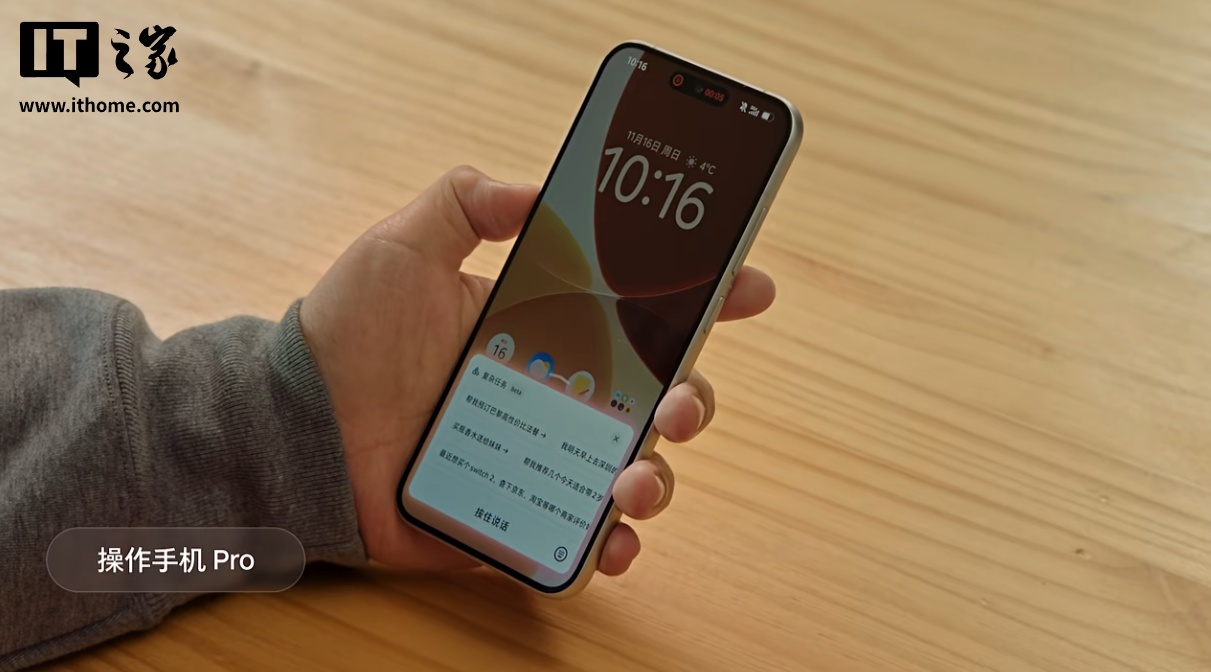
Core Viewpoint - The article discusses the recent challenges faced by Doubao, a mobile phone assistant developed by ByteDance, which has been blocked by major apps like WeChat, Taobao, and Alipay. In response, ByteDance is seeking partnerships with hardware manufacturers to pre-install AIGC plugins on mid-range devices priced above 2000 yuan [1][3]. Group 1: Partnerships and Collaborations - ByteDance is actively pursuing collaborations with smartphone manufacturers such as Vivo, Lenovo, and Transsion to pre-install AIGC plugins on their devices [3]. - Reports indicate that Vivo employees have confirmed a partnership agreement with ByteDance, and Lenovo is also in close communication regarding potential collaborations in the smart terminal sector [3]. - The strategy of partnering with hardware manufacturers is seen as a clever move by ByteDance to address the challenges posed by major app blockages [3]. Group 2: Industry Dynamics - The relationship between internet companies and smartphone manufacturers is characterized by significant conflicts of interest, particularly regarding app store revenue sharing [4]. - Internet giants like Tencent and ByteDance have developed "mini-programs" to circumvent the revenue-sharing model imposed by hardware manufacturers [4]. - Smartphone manufacturers have historically relied on software for profitability, leading to a competitive landscape where they must depend on internet companies for revenue [6]. Group 3: AI Integration and Cost Management - Without Doubao, many second and third-tier smartphone manufacturers would struggle to develop their own AI assistants due to resource limitations [7]. - ByteDance is not only providing technology but also creating a new revenue-sharing model that allows smartphone manufacturers to participate in traffic distribution and subscription services [7]. - By absorbing the costs associated with AI token usage, ByteDance makes it financially attractive for smartphone manufacturers to adopt its AI services [8]. Group 4: Market Implications - The success of the Doubao mobile assistant with ZTE sets a precedent, encouraging more smartphone manufacturers to explore similar collaborations with ByteDance [9].

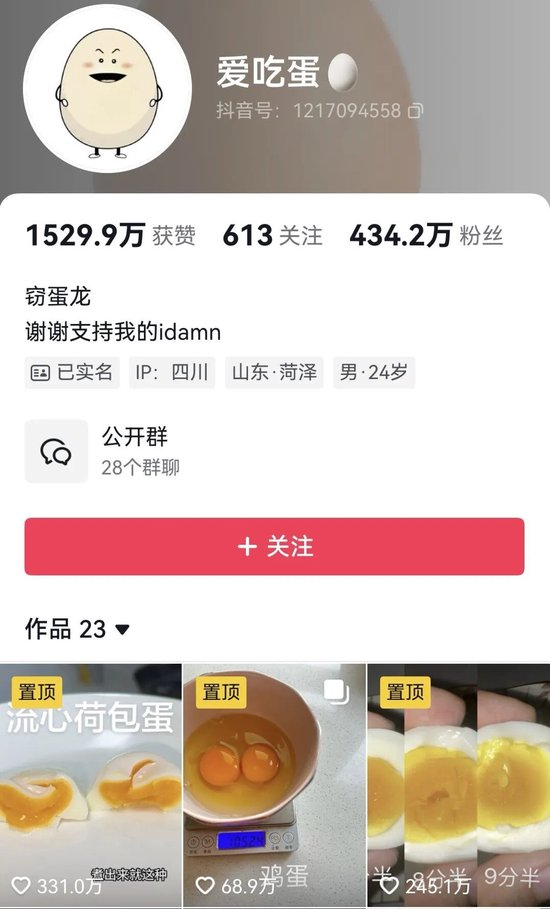
24岁山东小伙凭煮蛋9天涨粉400万,被称作“蛋神”,1分钟以上视频广告报价21万元
Xin Lang Cai Jing· 2025-12-24 08:23
Core Insights - A 24-year-old from Shandong, known as "Egg God," gained 4 million followers in just a few days by sharing precise egg cooking tutorials, particularly a "9 minutes 12 seconds" boiling method [1][9] - The Douyin account "Love Eating Eggs" has over 4.34 million followers and received 15.3 million likes, with a top video on "runny fried eggs" garnering 3.31 million likes [1] - The rapid growth in followers has led to a significant increase in advertising rates, with prices rising nearly 90 times in just half a month [7] Company Formation - A wholly-owned subsidiary, Yuncheng Love Eating Eggs Network Technology Co., Ltd., has been established with a registered capital of 200,000 yuan, focusing on software and information technology services [5] - The company is involved in internet sales, information services, and live streaming technology services [5] Advertising and Monetization - Current advertising rates for "Love Eating Eggs" are 140,000 yuan for 1-20 seconds, 170,000 yuan for 21-60 seconds, and 210,000 yuan for over 60 seconds [7] - The founder, Feng Changxu, stated that the primary reason for registering the company was to facilitate tax payments and emphasized the importance of being a lawful citizen [7] Public Response and Engagement - The "Egg God" phenomenon sparked a trend of imitation among users, with many successfully replicating the egg cooking method [9][12] - Feng expressed that he feels pressure from sudden fame and prefers to remain humble, encouraging others to pursue their passions [8][11] - The platform clarified that the rise of "Egg God" was not due to any algorithmic manipulation, but rather organic interest from users [9]
当豆包AI手机发起“硬件联盟”:一场向超级App宣战的“系统级革命”全面爆发
Mei Ri Jing Ji Xin Wen· 2025-12-19 14:20
Core Insights - ByteDance is collaborating with Lenovo to integrate AI capabilities into smartphones, aiming to gain user access and reshape the AI landscape in mobile technology [1][2] - The launch of the Doubao AI phone assistant has prompted major apps like WeChat and Taobao to defend their market positions, indicating a significant shift in the competitive landscape [1][4] - The strategy involves creating new revenue streams through partnerships with hardware manufacturers, positioning them as channel partners in ByteDance's AI ecosystem [2][3] Group 1: Collaboration and Strategy - ByteDance is working with various hardware manufacturers, including Lenovo, Vivo, and Transsion, to pre-install AI plugins on smartphones, aiming to capture the next generation of human-computer interaction [1][2] - The collaboration model discussed includes revenue sharing from traffic distribution and subscription services, with no upfront fees for customized development [2][3] - The goal is to transform smartphone manufacturers from mere device makers into integral partners within ByteDance's AI ecosystem [2][3] Group 2: Market Dynamics and Challenges - The Doubao AI phone has faced operational challenges with major apps, leading to adjustments in its AI capabilities to comply with existing app restrictions [4][5] - The strategy to target mid-range smartphones priced above 2000 yuan aims to build a substantial user base, with plans to expand to 150 million to 200 million devices [6][7] - The overseas market is seen as a more favorable environment for innovation, allowing for lower risk and better user education before entering the more competitive domestic market [7][8] Group 3: Future Prospects and Uncertainties - The potential for a hardware alliance could shift the balance of power against super apps, but the success of this strategy remains uncertain [3][8] - The sustainability of new business models, including revenue generation from AI services, is still unproven, posing a significant challenge for all players involved [8] - ByteDance's approach to leveraging AI in smartphones could reshape the mobile ecosystem, but it faces hurdles from super apps and the need for a clear commercial path [8]
豆包手机大家族:字节跳动被曝正推进与 vivo、联想、传音等多家硬件厂商开展 AI 手机合作
Xin Lang Cai Jing· 2025-12-19 12:48
Group 1 - ByteDance is advancing AI phone collaboration plans with hardware manufacturers such as Vivo, Lenovo, and Transsion, aiming to pre-install AIGC plugins to gain user access [1][4] - Vivo employees confirmed that ByteDance has established a cooperation intention with Vivo, while specific plans are still under discussion [1][4] - The collaboration aims to create a new traffic monetization channel by sharing traffic distribution and subscription revenue with phone manufacturers, exploring a model that does not charge for custom development fees or token sales [3][6] Group 2 - The cooperation plan will initially target mid-range models priced above 2000 yuan, with the first batch implemented through new device pre-installation and later expanded to existing models via OTA upgrades [3][6] - ByteDance has set an internal target of 150-200 million devices for this AI phone project, with a focus on leveraging its overseas channel advantages [3][6] - The AI phone project team at ByteDance has grown to over a thousand members, and while discussions with OPPO did not result in a partnership, ZTE is currently the only officially disclosed partner [3][6]
豆包手机扩充合作厂商 vivo、联想、传音在列
Xin Lang Cai Jing· 2025-12-19 12:42
Group 1 - ByteDance is advancing AI phone collaboration plans with hardware manufacturers such as Vivo, Lenovo, and Transsion, aiming to gain user access through pre-installed AIGC plugins [1][7] - The collaboration intends to create a new traffic monetization channel by sharing traffic distribution and subscription revenue with phone manufacturers, while exploring a model that does not charge for custom development fees or token sales [3][9] - The initial focus of the collaboration will be on mid-range models priced above 2000 yuan, with plans to implement pre-installation on new devices and later expand to existing models via OTA upgrades [4][11] Group 2 - ByteDance's AI phone project team has grown to over 1,000 members, with ZTE being the only officially disclosed partner, while Meizu has expressed interest in collaboration [7][13] - The internal target for ByteDance is to reach a scale of 150-200 million devices, with overseas channels likely being a key focus for deployment [4][11]
字节跳动正推进与多家厂商的AI手机合作
Xin Lang Cai Jing· 2025-12-19 02:44
Group 1 - ByteDance is advancing collaborations with hardware manufacturers such as Vivo, Lenovo, and Transsion to develop AI smartphones, aiming to pre-install AIGC plugins on their devices to gain user access and shift the current passive execution of AI [1][6] - Vivo employees have confirmed the partnership with ByteDance, and discussions on specific collaboration details are ongoing [1][6] - Vivo previously sought deep collaboration with Tencent on AI large models but could not reach an agreement due to commercialization challenges, particularly related to Token costs [2][7] Group 2 - ByteDance's strategy focuses on creating new monetization pathways for traffic, involving mobile manufacturers in revenue sharing from traffic distribution and subscription services [5][10] - The collaboration model being discussed includes no customization development fees or Token sales revenue sharing, with potential secondary revenue sharing for mobile manufacturers [5][10] - ByteDance aims to target mid-range smartphones priced above 2000 yuan, planning to launch new devices with manufacturers and subsequently expand through OTA updates to other models, with a goal of reaching 150-200 million units before competing with other internet companies [5][10]

抖音电商终于下狠手了,这类“打假网红”要凉了
Sou Hu Cai Jing· 2025-12-17 13:15
Core Viewpoint - The article discusses the emerging trend in the e-commerce industry where some influencers exploit "anti-counterfeiting" efforts to gain traffic and monetize through selling products, revealing a shift from genuine consumer protection to profit-driven motives [2][5][6]. Group 1: The Trend of "Anti-Counterfeiting" for Profit - Influencers create videos claiming to expose counterfeit products, often using emotional appeals to attract viewers, but they simultaneously promote similar products for profit [3][10]. - This practice has become a replicable business model, with many influencers engaging in "anti-counterfeiting" as a means to generate income [4][6]. - The rise of these "anti-counterfeiting" influencers has led to a misuse of public trust, turning a once noble cause into a tool for personal gain [5][6]. Group 2: The Impact on Brands and Consumers - Brands targeted by these influencers face significant reputational damage, often leading to decreased sales and financial losses, especially during critical sales periods [15][16]. - The malicious nature of these attacks creates an environment of fear among brands, leading to a cycle where genuine businesses suffer while fraudulent practices thrive [16][27]. - The overall e-commerce ecosystem is at risk, as the prevalence of "anti-counterfeiting" tactics undermines trust and quality, potentially driving consumers away [16][27]. Group 3: Regulatory Responses from Platforms - Douyin e-commerce has introduced new regulations aimed at curbing the spread of malicious "anti-counterfeiting" content, focusing on evidence-based claims and restricting influencers from selling products in the same category they criticize [19][20]. - The platform's measures include marking accounts that engage in malicious practices and restricting their ability to monetize content, effectively cutting off their revenue streams [21][22]. - These regulatory actions are part of a broader strategy to maintain a healthy ecosystem by promoting quality content and protecting both consumers and legitimate businesses [26][27].