
生态安全

Search documents
凝聚合力守护生态安全
Jing Ji Ri Bao· 2025-10-30 22:14
Group 1: Policy and Economic Framework - The 20th Central Committee's Fourth Plenary Session emphasizes the coordinated advancement of carbon reduction, pollution reduction, greening, and growth to strengthen ecological security and enhance green development momentum [1] - A green low-carbon circular economy system is to be constructed, focusing on ecological industrialization and industrial ecology, with strict implementation of spatial planning controls [2] - Establishment of a green industry development fund and innovation of green development incentive mechanisms to increase R&D tax deductions for environmental protection technologies [2] Group 2: Corporate Development and Innovation - Companies are encouraged to shift from "passive compliance" to "active governance," establishing environmental responsibility systems throughout the product lifecycle [2] - A collaborative innovation system involving government, industry, academia, research, finance, and services is to be supported, particularly for leading enterprises to form green technology innovation alliances [2] - Companies should integrate ecological responsibility into their development strategies and enhance internal ecological culture to improve employee environmental awareness [2] Group 3: Public Engagement and Cultural Shift - Ecological civilization education is to be integrated into national education and training systems to enhance public ecological awareness [3] - Development of digital platforms for public participation and improvement of environmental public interest litigation mechanisms to foster social supervision [3] - Promotion of a green lifestyle and encouragement for the public to prioritize green products and services, guiding market demand towards green transformation [3]
“五年规划”,更加注重统筹发展和安全
Xin Jing Bao· 2025-10-27 08:06
Core Viewpoint - The "15th Five-Year Plan" period is crucial for China to embark on a new journey towards building a modern socialist country and achieving the second centenary goal, emphasizing the integration of development and security as a strategic foundation [1][2]. Group 1: Development and Security - Development and security are interdependent; development provides the material basis for security, while security is a prerequisite for sustainable development [1][2]. - The current global landscape is characterized by significant changes, including rising unilateralism and geopolitical risks, necessitating a heightened awareness of potential challenges [1][2]. Group 2: Key Areas of Focus - Economic security is fundamental, requiring measures to ensure food security, energy resource supply, and the prevention of systemic financial risks [2]. - Technological self-reliance is essential for maintaining development autonomy, addressing critical challenges, and managing emerging risks related to technology ethics and data security [2]. - Social stability is vital for reform and development, necessitating improvements in public safety and health networks [2]. - Ecological security is crucial for sustainable development, advocating for a green development path [2]. Group 3: Systematic Approach - A comprehensive system is needed to ensure the integration of development and security, including a robust legal framework and enhanced risk assessment mechanisms [2]. - Strengthening national security education is important to build a resilient public defense against security threats [2][3].
公安机关严打危害鸟类等野生动物犯罪
Liao Ning Ri Bao· 2025-10-24 01:01
Group 1 - The core viewpoint of the articles emphasizes the ongoing efforts of provincial public security agencies to combat wildlife crimes, particularly those affecting bird species, through a series of coordinated actions and initiatives [1][2][3] - A total of 62 cases related to the destruction of bird and wildlife resources have been filed this year, resulting in the arrest of 131 suspects and the dismantling of 18 criminal gangs, with seized hunting tools valued at over 75 million yuan [1] - The provincial police have established three joint strike zones along key migratory routes for birds, creating an integrated mechanism for information sharing, joint law enforcement, and collaborative case handling to address cross-regional crimes [2] Group 2 - The special action has led to the successful resolution of significant cases involving endangered wildlife, including a major case in Shenyang where 34 suspects were arrested and six trafficking gangs were dismantled, severing nine cross-regional crime chains [2] - Multi-departmental collaboration is crucial for effectively combating wildlife crimes, with public security agencies coordinating with various departments such as natural resources, forestry, market regulation, and transportation to enhance operational efficiency [2] - Law enforcement has been complemented by extensive legal education and awareness campaigns, with over 120 activities conducted to promote public awareness of wildlife protection and illegal activity resistance [3]
甘肃庆阳:“五个协同”筑牢生态安全屏障
Zhong Guo Huan Jing Bao· 2025-10-13 03:09
Core Viewpoint - The city of Qingyang in Gansu Province is implementing comprehensive ecological protection and governance strategies to combat desertification and improve water and soil conservation, aligning with national ecological initiatives and enhancing its environmental quality [1][2][3][4]. Group 1: Ecological Protection and Governance - Qingyang is focusing on integrated protection and systematic governance of its natural resources, emphasizing the importance of collaboration among various departments and levels of government [1]. - The city has invested 610 million yuan in desertification control, establishing a protected area of 309,000 acres and treating 1.26428 million acres of desertified land, achieving a shift from "sand encroachment" to "green recovery" [1]. - The total area of soil erosion in Qingyang is 23,000 square kilometers, accounting for 86% of the city's land area, prompting extensive soil erosion control measures [2]. Group 2: Water and Soil Conservation - Qingyang has completed soil erosion control over 17,600 square kilometers and has reduced annual sediment discharge into the Yellow River to below 10 million tons, indicating a sustained decrease in soil erosion intensity [2]. - The city is actively monitoring biodiversity and natural ecosystems, employing advanced technologies for wildlife monitoring and enforcing laws against illegal wildlife activities [2]. Group 3: Financial and Policy Support - Qingyang has received 7.687 billion yuan in transfer payments for ecological functions, which have been effectively utilized for environmental pollution control and ecological protection projects [3]. - The local government has implemented a series of actions to strengthen ecological civilization, including the establishment of ecological protection red lines and the promotion of legislative measures for environmental protection [4]. - By 2024, Qingyang aims to achieve stable air quality, with 95.7% of surface water quality meeting standards and a forest coverage rate of 60.63% [4].
浙江自然博物院将展出海关罚没水生濒危野生动物制品
Zhong Guo Xin Wen Wang· 2025-09-11 14:21
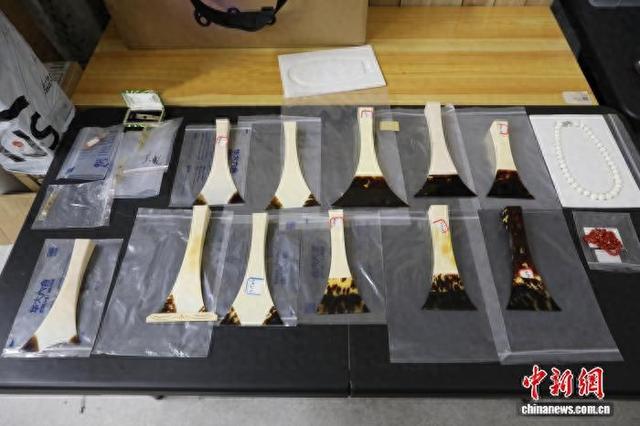
Core Points - The Zhejiang Natural History Museum received a batch of 18 items of aquatic endangered wildlife products, including red coral, giant clam, and hawksbill turtle, confiscated by Wenzhou Customs [1][2] - This is the 15th batch of natural product confiscations received by the museum since 2006, bringing the total number of confiscated items to 6,183 [1][2] Summary by Sections - **Confiscation Details** - The confiscated products were seized by Wenzhou Customs under the Customs Law of the People's Republic of China, confirming they belong to species prohibited for import and export [2] - Legal regulations require that import and export of such species must have a permit issued by the national authority, or legal consequences will follow [2] - **Museum's Responsibility and Plans** - The museum's director emphasized the responsibility that comes with receiving confiscated products and committed to proper scientific management and collection [2] - Plans are in place to launch a special exhibition showcasing the 6,183 confiscated items, with a tour across Zhejiang Province to raise public awareness about ecological safety [2]


甘肃省委书记胡昌升:以整改实效加力推进美丽甘肃建设
Zhong Guo Huan Jing Bao· 2025-09-01 00:31
Core Viewpoint - The meeting emphasized the importance of addressing feedback from the Central Ecological and Environmental Protection Inspection as a major political task, aiming to enhance ecological safety and improve the environment in Gansu Province [1][2]. Group 1: Key Actions and Strategies - The provincial government will focus on scientific water usage by implementing the "Four Waters and Four Determinations" principle, promoting water-saving measures across agriculture, industry, urban areas, and ecological conservation [2]. - There will be a strong emphasis on land use regulation, prioritizing protection, spatial control, and efficient utilization to ensure orderly land development [2]. - Energy conservation and reduction will be prioritized, with strict energy review processes and comprehensive evaluations of project energy use and carbon emissions [2]. - Integrated ecological governance will be pursued, focusing on the protection and systematic management of various ecosystems, including mountains, rivers, forests, fields, lakes, grasslands, and deserts [2]. - The government will conduct special rectifications to address illegal waste disposal, heavy metal pollution, and soil protection, ensuring ecological safety [2]. - Forest and grassland fire prevention measures will be strictly enforced, with responsibilities assigned at all levels and comprehensive risk assessments conducted [2].
完善国家生态安全工作协调机制重在协同
Ren Min Ri Bao· 2025-08-29 07:25
Core Viewpoint - Ecological security is a crucial component of national security and sustainable economic and social development, requiring a comprehensive and coordinated approach to address risks and challenges [1] Group 1: Ecological Security Governance - The governance of ecological security must involve multiple departments and levels, emphasizing a systematic and collaborative approach to enhance overall governance effectiveness [2][3] - Significant progress has been made in establishing cross-departmental and cross-regional collaborative mechanisms, such as the ecological restoration coordination mechanism between the Ministry of Ecology and Environment and the Ministry of Natural Resources [1][3] Group 2: Inter-Departmental Collaboration - Strengthening inter-departmental collaboration is essential for addressing ecological security issues, necessitating a clear and efficient collaborative framework that includes joint meetings, information sharing, and coordinated enforcement [2] - Targeted collaborative mechanisms should be developed for specific ecological security challenges, such as invasive species, requiring cooperation between forestry and customs departments [2] Group 3: Regional Collaboration - Regional collaboration is vital due to the interconnected nature of ecosystems, necessitating mechanisms for information sharing, joint enforcement, and emergency response across administrative boundaries [3] - Key economic regions like Beijing-Tianjin-Hebei and the Yangtze River Delta should enhance their ecological governance mechanisms to address pollution and resource management collectively [3] Group 4: Pollution Management - A comprehensive approach to managing multiple pollutants is necessary, recognizing the complex interactions and cumulative effects of pollutants across air, water, and soil [4] - Establishing monitoring, assessment, and evaluation mechanisms for multi-pollutant management is critical to ensure effective governance outcomes [4] Group 5: Policy Coordination - Ecological security requires the integration of policies across various fields, such as industry, energy, and land use, to create synergies and reduce conflicts [5] - The core of current policy coordination lies in developing mechanisms that promote green development while balancing ecological protection and economic growth [5][6]
完善国家生态安全工作协调机制
Ren Min Ri Bao· 2025-08-28 01:09
Core Viewpoint - Ecological security is a crucial component of national security and a vital guarantee for sustainable economic and social development, emphasizing the need for a comprehensive and coordinated approach to address ecological risks and challenges [1] Group 1: Coordination Mechanisms - Strengthening inter-departmental collaboration is essential to establish a joint working system, breaking down departmental barriers and enhancing overall governance efficiency [2] - A targeted inter-departmental coordination mechanism should be developed for specific ecological security issues, such as invasive species, requiring collaboration between forestry and customs departments [2] Group 2: Regional Collaboration - The integrity of ecosystems necessitates cross-regional cooperation in ecological security efforts, as ecological events often transcend administrative boundaries [3] - Mechanisms for information sharing, joint law enforcement, and emergency response should be established to enhance regional ecological security capabilities [3] Group 3: Pollution Management - A comprehensive approach to managing multiple pollutants is required, recognizing the complex interactions and cumulative effects of pollutants in the environment [4] - Establishing monitoring, assessment, and evaluation mechanisms for multi-pollutant governance is critical to ensure effective management and risk mitigation [4] Group 4: Policy Synergy - Ecological security policies must be coordinated across various fields, such as industry, energy, and land use, to create a synergistic effect and reduce policy conflicts [5] - The integration of ecological protection policies with spatial planning can promote complementary development between ecological conservation and socio-economic growth [5]

强化协同联动 完善国家生态安全工作协调机制(专题深思)
Ren Min Ri Bao· 2025-08-27 22:40
Core Viewpoint - Ecological security is a crucial component of national security and a vital guarantee for sustainable economic and social development, emphasizing the need for a comprehensive and coordinated approach to address ecological risks and challenges [1] Group 1: Coordination Mechanisms - Strengthening inter-departmental collaboration is essential to establish a joint working mechanism, breaking down departmental barriers and enhancing overall governance efficiency [2] - A targeted inter-departmental coordination mechanism should be developed for specific ecological security issues, such as invasive species, requiring collaboration between forestry and customs departments [2] Group 2: Regional Collaboration - The integrity of ecosystems necessitates cross-regional cooperation, as ecological security issues often transcend administrative boundaries, highlighting the need for joint prevention and control mechanisms [3] - Existing agreements among over 20 provinces for cross-provincial ecological protection compensation indicate progress in establishing collaborative mechanisms for ecological governance [3] Group 3: Pollution Management - A comprehensive approach to managing multiple pollutants is required, recognizing the complex interactions and cumulative effects of pollutants across different environmental media [4] - Establishing monitoring, assessment, and evaluation mechanisms for multi-pollutant governance is critical to ensure effective management and risk mitigation [4] Group 4: Policy Coordination - Ecological security policies must be mutually supportive across various fields, such as industry, energy, and land use, to enhance overall governance efficiency and reduce policy conflicts [5] - The integration of ecological protection policies with spatial planning can promote complementary development between ecological conservation and socio-economic growth [5][6]
完善国家生态安全工作协调机制(专题深思)
Ren Min Ri Bao· 2025-08-27 22:19
Core Viewpoint - Ecological security is a crucial component of national security and a vital guarantee for sustainable economic and social development, emphasizing the need for a comprehensive and coordinated approach to address ecological risks and challenges [1] Group 1: Coordination Mechanisms - Strengthening inter-departmental collaboration is essential to establish a joint working system, breaking down departmental barriers and enhancing overall governance efficiency [2] - A targeted inter-departmental coordination mechanism should be developed for specific ecological security issues, such as invasive species, requiring collaboration between forestry and customs departments [2] Group 2: Regional Collaboration - The integrity of ecosystems necessitates cross-regional cooperation in ecological security efforts, as ecological events often transcend administrative boundaries [3] - Mechanisms for information sharing, joint law enforcement, and emergency response should be established to enhance regional ecological security capabilities [3] Group 3: Pollution Control - A comprehensive approach to multi-pollutant governance is required, recognizing the complex interactions and cumulative effects of pollutants [4] - Establishing monitoring, assessment, and evaluation mechanisms for multi-pollutant governance is critical to ensure effective management and response to ecological risks [4] Group 4: Policy Synergy - Ecological security policies must be mutually supportive across various fields, such as industry, energy, and land use, to enhance overall governance efficiency [5] - The integration of ecological protection policies with spatial planning can promote complementary development between ecological conservation and socio-economic growth [5]