电力供应

Search documents
事关中国,马斯克最新发声
Xin Lang Cai Jing· 2026-01-07 17:13
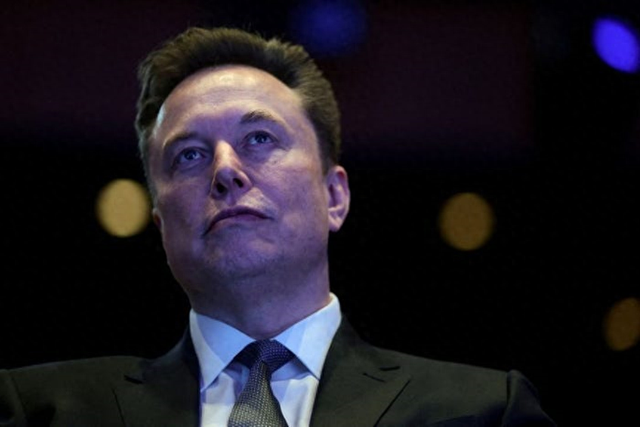
Core Viewpoint - Musk asserts that China will lead the world in AI computing capabilities, primarily due to its power supply capacity [1][3]. Group 1: AI Computing Capabilities - Musk predicts that China will produce more electricity than any other country, which will support its AI computing advancements [3]. - By 2026, China's electricity generation could reach three times that of the United States, enabling the operation of energy-intensive AI data centers [3]. - The ability to expand power production and supply is seen as a critical factor in scaling AI systems, with Musk emphasizing the underestimated challenges of power supply [3]. Group 2: Semiconductor and Chip Production - Musk believes that U.S. semiconductor export controls may become less significant over time, as China will "solve the chip problem" [4]. - The diminishing marginal returns in cutting-edge chip performance may allow China to close the AI technology gap even without access to the most advanced chip designs [4]. Group 3: Broader Technological Insights - Musk has expressed interest in learning from China's experiences in various fields, aiming to enhance his social platform X into a multifunctional application similar to WeChat [4].

先凑够电力再说:东南亚想接盘取代中国产业链,门儿都没有!
Sou Hu Cai Jing· 2026-01-02 07:15
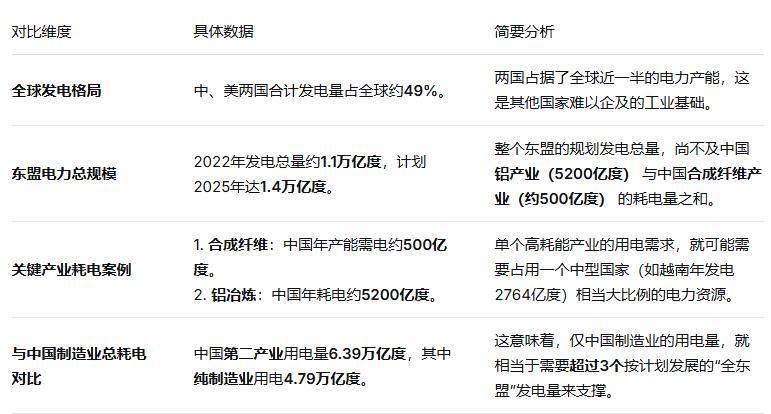
Group 1 - In 2023, China generated approximately 9.2 trillion kilowatt-hours of electricity, accounting for 34% of global electricity generation, while the US generated 4.5 trillion kilowatt-hours, making up 15% [1][8] - Together, China and the US account for nearly half of the world's electricity consumption, with the remaining 18 countries in the top 20 generating only about 49% combined [1][2] - The total electricity generation of ASEAN countries in 2022 was about 1.1 trillion kilowatt-hours, with a planned increase to 1.4 trillion kilowatt-hours by 2025, which is significantly lower than China's consumption in key industries [2][5] Group 2 - China's synthetic fiber industry produced 68.72 million tons in 2023, consuming about 500 billion kilowatt-hours of electricity, while the aluminum industry consumed 520 billion kilowatt-hours, surpassing the total electricity consumption of several major European countries [3][5] - Southeast Asian countries like Vietnam and Indonesia have significantly lower electricity generation, with Vietnam generating 2.764 trillion kilowatt-hours and Indonesia 1.85 trillion kilowatt-hours in 2023, highlighting the disparity in energy capacity [3][10] - The electricity demand for industries such as aluminum and automotive manufacturing in Southeast Asia would require a substantial increase in their current electricity generation capabilities, which is not feasible in the short term [5][11] Group 3 - China's manufacturing sector consumed 4.79 trillion kilowatt-hours in 2023, representing 52% of the country's total electricity generation, indicating the critical need for robust energy infrastructure to support industrial growth [6][11] - The current electricity supply in Southeast Asia is insufficient to support high-energy industries, with countries like Vietnam and Indonesia struggling to meet basic electricity needs [10][11] - The transition of industrial chains from China to Southeast Asia is not merely a logistical challenge but requires decades of investment in energy infrastructure to achieve comparable levels of electricity supply [11][12]
工业硅:逢高做空为主,多晶硅:部分企业报价抬升,关注实际成交
Guo Tai Jun An Qi Huo· 2025-12-17 01:37
Group 1: Report Industry Investment Ratings - The investment strategy for industrial silicon is to short on rallies [1] - For polysilicon, some companies have raised their quotes, and attention should be paid to actual transactions [2] Group 2: Core Views of the Report - The report provides detailed fundamental data of industrial silicon and polysilicon, including futures market prices, trading volumes, open interests, basis, spot prices, profits, inventories, and raw material costs [2] - It also presents macro and industry news, such as the power supply situation and electricity consumption forecasts [2][4] - The trend intensities of industrial silicon and polysilicon are given, with -1 for industrial silicon and 1 for polysilicon [4] Group 3: Summary by Relevant Catalogs 1. Fundamental Data - **Futures Market**: Si2605 closing price is 8,365 yuan/ton, with a change of -655 compared to T - 22; PS2605 closing price is 58,600 yuan/ton, up 570 from T - 1 [2] - **Basis**: Industrial silicon spot has different premiums or discounts against different benchmarks, and polysilicon spot has a discount against N - type re - investment material [2] - **Prices**: The price of Xinjiang 99 silicon is 8750 yuan/ton, and the price of polysilicon - N - type re - investment material is 52300 yuan/ton [2] - **Profits**: Silicon factory profits for Xinjiang and Yunnan new - standard 553 are - 2919.5 yuan/ton and - 5344 yuan/ton respectively; polysilicon enterprise profit is 8.0 yuan/kg [2] - **Inventories**: Industrial silicon social inventory is 56.1 tons, enterprise inventory is 18.7 tons, and industry inventory is 74.8 tons; polysilicon factory inventory is 29.3 tons [2] - **Raw Material Costs**: The prices of silicon ore, washed coal, petroleum coke, electrodes, etc. are provided, with little change in most cases [2] 2. Macro and Industry News - This year, the national power supply has remained safe and stable, and the annual social electricity consumption is expected to exceed 10 trillion kWh [2][4] - In 2025, the national total power generation installed capacity will exceed 3.8 billion kilowatts, a 14% year - on - year increase, and the social electricity consumption is expected to exceed 10 trillion kWh for the first time [4] 3. Trend Intensities - Industrial silicon trend intensity is - 1, indicating a bearish view; polysilicon trend intensity is 1, indicating a bullish view [4]
需求远超供应!法巴银行:半导体业集体看多2026,电力与ASIC风险被高估
智通财经网· 2025-12-15 01:13
Core Viewpoint - The semiconductor industry remains optimistic about supply and demand dynamics leading into 2026, with demand expected to significantly outpace supply [1][2] Group 1: Industry Outlook - Numerous semiconductor companies, including AMD and NVIDIA, express a positive outlook for market performance and capacity ramp-up through 2026, despite concerns regarding power supply and ASIC competition [1] - The recent Silicon Valley bus tour organized by BNP Paribas involved meetings with executives from major companies such as Intel, Applied Materials, and Seagate Technology, highlighting a collective confidence in future demand [1] Group 2: Power Supply Concerns - Power supply is identified as a major bottleneck in the artificial intelligence arms race, with AMD and NVIDIA acknowledging tightening electricity availability across the U.S. [2] - Both companies believe that the U.S. government is taking steps to alleviate power constraints, viewing the issue as a short-term challenge rather than a long-term barrier [2] Group 3: ASIC Competition - The introduction of custom chips, particularly Google's Tensor Processing Units (TPUs), has raised concerns about ASIC competition in the market [2] - Analysts note that TPUs are optimized for specific cloud service providers and workloads, suggesting that their market share growth should not be extrapolated to other vendors outside of current TPU adopters [2]


高盛:电力供应或成AI基础设施领域关键变量 中国电力充足较美更具优势
智通财经网· 2025-11-14 06:21
Core Insights - Goldman Sachs highlights that significant disparities in electricity supply are becoming a critical variable that may slow down the expansion of AI infrastructure in the United States [1] - In contrast, China's abundant and cost-effective electricity supply could attract data center investments, potentially altering the global distribution of data centers and impacting related industries such as energy equipment and high-energy-consuming sectors like aluminum [1] Electricity Supply and Demand - By 2030, under a scenario of rapid growth in data center demand, the effective reserve electricity capacity in the U.S. may fall below the industry-recognized "critical line" of 15%, posing serious challenges to grid reliability [1] - Conversely, China's situation is markedly different, with projections indicating that due to substantial investments in renewable energy, coal, and nuclear power, it will have approximately 400 gigawatts of reserve electricity capacity by 2030, exceeding its own demand and more than three times the expected global data center electricity demand of about 120 gigawatts [1] Implications for AI Development - The bottleneck in electricity infrastructure may temporarily hinder the development of AI in the U.S. at least until 2030 [1] - Companies and investors relying on large-scale data centers in the U.S. may face higher electricity costs, longer project approval times, and even risks of electricity shortages in certain regions in the future [1]

算力的尽头是电力,电网设备ETF(159326)回调迎布局机会,行业长期逻辑坚实
Mei Ri Jing Ji Xin Wen· 2025-11-10 06:45
华西证券指出,随着新能源大规模接入,配套电网建设需求大幅提升,同时对于电网协调运行能力要求 提升,预计配网侧投资也将具备广阔空间,配电一二次融合设备领先供应商将持续受益,同时,在AI 拉动美国电力需求背景下,电力系统存在升级和扩建需求,相关电力设备需求也有望维持高景气,行业 或将加速发展。 电网设备ETF(159326)是全市场唯一跟踪中证电网设备主题指数的ETF,从申万三级行业分类上看, 指数成分股的行业分布以输变电设备、电网自动化设备、线缆部件及其他、通信线缆及配套、配电设备 为主,拥有较强的代表性。持仓股特高压权重占比高达64%,均为全市场最高。 (文章来源:每日经济新闻) 11月10日,A股三大指数涨跌不一,沪指小幅震荡,创业板指全天走低,上周表现强势的电网设备板块 出现回调,截至14:06,全市场唯一的电网设备ETF(159326)跌幅1.14%,盘中交投依然活跃,成交额 达4.65亿元,持仓股双杰电气涨超9%,保变电气涨超8%,亿嘉和、金利华电、明阳电气、永福股份、 风范股份、麦克奥迪等股跟涨。 近期电网设备板块获资金抢筹,截至11月7日,电网设备ETF(159326)已连续10个交易日获资金净流 ...
美国互联网巨头撕开AI遮羞布,芯片过剩严重,中国卡住AI的脖子
Sou Hu Cai Jing· 2025-11-05 01:09
Group 1 - The core issue in AI technology development is shifting from AI chips to electricity supply, as highlighted by Microsoft CEO Satya Nadella [1][3] - The current AI chip supply in the U.S. is nearing depletion, leading to a surplus of unused chips, which emphasizes the critical role of electricity in AI advancements [3] - China leads globally in electricity generation and has a significant advantage in both traditional and clean energy sectors, particularly in solar energy [5][7] Group 2 - The U.S. electricity infrastructure is lagging behind China's, with many American facilities outdated and in need of major upgrades [5] - China holds approximately 60% of the global transformer market, which is essential for upgrading power networks, and has a backlog of transformer orders extending into the next year [5] - In the solar panel market, China dominates with nearly 90% market share, and also leads in the supply of materials necessary for solar technology [7] Group 3 - The importance of electricity in AI technology is increasing, while the significance of AI chips is diminishing, indicating a potential shift in competitive dynamics [9] - China's advancements in its AI chip industry are reducing the impact of U.S. restrictions, while the electricity supply issue remains a long-term challenge for the U.S. [9]

古巴全国大停电后逐步恢复供电
Zhong Guo Xin Wen Wang· 2025-09-11 02:03
Core Points - Cuba is gradually restoring power after a nationwide blackout caused by a failure at the Antonio Guiteras thermoelectric plant on September 10 [1][2] - As of the afternoon of September 10, four substations and 13 distribution lines in Havana had resumed operations, providing power to approximately 39,000 users and ensuring electricity for three hospitals [1] - The total power supply from microgrids across Cuba has exceeded 200 megawatts, focusing on critical facilities such as hospitals, bakeries, and water pump stations [1] - The Cuban government is adjusting its energy structure and optimizing power generation processes to increase electricity output, despite challenges such as fuel shortages and increased summer electricity demand [1][2] Summary by Sections Power Restoration Efforts - The Cuban Electric Union announced measures to gradually restore power following the blackout [1] - Microgrid systems are being utilized in various provinces to restore electricity [1] Government Response - President Diaz-Canel stated that efforts are underway to restore the national grid connection and improve information communication mechanisms [1] Historical Context - This incident marks the second nationwide blackout in Cuba this year, with previous occurrences linked to transformer failures and transmission line issues [2] - The long-term impact of U.S. sanctions has hindered Cuba's ability to import fuel and repair power plant equipment, with many facilities operating for over 30 years [2]
电力不足成美国AI进步最大绊脚石 专家建议转移来我国
Sou Hu Cai Jing· 2025-08-17 22:53
Group 1 - The rapid advancement of AI technology is facing a significant bottleneck due to power supply issues, with AI data centers in the U.S. consuming 8.9% of the national electricity demand, projected to rise to 12% by 2028 [1] - Virginia's electricity prices may surge by 25%, reflecting a broader crisis in the U.S. power system, which has seen a cumulative 30% increase in electricity prices since 2008 due to grid upgrades [3] - The disparity in power generation between the U.S. and China is becoming evident, with China's projected electricity generation in 2024 reaching 9-10 trillion kilowatt-hours, more than double the U.S.'s 4 trillion kilowatt-hours [3] Group 2 - The aging U.S. power grid, combined with the high demand from AI, creates a vicious cycle, forcing tech giants to divert funds from algorithm development to backup power systems [3] - Industry experts are increasingly looking towards China, which boasts the largest power supply network and impressive growth in renewable energy, with 83% of new clean energy capacity in 2024 coming from China [3] - The migration of AI labs to power-rich areas is not just a geographical shift but a strategic rebalancing of global computing resources, with China's robust power infrastructure making it an attractive location for AI development [4]

中美AI竞赛新局:美专家访华后称中国电力优势或已决定胜负
Sou Hu Cai Jing· 2025-08-16 12:33
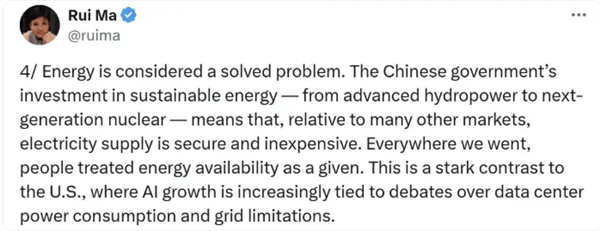
Group 1 - The core observation from the recent visit by Tech Buzz China's founder, Ma Rui, indicates that power supply issues for data centers are no longer a focal point in China, contrasting sharply with the ongoing discussions in the U.S. regarding electricity consumption and grid limitations related to AI development [1] - McKinsey predicts that global enterprises will invest $6.7 trillion in new data centers between 2025 and 2030 to meet AI development needs, while the current state of the U.S. power grid poses significant challenges to supporting such investments [2] - Chinese power expert David Fishman highlights that China's proactive investments in the power sector have ensured a high level of reserve capacity, providing a robust power supply for AI data centers, which is not the case in the U.S. [2] Group 2 - Fishman notes that China's advancements in power generation and transmission, as well as progress in next-generation nuclear energy, contribute to its strong power supply, which is difficult to imagine in the U.S. due to lower reserve margins [2] - Even if AI electricity demand grows rapidly, China has sufficient idle coal-fired power plants to activate while continuing to develop sustainable energy projects, unlike the U.S., which faces lengthy approval processes for new power generation capacity [2] - Data from the State Grid shows that electricity load in its operating area reached a historical high of 1.233 billion kilowatts, an increase of 53 million kilowatts compared to last year, reinforcing China's leading position in the AI sector [3]