算力过剩

Search documents
AI面临的不是泡沫,而是野火
3 6 Ke· 2025-11-22 00:07
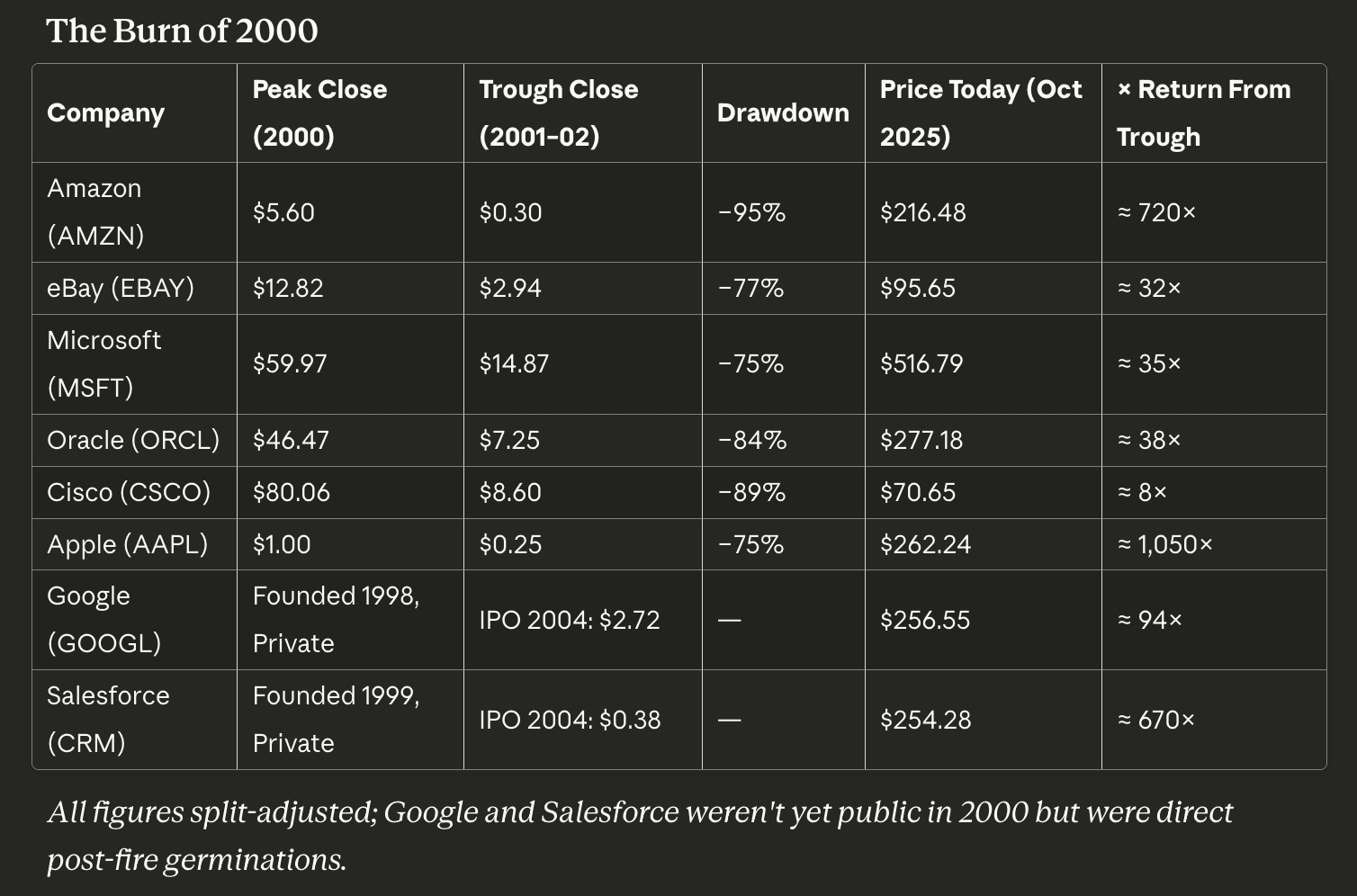
Core Insights - The article argues that the ultimate battle in AI is not about chips but about energy, suggesting that while computational power may become excessive, energy will remain a critical resource [2][44] - The metaphor of a wildfire is used to describe the current state of the AI industry, indicating that the upcoming correction will not be a bubble burst but a necessary cleansing process that will allow stronger entities to thrive [5][60] - Historical cycles in Silicon Valley demonstrate that periods of excessive growth often lead to corrections that ultimately benefit resilient companies, as seen in previous tech booms and busts [3][20] Group 1: Current AI Landscape - The AI ecosystem is currently characterized by an abundance of capital but a scarcity of talent, leading to intense competition among startups for skilled professionals [7][8] - The article highlights that many startups lack proprietary data or distribution channels, making them vulnerable to market corrections [12] - The upcoming correction is expected to clear out weaker companies, allowing stronger firms to absorb talent and resources [5][9] Group 2: Historical Context - Previous tech cycles, such as the dot-com bubble and the 2008 financial crisis, followed similar patterns of overgrowth followed by a cleansing fire that left behind stronger companies [21][27] - Companies like Amazon and Google emerged stronger from past corrections, demonstrating the potential for resilience and growth post-crisis [24][29] Group 3: Future Considerations - The article emphasizes the importance of energy infrastructure for the future of AI, suggesting that companies focusing on energy capacity will have a competitive advantage [44][45] - The current AI market is facing supply constraints in computational resources, which could lead to a significant correction in the future [32][33] - The distinction between training compute and inference compute is crucial, as the latter is expected to see strong demand, potentially absorbing excess capacity created during the current investment frenzy [36][38] Group 4: Evaluating Resilience - Companies will be evaluated based on their ability to sustain operations in a resource-scarce environment, with specific KPIs for different types of firms [47][51] - The article suggests that true resilience will come from companies that can maintain profitability and growth despite external pressures, rather than those that rely on abundant capital [51][52] - The metaphor of plants is used to illustrate the varying degrees of resilience among companies, with "fire-resistant" firms likely to thrive post-correction [59][61]






英伟达,盛极而衰?
Tai Mei Ti A P P· 2025-11-12 07:39
Core Insights - Nvidia's GTC conference in Washington D.C. marked a significant event where CEO Jensen Huang announced the next-generation Vera Rubin superchip and a $1 billion investment in Nokia, leading to a surge in Nvidia's stock price, which crossed $200 for the first time and made it the first company to reach a $5 trillion market cap [1][2] Stock Performance - Following the initial surge, Nvidia's stock experienced a decline from October 30 to November 6, with a maximum single-day drop of 3.7%, resulting in a market cap reduction of over $460 billion [2] - On November 10, Nvidia's stock rebounded with a 5.8% increase, marking the largest single-day gain since April [2] SoftBank's Actions - SoftBank announced it sold all its Nvidia shares in October, a move that sparked negative market sentiment, leading to a nearly 3% drop in Nvidia's stock price on the announcement day [3] - The sale, amounting to $5.83 billion, was interpreted as a signal of SoftBank's shift in focus towards investing in OpenAI, which SoftBank views as a future leader in the AI space [3][4] OpenAI Investment - SoftBank's investment in OpenAI, potentially up to $30 billion for a 5%-10% stake, indicates a strategic pivot towards AI, with OpenAI being a significant contributor to SoftBank's profits [4] - The anticipated IPO of OpenAI in 2027 could reach a valuation of $1 trillion, further emphasizing the potential of AI investments [4] Market Sentiment and Concerns - The market is experiencing heightened anxiety regarding the sustainability of AI valuations, drawing parallels to the internet bubble of the late 1990s [7] - Concerns are growing over potential oversupply in the AI chip market, as highlighted by recent underperformance from key players like TSMC and CoreWeave [8] - The competitive landscape is intensifying with the emergence of Chinese companies in the AI chip sector, posing a challenge to Nvidia's market position [8] Future Outlook - The ongoing debate about whether Nvidia will face a "big but not falling" scenario or a "prosperity followed by decline" situation is central to current market discussions [9] - Nvidia's future trajectory remains uncertain amid these market dynamics, with significant implications for investors and the broader tech industry [9]
OpenAI和微软的关系没那么糟,跟英伟达也没那么好
创业邦· 2025-11-07 10:39
Core Insights - OpenAI has restructured its partnership with Microsoft, ending the exclusive agreement with Azure and forming a new strategic collaboration with AWS worth $38 billion, which includes access to extensive computing resources [5][10][12]. Group 1: OpenAI's Strategic Shift - OpenAI's focus has shifted from solely training models to making them widely accessible, indicating a transition from a "model development lab" to a "global AI platform company" [14][15]. - The partnership with AWS is seen as a move to enhance commercial reach rather than just technological breakthroughs, contrasting with the previous exclusive relationship with Azure [15][16]. Group 2: Implications of the New Alliance - The new collaboration with AWS allows OpenAI to leverage a broader ecosystem, ensuring its models are available across multiple platforms, including Azure, AWS, and potentially Google Cloud [14][15]. - The relationship with Microsoft remains crucial, as both companies aim to redefine the AI industry's value distribution logic amidst rising competition and technological advancements [22][23]. Group 3: Insights on Computing Power - Both Sam Altman and Satya Nadella emphasized that the future of computing power will eventually become abundant, with the real challenge being the physical infrastructure needed to support it [19][21]. - They highlighted the importance of software optimization over just hardware advancements, suggesting a shift in focus from GPU manufacturing to platform services and system integration [21][22].

OpenAI CEO:算力总有一天会过剩
Sou Hu Cai Jing· 2025-11-03 04:20
Core Insights - OpenAI's CEO Sam Altman denied rumors of an IPO next year and stated that the company's revenue is significantly higher than the reported $13 billion [1][6] - Altman emphasized that there is strong demand for OpenAI's stock, indicating that if shares were available, they would be quickly purchased by interested investors [5] - The company is making substantial investments in infrastructure, betting on continued revenue growth from AI services and products [5][6] Revenue and Financials - Altman claimed that OpenAI's actual revenue exceeds $13 billion, and the company is experiencing rapid revenue growth [5] - OpenAI recently underwent a capital restructuring, with its nonprofit entity renamed OpenAI Foundation, holding approximately $130 billion in equity from its for-profit division, now called OpenAI Group PBC [6] Infrastructure and Capacity - Altman acknowledged that there will eventually be an oversupply of computing power, but the timeline for this is uncertain [6] - Microsoft CEO Satya Nadella pointed out that the main challenge is not oversupply but the speed of power and infrastructure development for data centers [6] AI Development and Future Outlook - Altman highlighted the significant advancements in AI, particularly with the Codex model, which is expected to evolve from handling "hours-long tasks" to "days-long tasks" [7] - By 2026, Altman hopes AI will contribute to even minor scientific discoveries, marking a significant moment for human civilization [8]

OpenAI CEO最新回应:收入远不止130亿美元
第一财经· 2025-11-03 04:11
Core Viewpoint - OpenAI's CEO Sam Altman denies rumors of an IPO in the near future and emphasizes that the company's revenue is significantly higher than the reported $13 billion, indicating strong demand for OpenAI's stock among potential investors [3][7]. Group 1: Financial Performance and Projections - Altman asserts that OpenAI's actual revenue exceeds $13 billion, and there is a high demand for its stock from investors [5][6]. - The company is making substantial investments in computing infrastructure, amounting to $1.4 trillion in commitments, which Altman defends as a forward-looking bet on continued growth [5][6]. - OpenAI aims to become a significant AI cloud service provider, with additional revenue streams expected from consumer devices and technologies that automate scientific research [6][7]. Group 2: Market Dynamics and Infrastructure Challenges - Altman acknowledges the potential for overcapacity in computing power in the future, but he cannot predict the exact timeline for this occurrence [6]. - Microsoft CEO Satya Nadella highlights that the primary challenge is not overcapacity but rather the speed of power and infrastructure development necessary for data centers [6]. - OpenAI's strategy is based on the belief that as AI technology becomes cheaper, demand will continue to grow exponentially [6]. Group 3: Future Developments in AI - Altman expresses optimism about the advancements in AI, particularly with the Codex programming model, which is expected to evolve from handling "hours-long tasks" to "days-long tasks" [7]. - By 2026, Altman hopes AI will contribute to even minor scientific discoveries, marking a significant milestone for human civilization [8].

OpenAI CEO最新回应:收入远不止130亿美元,但算力总有一天会过剩
Di Yi Cai Jing· 2025-11-03 04:01
Core Viewpoint - OpenAI's CEO Sam Altman denies rumors of an IPO in the near future, emphasizing that the company's actual revenue exceeds the reported $13 billion and that there is significant interest in purchasing OpenAI stock [1][3][4]. Group 1: Financial Performance and Future Plans - Altman claims that OpenAI's revenue is growing rapidly, and the company's investments in infrastructure are a forward-looking bet on continued growth [3][4]. - The company has recently undergone a capital restructuring, with its nonprofit entity rebranded as OpenAI Foundation, holding approximately $130 billion in equity of the profit-making division, which has transitioned to a public benefit corporation named OpenAI Group PBC [5]. Group 2: Infrastructure and Market Dynamics - Concerns have been raised about OpenAI's substantial commitments in computing power, with Altman asserting that the actual revenue far exceeds $13 billion, and that if shares were available, there would be a rush to buy them [3][4]. - Altman acknowledges the complexity of the supply chain and the potential for computing power to eventually become oversupplied, but he believes that demand will continue to grow as AI technology becomes cheaper [5]. Group 3: Technological Advancements - Altman highlights the significant progress of Codex, an AI programming model, which is expected to evolve from handling "hours-long tasks" to "days-long tasks," potentially transforming software creation [6]. - He expresses optimism that AI advancements could lead to even minor scientific discoveries by 2026, marking a significant moment for human civilization [6].

微软CEO:不想再买英伟达芯片了
半导体行业观察· 2025-11-02 02:08
Core Insights - Microsoft CEO Satya Nadella highlighted the current limitations in AI GPU deployment due to insufficient space and energy, suggesting a potential "power glut" issue rather than a surplus of computing power [2][3] - Nadella disagreed with NVIDIA CEO Jensen Huang's assertion that there will be no computing power surplus in the next two to three years, emphasizing that the real challenge lies in energy availability [2] - The expansion of computing infrastructure is reaching a new phase where tech giants like Microsoft cannot accommodate more chips in their existing setups, primarily due to the increasing power demands of each new generation of NVIDIA's architecture [2] Group 1 - Nadella stated that the main issue is not a lack of chip supply but rather the inability to integrate these chips into existing systems due to power constraints [2] - The power consumption of NVIDIA's systems is expected to increase significantly, with reports indicating a potential rise of up to 100 times from the Ampere architecture to the upcoming "Kyber" design [2] Group 2 - The industry is facing a bottleneck in energy infrastructure capacity, which is becoming a critical constraint on the deployment of advanced AI chips [3] - Nadella noted that short-term market demand for NVIDIA chips is unpredictable and will depend on supply chain developments and overall energy conditions [3]
36.9亿大单竟是″空气合同″?股东暴增17.8万,董事长却套现41.8亿
Xin Lang Cai Jing· 2025-10-14 03:24
Group 1 - The core issue revolves around the significant stock sell-off by major shareholders, particularly the chairman of Xinyiseng, who cashed out 4.18 billion yuan in Hainan Huatie stocks, raising concerns about the implications for retail investors [1][17] - Hainan Huatie's stock price surged after announcing a 3.69 billion yuan contract, only to later reveal the contract was voided, resulting in no revenue or product delivery [1][11] - The number of shareholders in Hainan Huatie increased dramatically from 46,000 to 224,000, indicating a large influx of retail investors during a speculative phase [1][11] Group 2 - The semiconductor industry, particularly in computing power chips, has seen explosive growth, with companies like Xinyiseng and Zhongji Xuchuang experiencing stock price increases of 345% and 228% respectively [3][4] - However, the market is becoming saturated with numerous companies entering the space, leading to intense competition and concerns about the sustainability of such growth [4][7] - The performance of domestic chips is reportedly inadequate, with only about 10% of projects in intelligent computing centers being operational due to poor performance and low utilization rates [5][15] Group 3 - Major shareholders are strategically selling their stocks at peak prices, with Xinyiseng's chairman and Zhongji Xuchuang's controlling shareholder planning significant sell-offs [8][9] - The current market valuations for companies like Cambricon are extraordinarily high, with a price-to-earnings ratio of 400, raising questions about the sustainability of such valuations [12][14] - The disparity between high valuations of domestic companies compared to established players like AMD and NVIDIA, which have more robust market positions, highlights potential overvaluation risks in the sector [14][18] Group 4 - The current state of intelligent computing centers reveals a mismatch in supply and demand, with a significant portion of purchased chips not being utilized effectively [15][18] - The industry is experiencing a structural mismatch, where high-end computing power is still in demand, but low-end, ineffective chips are oversupplied [15][18] - Historical parallels are drawn to the "chip fever" of 2018, suggesting that the current hype around computing power chips may lead to a similar outcome of market correction [15][18]

部分国产芯片闲置率高达80%?智算中心建设“点刹”背后
3 6 Ke· 2025-04-28 10:25
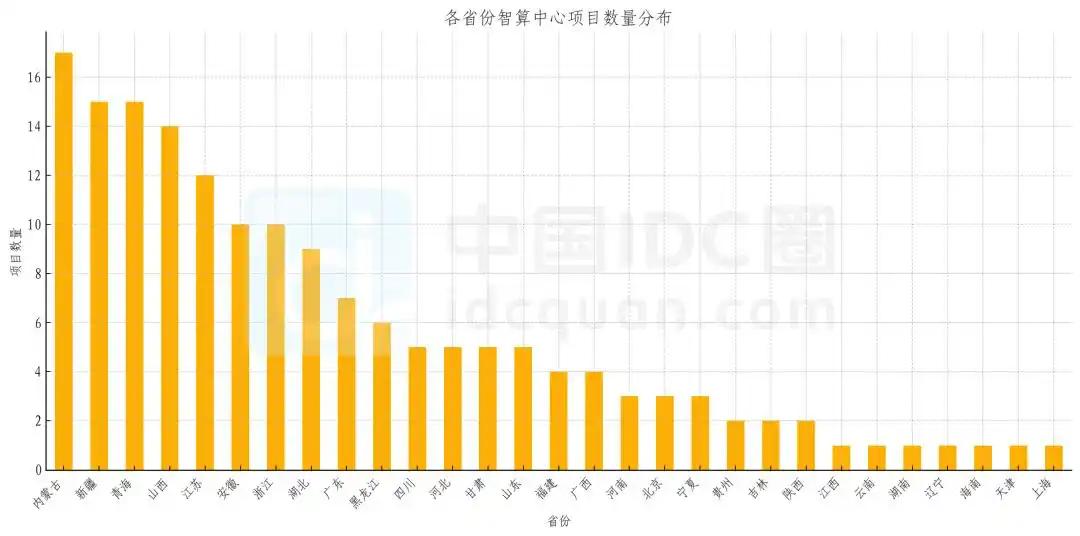
Core Insights - The rapid development of artificial intelligence (AI) technology has intensified global strategic competition, with intelligent computing centers becoming a new infrastructure in tech competition [1] - Investment in intelligent computing centers in China has surged from hundreds of billions to trillions, with nearly 150 operational projects and close to 400 under construction or planning as of November 2024 [2][3] Investment Trends - As of August 2024, the total number of intelligent computing center projects in China exceeded 300, with a computing power scale surpassing 500,000 PFlops, and over 50 new projects launched in 2024 alone [3] - The total investment in 128 disclosed projects reached over 430 billion yuan, but only 16 projects are in operation or trial phases, indicating a significant gap between planned and actual deployment [3][9] Structural Issues - The market is experiencing a "structural mismatch" rather than an outright surplus of computing power, with significant demand growth in AI inference driving the need for more efficient resource allocation [5][9] - Some intelligent computing centers report utilization rates as low as 10-15%, with certain centers having GPU utilization below 30%, leading to concerns about resource wastage [9][11] Management and Operational Challenges - The supply chain uncertainties, particularly regarding NVIDIA chips, pose challenges for intelligent computing centers, prompting a shift towards domestic chip manufacturers providing comprehensive solutions [12][14] - The industry is moving towards "refined management," with traditional leasing models becoming less profitable, necessitating mergers and resource reallocation to enhance efficiency [14][15] Future Outlook - The ongoing demand for AI inference and the acceleration of domestic chip development are critical for the industry's future, with a focus on building a sustainable computing power system [14] - The integration of AI technology with industry applications requires a skilled workforce, emphasizing the need for professionals who understand both AI and industry-specific needs [14]
特斯拉、英伟达双双大跌超5%,什么情况?纳指100ETF(159660)跌超1.5%,资金连续20日疯狂涌入!
Zhi Tong Cai Jing· 2025-03-27 05:45
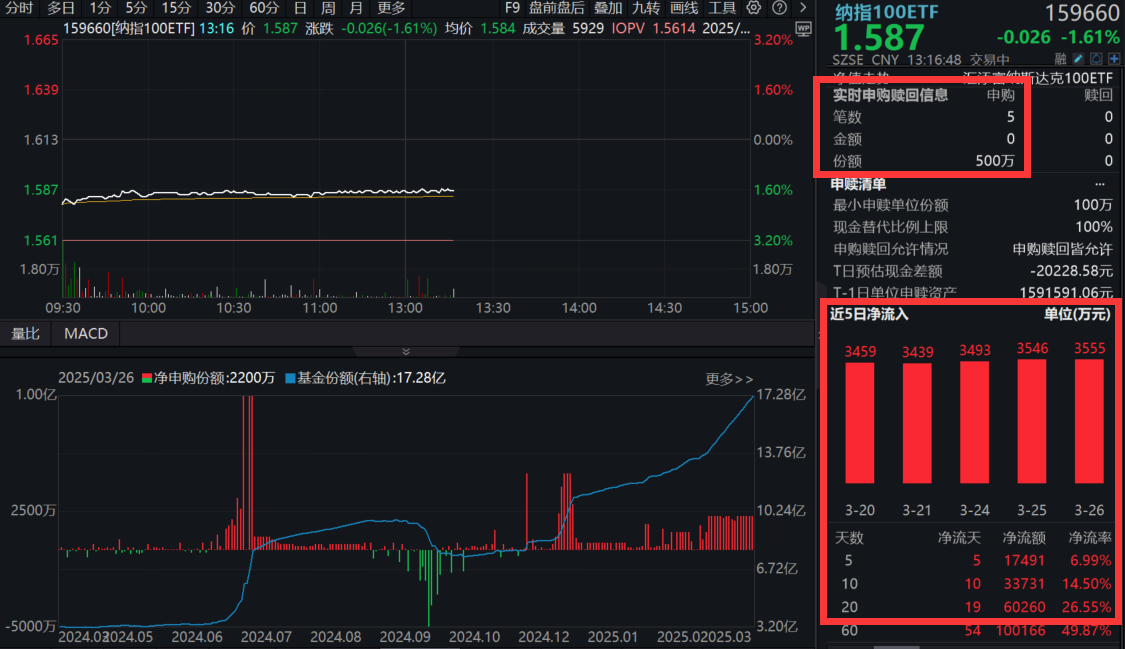
Core Viewpoint - Tesla and Nvidia experienced significant declines exceeding 5%, contributing to a broader downturn in the Nasdaq 100 index, which fell by 1.83% on March 26, 2023, amid concerns over new tariffs on imported vehicles and data center demand issues [3][4]. Group 1: Market Performance - The Nasdaq 100 ETF (159660) opened lower and was down 1.61% with a trading volume of 80 million yuan, while it saw a net inflow of 5 million shares during the day, marking 20 consecutive days of substantial inflows totaling over 600 million yuan [1][3]. - Major US stock indices, including the Nasdaq, S&P 500, and Dow Jones, all closed lower, with Nvidia's market value dropping by approximately 1.2 trillion yuan due to a 5.74% decline [3]. Group 2: Tariff Impact - The US government announced a 25% tariff on all automobiles not manufactured in the US, effective April 2, 2023, which is a significant increase from the current 2.5% tariff [3][4]. - Components produced in the US will be exempt from these tariffs if the entire vehicle is not manufactured domestically [3]. Group 3: Data Center Demand - A report from TD Cowen indicated that while data center demand is still growing year-over-year, Microsoft has canceled or postponed more data center leases than initially expected, leading to concerns of oversupply in the market [3]. - The total power consumption of the canceled projects amounts to 2 gigawatts, highlighting a potential mismatch between supply and demand in the data center sector [3]. Group 4: Investment Outlook - Analysts from Guosen Securities believe that US stocks have reached a sufficient price-performance ratio, suggesting that the S&P 500 could be a good buy at 5,700 points, with a potential floor at 5,300 points in the second quarter [4]. - Citic Securities noted that uncertainties such as tariffs and potential recession risks have been adequately priced into the market, indicating that tech stocks with significant prior declines may see a technical rebound [4]. Group 5: ETF Advantages - The Nasdaq 100 ETF (159660) is expected to benefit from the strong performance and capital expenditures of leading tech companies, with a management fee of 0.5% per year, which is lower than the market average [5][6].