
薪资增长

Search documents
美联储褐皮书:消费开支和持平或下滑,因为对许多家庭而言,薪资没能与价格涨势保持一致
Hua Er Jie Jian Wen· 2025-09-03 18:02
Core Insights - The Federal Reserve's Beige Book indicates that consumer spending is either flat or declining, as wages have not kept pace with rising prices [1] Group 1 - Consumer spending is showing signs of stagnation or decrease [1] - Many households are experiencing a mismatch between wage growth and inflation [1]
英国央行行长:将采取一切必要措施实现2%的通胀目标
Sou Hu Cai Jing· 2025-08-07 12:31
Core Viewpoint - The Bank of England's Governor Bailey emphasizes that the central bank should not lower interest rates too quickly or excessively, indicating a cautious approach to monetary policy amid economic uncertainties [1] Economic Outlook - Inflation is not expected to rebound persistently, with different levels of price and wage pressures observed [1] - Wage growth is projected to slow to just below 4% by the end of the year, reflecting a cooling labor market [1] - There is an increased focus on the risks of second-round effects from inflation, particularly concerning food and energy prices, which are significant for consumers [1] Consumer Behavior - Consumers are exhibiting more caution than previously anticipated, which may impact overall economic activity [1] - The risks of economic activity declining are slightly elevated, suggesting potential challenges ahead for growth [1] Inflation Targeting - The central bank is committed to taking all necessary measures to achieve a 2% inflation target, indicating a strong focus on maintaining price stability [1]
日本6月名义薪资增速四个月新高 央行加息再添关键砝码
智通财经网· 2025-08-06 01:46
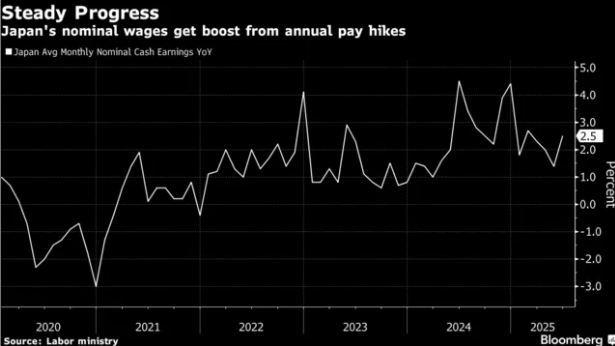
Group 1 - Japan's nominal wages in June increased by 2.5% year-on-year, marking the fastest growth in four months, despite being below economists' expectations of 3.1% [1][3] - The Bank of Japan is considering potential interest rate hikes in the coming months, with over 40% of analysts predicting action in the October policy meeting [3][4] - The strong wage data reflects the results of this year's annual wage negotiations, with approximately 70% of wage increases already implemented by mid-June [3][4] Group 2 - Despite strong nominal wage growth, real wages have declined by 1.3% due to rising inflation, with the core inflation rate reaching 3.3% in June [4][5] - The ongoing inflation is expected to suppress consumer spending, leading to anticipated weak economic growth in the second quarter [4] - Long-term labor shortages are expected to continue exerting upward pressure on wages, although U.S. trade policies pose risks to corporate profit margins and wage growth capabilities [5]

逆势而为?英国央行或将降息,但通胀已“蠢蠢欲动”
Jin Shi Shu Ju· 2025-08-04 09:27
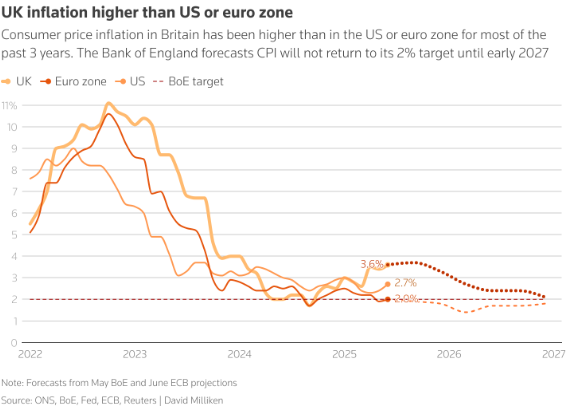
Group 1 - The Bank of England is expected to lower its key interest rate from 4.25% to 4% this Thursday, with further cuts anticipated by the end of the year, despite rising inflation concerns [2] - UK inflation surged to a peak of 11.1% post-Russia-Ukraine conflict, significantly higher than the Eurozone or the US, primarily due to reliance on natural gas for heating and electricity [2] - Inflation rates in the UK are projected to decline significantly, reaching a low of 1.7% by September 2024, but are expected to rebound faster than in the US or Eurozone [2] Group 2 - Inflation expectations in the UK have risen, with long-term inflation indicators nearing their highest levels since late 2022, reflecting concerns about future price increases and wage demands [5] - Despite a significant drop in overall consumer inflation in 2023, key components used to measure long-term domestic price pressures have not decreased similarly [8] - Service sector price inflation is heavily influenced by rising labor costs, and food and beverage prices are also experiencing a rapid increase, impacting public perception of inflation, especially among poorer demographics [9][12] Group 3 - Private sector annual wage growth is slightly below 5%, down from over 8% two years ago, but still above pre-pandemic levels, indicating persistent inflationary pressures [13] - Wage growth is expected to slow to around 3% over the next 18 months, which could exert downward pressure on inflation [13][15] - The July Purchasing Managers' Index (PMI) indicates strong pricing pressures, with significant cost increases reported by service and manufacturing sectors, suggesting potential upward pressure on consumer prices [16][19]
美国7月ADP就业增10.4万超预期 仍难掩劳动力市场降温现实
智通财经网· 2025-07-30 13:33
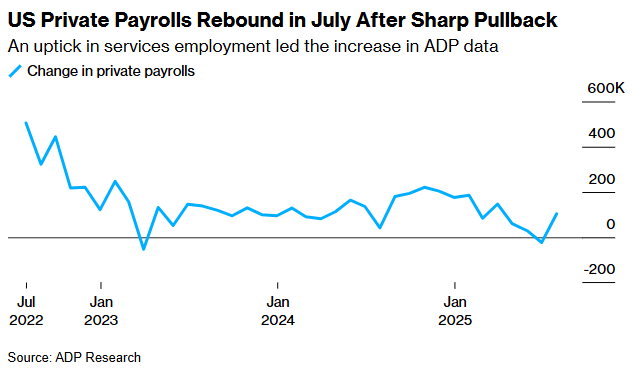
Core Insights - The U.S. private sector job market showed unexpected growth in July, with ADP reporting an increase of 104,000 jobs, the largest since March, surpassing the market expectation of 75,000 jobs [1][4] - Despite the positive job growth, there is a notable cooling in the overall labor market, as the proportion of consumers finding it "hard to get a job" has reached a near four-and-a-half-year high, coinciding with a rising trend in initial unemployment claims [1][4] Employment Sector Analysis - The most significant feature of the July job market is sectoral differentiation, with leisure and hospitality, as well as financial activities, being the main hiring sectors, while education and health services have seen layoffs for the fourth consecutive month [4] - The construction sector added 15,000 jobs, showing an acceleration from June's 9,000 jobs; manufacturing saw a notable slowdown, adding only 7,000 jobs in July compared to 15,000 in June; trade, transportation, and utilities added 18,000 jobs, up from 14,000 in June; financial services rebounded strongly with 28,000 new jobs, reversing a loss of 14,000 in June [4] - Professional and business services improved slightly from a decline of 56,000 jobs in June, adding only 9,000 jobs in July, indicating that future trends need to be monitored [4] Economic Outlook - ADP's Chief Economist Nela Richardson noted that current hiring and wage data reflect a healthy economic state, with employers gaining confidence in consumer demand; however, private sector hiring remains significantly below last year's average levels, and companies are becoming increasingly cautious in staffing decisions amid heightened policy uncertainty [4] - Initial unemployment claims remain low, but the extended reemployment cycle for unemployed workers indicates a decline in labor market fluidity [4] - The market anticipates that the upcoming U.S. Labor Department's non-farm payroll report will show an increase of 110,000 jobs, with the unemployment rate potentially rising from 4.1% in June to 4.2% in July [5] - Salary growth remains stable, with a 4.4% year-over-year increase for retained employees and a 7% increase for job switchers; the service sector recovery is a primary driver of job growth, although education and health sectors have experienced a net loss of jobs this year [5]
欧洲央行行长拉加德:薪资增长正在朝着正确的方向发展。
news flash· 2025-07-24 13:09
Core Viewpoint - The President of the European Central Bank, Christine Lagarde, stated that wage growth is moving in the right direction [1] Group 1 - Wage growth is seen as a positive development for the European economy [1] - The comments reflect the ECB's focus on labor market conditions and inflation dynamics [1]
凯德北京投资基金管理有限公司:小企业加薪迟缓拖后腿 日本整体薪资增长乏力
Sou Hu Cai Jing· 2025-07-07 11:22
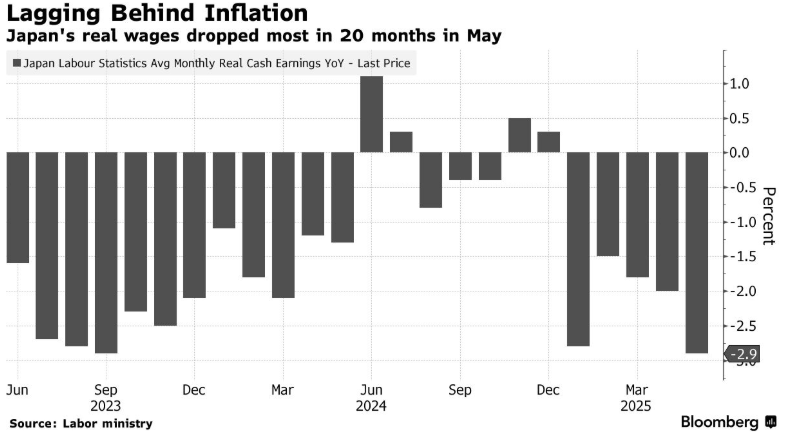
Group 1 - The core point of the article highlights a significant decline in Japan's real wages, which fell by 2.9% year-on-year in May, marking the largest drop in nearly two years, indicating a continuous erosion of household purchasing power due to inflation [1][3] - Despite nominal wages increasing by 1.0% year-on-year to 300,100 yen (approximately 14,900 RMB), the growth rate has notably slowed compared to April, primarily due to a sharp decline of 18.7% in special compensation, which includes unstable bonuses and one-time income [3][5] - The consumer price index, which is used to calculate real wages and includes fresh food but excludes rent, rose by 4.0% year-on-year in May, outpacing the nominal wage increase, thus highlighting the struggle of households against rising prices [3][5] Group 2 - A report from a labor organization indicated that average wages for union workers saw the largest increase in 34 years, yet the overall wage data presents a weak picture due to the slower wage growth in many non-unionized small enterprises [5][7] - There is a contradictory signal as household spending in May rose at the fastest pace in nearly three years, suggesting some resilience in consumption despite declining purchasing power [5][7] - Analysts suggest that the full impact of the wage increases from the spring labor negotiations may not be reflected in the statistics until summer, making sustained wage growth crucial for maintaining consumer momentum and supporting Japan's economic recovery [7][8]

日本实际薪资意外创2023年9月以来最大降幅 但央行加息预期未受扰动
智通财经网· 2025-07-07 01:53
Group 1 - Japan's real wages fell by 2.9% year-on-year in May, marking the largest decline since September 2023, which poses a significant challenge for Prime Minister Kishida ahead of the upcoming elections [1][4] - The nominal wage growth was only 1%, significantly below economists' expectations, primarily due to reduced bonuses [1][4] - The largest labor union, Rengo, reported a 5.25% increase in agreed wages this year, the highest in 34 years, driven by inflation and labor shortages [1][6] Group 2 - Japan's core inflation rate reached 3.7% in May, well above the Bank of Japan's target of 2%, with essential goods and services driving the increase [4] - The ruling Liberal Democratic Party has proposed cash handouts and measures to stimulate wage growth, but recent polls indicate low public support for these initiatives [4][5] - Despite the decline in real wages, the Bank of Japan may still consider further interest rate hikes due to the ongoing nominal wage increases and inflation pressures [4][7] Group 3 - Basic wages increased by 2.1% in May, with stable indicators showing full-time employee wages rising by 2.4%, maintaining growth above 2% for nearly two years [5][6] - Structural labor shortages are pushing companies to raise wages to attract and retain talent, particularly in sectors like information technology [6] - Economic uncertainties, particularly related to U.S. tariff policies, pose risks to wage growth momentum, especially for large manufacturers [6][7]
日本央行审议委员田村直树:消费支出面临的首要问题是通货膨胀。经济需要薪资增长来应对通胀。
news flash· 2025-06-25 05:47
Core Insights - The primary issue facing consumer spending in Japan is inflation, as highlighted by Bank of Japan's policy board member Naoki Tamura [1] - Economic growth requires wage increases to effectively combat inflation [1] Group 1 - Consumer spending is significantly impacted by inflationary pressures [1] - There is a need for wage growth to support economic stability and address inflation concerns [1]
押注大幅加薪赢得选民支持,日本执政党承诺2040年实现薪资增长50%
Hua Er Jie Jian Wen· 2025-06-19 09:39
Group 1 - The ruling Liberal Democratic Party of Japan has introduced a new campaign platform aiming to increase the average annual salary by 1 million yen by the fiscal year 2030, with a target of 520 million yen from the current 420 million yen [1] - The party plans to achieve this by ensuring a 1% annual increase in real wages and a 3% annual increase in nominal wages [1] Group 2 - The government is facing public dissatisfaction due to ongoing inflation and the economic risks posed by tariffs, leading to a commitment to distribute cash subsidies to low-income individuals and families [2] - Each low-income individual and child will receive 40,000 yen, while the rest of the population will receive 20,000 yen as a temporary measure until wages increase [2] - Prime Minister Kishida's recent support has slightly risen, partly due to progress made in controlling rice prices, which have become a significant indicator of inflation's impact on household spending [2] - The government previously set a goal to achieve a nominal GDP of 1,000 trillion yen by around 2040, with the nominal GDP reaching a record 609 trillion yen in 2024 [2]