
资金入市

Search documents
机构与居民资金持续入市,“旗手”券商ETF(512000)连续3天净流入合计“吸金"超7亿!
Sou Hu Cai Jing· 2025-09-02 06:04
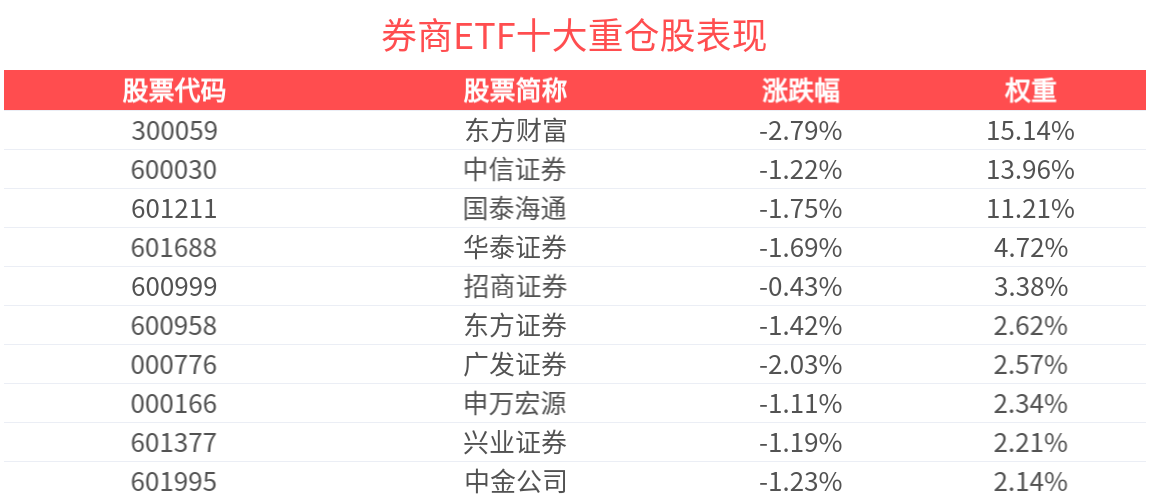
Core Viewpoint - The securities industry is experiencing mixed performance, with significant growth in the ETF sector, particularly the broker ETF, which has seen substantial inflows and a notable increase in net asset value and share count [1][2][6]. Group 1: ETF Performance - As of September 1, the broker ETF has achieved a net value increase of 61.10% over the past year [2]. - The broker ETF's latest scale reached 31.265 billion, marking a one-year high, and its share count reached 49.801 billion, also a one-year high [1]. - The ETF has seen a daily average net inflow of 248 million over the past three days, with a peak single-day inflow of 462 million [1]. Group 2: Market Dynamics - Major brokerage firms have outperformed the industry average in profit growth, with top firms showing a net profit growth rate of 37% for the first half of the year, surpassing the overall growth rate of 31% for listed brokerages [2]. - The market has seen a significant increase in daily trading volume and margin financing balances since July, enhancing the profitability outlook for the year [2][3]. Group 3: Investment Strategy - Analysts suggest focusing on high-quality brokerages with valuations significantly below the average, as well as those with strong performance potential among smaller firms [2]. - The broker ETF provides an efficient investment tool that encompasses both leading brokerages and smaller firms with high growth potential, with nearly 60% of its holdings concentrated in the top ten brokerages [6].







兴业证券(601377):把握资金入市机遇 持续扩表增厚业绩
Xin Lang Cai Jing· 2025-09-02 04:35
Group 1 - The company's performance growth in 25H1 is driven by investment performance, while asset sales have led to a decline in asset management business [1] - The company maintains a "Buy" rating with a target price of 8.85 yuan, projecting 2025H1 revenue and net profit of 5.404 billion and 1.33 billion yuan, respectively, representing year-on-year growth of 0.24% and 41.24% [2] - The company's investment business net income increased by 48.6% year-on-year to 1.767 billion yuan, contributing 47.79% to adjusted revenue growth [2] Group 2 - The company is entering a new phase of high-quality development, with opportunities arising from the reallocation of assets in both institutional and retail sectors due to changes in equity and interest rate markets [3] - The appointment of former Huafu Securities Chairman Su Junliang as Chairman of the company is expected to lead to multiple initiatives aimed at enhancing comprehensive value across regional platforms [3] - The active participation of retail funds in the market is anticipated to further enhance the company's valuation levels [3] Group 3 - Catalysts for growth include sustained activity and favorable trends in the equity market [4]
早盘直击|今日行情关注
申万宏源证券上海北京西路营业部· 2025-08-25 02:44
Core Viewpoint - The market demonstrated strong resilience last week, remaining unaffected by external disturbances, indicating its independence from overseas market fluctuations [1] Market Performance - The A-share market continued to rebound, with the Shanghai Composite Index reaching a new high for the current market cycle, closing at its highest point of the year on Friday [1] - The Shenzhen Component Index accelerated its recovery, successfully surpassing the high point from the fourth quarter of last year [1] - Average daily trading volume exceeded 25 billion yuan for two consecutive weeks, indicating significant market activity [1] Investment Trends - The main market focus was on the TMT (Technology, Media, and Telecommunications) and consumer sectors, with technology stocks leading in gains [1] - The low interest rate environment has prompted a gradual shift of deposit funds towards equity assets, contributing to the market's rebound [1] Market Dynamics - The Shanghai Composite Index has surpassed the 2021 market high, with its focus continuing to shift upward [1] - The index broke through the upper boundary of a weekly large box pattern earlier this month, which has now turned from a resistance level into a support level [1] - The market is currently in a process of upward movement within this box pattern [1]

华西证券:沪指创近10年新高,增量资金来自何方?
Sou Hu Cai Jing· 2025-08-24 09:11
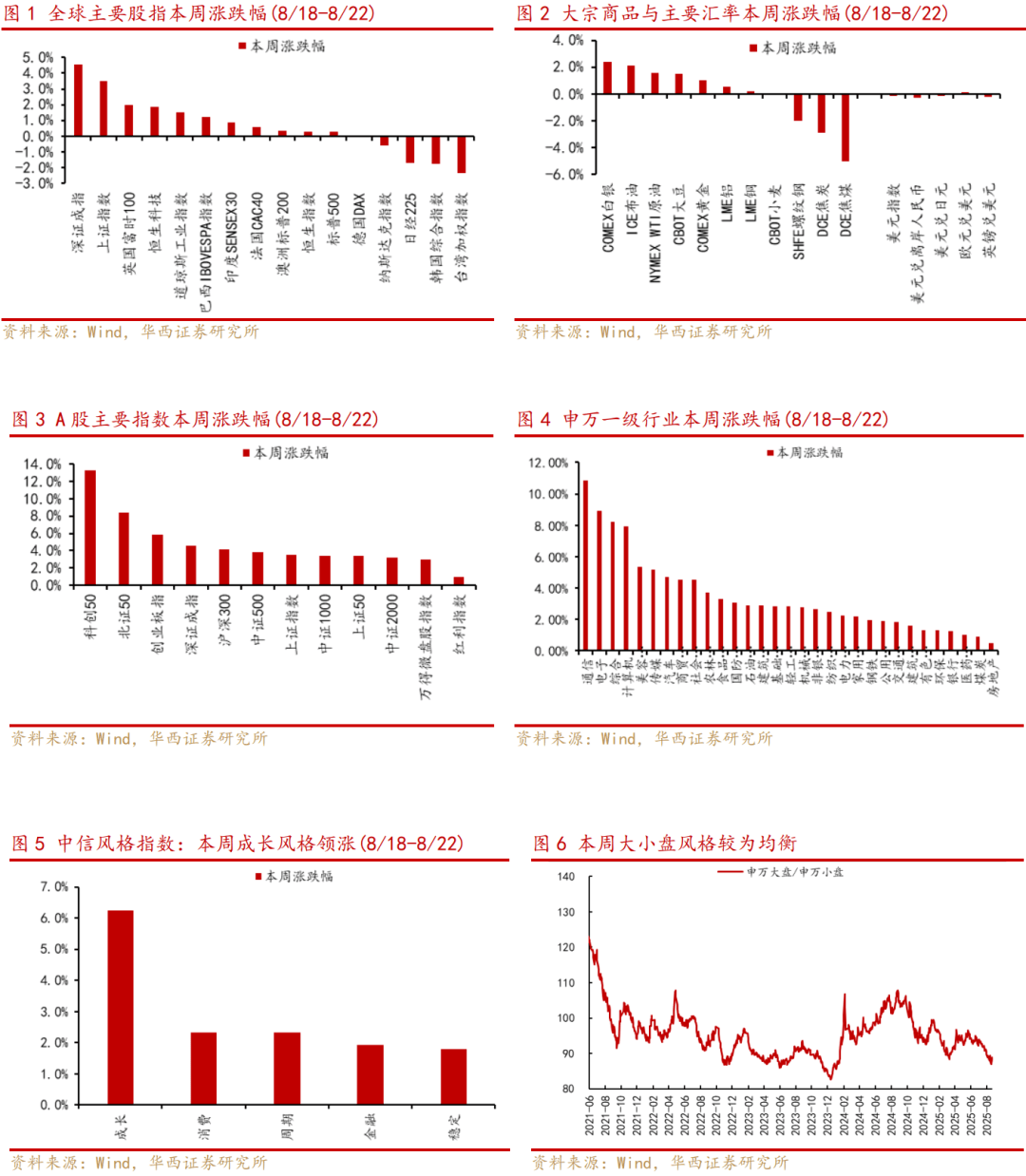
Market Review - The Chinese stock market continues to lead globally, with the Shenzhen Composite Index and Shanghai Composite Index rising by 4.6% and 3.5% respectively, with the Shanghai Index surpassing 3,800 points, a ten-year high [1] - A-share trading volume has increased significantly, with margin trading balances exceeding 2.1 trillion yuan, and the proportion of financing purchases in total A-share trading surpassing 11%, the highest since February 2020, indicating an increased risk appetite in the market [1] - Growth sectors such as semiconductors, CPO, and robotics remain strong, with the Sci-Tech Innovation 50 Index soaring by 13.31% [1] - Following Powell's speech, U.S. Treasury yields fell, the dollar index declined, and the offshore RMB appreciated against the dollar [1] Market Outlook - Multiple sources of incremental capital are entering the market, signaling the beginning of a "slow bull" cycle for A-shares [1] - The current bull market has evolved since the "924" rally, with long-term funds such as insurance and pension funds continuously increasing their holdings in A-shares over the past three years [1] - Financing funds and private equity trading remain active, with foreign investment interest in A-shares also rising [1] - There are early signs of residents moving deposits, which could lead to increased capital inflow into the market through ETFs, direct stock holdings, and public funds, becoming a key driver for the "slow bull" trend [1] Key Focus Areas - Recent market attention is on overseas monetary policy, with Powell's dovish signals increasing expectations for a rate cut in September [2] - The A-share bull market has seen a 57% increase in financing balances since the "924" rally began, with the proportion of financing purchases rising from 7.5% to 11% [3] - Long-term funds, including insurance and pension funds, have been steadily increasing their holdings in A-shares, with insurance funds and pensions holding 3.57% and 1.8% of A-share market capitalization respectively as of Q1 2025 [4] - There is a trend of residents reallocating their assets from real estate to financial assets, with potential for significant capital inflow into the stock market [5] Industry and Theme Focus - Industry focus is on new technologies and growth areas such as domestic computing power, robotics, and AI applications, alongside sectors like large finance and new consumption [6] - Thematic investment interests include self-controllable technologies, military industry, low-altitude economy, and marine technology [7]

太猛了!10万亿待入市?
Ge Long Hui A P P· 2025-08-22 07:40
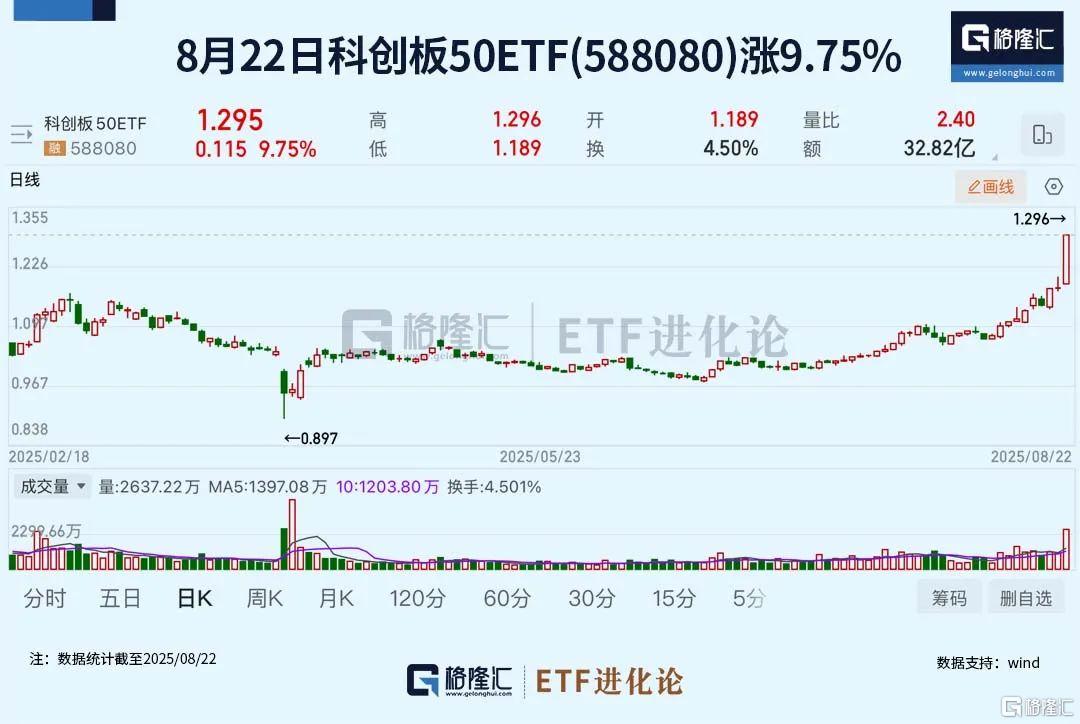
Group 1 - The core index of the Shanghai Composite Index has surpassed 3800 points for the first time in ten years, marking a significant milestone in the A-share market [1] - A-shares have seen a continuous increase in trading volume, with the trading volume exceeding 2 trillion yuan for the eighth consecutive trading day, setting a new record [1] - The semiconductor industry has experienced a surge, with stocks like Cambricon Technologies hitting the daily limit and achieving a market capitalization of over 520 billion yuan [1][6] Group 2 - The ChiNext 50 ETF has shown strong performance, with a year-to-date increase of 27.71%, reflecting the growth of hard technology companies, particularly in the semiconductor sector [3][6] - Since the market rally began on April 8, the Shanghai Composite Index has risen over 23%, while the ChiNext Index has surged over 48% [6] Group 3 - There is a notable shift in retail investor sentiment and foreign capital inflow, with predictions of significant funds moving into the stock market, estimated between 4.5 trillion to over 10 trillion yuan [8][9] - The trend of "deposit migration" is observed, with household deposits decreasing while non-bank deposits are increasing, indicating a potential shift towards equity markets [8][9] Group 4 - Foreign institutional investment in A-shares has accelerated, with a reported market value of approximately 2.5 trillion yuan, reflecting an 8% increase from the end of 2024 [11] - Global investors are increasingly optimistic about the Chinese market, with major foreign institutions like Goldman Sachs and UBS expressing positive outlooks on A-shares [10][12]
险资猛砸万亿元,散户资金入市潜力大
Di Yi Cai Jing Zi Xun· 2025-08-22 05:12
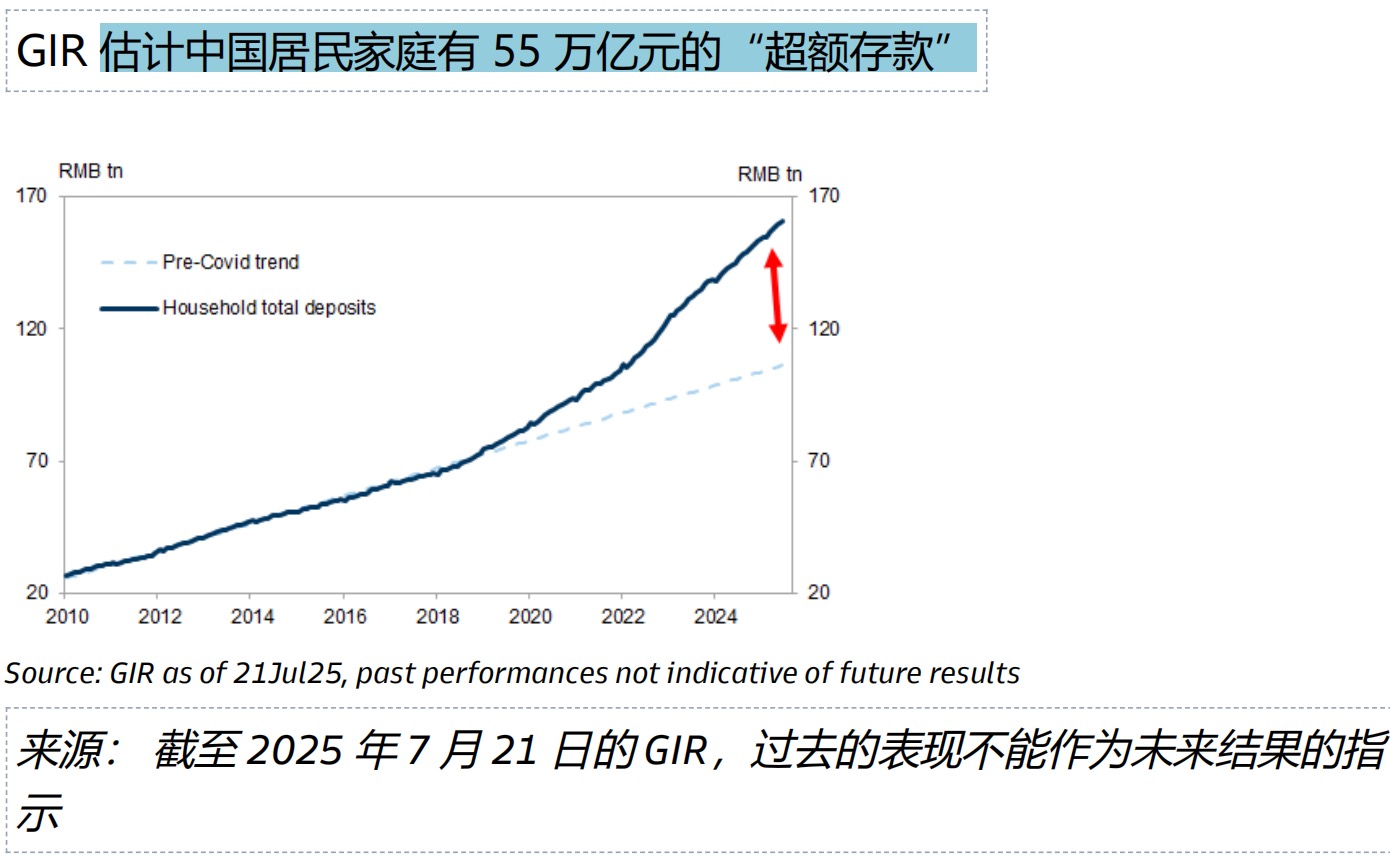
Core Viewpoint - The article discusses the evolving dynamics of the A-share bull market, highlighting the significant roles played by various investor groups, including retail investors, insurance funds, and foreign capital, in driving market momentum and liquidity [2][3]. Group 1: Retail Investor Participation - Retail investors have emerged as key players in the current bull market, igniting enthusiasm despite initially being latecomers [3]. - As of August 20, the Shanghai Composite Index reached 3766.21 points, marking a ten-year high, with retail investors dominating trading activity [3]. - High trading volumes were recorded, with the Shanghai and Shenzhen markets achieving a transaction volume of 2.75 trillion yuan on August 18, the third-highest in history [3]. - Goldman Sachs estimates that Chinese households have 55 trillion yuan in excess savings, with potential market inflows exceeding 10 trillion yuan due to a 22% allocation in funds and stocks [3][6]. Group 2: Insurance Fund Involvement - Insurance funds have significantly increased their equity investments, with direct investments in stocks rising by approximately 1 trillion yuan over the past year [7]. - Major insurance companies are reportedly increasing their stock market allocations, with some firms expected to invest over 100 billion yuan each [7][8]. - Recent regulatory changes have allowed for greater flexibility in insurance fund allocations, further encouraging stock market investments [7]. Group 3: Foreign Capital Trends - Foreign capital is gradually correcting its "underweight" stance on Chinese equities, with increased interest from hedge funds and long-term investors [9][10]. - Since summer, there has been a notable rise in trading volumes and interest from North American investors in A-shares, indicating a shift in foreign investment strategies [9]. - Morgan Stanley reported a net inflow of 1.2 billion USD in long-only foreign capital into Chinese stocks in June, with this trend continuing into July [9]. Group 4: Fund Issuance and Market Dynamics - The issuance of public funds is expected to increase as the stock market recovers, creating a positive feedback loop for liquidity [11]. - Public funds had a slow start in 2023, with only 145.6 billion yuan added to A-shares in the first half, but recent trends indicate a rise in new fund launches [11]. - The overall performance of equity funds has improved, with a 17% return recorded, aligning with the broader market recovery [11]. Group 5: Wealth Management and Asset Allocation - Wealth management products from banks currently allocate only 2% to 5% of their assets to the stock market, but this is expected to increase as market conditions improve [12][13]. - Bank wealth management executives indicate a need to diversify asset allocations beyond fixed income to include equities [13]. - The shift towards equities is seen as a necessary response to low returns from cash and bonds, with a gradual increase in risk tolerance among clients [12][13].

A股资金入局详解:险资猛砸万亿元 散户外资潜力大
Di Yi Cai Jing· 2025-08-21 14:53
Core Viewpoint - Investors' recognition of the A-share bull market has evolved through multiple stages, supported by state funds, insurance capital, and retail investor enthusiasm, amidst significant market reforms and increased liquidity [1] Group 1: Retail Investor Participation - Retail investors have emerged as significant contributors to the current bull market, igniting market enthusiasm despite being latecomers [2] - Goldman Sachs reports that since June, state funds have been largely inactive, with retail investors dominating the market [3] - As of August 20, the Shanghai Composite Index reached a ten-year high of 3766.21 points, driven by increased market activity, with trading volume hitting 2.75 trillion yuan, the third highest in history [4] Group 2: Potential for Further Investment - Chinese households hold approximately 55 trillion yuan in excess savings, with 22% allocated to funds and stocks, indicating a potential influx of over 10 trillion yuan into the market [4] - Retail investors show a preference for small-cap stocks, with significant holdings in the CSI 1000 and CSI 500 indices, which are more sensitive to market performance and liquidity [7] Group 3: Insurance Capital Inflow - Insurance capital has significantly increased its direct investment in stocks, with an estimated 1 trillion yuan added over the past year, primarily directed towards A-shares [8] - Major insurance companies are reportedly increasing their stock market allocations, with individual firms expected to raise their holdings by over 100 billion yuan [9] Group 4: Foreign Investment Trends - Foreign investors are gradually correcting their "underweight" stance on Chinese equities, with increased interest from hedge funds and long-term investors [10] - Morgan Stanley reported a net inflow of 1.2 billion USD from long-only foreign funds into Chinese stocks in June, which expanded to 2.7 billion USD in July [10] Group 5: Fund Issuance and Performance - The issuance of public funds is expected to rise as the stock market recovers, with a projected increase in A-share holdings by public funds over the next three years [12] - Public funds recorded a 17% return this year, aligning with the overall market performance, indicating a turnaround from previous underperformance [12] Group 6: Wealth Management and Asset Allocation - Wealth management firms are likely to gradually increase their equity market allocations, currently ranging from 2% to 5% of total assets [13] - There is a growing acceptance among clients for products with higher volatility and returns, prompting wealth management firms to diversify their asset offerings [15]
A股资金入局详解:险资猛砸万亿元,散户外资潜力大
Di Yi Cai Jing· 2025-08-21 14:25
Core Viewpoint - The current bull market in A-shares is supported by state funds and insurance capital, igniting retail investor sentiment, with various stages of investor confidence observed [1][2]. Group 1: Market Dynamics - The A-share market has undergone significant transformation, including corporate governance reforms and increased dividend buybacks, leading to a more favorable investment environment [1]. - The Shanghai Composite Index reached a ten-year high of 3766.21 points on August 20, with trading volumes remaining high, indicating increased market activity [4]. - Retail investors have become the main drivers of the bull market, with significant potential for further market entry, as Chinese households hold substantial excess savings [3][4]. Group 2: Retail Investor Behavior - Retail investors show a preference for small and mid-cap stocks, with higher ownership ratios in indices like the CSI 1000 and CSI 500 compared to foreign investors [6]. - The CSI 1000 index has a significant margin trading exposure, indicating its sensitivity to market performance and liquidity conditions [6]. Group 3: Institutional Investment - Insurance capital has significantly increased its direct investment in stocks, with an estimated 1 trillion yuan invested over the past year, indicating a strong commitment to the A-share market [8]. - Recent regulatory changes have allowed insurance funds to increase their equity asset allocation, further boosting their market presence [8]. Group 4: Foreign Investment Trends - Foreign investors are gradually correcting their underweight positions in Chinese equities, with increased interest from hedge funds and long-term investors [10]. - Notable inflows of long-only foreign capital have been observed, indicating a shift in sentiment towards Chinese stocks [10][11]. Group 5: Fund Issuance and Performance - The issuance of public funds is expected to rise as the stock market recovers, creating a positive feedback loop for liquidity in the A-share market [12]. - Despite a slow start in fund issuance this year, recent performance improvements have led to a higher number of new fund launches [12]. Group 6: Wealth Management and Asset Allocation - Wealth management firms are likely to gradually increase their equity market allocations as bond yields remain low, indicating a shift in investment strategy [13][14]. - There is a growing acceptance among clients for products with higher volatility and better returns, suggesting a potential increase in equity exposure [14].

和讯投顾蒲宇宁:A股创下10年新高,有三路资金后续可能追高
Sou Hu Cai Jing· 2025-08-19 01:36
Group 1 - The A-share market has reached a 10-year high, prompting market participants to inquire about whether to chase the rally, what to buy, and when to sell [1] - Three potential sources of capital that may drive further market increases include a reduction of 1.1 trillion yuan in resident deposits in July, the return of offshore RMB from Singapore to Hong Kong, and the anticipated interest rate cut by the Federal Reserve in September [1] - The current market themes focus on anti-involution and technology, suggesting that investors should consider leading ETFs and technology ETFs, which are expected to attract continuous inflows from both institutional and retail investors [1] Group 2 - The Hang Seng Technology Index is noted for its low valuation, making it a potential target for foreign investment [1] - The current valuation of the Hang Seng Index is at 13 times PE, with a historical high of 18 times PE in 2021, indicating approximately 25% upside potential in the market [1] - A breakout of the CSI 300 above the 18 times PE high from 2021 could serve as a reference indicator for selling decisions [1]
A股定价权三问:谁在主导?谁能主导?谁将主导?
Shang Hai Zheng Quan Bao· 2025-08-18 23:53
Core Viewpoint - The A-share market has reached a new high, with the Shanghai Composite Index hitting 3745.94 points, driven by ample liquidity and active trading, particularly from leveraged funds and individual investors [1][2]. Group 1: Market Dynamics - The Shanghai Composite Index has surpassed 3700 points without exceeding a daily increase of 2% since early April, indicating a steady upward trend [1]. - The financing balance has exceeded 2 trillion yuan, reflecting increased market activity and a "deposit migration" phenomenon where household savings are moving into capital markets [1]. - Stock ETFs have seen a resurgence in trading volume, with significant daily transactions, particularly on August 18, where the trading volume reached 1454.54 billion yuan [2]. Group 2: Investor Composition - Individual investors are increasingly prominent among the top holders of newly issued ETFs, with a notable presence in funds like the E Fund ChiNext 50 ETF [2]. - Foreign and insurance capital are also becoming significant sources of incremental funds, with foreign investment in Chinese assets rising since July [2][3]. - The insurance industry's stock investment ratio has increased to 8.4%, indicating a potential for more aggressive stock investments as reforms progress [3]. Group 3: Future Market Outlook - The continued strong performance of public funds is expected to attract more incremental capital into the A-share market, with active equity funds outperforming the CSI 300 index [4]. - The issuance of new equity funds has surged, with several funds exceeding 2 billion yuan in scale, reflecting a positive market sentiment [4]. - The correlation between new institutional accounts and the issuance of equity funds suggests a reinforcing cycle of investment activity [5]. Group 4: Long-term Investment Focus - The long-term performance of funds is increasingly tied to the fundamentals of listed companies, with managers focusing on in-depth research and industry analysis [6]. - Recent trends show a significant increase in institutional research activities, with over 14,000 instances of company visits in the past month [6]. - Fund managers are adjusting their portfolios to favor companies with strong fundamentals and growth potential, particularly in sectors like AI and energy storage [7][8].