跨学科融合

Search documents
划重点!中小学科技教育将有这些新变化
Xin Hua She· 2025-11-13 13:41
Core Viewpoint - The recent joint issuance of opinions by seven departments aims to strengthen science and technology education in primary and secondary schools, focusing on enhancing students' innovative capabilities from a young age [1] Group 1: Educational Framework - The opinions follow the cognitive development of students and aim to establish a "step-by-step" educational system, starting from basic education to systematically improve youth's science and technology innovation abilities [2] - In primary education, the focus is on igniting curiosity through life-related and game-based scenarios; in middle school, the emphasis is on solving real problems through interdisciplinary project-based learning; and in high school, students are encouraged to engage with cutting-edge technology and conduct experimental inquiries [2] Group 2: Curriculum and Learning Methods - The opinions propose specific requirements to promote educational reform by emphasizing interdisciplinary integration, nurturing humanistic feelings while exploring scientific laws, and fostering rational thinking and innovative spirit through humanistic immersion [3] - There is a call to enhance the conversion of cutting-edge scientific achievements into teaching resources and to develop high-quality science and technology education curriculum resources [3] - Students are encouraged to take initiative in learning, engage in discussions, conduct hands-on experiments, and apply multidisciplinary knowledge and skills to solve problems [3] Group 3: Collaborative Efforts - The implementation of enhanced science and technology education in primary and secondary schools requires collaboration from various sectors to form a cohesive effort [4] - Current challenges in primary science education include a lack of professional teachers, limited practical venues, and fragmented curriculum resources; the opinions provide clear requirements to strengthen the teaching workforce and promote collaborative education [4] Group 4: Resource Integration - The China Association for Science and Technology will continue to strengthen the co-construction and sharing of science education resources both inside and outside schools, promoting high-quality development in science education [5]
“十四五”首都高校答卷|北京联大:走应用型大学特色发展之路
Xin Jing Bao· 2025-10-30 10:25
Core Insights - Beijing Union University is focusing on high-quality development during the "14th Five-Year Plan" period, emphasizing the cultivation of applied talents and the integration of technology and industry [1][4]. Group 1: Talent Development - The university has established a comprehensive talent cultivation system from associate degree to doctoral level, marking a significant milestone with the approval of two new doctoral programs [2]. - The university has seen an increase in graduate students, surpassing 1,500, and has been recognized as a recommended institution for outstanding undergraduate students to pursue master's degrees without examination [2]. - Interdisciplinary collaboration is evident in projects like the "Beijing Community Elderly Care Resource Optimization Platform," showcasing the university's commitment to solving social issues through technology [2][3]. Group 2: Academic and Research Achievements - Over the past five years, the university has added 17 national and municipal first-class undergraduate programs and established 26 micro-specialties, aligning closely with Beijing's development needs [3]. - The university's research funding has reached 850 million yuan, with 54 major national and provincial projects undertaken, reflecting a shift from quantity to practical value in research output [4]. - The transformation of scientific achievements has resulted in a 60% increase in the amount of technology transfer and service, demonstrating the university's impact on the capital's development [4]. Group 3: Community and International Engagement - The university has signed cooperation agreements with 8 local governments and 43 enterprises, positioning itself as a strategic partner in the development of the capital [5]. - In terms of internationalization, the university has established 41 new inter-institutional agreements and has over 100 student exchange programs [6]. - Governance modernization efforts have improved administrative efficiency, allowing faculty to focus more on teaching and research [6].
联影智能首席科学家高耀宗:应重视技术敏感性与跨学科融合
2 1 Shi Ji Jing Ji Bao Dao· 2025-09-22 12:24
Group 1 - The article focuses on the impact of AI technology on the medical imaging market and its future development trends [1] - Gao Yaozong, Senior Vice President of R&D and Chief Scientist at United Imaging, emphasizes the importance of continuously tracking research papers and the latest industry achievements to stay updated with technological advancements [1] - The company encourages its team to regularly engage in cutting-edge technology learning and to assess which innovations have practical application potential [1] Group 2 - Gao highlights the significance of interdisciplinary collaboration, as many innovations arise from cross-disciplinary integration [1] - The challenges of communication barriers between disciplines are noted, including significant differences in terminology and thought processes, which can lead to misunderstandings [1] - Long-term collaboration is essential for enhancing mutual understanding among professionals from different fields [1]
“新基石50 论坛”在深圳开幕
Zhong Zheng Wang· 2025-09-22 04:52
Core Insights - The "New Cornerstone 50 Forum" focuses on the theme of "Technological Innovation Driving Sustainable Development" and aims to foster discussions on the relationship between fundamental research, disruptive technologies, and sustainable development [1][2] - The forum has been held annually for five years, providing a platform for scientists from various fields to engage in cross-disciplinary dialogue [1] - The event gathered around 500 participants, including renowned scholars and award winners, to discuss enhancing China's originality in scientific research [1][2] Group 1: Forum Overview - The forum is co-hosted by Tencent's Sustainable Social Value Division, the New Cornerstone Science Foundation, and Southern University of Science and Technology [1] - The "Square Dialogue" roundtable will be introduced in 2025 to facilitate discussions on optimizing research environments and reforming evaluation systems [1] Group 2: Scientific Contributions - Professor Yu Hongtao emphasized the need for scientists to avoid biases in familiar fields to recognize original contributions [2] - Academician Zheng Nanfeng highlighted that originality can stem from both novel ideas and innovative combinations of existing principles [2] - Academician Xie Xiaoliang discussed the transformative impact of big data and AI on biomedical research, providing sustainable solutions for long-standing health risks [2] Group 3: Breakthroughs and Future Directions - Academician Xue Qikun shared breakthroughs in unconventional high-temperature superconductors, stressing the importance of curiosity and collaboration in achieving original innovations [3] - Tencent's Senior Vice President Xi Dan noted that interdisciplinary integration is becoming a core engine for technological innovation and will define future research paradigms [3]

趋势研判!2025年中国纳米金属材料行业生产方式、相关政策、产业链、发展现状及未来前景展望:纳米金属材料应用前景广阔,行业规模超700亿元[图]
Chan Ye Xin Xi Wang· 2025-07-21 01:21
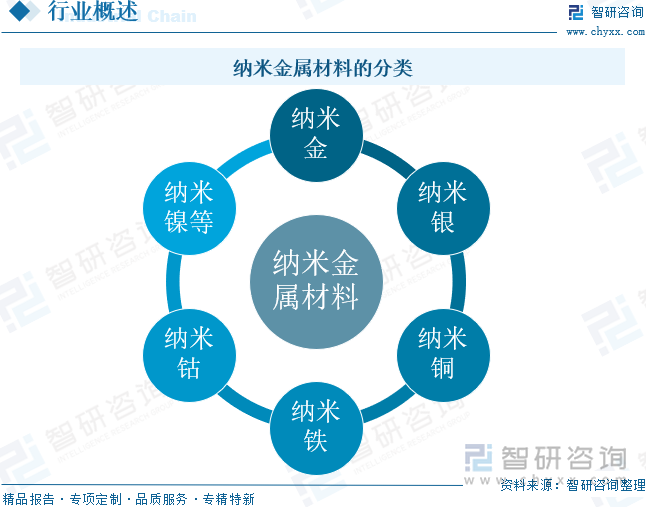
Core Insights - The article highlights the rapid growth and strategic importance of the nano-metal materials industry in China, driven by technological advancements and increasing market demand [1][14]. Industry Overview - Nano-metal materials, characterized by grain sizes between 1-100 nanometers, exhibit superior properties such as ultra-high strength, excellent thermal stability, and unique electromagnetic characteristics [1][14]. - The market size for nano-metal materials in China is projected to grow from 28.98 billion yuan in 2018 to 74.451 billion yuan in 2024, with a compound annual growth rate (CAGR) of 17.03% [1][14]. - Key applications of nano-metal materials include electronics, new energy development, biomedicine, and aerospace [1][14]. Production Methods - The production methods for nano-metal materials are categorized into physical and chemical methods, including evaporation-condensation, high-energy ball milling, and chemical reduction [5]. Policy Support - The Chinese government has identified nano-materials as a key area for development, with various policies aimed at promoting innovation and industrial upgrades [7]. Industry Chain - The upstream of the nano-metal materials industry includes raw material supply and manufacturing equipment, while the downstream encompasses applications in biomedical, aerospace, construction, automotive, and electronics sectors [9]. Key Companies - Notable companies in the nano-metal materials sector include Jiangsu Boqian New Materials Co., Ltd., Jiangxi Baohong Nano Technology Co., Ltd., and Shandong Changxin Nano Technology Co., Ltd., which are involved in the R&D and production of high-performance nano-metal materials [17][19][21]. Development Trends - The industry is moving towards high-performance and multifunctional materials, with innovations in atomic-level structure design and surface modification technologies [25]. - There is a shift towards green and low-carbon production methods, emphasizing sustainable practices in the manufacturing of nano-metal materials [26][27]. - Cross-disciplinary integration is expanding the application boundaries of nano-metal materials, particularly in biomedicine and information technology [28].




AI时代的教育之问Ⅶ:就业转型
腾讯研究院· 2025-07-18 08:18
Core Viewpoint - The article discusses the complex impact of artificial intelligence (AI) on the education system and labor market, emphasizing the need for interdisciplinary dialogue to address challenges and opportunities presented by AI [1]. Group 1: Impact of AI on Employment and Labor Market - AI has not fundamentally changed the structure of the labor market but is reshaping the risk distribution of job roles, with middle-tier positions being the most susceptible to automation [3][4]. - Companies are focusing on enhancing existing job capabilities rather than creating new AI-related positions, favoring candidates with both technical understanding and emotional judgment, especially in creative roles [3][4]. - The demand for interdisciplinary skills is increasing, as single-discipline training is no longer sufficient to meet real-world job requirements [3][4][6]. Group 2: Job Transition and Talent Development - AI is driving the evolution of job roles, with new positions emerging that require a blend of business acumen and digital skills, such as MES and ERP specialists [11][12]. - Companies are prioritizing skill enhancement for current employees over hiring new talent, particularly in HR and IT departments [12][14]. - The recruitment strategy is shifting towards candidates with a combination of design and production capabilities, reflecting a need for integrated talent in the design industry [21][22]. Group 3: Education Supply and Employment Demand Matching - There is a structural mismatch between education supply and employment demand, necessitating reforms in higher education to better align with market needs [22][30]. - Companies are increasingly focusing on hiring graduates with technical backgrounds, particularly in fields like microelectronics and semiconductors, while also recognizing the importance of interdisciplinary skills [19][21]. - The need for practical experience and industry exposure in educational programs is highlighted, with calls for more collaboration between educational institutions and businesses [28][30]. Group 4: Future Outlook and Recommendations - The education system should emphasize the cultivation of soft skills, teamwork, and self-awareness among students to better prepare them for the workforce [24][30]. - There is a need for a standardized talent certification system in the AI field to provide clear guidelines for recruitment and training [29][30]. - Policies should support deeper integration between education and industry, facilitating practical training opportunities and aligning educational outcomes with market demands [28][30].

科技手段“唤醒”千年陶寺遗址
Ke Ji Ri Bao· 2025-07-11 01:20
Core Viewpoint - The article highlights the innovative use of technology in revitalizing the Taosi archaeological site, which is approximately 4,000 years old, by employing methods such as 3D modeling and VR technology to enhance public understanding and appreciation of ancient civilizations [1][2]. Group 1: Technological Innovations - The Taosi site, covering over 500 hectares, faces challenges in displaying its vast and fragmented historical remains. The team led by Wang Lu aims to make the ancient civilization more accessible through sustainable planning and various technological methods [2][3]. - Key innovations include the creation of a "flowing museum" concept with six thematic exhibition halls that utilize digital presentation techniques to showcase significant artifacts and historical contexts [2][3]. Group 2: Interdisciplinary Collaboration - The success of the Taosi site planning is attributed to nearly 20 years of experience in large site protection, with previous projects like the Daming Palace National Heritage Park serving as a foundation for current methodologies [4][5]. - The project integrates expertise from multiple disciplines, including architecture, archaeology, urban planning, cultural heritage protection, and computer science, forming a comprehensive technical support system for research, protection, education, and utilization [5]. Group 3: Academic and Practical Impact - The planning team's depth of understanding and innovative approach to the Taosi site has been recognized as a valuable academic reference and practical example for the activation and utilization of early urban archaeological sites [5].
从达沃斯论坛新兴技术报告看未来科技走向
Zheng Quan Shi Bao· 2025-06-26 18:08
Core Insights - The World Economic Forum's 2025 "Top Ten Emerging Technologies Report" highlights technologies such as structural battery composite materials, engineered living therapies, autonomous biochemical sensors, green nitrogen fixation, collaborative sensing, and generative watermarks, which are expected to address global challenges within 3 to 5 years [1][4] Group 1: Emerging Technologies - The selected technologies reflect four core trends: trust and security in an interconnected world, sustainable industrial restructuring, next-generation health biotechnologies, and the fusion of energy and materials [1][2] - Many of the emerging technologies are characterized by interdisciplinary integration, breaking down traditional academic barriers and combining insights from various fields to tackle complex global issues [2] Group 2: Applications and Challenges - Collaborative sensing technology is empowering vehicles, traffic systems, and emergency services to interact in real-time, enhancing safety and alleviating congestion [3] - Generative watermark technology provides a solution for identifying AI-generated content, helping users discern real information in an increasingly complex internet landscape [3] - The path from laboratory to large-scale application for emerging technologies is fraught with challenges, including the need for improved technology maturity and societal acceptance, as well as supportive infrastructure and public awareness [3][4]
对话欧洲管理发展基金会全球总裁:复杂环境下,如何重塑可持续商业领导力?
Xin Lang Cai Jing· 2025-05-16 01:13
Core Insights - The rapid advancement of technology, particularly artificial intelligence, is profoundly transforming business management and education, creating both challenges and opportunities for management education institutions [4][5][6] - The European Foundation for Management Development (EFMD) is adapting its strategy to support business schools and companies in this transformation through accreditation systems and professional development services [4][6][15] Group 1: Trends in Management Education - Technology will reshape education and research over the next 5 to 10 years, enhancing data analytics and requiring new teaching methods [5][12] - There is an increasing emphasis on multidisciplinary research and teaching to address complex global challenges, particularly in sustainable business practices [6][14] - The need for continuous skill enhancement is critical for graduates to remain competitive in the workforce [5][13] Group 2: EFMD's Role and Initiatives - EFMD's EQUIS accreditation system is a comprehensive global standard that promotes excellence in management education while respecting institutional diversity [7][20][21] - The organization has facilitated global exchanges in management education, with flagship conferences addressing current challenges and emerging trends [8][18] - EFMD's involvement in founding the China Europe International Business School (CEIBS) exemplifies its commitment to innovation and leadership in management education [8][19] Group 3: Future Management Talent Requirements - Future management leaders must possess ethical grounding, critical thinking, and adaptability to navigate a data-rich environment [10][24][26] - Embracing a lifelong learning mindset is essential for future managers to continuously update their skills [10][25] - Human aspects of leadership, such as ethics and empathy, are fundamental for effective management [10][26]